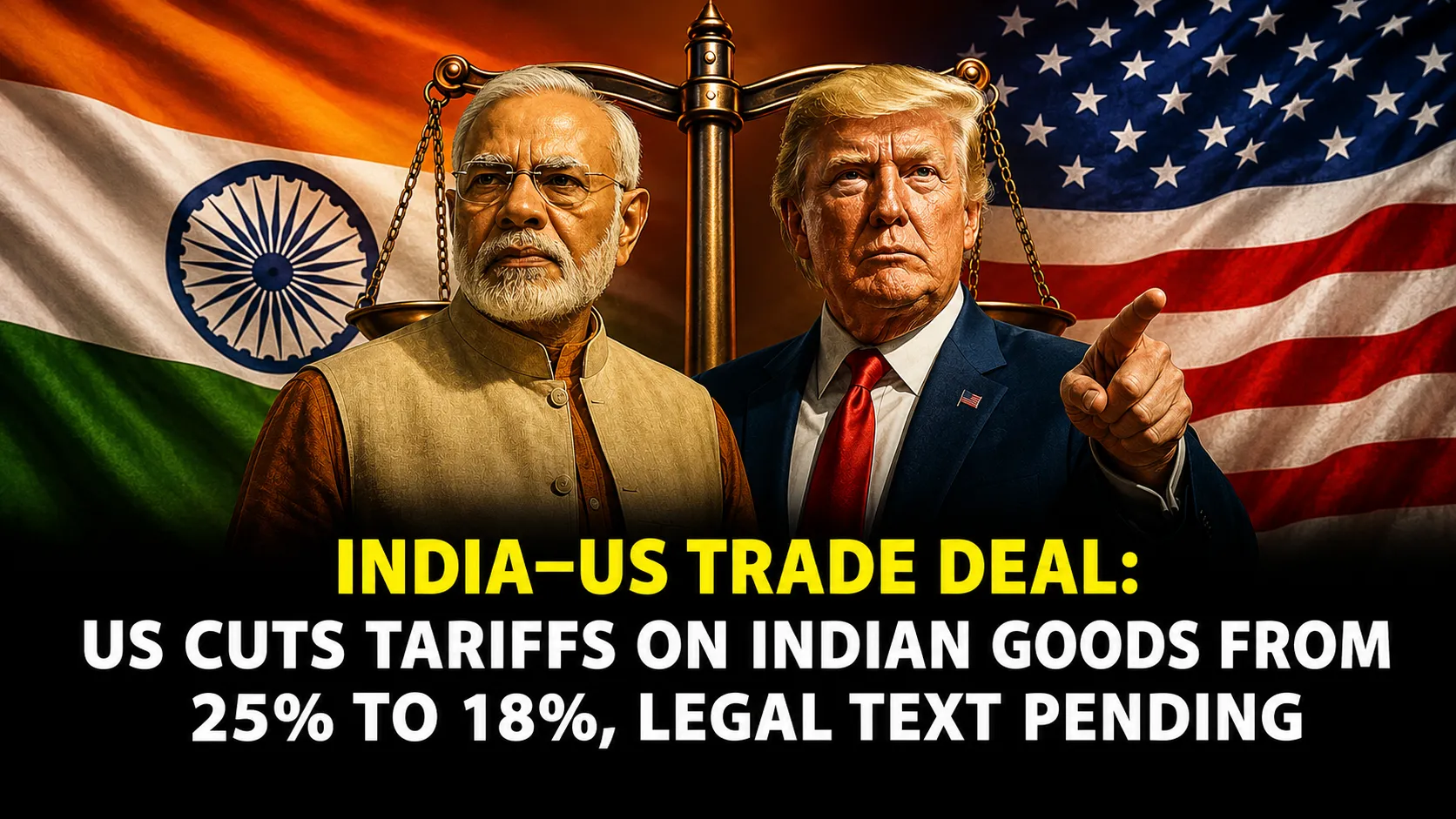
Amid all the uncertainty surrounding the still-unsigned India-US Bilateral Trade Agreement, one concrete, already-implemented fact has quietly become the fixed point around which the entire remaining negotiation revolves: Washington's reciprocal tariff on Indian goods has already been cut from a punishing 25 per cent down to 18 per cent, a reduction won through months of painstaking negotiation earlier in the year and now serving as the effective baseline both governments are working from as they race to close out the remaining details of a fuller, more durable bilateral trade arrangement.
To understand why this 18 per cent figure matters as much as it does, it helps to trace the sequence of tariff actions that preceded it. The reciprocal tariff regime itself traces back to a period of considerable trade policy volatility, during which President Donald Trump's administration moved to impose a punitive 25 per cent tariff on a wide range of Indian imports as part of a broader reciprocal tariff strategy applied across numerous US trading partners simultaneously. That initial 25 per cent rate represented a genuinely significant cost burden for Indian exporters across sectors ranging from textiles and engineering goods to gems, jewellery, and select agricultural products — categories where the United States represents one of India's most important single-country export markets, and where a tariff differential of this magnitude could meaningfully affect the price competitiveness of Indian goods relative to alternative sourcing options available to American importers and retailers.
The subsequent negotiation between Commerce and Industry Minister Piyush Goyal's team and US Trade Representative Jamieson Greer's counterparts, conducted across repeated rounds addressing market access, agricultural trade barriers, and non-tariff regulatory issues, ultimately succeeded in bringing that punitive rate down to the current 18 per cent level — a reduction of seven full percentage points that, while leaving Indian exporters still facing a meaningfully higher tariff burden than they experienced prior to the reciprocal tariff regime's original imposition, nonetheless represents a substantial, tangible improvement that Indian officials have consistently and publicly framed as evidence of genuine progress in the broader negotiation, even as the more comprehensive first-phase Bilateral Trade Agreement has remained parked at what negotiators on both sides have repeatedly described as the "last one per cent" of legal text.
The comparative dimension of this 18 per cent rate matters enormously for how Indian exporters and policymakers have chosen to interpret and communicate about it. Commerce Minister Goyal has repeatedly highlighted that India's current tariff rate compares favourably to several of its most direct regional export competitors, including China, Pakistan, Bangladesh, and Vietnam — a framing that reflects India's consistent negotiating priority throughout this entire process: securing not merely a low absolute tariff rate in isolation, but specifically a rate that provides genuine comparative advantage over the Asian economies India competes with most directly across categories like textiles, apparel, footwear, and lower-value manufactured goods, where price competitiveness on the American retail shelf can often be the deciding factor in whether an American importer sources from an Indian supplier or shifts that order to a competing manufacturing base elsewhere in Asia.
This comparative-advantage framing helps explain why India's negotiating team has, throughout the broader trade negotiation, consistently prioritised holding out for durable, favourable terms over rushing to close a deal purely to beat any specific calendar deadline, even as a temporary tariff arrangement's expiry date approached and eventually passed without a fully signed comprehensive agreement in place. From India's perspective, a headline tariff rate that merely matches what competing Asian exporters receive would offer considerably less commercial value than a rate that provides Indian exporters a genuine, quantifiable edge — the difference, in practical terms, between merely remaining competitive in the American market and actively gaining market share at the expense of regional rivals as American importers and retailers make sourcing decisions based substantially on landed cost comparisons across competing supplier countries.
The specific product categories most directly affected by this reduced tariff rate span several of India's most economically and employment-significant export sectors. Textiles and apparel, an industry that provides employment to millions of workers across manufacturing clusters concentrated in states like Tamil Nadu, Gujarat, and Punjab, face perhaps the most direct sensitivity to tariff differentials given the sector's characteristically thin margins and highly price-competitive global market structure, where even modest tariff rate differences relative to competing sourcing countries can meaningfully shift order volumes between countries. Gems and jewellery, another major export category with deep employment significance particularly in manufacturing hubs like Surat, similarly operates in a globally competitive market where tariff treatment relative to other major exporting countries can significantly influence American buyers' sourcing decisions. Engineering goods and select pharmaceutical categories round out the list of sectors most closely watching how the final, comprehensive trade agreement ultimately treats their specific tariff lines, given the considerable variation in tariff sensitivity that can exist even within these broader sector categories depending on the specific product's price point, differentiation, and the availability of viable alternative sourcing options for American buyers.
Notably, certain agricultural product categories have already secured particularly favourable treatment under the terms negotiated so far, with officials confirming that products including spices, tea, coffee, cashew nuts, chestnuts, avocados, bananas, mangoes, kiwis, and papayas are set to attract zero duty in the American market under the interim arrangement — a set of concessions the Commerce Ministry has specifically highlighted as protecting and benefiting India's broader agriculture and dairy sector, categories that have historically represented some of India's most politically sensitive areas in any trade negotiation, given how directly they touch the livelihoods of large numbers of Indian smallholder farmers whose economic interests carry substantial political weight in India's domestic policy calculus, independent of the pure economic logic that might otherwise govern trade negotiation outcomes in a less politically sensitive sector.
The broader strategic context framing this tariff negotiation is the shared "Mission 500" ambition both governments have articulated: a goal of doubling two-way trade between India and the United States to $500 billion by 2030, a target that would require sustained, multi-year growth in bilateral trade flows considerably exceeding the pace that has characterised the relationship in recent years. The current 18 per cent tariff rate, and whatever further refinements emerge from the still-unsigned comprehensive Bilateral Trade Agreement, will play a meaningfully important role in determining whether that ambitious target proves achievable, since tariff treatment represents one of the most direct, quantifiable levers governments can adjust to influence the trajectory of bilateral trade flows, alongside the broader set of non-tariff market access, regulatory harmonisation, and investment facilitation measures that a comprehensive trade agreement typically encompasses beyond tariff schedules alone.
For American businesses and consumers, the tariff reduction from 25 to 18 per cent carries its own set of implications worth considering alongside the more commonly discussed impact on Indian exporters. American retailers and importers sourcing from India across the affected product categories face correspondingly reduced landed costs under the lower tariff rate, a saving that, depending on competitive dynamics within each specific retail category, may be passed through to American consumers in the form of lower retail prices, retained by importers and retailers as improved margins, or some combination of both — the specific outcome varying considerably across product categories depending on the underlying competitive intensity and pricing power at each stage of the relevant supply chain.
Looking ahead, the critical open question is whether the current 18 per cent rate represents a durable, final settlement point, or merely an interim staging post on the way toward further reductions once the comprehensive first-phase Bilateral Trade Agreement is eventually finalised and signed. India's negotiating position throughout this process has consistently suggested the latter interpretation — that 18 per cent, while a meaningful improvement over the original 25 per cent punitive rate, remains a waypoint rather than a destination, with Indian officials continuing to push for further, more durable tariff concessions as part of the broader comprehensive agreement still being finalised. Whether that continued push succeeds in extracting further meaningful concessions, or whether 18 per cent proves to be close to the practical ceiling of what India can realistically expect to achieve given the broader political and economic considerations shaping US trade policy, will become clearer only once negotiators finally close out the "last one per cent" of legal text that has, for weeks now, stood between the two sides and a fully signed, comprehensive Bilateral Trade Agreement.
Currency dynamics add a further layer of complexity to how Indian exporters are experiencing this tariff environment in practice. Even as the reduced 18 per cent tariff rate has improved the relative cost competitiveness of Indian goods in the American market compared to the earlier 25 per cent regime, the rupee's persistent weakness against the dollar through much of 2026 — itself driven substantially by the unrelated but concurrent surge in global crude oil prices tied to the West Asia crisis — has provided Indian exporters an additional, if somewhat serendipitous, source of competitive advantage, since a weaker rupee effectively lowers the dollar-denominated cost of Indian-manufactured goods for American buyers, partially offsetting whatever tariff burden remains even at the reduced 18 per cent rate. This currency tailwind, while not something Indian trade negotiators can claim credit for or rely upon as a durable feature of the trade relationship, has nonetheless meaningfully cushioned the net competitive impact of tariff policy on Indian exporters through this particular period, illustrating how multiple, seemingly unrelated macroeconomic threads running through India's 2026 story — the trade negotiation, the crude oil shock, and the rupee's depreciation — have ended up interacting in ways that partially offset one another from the specific vantage point of export competitiveness, even as each individual thread carries its own distinct set of costs and risks for the broader economy.
For India's exporters navigating this extended period of interim, rather than final, tariff treatment, the practical reality has been one of operating under genuine uncertainty even as the current 18 per cent rate provides a meaningfully improved, if not fully settled, planning baseline compared to the original 25 per cent punitive rate. Government officials on both sides have continued to signal that the broader trajectory of the relationship remains constructive despite the extended timeline, pointing to the parallel deepening of India-US ties across other domains — including the newly launched Illinois Tech-Mumbai campus and IIT Bombay's planned US sub-campus — as evidence that the two countries' institutional relationship continues to strengthen on multiple fronts simultaneously, even as the specific tariff and trade text negotiation has taken longer than either side's more optimistic early-year projections had anticipated. This broader context matters for how the tariff negotiation itself should be read: not as an isolated, transactional dispute over specific duty rates, but as one strand within a considerably wider, multi-dimensional bilateral relationship that both governments appear committed to deepening over the medium to long term, regardless of the specific timeline on which any individual component, including the currently pending comprehensive trade text, ultimately concludes.
Industry bodies representing the textile, gems and jewellery, and engineering goods export sectors have continued to press for expedited finalisation of the comprehensive agreement, arguing that even favourable interim tariff treatment cannot fully substitute for the certainty and confidence that a signed, durable trade agreement would provide to businesses making longer-term sourcing, investment, and capacity expansion decisions that depend on clarity about the trade policy environment they will be operating within for years to come, rather than an interim arrangement that, however currently favourable, remains subject to further negotiation and potential revision at any point until a comprehensive, signed agreement is finally in place, a certainty gap that continues to shape investment and hiring decisions across India's export manufacturing base even as the headline tariff number itself has already moved decisively in exporters' favour, leaving many businesses caught between welcome near-term relief and lingering medium-term uncertainty as they wait for negotiators to finally close out the deal's remaining legal text, a wait that, by every public signal from both New Delhi and Washington, appears to be nearing its end even if the exact date of resolution remains, for now, unconfirmed.