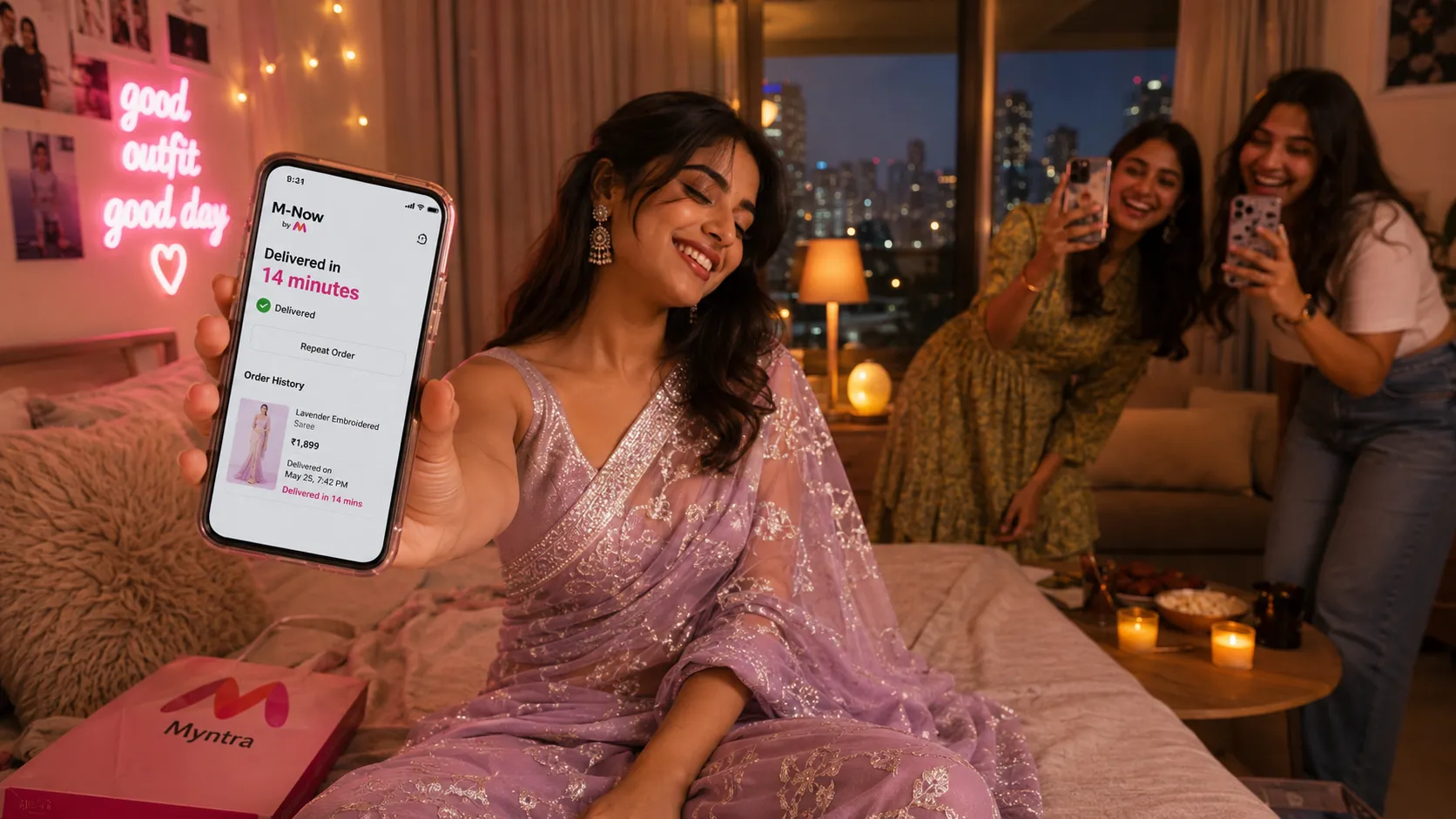
The 15-Minute Saree: Quick Commerce's Unlikely Fashion Hero
It was 6 PM on a balmy Friday evening in South Delhi. Riya, a 26-year-old marketing executive, had just received a text from her mother: her cousin's mehendi had been rescheduled to tomorrow morning, and she needed a banarasi silk saree—by 7 PM.
Malls were 45 minutes away. Traditional e-commerce promised delivery by Monday. The family saree shop was across town, closed for repairs.
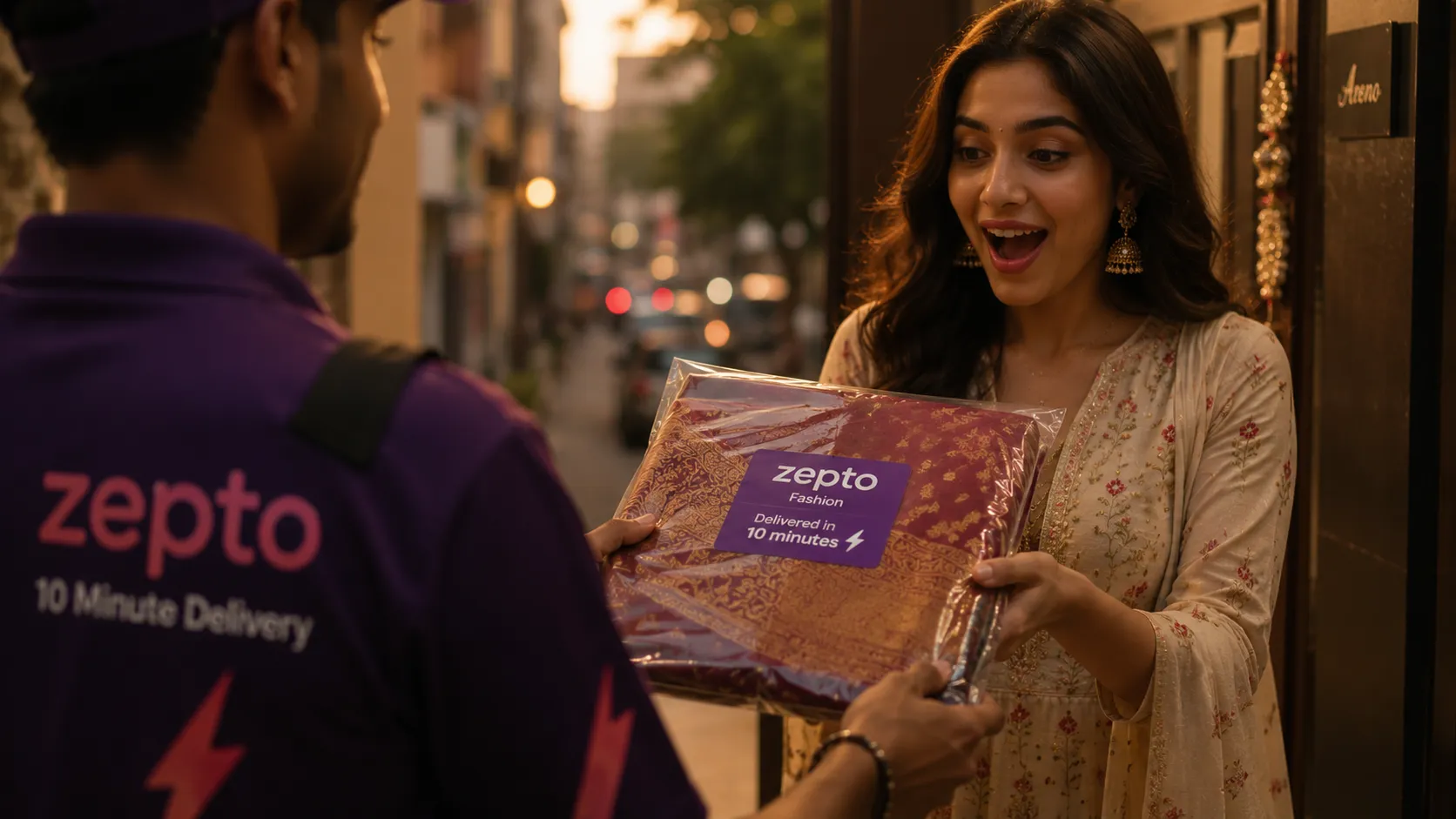
On impulse, she opened an app designed for groceries. Two minutes of scrolling. A ₹4,500 banarasi from a D2C ethnic wear brand. Tap. Pay. Wait.
Fourteen minutes later, a delivery executive rang her doorbell.
This is not an isolated miracle. This is the new reality of Indian fashion retail—and it is rewriting every rule in the ₹11 lakh crore apparel market.
The Number That Explains Everything
Eighteen months ago, quick-commerce fashion was dismissed as an expensive experiment—an indulgence for venture capitalists with money to burn. Critics argued that apparel could never fit into the same rapid-delivery ecosystem as groceries. Fashion, they said, demanded endless catalog depth, tactile discovery, and complex return cycles.
By early 2026, those critics have been proven spectacularly wrong.
India's quick-commerce sector has evolved from an emergency convenience model into a $6.9 billion gross merchandise value (GMV) business, accounting for nearly 10 per cent of the country's total e-retail market. Growth rates between 75 and 85 per cent year-on-year are forcing retailers, brands and logistics operators to fundamentally rethink how Indian consumers now shop for fashion.
The sector accounted for approximately 8-10% of total quick-commerce orders in early 2026 across metros, according to industry analysts. And according to the Redseer-Flipkart report, Quick Commerce has emerged as the dominant growth engine in metro India, reaching 17% of total online retail and growing at ~120% year-on-year in FY26, with online grocery as its anchor and fashion, mobiles and electronics now aggressively entering the mix.
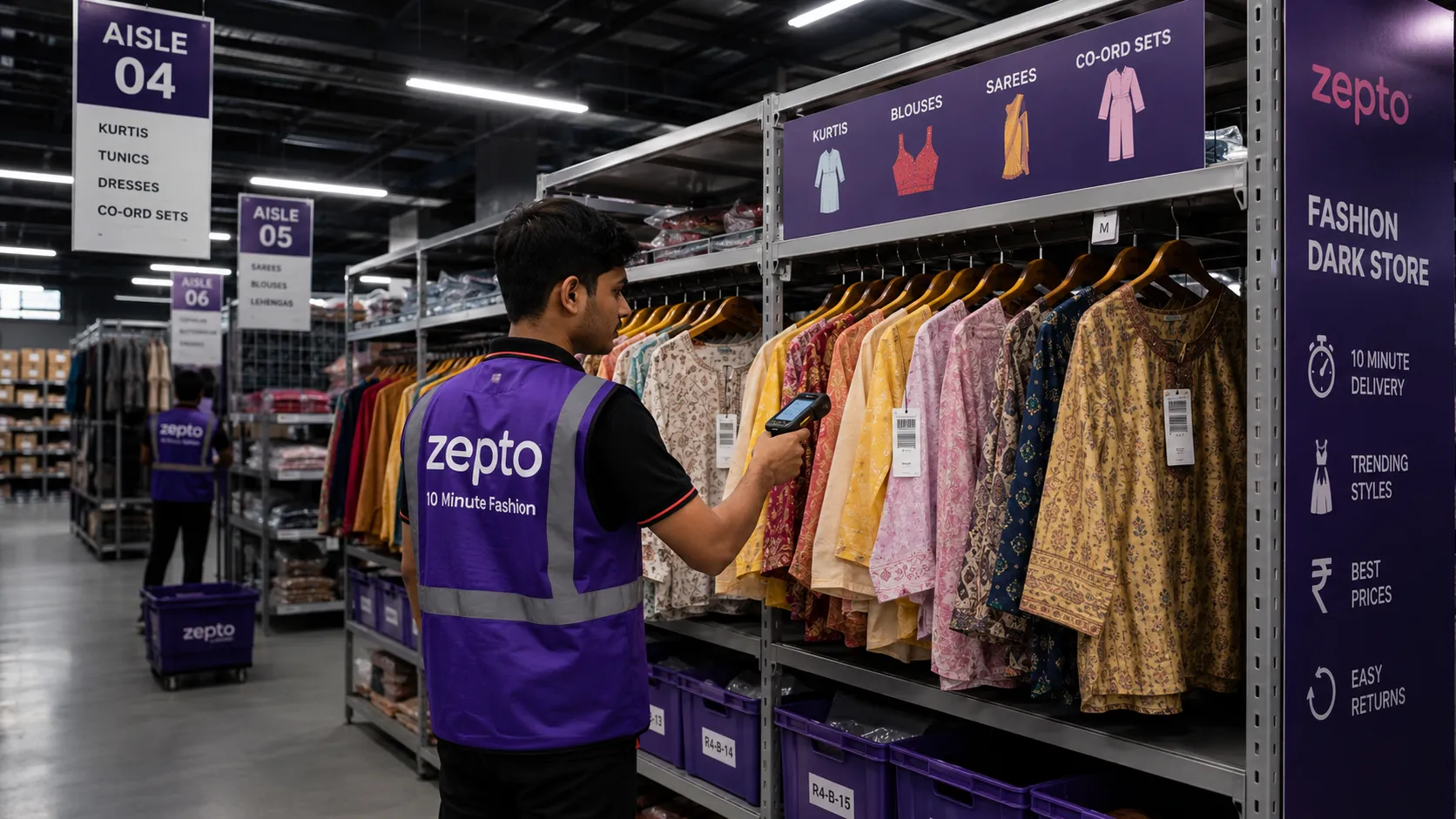
The Unexpected Hero: Ethnic Wear
The biggest surprise in 2026? Sarees, kurtis, and blouses—the very categories industry experts predicted would resist speed—are quietly becoming the stars of quick-commerce fashion.
According to market data, occasion wear and ethnic apparel now see adoption of ~12% on quick-commerce platforms. While this lags behind innerwear (68% adoption) and beauty (75%), the growth trajectory is steep and accelerating.
Why are sarees working on 15-minute delivery platforms? Three reasons.
First, the "second-wave" impulse buyer. Unlike innerwear or basics (where consumers know their size), ethnic wear purchases are increasingly driven by last-minute occasions—the cousin's mehendi rescheduled, the unexpected puja invitation, the office Diwali party sprung upon you at 4 PM. These are not considered purchases; they are rescue purchases.
Second, standardized sizing in modern D2C ethnic wear brands. The new generation of digital-first brands—Liba, NEWME, Indya—has invested heavily in size charts, virtual try-ons, and consistent fits across styles. Consumers are no longer guessing; they know.
Third, the "display effect." Dark store operators report that sarees and kurtis are among the most browsed categories even when conversion remains lower. The visual appeal drives platform stickiness, and once users are in the app for ethnic wear, they buy innerwear, accessories, and beauty products in the same cart.
The Saree Goes Digital: How D2C Brands Are Winning
The traditional ethnic wear sector—dominated by offline specialty retailers—was notoriously resistant to e-commerce. But the rise of quick-commerce fashion is changing that calculus.
Libas, an ethnic wear brand that built its reputation on affordable kurtis and sarees, collaborated with Zepto during the festive season to enable 10–12 minute deliveries for select styles, also launching its own quick-commerce vertical.
NEWME, a D2C-first brand catering to Gen Z women across Tier I, II, and III cities, launched NEWME ZIP, a quick-commerce fashion service that began as a pilot with 60–90 minute deliveries in Delhi NCR and Bengaluru and has since evolved into a 24/7 offering in key markets, providing access to over 1,500 styles. Having already served over 20 lakh customers, NEWME is on track to double its revenues year-on-year.
Zilo, a fashion quick-commerce startup, reports that shopping behavior has clearly shifted. "They're not doing planned shopping. They are doing fashion shopping instantly. They don't need to plan. They can buy fashion instantly," said Padmakumar Pal, Co-Founder and CEO of Zilo.
Booon, a dedicated fashion quick-commerce platform, offers curated occasion-first styles from party and date-night looks to festive wear delivered within two hours. Positioned as the "Zudio for e-commerce," Booon keeps the majority of its products priced under ₹1,000, with an average selling price of around ₹800, and partners with online-first brands including Biba, Sassafras, and The Bear House.
The New Battlefield: Platforms Race for Fashion Dominance
The quick-commerce fashion war is being fought on three fronts:
The Grocery Titans: Zepto, Blinkit, and Swiggy Instamart—originally built to deliver milk and bread—are now siphoning off a significant portion of the apparel market. Zepto has partnered with brands including Cantabil, US Polo Assn, and Decathlon. Blinkit operates over 2,200 dark stores under an inventory-led model.
The E-commerce Incumbents: Myntra's M-Now program—delivering as fast as 30 minutes—now operates through more than 80 dark stores across 10 cities, covering over 940 pin codes. Nearly 20% of customers in these cities are already shopping through M-Now. Reliance Retail entered the segment with Ajio Rush, offering fashion delivery in under four hours.
The Pure-Play Fashion Q-Commerce Startups: Platforms like Zilo, Knot, and Zulu Club are building entirely for fashion, leveraging AI-led virtual try-ons, try-and-buy-at-home models, and social shopping features to differentiate themselves from the grocery giants.
The Conversion Miracle: From 1.8% to 40%
The most compelling metric in quick-commerce fashion is not speed—it is conversion.
Traditional e-commerce continues to battle cart abandonment rates of 60-70%, primarily due to delivery friction. Quick-commerce platforms, by contrast, report abandonment as low as 15-25%, with conversion rates rising to 40-50%—nearly triple the industry average for conventional online apparel retail.
Metric | Traditional E-commerce | Quick Commerce (2026) |
|---|---|---|
Average Delivery Time | 24-72 hours | 10-30 minutes |
Cart Abandonment Rate | 60-70% | 15-25% |
Conversion Rate (CVR) | 1.8-2.5% | 40-50% |
Peak Activity Window | Late Night (10 PM-12 AM) | Evening Rush (6 PM-9 PM) |
[Based on DFU Publications, April 2026]
Peak quick-commerce activity between 6 PM and 9 PM reflects a moment of immediate need: a white shirt for a last-minute meeting, an accessory for a spontaneous evening event, a saree for a rescheduled wedding function. These are reflexive purchases, not considered fashion investments—and they are converting at rates traditional e-commerce can only dream of.
The Dark Store Revolution: AI Meets Inventory
One of the biggest early limitations of quick-commerce fashion was inventory depth. Dark stores simply could not stock enough styles and sizes to satisfy fashion shoppers accustomed to endless online catalogs.
That bottleneck has now been largely resolved. Leading platforms including Blinkit and Zepto have expanded their assortment to over 30,000 SKUs by deploying Regional Inventory Intelligence (RII) systems. Rather than replicating identical inventories across cities, platforms now use hyperlocal demand prediction models. Inventory is curated neighbourhood by neighbourhood, based on real-time purchase behaviour, demographics, and replenishment cycles.
In affluent South Delhi clusters, demand skews toward premium organic cotton basics and sustainable essentials. Gen Z-heavy micro-markets prioritise trend-led streetwear and oversized silhouettes. This precision stocking model has changed the economics of fashion dark stores entirely—transforming them from miniature warehouses into dynamic retail intelligence nodes.
The Returns Conundrum: The Achilles' Heel
Despite the rapid adoption, fashion quick commerce faces a significant hurdle: returns.
Unlike groceries, apparel carries inherent variables—fit, texture, colour fidelity. Traditional e-commerce tolerates return rates of 25-35%; women's ethnic wear often exceeds this. Quick-commerce platforms, built on 10-minute turnaround times, are ill-equipped for high-volume returns.
This creates a bifurcated market: quick commerce dominates utility and impulse purchases (innerwear, basics, accessories), while traditional platforms and offline retail retain dominance for experience-driven, high-involvement purchases.
Platforms are experimenting with solutions. Zepto has simplified fashion for users through better product information, clear sizing, and a three-day return window on eligible items. Some startups are betting on AI-led virtual try-ons and try-and-buy-at-home models. Others, like NEWME's Jasoria, caution that try-and-buy remains economically unviable and may never scale.
The TIer 2/3 Opportunity: Where Growth Lives
While quick-commerce fashion currently dominates in Tier 1 metros, the real growth story—as with every other Indian consumer trend—lies in Tier 2 and 3 cities.
Industry data suggests that categories once seen as metro-centric—ethnic wear, premium skincare, wellness supplements, fashion apparel—are now witnessing strong adoption across smaller cities. The same UPI-enabled trust, vernacular content, and logistics maturity that fueled the broader D2C boom are now powering quick-commerce fashion beyond the metros.
The Redseer-Flipkart report confirms that new user acquisition is shifting decisively toward Tier 2+ India, expanding the annual transacting user base to 320-340 million in FY26.
The Global Indian Takeaway
For the diaspora investor, the quick-commerce fashion story is still in its early innings. Fashion currently accounts for less than 5% of online fashion GMV on quick-commerce, according to Redseer. That means the runway is enormous.
The winners will be those who solve the returns problem (technology-led fits, try-at-home economics), master hyperlocal inventory intelligence (AI-powered demand prediction), and crack the saree-to-sneakers assortment (categories that convert at speed).
Fashion D2C brands have already raised close to USD 390 million in disclosed funding—a fraction of what is likely to flow into this sector over the next 24 months.
The Final Word
The 15-minute saree is not a gimmick. It is a signal.
A signal that Indian consumers have decisively shifted from "wait and plan" to "tap and receive." A signal that the same infrastructure that delivers groceries in ten minutes can now deliver a ₹4,500 banarasi silk to your doorstep before your dinner reservation. And a signal that the ₹11 lakh crore Indian apparel market—long dominated by malls and mom-and-pop stores—is being fundamentally restructured by speed.
Riya got her saree at 6:14 PM. She wore it the next morning. And somewhere in a dark store in South Delhi, an AI algorithm logged her purchase—one more data point in the quiet revolution of the 15-minute wardrobe.
The saree has always been a symbol of Indian elegance. Now, it is also a symbol of Indian efficiency.
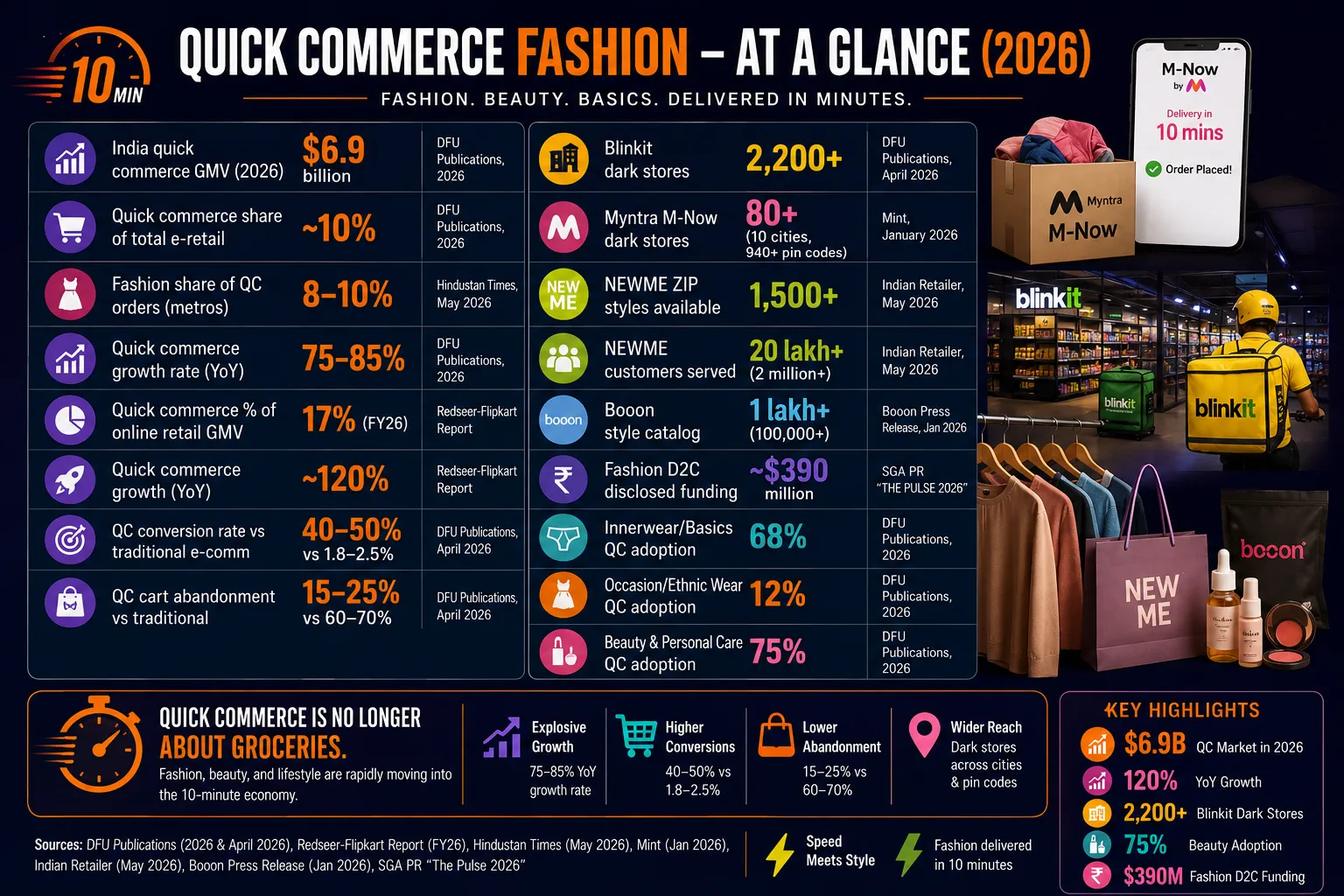
CHART: "Quick Commerce Fashion – At a Glance (2026)"
Metric | Data | Source |
|---|---|---|
India quick commerce GMV (2026) | $6.9 billion | DFU Publications, 2026 |
Quick commerce share of total e-retail | ~10% | DFU Publications, 2026 |
Fashion share of QC orders (metros) | 8-10% | Hindustan Times, May 2026 |
Quick commerce growth rate (YoY) | 75-85% | DFU Publications, 2026 |
Quick commerce % of online retail GMV | 17% (FY26) | Redseer-Flipkart Report |
Quick commerce growth (YoY) | ~120% | Redseer-Flipkart Report |
QC conversion rate vs traditional e-comm | 40-50% vs 1.8-2.5% | DFU Publications, April 2026 |
QC cart abandonment vs traditional | 15-25% vs 60-70% | DFU Publications, April 2026 |
Blinkit dark stores | 2,200+ | DFU Publications, April 2026 |
Myntra M-Now dark stores | 80+ (10 cities, 940+ pin codes) | Mint, January 2026 |
NEWME ZIP styles available | 1,500+ | Indian Retailer, May 2026 |
NEWME customers served | 20 lakh+ (2 million+) | Indian Retailer, May 2026 |
Booon style catalog | 1 lakh+ (100,000+) | Booon Press Release, Jan 2026 |
Fashion D2C disclosed funding | ~$390 million | SGA PR "The Pulse 2026" |
Innerwear/Basics QC adoption | 68% | DFU Publications, 2026 |
Occasion/Ethnic Wear QC adoption | 12% | DFU Publications, 2026 |
Beauty & Personal Care QC adoption | 75% | DFU Publications, 2026 |


