The $15 Million Bet That Indian Mythology Can Be Bigger Than Marvel: How the Turnaround CEO Who Sold a Superhero Company for $100 Million Is Building the "Disney from the East"
MUMBAI — May 25, 2026 — Jason Kothari was 12 years old when he first imagined Bloodshot as a movie. The character—a nanite-infused super-soldier from the Valiant Comics universe—was not yet famous. Valiant itself was not yet famous. It was, in fact, bankrupt. Two decades later, Kothari had acquired Valiant Entertainment while still an undergraduate at Wharton, recruited the management team behind the historic Marvel turnaround, led the company out of bankruptcy, sold it to China's DMG Entertainment for $100 million, and served as executive producer on the Vin Diesel-led Bloodshot film for Sony Pictures. He was, by any measure, one of the most unusual entrepreneurs in the Indian diaspora—a turnaround specialist who had operated at the intersection of entertainment, finance, and technology his entire career.
Now he is 41. And this week, the company he founded to answer a question no one else had seriously asked—can Eastern mythology be a global entertainment franchise?—closed its second funding round, raising an additional $5 million from investors including Dream11 co-founder Harsh Jain, Blume Founders Fund, former McKinsey managing director Rajat Gupta, and Zubin Bharti Mittal of the Bharti Mittal Family Office. The round valued the company at more than $50 million. Combined with the $15 million seed round announced in May 2025—which brought in Shah Rukh Khan's family office, Sakal Media Group, BITKRAFT Ventures, VC Grid, Visceral Capital, the Patni Family Office, Polygon co-founder Jaynti Kanani, and more than a dozen other investors—Mythik has now raised $20 million in total. The company reported operating income of ₹17 crore alongside a profit after tax of ₹2 crore for FY25—making it one of the rare AI startups that is both growing and profitable.
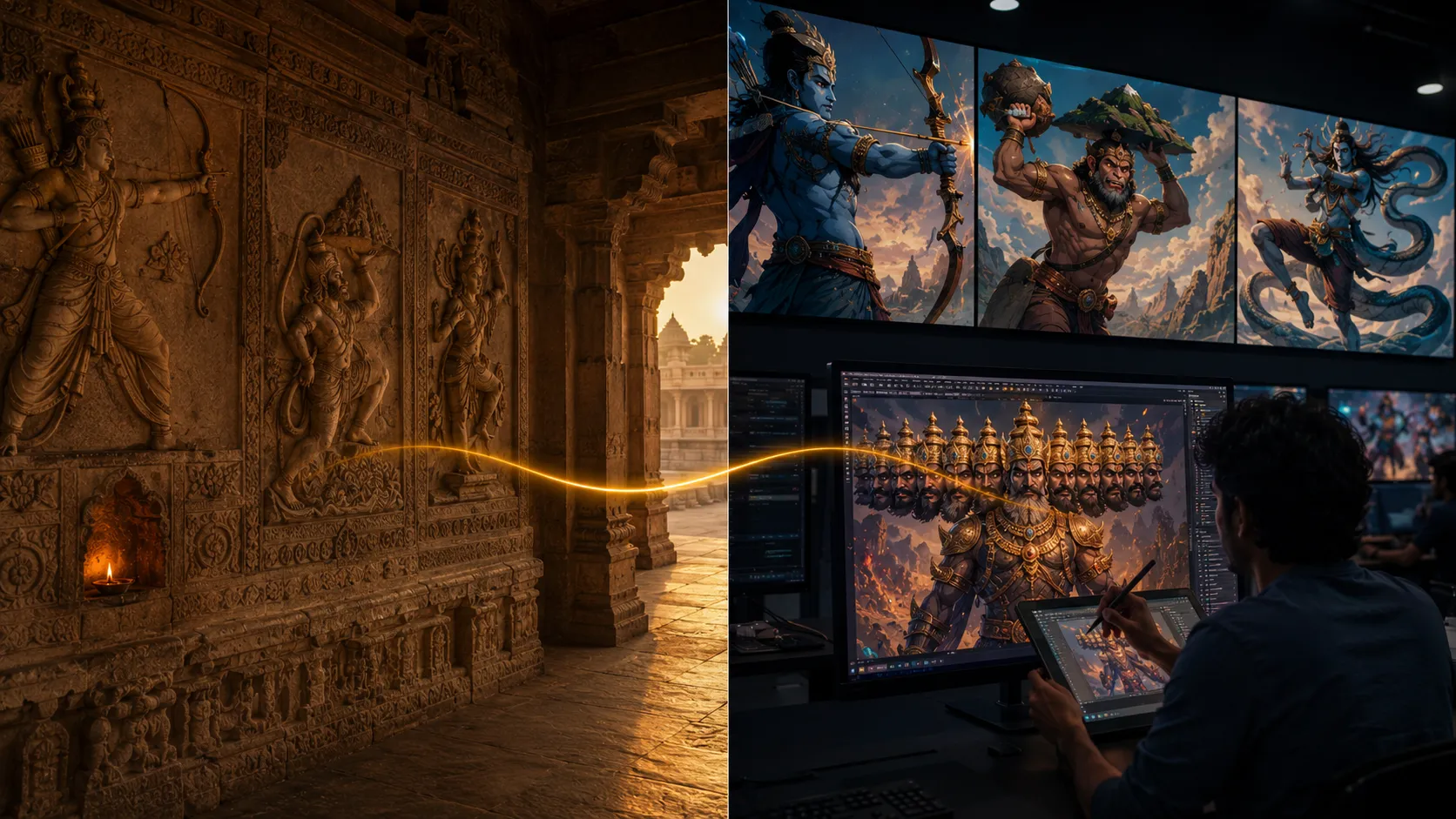
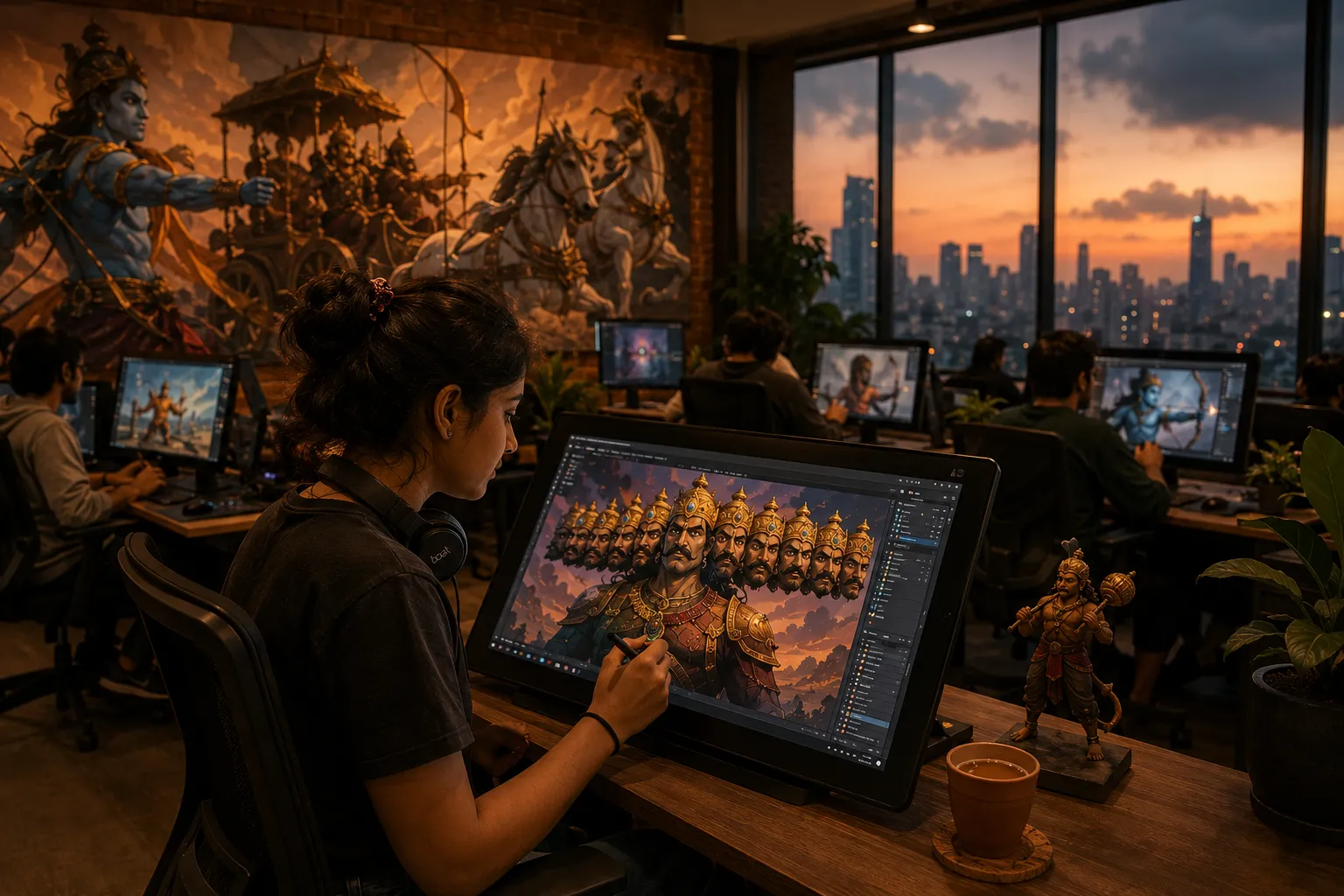
The numbers are unusual. The ambition behind them is larger. Mythik is trying to do something that has never been done: build a global entertainment franchise rooted in Eastern mythology—Indian, Southeast Asian, Middle Eastern—using generative AI to produce short-form content at a scale and cost that no traditional animation studio can match. The company employs roughly 200 professionals, including former senior leaders from Disney, Netflix, Amazon Studios, Jio, and Tencent. Its productions include Ram vs Ravan: The Final Duel, Shakuni's Story, and The Women of Ramayan. Its target audience is 3.5 billion people. And its stated ambition, repeated in every press release and interview, is to build the "Disney from the East."
The Man Who Turned a Bankrupt Comic Company Into a Vin Diesel Movie
To understand Mythik, one must first understand its founder—and to understand its founder, one must go back to a dorm room at the University of Pennsylvania's Wharton School in the early 2000s.
Jason Kothari was born in Mumbai and raised in Hong Kong, the son of a businessman who moved the family across Asia for work. He grew up reading comic books—Marvel, DC, Valiant—and nursing a fascination with the superhero genre that would, decades later, define his career. At Wharton, he encountered an opportunity that most undergraduates would have dismissed as absurd: Valiant Entertainment, the publisher of Bloodshot, X-O Manowar, and Harbinger, was bankrupt and available for acquisition. Kothari, barely out of his teens, believed he could turn it around.
He was right. He assembled a team of investors, acquired Valiant's assets out of bankruptcy, and recruited the same management team that had engineered the historic turnaround of Marvel Entertainment in the late 1990s—the executives who had taken a company on the brink of collapse and built it into the foundation of the Marvel Cinematic Universe, the most successful film franchise in history. Under Kothari's leadership, Valiant was restructured, recapitalised, and eventually sold to China's DMG Entertainment for $100 million. Kothari served as executive producer on Bloodshot, the Vin Diesel-led film released by Sony Pictures in 2020. He had, by the age of 30, achieved something that most entertainment executives spend entire careers pursuing.
Then he pivoted. He returned to India and joined Housing.com—the SoftBank-backed real estate platform that was, at the time, in the throes of a very public crisis following the departure of its founding CEO. Kothari was named CEO in November 2015. He stabilised the company, restructured its operations, and navigated it through one of the most difficult turnaround situations in Indian startup history. He later served as chief strategy and investment officer at Snapdeal, the e-commerce platform valued at $6.5 billion at its peak, and as CEO of FreeCharge, the digital payments firm, where he oversaw its sale to Axis Bank.
The thread connecting all of these roles is not industry expertise. It is turnaround expertise—the ability to enter a distressed situation, diagnose what is broken, and rebuild. Kothari is not a founder in the conventional sense. He is a fixer. And the question that Mythik represents is whether a fixer, given enough capital, enough talent, and enough conviction, can build something from scratch that is larger than anything he has ever fixed.
The Thesis That Nobody Had Bet On
The creative thesis behind Mythik is deceptively simple. The world's largest entertainment franchises—the Marvel Cinematic Universe, the DC Universe, Star Wars, Harry Potter, The Lord of the Rings—are all Western. They draw on Western mythology, Western history, Western storytelling traditions. The stories of the East—the Ramayana, the Mahabharata, the Panchatantra, the Jataka tales, the vast and sophisticated narrative traditions of India, China, Southeast Asia, and the Middle East—have never been adapted into a globally competitive entertainment franchise. They have been treated as cultural heritage, not as intellectual property. They have been retold in local languages, for local audiences, by local producers. They have never been packaged, branded, and distributed with the ambition and the production values of a Hollywood studio.
Kothari's thesis is that this is not a cultural preference. It is a supply-side failure. The stories exist. The audience exists—Mythik estimates the built-in audience for Eastern mythology at 3.5 billion people globally. The talent exists. What has been missing is a company with the technology, the capital, and the global distribution ambition to treat the Ramayana the way Disney treated The Lion King—as source material for a franchise that can be adapted into short-form content, feature films, consumer products, and immersive experiences.
"Global entertainment has been dominated by Hollywood and Western stories," Kothari told The Economic Times at the company's launch. "It's time to share Eastern stories—our history, culture, values, and greatest legends—with the world."
The strategic timing is deliberate. The global entertainment industry is in the midst of a structural transformation driven by two forces: the fragmentation of distribution from legacy television toward digital platforms, and the emergence of generative AI as a tool for producing high-quality animated and visual content at dramatically lower cost. The same technology that has disrupted publishing, software, and advertising is now arriving in the entertainment industry—and Kothari believes it will make possible a kind of content production that was previously uneconomical. A traditional animation studio might spend millions of dollars and months of labour producing a 10-minute short. Mythik's AI pipeline can produce the same length of content at a fraction of the cost and in a fraction of the time. The economics of Eastern mythology as a global franchise are being rewritten by technology—and Mythik is positioning itself at the centre of that rewrite.
The Team That Could Actually Build It
The most strategically significant asset that Kothari has assembled at Mythik is not the AI pipeline. It is the people.
The company's founding team includes former senior executives from Disney, Netflix, Amazon Studios, Jio, and Tencent—a concentration of global entertainment and technology talent that is unusual for an Indian startup of any size, let alone one that was founded barely a year ago. The team brings decades of combined experience in content creation, production, distribution, and platform management across the world's largest entertainment markets.
The presence of Jio and Tencent veterans is particularly significant. Jio's streaming platform, JioCinema, has become one of India's largest digital content distributors, and the experience of building and scaling a platform in the Indian market is directly relevant to Mythik's ambitions. Tencent's expertise in the Chinese market—where Eastern mythology is already a significant entertainment category, albeit one that is largely inaccessible to non-Chinese producers—provides a window into a market that Mythik will eventually need to enter.
The Disney and Netflix alumni bring expertise in global content strategy, brand management, and the mechanics of building entertainment franchises that travel across cultures. The Ramayana and the Mahabharata are Indian stories, but the themes they explore—duty, sacrifice, the conflict between good and evil, the complexity of family loyalty—are universal. The challenge of adapting them for global audiences is not fundamentally different from the challenge Disney faced in adapting European fairy tales for global audiences, or the challenge Marvel faced in adapting American comic book characters for audiences in Mumbai, São Paulo, and Shanghai. The people who solved those challenges are now working on the same problem for Eastern mythology.
The team now numbers roughly 200 professionals, and Kothari has been clear that the fresh capital will be used, in significant part, to "accelerate the scaling of Mythik's content slate, technology platform, launch and growth plan across digital experiences and consumer products." The mention of consumer products is telling. Disney's empire was not built on films alone. It was built on licensing—the theme parks, the merchandise, the branded experiences that turn a story into a franchise. Mythik's ambition to follow the same path is implicit in every description of its vision. The "Disney from the East" is not a metaphor. It is a business plan.
The AI That Makes It Possible
The third pillar of Mythik's strategy—alongside the source material and the team—is the technology. The company describes its AI capabilities in deliberately broad terms: "highly sophisticated, proprietary artificial intelligence and Generative AI engines" that "recreate complex Indian mythology, traditional folktales, and historical events into premium, short-form video content formats designed to capture the digital-first global audience." The description is generic, but the business logic behind it is specific.
Generative AI has reached a point where high-quality animated and visual content can be produced at a speed and cost that were unimaginable even three years ago. Models can generate character designs, backgrounds, frame sequences, and even coherent motion. Human artists are still essential—for creative direction, for quality control, for the emotional nuance that AI cannot yet capture—but the ratio of human labour to machine output has shifted dramatically. A production that might have required a team of 50 animators working for six months can now be completed by a team of 10 working for six weeks.
Mythik's content is designed for the short-form format: videos lasting approximately 10 to 12 minutes, distributed on YouTube, Instagram, and other digital platforms. The format is deliberate. Short-form content is cheaper to produce, faster to iterate, and easier to distribute globally than feature films. It allows the company to test characters, storylines, and visual styles with audiences before investing in longer-form productions. It builds an audience gradually, through consistent release cadence, rather than betting everything on a single theatrical release. And it is perfectly suited to the consumption habits of the digital-first audience that Mythik is targeting—the same audience that has made anime, K-drama, and other non-Western entertainment categories global phenomena.
The financial results from FY25 suggest the model is working. Revenue of ₹17 crore and profit after tax of ₹2 crore are modest in absolute terms, but the fact that Mythik is generating revenue and profit at all—at a stage when most AI startups are burning tens of millions of dollars per quarter—is a signal that the unit economics of AI-powered content production may be more favourable than the sceptics assume. The company's YouTube channel has grown to more than 160,000 subscribers, and its Instagram presence has crossed 25,000 followers, all within roughly a year of launching its first titles.
The Investor Roster That Validates the Bet
The single most impressive thing about Mythik, from an external perspective, is not the vision or the technology or the team. It is the cap table.
The $15 million seed round announced in May 2025 brought together an extraordinarily diverse group of investors: Sakal Media Group, one of India's largest regional media conglomerates; BITKRAFT Ventures, the leading global gaming and interactive content venture capital firm; VC Grid, backed by Venture Catalysts; Visceral Capital, a US-based investment firm; Shah Rukh Khan's family office; the Patni Family Office; the Parekh Family Office; Saif Saeed Ghobash, Secretary General of the Abu Dhabi Executive Council; Jaynti Kanani, co-founder of Polygon; Deepen Parikh of Courtside Ventures; Samir Vora of Enam Asset Management; and more than a dozen other high-net-worth individuals and institutional investors.
The $5 million extension announced this week added Harsh Jain, the co-founder and CEO of Dream11—India's largest fantasy sports platform and one of the country's most successful consumer technology companies—along with Rajat Gupta, the former managing director of McKinsey & Company and co-founder of the Indian School of Business; Zubin Bharti Mittal of the Bharti Mittal Family Office; Ishan Sinha, head of private investing at Point72; Rooshabh Shah of SVAR Projects; and Blume Founders Fund.
The investor roster is significant not just for the names, but for what it represents. Shah Rukh Khan's family office does not invest in early-stage media startups as a matter of course. Neither does the Secretary General of the Abu Dhabi Executive Council, nor the co-founder of Polygon, nor the group CEO of Enam Asset Management. These are not passive, institutional bets placed by venture capital firms diversifying across sectors. They are personal, conviction-driven investments by individuals and institutions who believe—genuinely believe—that Kothari's thesis is correct, and that the first company to package Eastern mythology as a global entertainment franchise will be worth a great deal more than $50 million.
"The additional capital will further accelerate the scaling of Mythik's content slate, technology platform, launch and growth plan across digital experiences and consumer products," Kothari said at the close of the extension round. "We are building a category-defining tech-first global entertainment company." The statement is ambitious. The cap table suggests the ambition is shared.
The Doubters and the Challenge
For all the impressive architecture of the company—the founder's track record, the team's experience, the investors' conviction, the technology's promise—Mythik's thesis remains unproven. The question at the heart of the venture is one that no amount of funding can answer: will global audiences actually watch AI-generated adaptations of Eastern mythology?
The evidence is mixed. Anime, the Japanese animation tradition that draws heavily on Japanese mythology and folklore, has become a global cultural phenomenon, generating billions of dollars in annual revenue and attracting audiences across every continent. K-drama, the Korean television genre that draws on Korean history and cultural traditions, has achieved similar global reach. The underlying thesis—that non-Western storytelling traditions can attract global audiences—has been validated by multiple precedents. But anime and K-drama were built over decades, by ecosystems of studios, distributors, and talent that developed organically. Mythik is attempting to compress that timeline using AI, and whether AI-generated content can achieve the emotional depth and artistic quality that audiences demand remains an open question.
The competitive landscape is also intensifying. Reliance Industries, through its JioCinema platform and its broader entertainment ambitions, has the capital, the distribution, and the content pipeline to dominate the Indian entertainment market—and potentially the global market for Indian storytelling. Disney itself, through its Hotstar platform in India, has access to the same mythological source material and the production capabilities to adapt it. The "Disney from the East" may, in the end, be built by Disney.
Mythik's response to the competitive threat is to focus on what the incumbents cannot easily replicate: speed and cost. The AI-powered production pipeline allows the company to produce content faster and cheaper than any traditional studio, and the short-form digital distribution strategy allows it to build an audience without the enormous marketing spend required for a theatrical release. The company is not trying to compete with Disney on scale. It is trying to compete on agility—and on the conviction that being first to market with a credible, AI-powered adaptation of the world's richest mythological tradition will create a brand that competitors cannot easily displace.
Kothari said the company will begin introducing its products "in stages" later this year. The content slate, the rollout timelines, and the specific platforms on which Mythik's productions will be distributed have not yet been announced. The silence is strategic. The company is building its pipeline, refining its technology, and preparing for a launch that it hopes will define a category. The $20 million in total funding is the fuel. The 200-person team is the engine. The 3.5 billion-person target audience is the destination. The only question that remains is whether they will watch.
What This Signals
The Mythik story is not primarily about a startup raising $20 million at a $50 million valuation. It is about a structural bet—that the next great global entertainment franchise will not come from Hollywood, and that the stories that have been told for millennia in the East can be adapted, through technology, into the intellectual property that will dominate the next century.
Jason Kothari is not the founder he was supposed to be. He was supposed to be a turnaround CEO—the person who fixed broken companies and sold them for returns. He did that at Valiant, at Housing.com, at FreeCharge. But at 41, he has chosen to build something from scratch—something that has never been attempted at this scale, with this technology, for this audience. The "Disney from the East" is not a modest ambition. It is a statement of intent from a founder who has spent his career in the shadow of Western entertainment giants and has decided, at the midpoint of his professional life, that the stories he grew up with deserve the same treatment as the ones he helped turn into Hollywood films.
The 12-year-old who imagined Bloodshot as a movie is now 41. The company he has built to answer a question no one else had seriously asked has raised $20 million, assembled a team of 200, and secured the backing of Shah Rukh Khan, Harsh Jain, Rajat Gupta, and a dozen other investors who believe the answer is yes. The Ramayana is not a Marvel franchise yet. But the man who sold a bankrupt comic book company for $100 million is betting, with his own money and his own conviction, that it will be.