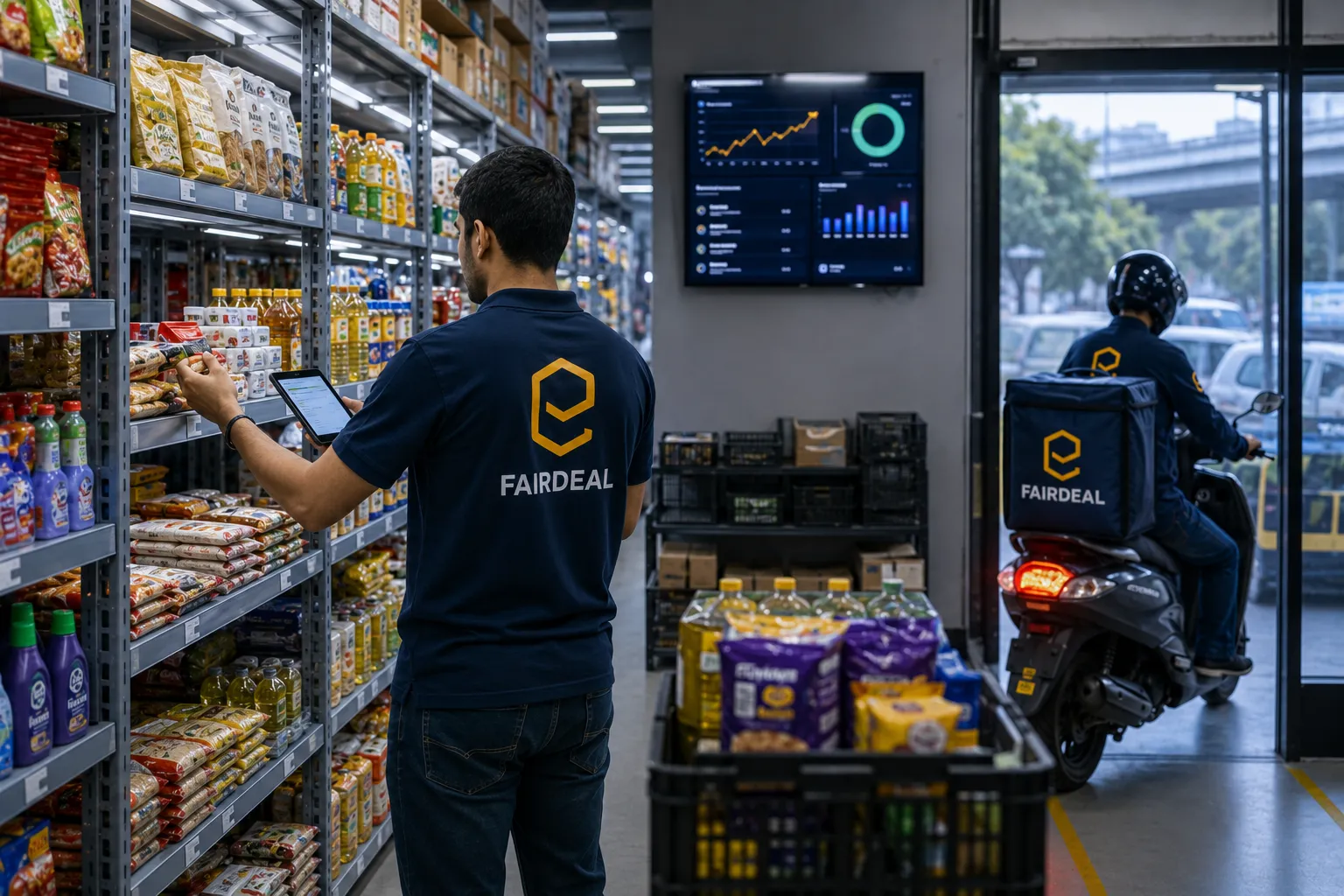
The ₹143 Crore Bet That Kirana Stores Deserve a 60-Minute Supply Chain: How Fairdeal Is Building the Replenishment Infrastructure India's 13 Million Shopkeepers Never Had
DELHI — May 27, 2026 — India has 13 million kirana stores — the small, family-run shops that are the backbone of the country's retail economy, selling everything from rice and dal to shampoo and detergent. They account for more than 80 percent of India's grocery sales. They survived the arrival of supermarkets, the rise of e‑commerce, and the entry of the world's largest retailers into the Indian market. They are, by any measure, among the most resilient institutions in the Indian economy. And yet, for most of their history, they have been served by a supply chain that has barely evolved in decades.
When a kirana store owner in Delhi runs out of a particular brand of atta, or cooking oil, or biscuits, they do not open an app and place an order for delivery within the hour. They call a distributor, or visit a wholesale market, or wait for the weekly salesman who may or may not show up. The fill rate — the percentage of ordered products that actually arrive — is low. The prices are unpredictable. The inventory management is done by instinct and experience, not by data. The entire procurement infrastructure that serves the kirana economy was designed for an era before smartphones, before dark stores, before the expectation that anything can be delivered in under an hour.
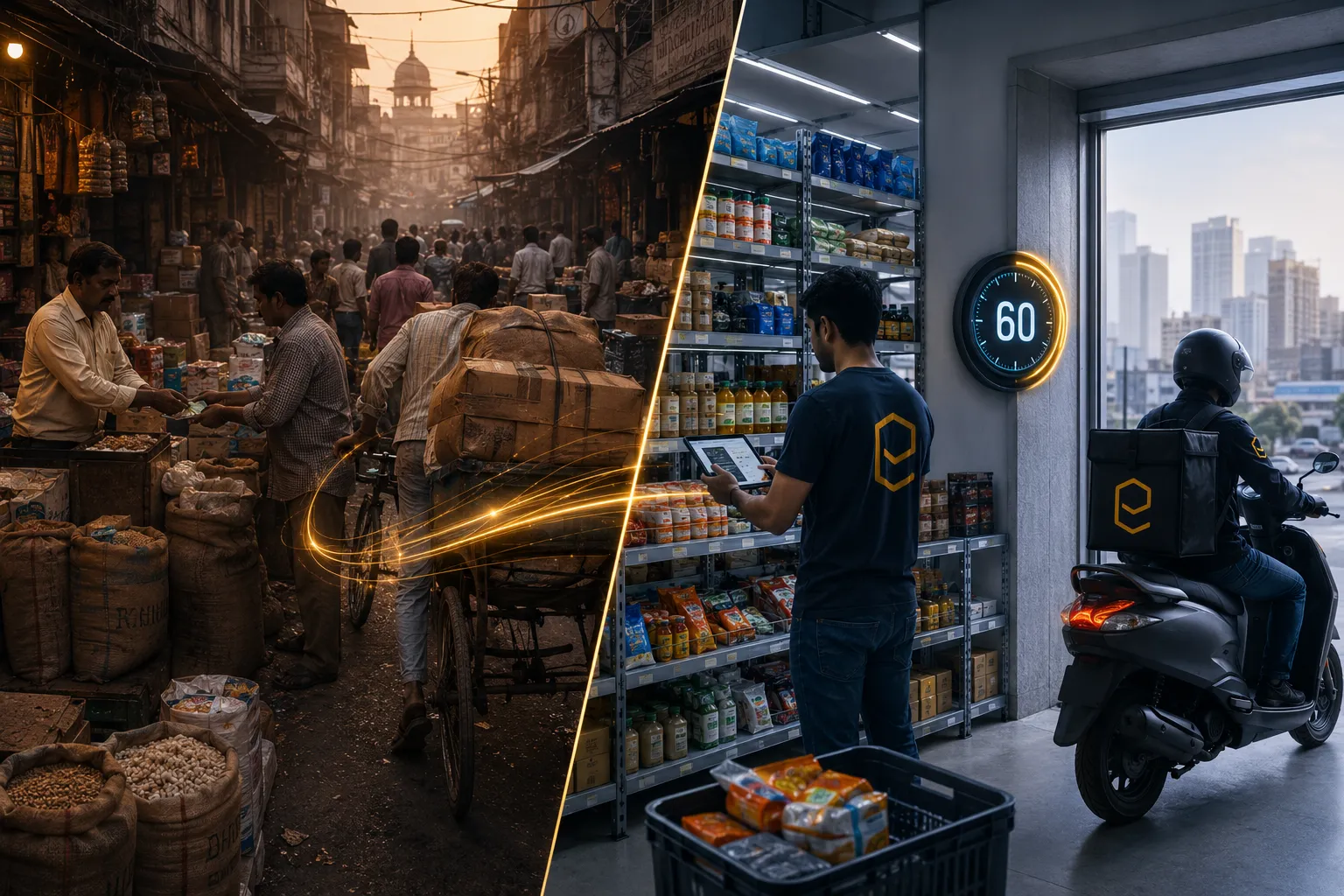
On May 26, a 20,000-retailer-strong startup called Fairdeal.Market announced a $15 million Series A funding round that challenges every assumption embedded in that legacy supply chain. Led by Bertelsmann India Investments, with participation from WaterBridge Ventures and Incubate Asia Fund, the round values Fairdeal at approximately ₹600 crore and gives it the capital to scale its dark-store network from Delhi‑NCR into Mumbai, Bengaluru, and beyond. The company's proposition is deceptively simple: give kirana store owners the same 60‑minute delivery experience that their customers now take for granted. "The biggest problem statement the kirana shop owners face is the fill rate," co‑founder Prateek Bansal told The Economic Times. "If the fill rate is lower, they will start facing revenue losses as customers will transact with stores with a better fill rate. That's where the idea came in — to deliver to kirana store owners within 60 minutes."
"If we can help millions of small retailers operate better every day, the impact will go far beyond commerce — it will strengthen local economies across the country." — Prateek Bansal, Co‑founder, Fairdeal.Market
The Udaan Comparison and the Quick‑Commerce Moat
Fairdeal is not the first company to attempt to digitise the kirana supply chain. Udaan, the Bengaluru‑based B2B e‑commerce platform founded by former Flipkart executives, raised over $1.5 billion and was once valued at more than $3 billion on the premise that it could connect manufacturers directly to kirana retailers, eliminating the layers of distributors and wholesalers that dominate the traditional supply chain. Jumbotail, another B2B marketplace, has raised over $150 million pursuing a similar thesis.
The difference between Fairdeal and its predecessors is the fulfilment model. Udaan and Jumbotail are marketplaces — they connect buyers and sellers, but they do not own the inventory or control the delivery. The kirana owner who orders through Udaan may receive the product within a day, or two days, or three — the delivery timeline is determined by the seller, not the platform. Fairdeal, by contrast, owns the inventory and controls the last‑mile delivery. The dark store model allows the company to guarantee delivery within 60 minutes, and the guarantee is what changes the behaviour of the kirana owner. The store that knows it can restock within the hour does not need to carry as much inventory. It can order more frequently, in smaller quantities, and respond more nimbly to changes in customer demand. The supply chain becomes a competitive advantage for the kirana store, rather than a constraint on its ability to compete with the quick‑commerce giants.
The dark‑store model also creates a moat that is difficult for competitors to breach. Building a network of dark stores — securing the real estate, stocking the inventory, hiring the pickers, managing the delivery fleet — is capital‑intensive and operationally complex. The marketplace model, by contrast, is asset‑light but offers no control over the customer experience. The company that builds the dark‑store network first, and that proves the unit economics of the B2B quick‑commerce model, will have a structural advantage that a marketplace cannot easily replicate.
Fairdeal is now planning to expand beyond Delhi‑NCR into Mumbai and Bengaluru, with a target of scaling its retailer network to over 100,000 stores within the current financial year. The expansion will be capital‑intensive — each new dark store requires investment in real estate, inventory, and last‑mile delivery infrastructure — but the $15 million Series A provides the runway to execute the first phase of the national rollout. The company is also investing in technology and data infrastructure, building the systems that will allow it to predict demand, optimise inventory, and manage a delivery fleet that will eventually number in the thousands.
The broader context is an Indian retail market in which the kirana store's survival is not guaranteed. The quick‑commerce giants — Zepto, Blinkit, Swiggy Instamart — are growing at triple‑digit rates, and their primary competitive threat is not each other. It is the kirana store. The customer who used to walk to the neighbourhood shop for a packet of butter now opens an app and receives it within ten minutes. The kirana store that loses that customer loses more than a transaction. It loses the habit, the relationship, and the footfall that drives sales of everything else in the shop. The store that can replenish its inventory within the hour — that can match the speed of the quick‑commerce giants on the supply side, even if it cannot match them on the delivery side — is better positioned to survive the structural transformation that is reshaping Indian retail. Fairdeal is building the infrastructure that will give kirana stores that capability.
The 13 million kirana stores are not going to disappear overnight. The Indian retail market is too large, too diverse, and too price‑sensitive to be captured entirely by venture‑backed platforms. But the stores that survive the next decade will be the ones that have access to the same supply‑chain technology that the platforms have — the dark stores, the data analytics, the 60‑minute replenishment. Fairdeal is betting that it can be the company that provides that access, and the $15 million Series A is a down payment on a market that is measured in the hundreds of billions of dollars. The kirana store that was once the most analogue institution in the Indian economy is about to get a digital supply chain. The brothers who saw the gap before anyone else are racing to fill it before the giants do.
What This Signals
The Fairdeal story is not primarily about a B2B quick‑commerce startup. It is about the structural transformation of Indian retail's last mile — and about the entrepreneurs who are building the infrastructure to ensure that the kirana store, the most resilient institution in the Indian economy, is not left behind.
For decades, the kirana store has been the subject of a persistent myth: that it would be destroyed by modern retail. The supermarkets were supposed to kill it. Then the e‑commerce platforms. Then the quick‑commerce giants. Each time, the kirana survived — not because it was more efficient, but because it offered something that the modern alternatives could not: proximity, credit, and the personal relationship between the shopkeeper and the customer. But survival is not guaranteed forever, and the store that survives the next decade will be the one that has access to the same supply‑chain technology as the platforms that are trying to displace it.
Prateek and Yash Bansal are not the founders they were supposed to be. They were supposed to build a consumer‑facing platform, the kind that attracts the largest venture‑capital rounds and the most breathless media coverage. Instead, they built a B2B quick‑commerce platform for the 13 million kirana stores that the venture‑capital industry has spent a decade trying to disrupt. The $15 million Series A is the first institutional validation of the thesis. The 20,000‑retailer network in Delhi‑NCR is the proof that the model works. The 100,000‑retailer target is the ambition. The dark stores are being built. The kirana stores are being restocked. The supply chain that was designed for the pre‑digital era is finally being upgraded to the age of instant commerce.


