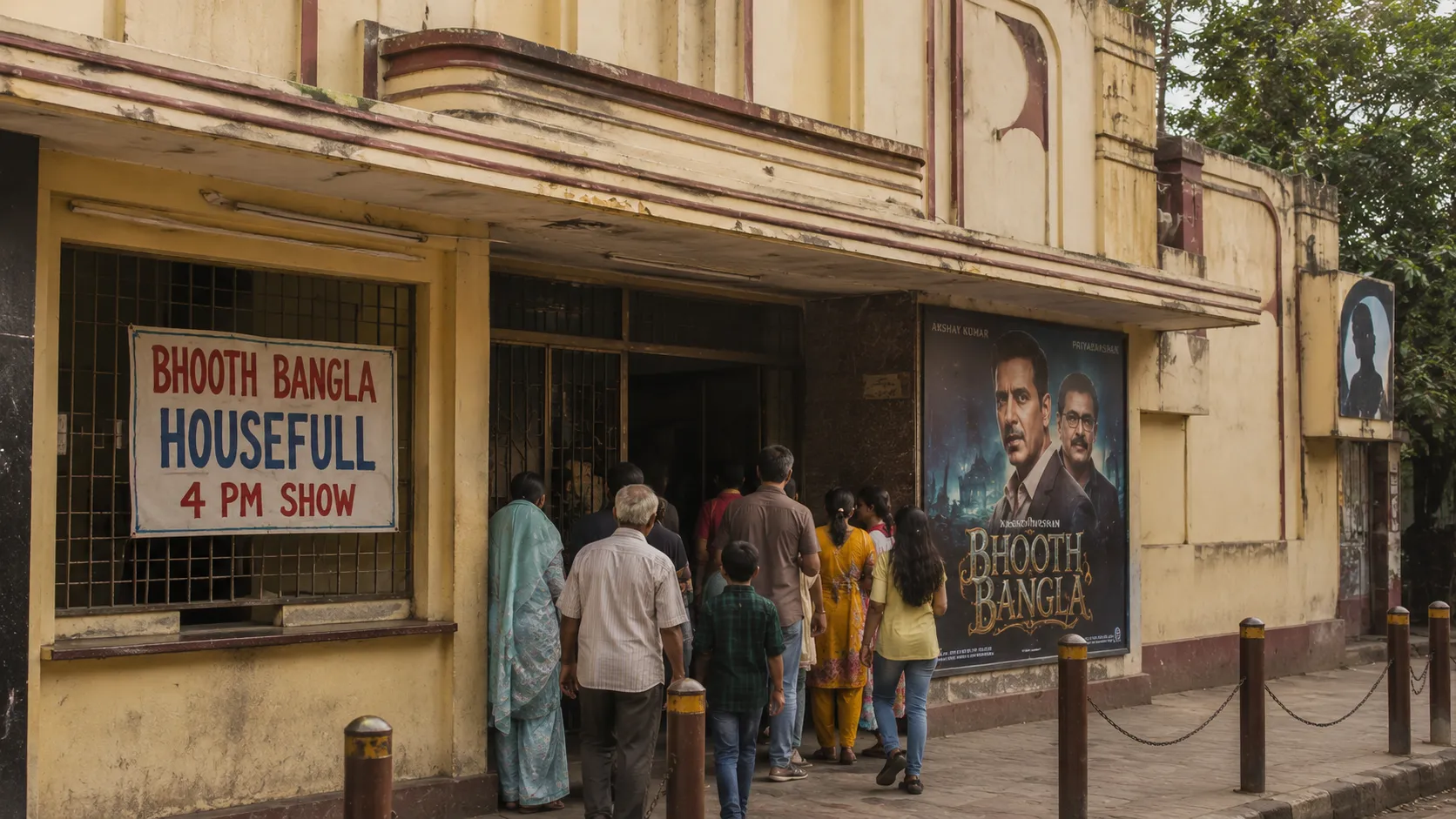
The 14-Year Exile That Ended in a Haunted Mansion: How Akshay Kumar's 'Ghar Wapsi' With Priyadarshan Became His Fourth Consecutive Hit—And Silenced the Critics Who Said He Was Finished
MUMBAI — May 28, 2026 — There is a moment in the arc of every major film star's career when the audience begins to wonder whether the magic has gone. For Akshay Kumar, that moment lasted roughly two years. Between 2023 and early 2025, the actor who had once been the most reliable hit machine in Bollywood—the man who delivered four consecutive ₹100 crore grossers in 2019 alone—endured a stretch so barren that industry analysts began using words like "terminal." Eight consecutive films underperformed. Bachchhan Paandey, Samrat Prithviraj, Raksha Bandhan, Ram Setu, Selfiee, Mission Raniganj, Bade Miyan Chote Miyan, Sarfira—each one a box-office disappointment, each one eroding the narrative of invincibility that had defined his career for nearly three decades. The pandemic had broken something in the theatrical audience, the pundits said, and Akshay Kumar—the everyman who had once bridged the gap between mass and class with an ease that no other star could replicate—was the most visible casualty.
Then came the pivot. Not a single dramatic reinvention, but a quiet, methodical, four-film recalibration that has, in the space of twelve months, transformed Akshay Kumar from the industry's most chronicled cautionary tale into its most compelling comeback story. Kesari Chapter 2 opened in mid-2025 and crossed ₹142 crore worldwide. Housefull 5 followed, grossing over ₹304 crore globally—the actor's biggest post-pandemic hit. Jolly LLB 3 sustained the momentum. And then, on April 16, 2026, came Bhooth Bangla—the film that would not merely extend the streak but redefine what a successful Akshay Kumar film looks like in the post-pandemic era.
Bhooth Bangla is now the third-highest-grossing Hindi film of 2026, behind only Border 2 and Dhurandhar 2. It has earned over ₹256 crore in worldwide gross, with ₹170.75 crore net from India alone. It crossed the ₹250 crore global mark during its fifth weekend—a milestone that none of Akshay's previous horror-comedies, including the iconic Bhool Bhulaiyaa, had achieved. It is the first non-sequel Indian horror-comedy to earn ₹250 crore worldwide. It has comfortably returned a profit on its ₹120 crore budget, with a return on investment exceeding 52 percent. And it represents the fourth consecutive box-office success for an actor who, as recently as 2024, was being written off as a relic of a bygone era.
The Priyadarshan Reunion
The most strategically significant decision behind Bhooth Bangla was not the choice of genre, the casting of the ensemble, or the release date. It was the reunion of Akshay Kumar with director Priyadarshan—a partnership that had defined an entire era of Indian comedy and that had been dormant for fourteen years.
Between 2000 and 2010, the Akshay-Priyadarshan collaboration produced a string of films that have since become canonical texts in the history of Bollywood comedy: Hera Pheri, Garam Masala, Bhagam Bhag, Bhool Bhulaiyaa, De Dana Dan. These were not merely hit films; they were films that established a specific grammar of Indian comedy—the ensemble chaos, the escalating misunderstandings, the precise calibration of slapstick and wit—that no other director-actor pair has successfully replicated. When the partnership ended after Khatta Meetha in 2010, it was not due to any falling-out. It was simply that both men moved on to other projects, and the years accumulated without either of them finding the script that justified a reunion.
The fourteen-year gap was, in retrospect, a blessing. When Priyadarshan and Akshay finally reunited for Bhooth Bangla, the audience's appetite for their specific brand of comedy had been building for more than a decade. The nostalgia factor alone—the return of the "OG gang," as the marketing campaign framed it—was enough to generate an opening weekend of approximately ₹56 crore net, the fifth-highest opening of Akshay's career. But nostalgia, as every filmmaker knows, can only carry a film through its first three days. What sustained Bhooth Bangla through five weeks of theatrical run was something rarer: genuine word-of-mouth.
The reviews were mixed—horror-comedies rarely please critics—but the audience response was emphatically positive. The film managed a remarkably low 18 percent drop on its first Monday, collecting ₹6.75 crore, and then experienced a rare mid-week bounce on Tuesday, rising to ₹8 crore as family audiences filled the night shows. The pattern repeated across its entire run: strong weekends, resilient weekdays, and a stamina that outperformed every previous Akshay Kumar horror-comedy, including Bhool Bhulaiyaa 2 and Bhool Bhulaiyaa 3. "The film saw its lowest drop on the fourth Monday compared to any previous Monday," noted The Week, "which is a testament to the film's strong word-of-mouth." In an era when most blockbusters are front-loaded—earning 60 to 70 percent of their total collections in the first weekend—Bhooth Bangla earned less than 40 percent of its eventual total in its opening weekend. The rest came from audiences who heard about the film from friends and decided to see it in its second, third, or fourth week. That kind of trajectory is vanishingly rare in modern Bollywood, and it suggests that the film connected with audiences on a level that no marketing campaign could manufacture.
Priyadarshan has since confirmed that he and Akshay are planning a third collaboration, reportedly another comedy, to follow the Bhooth Bangla success. The partnership that defined an era has not merely been revived; it has been restored to the centre of the commercial conversation. The fourteen-year exile is over. The homecoming is complete.
The Post-COVID Volume Play
The most underappreciated dimension of Akshay Kumar's career strategy—and the one that is most directly responsible for his comeback—is his sheer volume of output. While most of his contemporaries have released three or four films in the entire post-pandemic period, Akshay has released nearly fifteen. The strategy was widely mocked during his fallow period: why keep making films, the critics asked, if no one wants to watch them? The answer, now visible in retrospect, is that the volume kept the machine running. The theatres that screened Bachchhan Paandey and Samrat Prithviraj and Selfiee were the same theatres that would eventually screen Kesari 2 and Housefull 5 and Bhooth Bangla. The relationships with exhibitors, distributors, and studio executives that were strained by the failures were maintained by the simple fact that Akshay kept showing up with new product. The actor who disappears for two years between releases loses his leverage. The actor who delivers four films a year, even if some of them fail, keeps his place at the table.
The cumulative post-COVID gross of Akshay Kumar's films has now crossed ₹2,120 crore—a figure that places him among the highest-grossing Indian actors of the pandemic era. The run has been volatile: Sooryavanshi (₹291 crore) at the high end, Selfiee (₹23.97 crore) at the low. But the volatility has been absorbed by the volume, and the volume has now produced a streak—four consecutive hits in twelve months—that is statistically improbable and commercially transformative. "Four consecutive hits in 12 months is a statistic that will force studios to revisit Akshay's fee negotiations," noted AltBollywood in its analysis of the streak. "After Kesari 2, Housefull 5, and Jolly LLB 3, Akshay Kumar has now delivered a fourth consecutive success in under a year—a career reset that most analysts called impossible in 2023."
The streak has also shifted the narrative around Akshay's box-office draw in a way that individual hits could not. A single hit can be dismissed as a fluke—good timing, a lucky script, a co-star who carried the film. Four consecutive hits, across four different genres—period action-drama, ensemble comedy, courtroom drama, horror-comedy—cannot be dismissed as anything but a sustained recovery of commercial relevance. The actor who was being written off as "finished" in 2024 is now being discussed as a candidate to cross the ₹2,500 crore post-COVID milestone with his upcoming slate, which includes Welcome to the Jungle, Haiwaan, and a third film with Priyadarshan.
The Overseas Surprise
The most quietly impressive dimension of Bhooth Bangla's performance was its overseas run. The film collected approximately $5.6 million (₹53.63 crore) from international markets—not a blockbuster figure by the standards of pan-Indian spectacles like RRR or Dhurandhar 2, but a solid, profitable return for a comedy that was never designed for the diaspora. The Gulf market, in particular, overperformed—the film collected more than $800,000 in the UAE alone, making it the first major Bollywood release to perform strongly in the region in 2026, after both Border 2 and Dhurandhar 2 were unable to secure Gulf releases due to regulatory complications.
The U.S./Canada market contributed over $1 million—a figure that, while modest, represents a recovery from the dismal overseas performance of Akshay's 2024 releases. Bade Miyan Chote Miyan, for all its aggressive international marketing, had struggled to cross the $2 million mark in North America. Bhooth Bangla, a film with no action set-pieces and no international locations, earned roughly the same amount through the steady accumulation of family audiences and word-of-mouth. The overseas trajectory—modest but consistent—mirrored the domestic pattern and suggested that the Akshay-Priyadarshan brand of comedy travels better than the industry had assumed.
The overseas figures are also a reminder that the international market for Hindi cinema is bifurcating. The blockbuster spectacles—Dhurandhar 2, Border 2, the upcoming Ramayana—will continue to chase $50 million to $100 million in overseas revenue. The mid-budget films—comedies, dramas, thrillers—will earn $5 million to $15 million if they connect with the diaspora. Bhooth Bangla fell squarely into the latter category, and its performance there was, by any reasonable measure, a success.
The ₹120 Crore Discipline
The most commercially instructive dimension of Bhooth Bangla is not its revenue. It is its cost. The film was produced on a budget of ₹120 crore—a figure that, by the standards of contemporary Bollywood, is almost conservative. The major star vehicles of 2026 have routinely carried budgets of ₹200 crore to ₹350 crore. King, Shah Rukh Khan's upcoming film with Siddharth Anand, is reportedly budgeted at ₹350 crore. Ramayana is budgeted at ₹4,000 crore across two parts. In that environment, a ₹120 crore Akshay Kumar film—with a major ensemble cast including Tabu, Paresh Rawal, Rajpal Yadav, Wamiqa Gabbi, and Jisshu Sengupta—is an exercise in cost discipline that the rest of the industry would do well to study.
The discipline is not accidental. Akshay Kumar has, throughout his career, been one of the few Bollywood stars who treats filmmaking as a business rather than an indulgence. He is reported to have reduced his own fee for Bhooth Bangla, betting on the film's back-end rather than demanding a guaranteed upfront payment. The ensemble cast was paid modestly by the standards of their market value—Tabu and Paresh Rawal are among the most respected actors in the country, but neither commands the kind of fee that would have inflated the budget beyond recovery. The production design, while effective, was not extravagant. The visual effects, while competent, were not the primary draw. The film was designed to be profitable at a reasonable level of box-office performance, not at the kind of blockbuster numbers that only a handful of films achieve.
The result is a film that crossed into profit well before it reached the ₹200 crore mark, and that has generated a return on investment exceeding 52 percent on theatrical revenue alone. When satellite, digital, and music rights are factored in, the film will be substantially more profitable than its theatrical ROI suggests. The lesson for the rest of the industry is that the economics of star-driven cinema are not broken; they are simply misaligned. The films that fail are the ones that spend ₹250 crore to earn ₹300 crore, generating thin margins and requiring a global blockbuster performance just to break even. The films that succeed are the ones that spend ₹120 crore to earn ₹250 crore, generating healthy margins and building sustainable franchises. The math is not complicated. The discipline required to follow it is what separates the Akshay Kumars from the rest of the industry.
The broader context is a Bollywood economy in which production costs have escalated beyond the market's capacity to absorb them. The ₹100 crore club, which was once the benchmark of commercial success, is now the benchmark of financial survival: a film that costs ₹100 crore must earn at least ₹150 crore to break even, and most films that cost ₹100 crore do not. The industry's response to this structural problem has been to increase budgets rather than to reduce them—to bet on spectacle, on scale, on the assumption that a ₹300 crore film will earn ₹500 crore because it cost ₹300 crore. The Akshay Kumar model—four films a year, each budgeted conservatively, each designed to turn a profit at a reasonable level of performance—is a rebuke to that assumption. Bhooth Bangla is not the highest-grossing film of the year. It is one of the most profitable, and profitability, not box-office rank, is the metric that determines which films get made and which films do not.
What This Signals
The Bhooth Bangla story is not primarily about a horror-comedy. It is about the structural recovery of a film star's commercial viability—and about the industrial lessons embedded in that recovery.
For two years, Akshay Kumar was the most visible symbol of Bollywood's post-pandemic struggles. The actor who had once been the safest bet in the business had become its riskiest proposition. The films that were supposed to work did not. The audiences that were supposed to show up stayed home. The critics who had once praised his work ethic began to mock it—why keep making films, they asked, if no one wants to watch them? The question was reasonable. The answer, now visible in the four-film streak that has produced Kesari 2, Housefull 5, Jolly LLB 3, and Bhooth Bangla, is that the volume kept the machine running long enough for the magic to return.
The magic that returned was not a new kind of Akshay Kumar film. It was the old kind—the kind that he and Priyadarshan had been making together for a decade before their partnership went dormant. The haunted mansion, the ensemble chaos, the escalating misunderstandings, the precise calibration of slapstick and wit—this was not a reinvention. It was a restoration. The fourteen-year gap between their last collaboration and Bhooth Bangla was, in retrospect, the film's greatest asset: the audience had spent more than a decade waiting for the reunion, and when it finally arrived, they showed up in numbers that no marketing campaign could have generated.
Akshay Kumar is no longer the actor who could not buy a hit. He is the actor who has delivered four consecutive successes in twelve months, whose post-COVID cumulative gross has crossed ₹2,120 crore, and whose next slate—Welcome to the Jungle, Haiwaan, a third Priyadarshan film—is among the most commercially promising of any Indian star. The critics who wrote him off have gone quiet. The theatres that emptied during his fallow period are filling again. The haunted mansion on the poster was not just a setting. It was a metaphor—for the career that was supposed to be dead, and for the ghost of the comedian who turned out to be very much alive.


