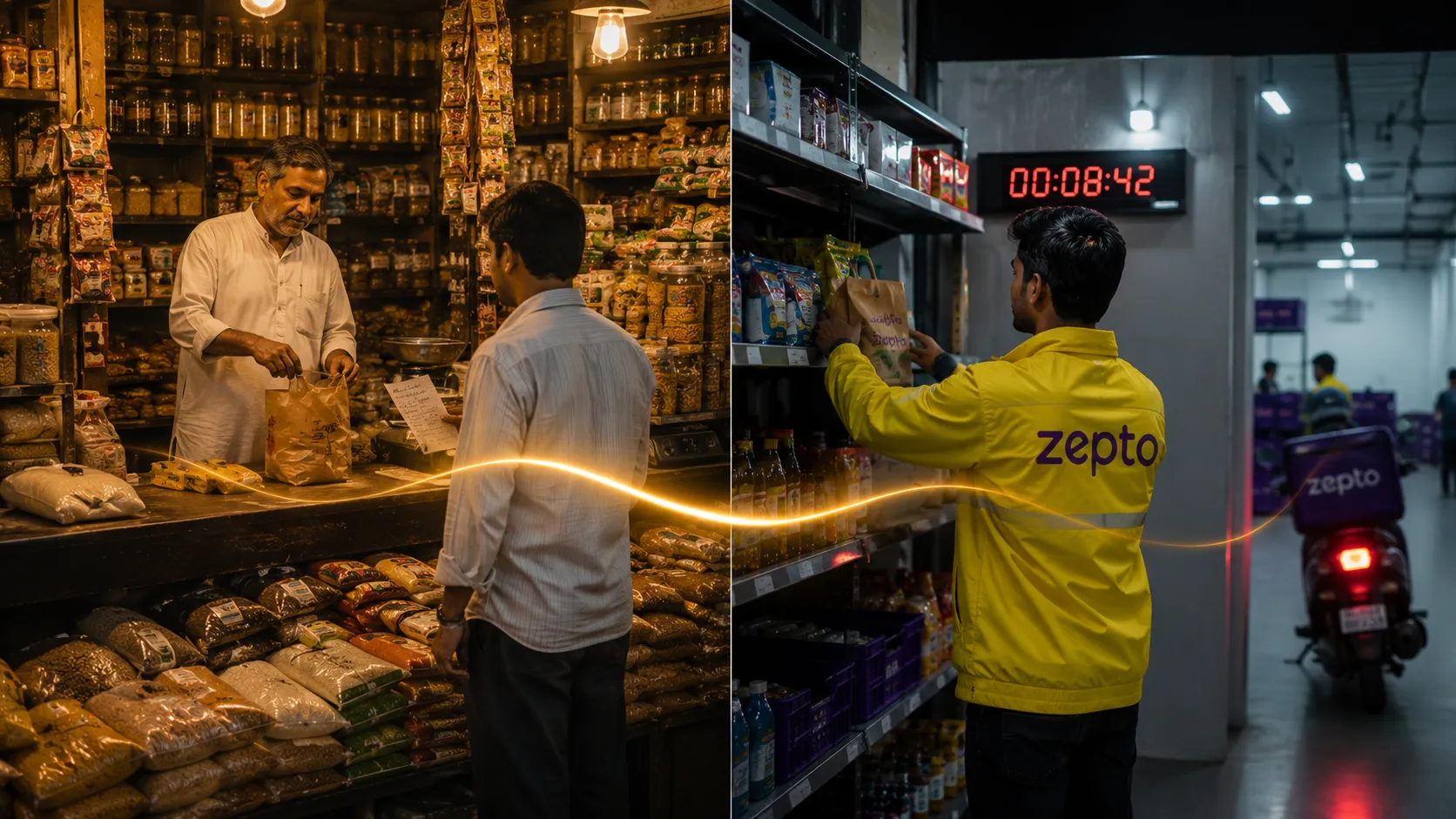
The 10-Minute Grocery War: How a 22-Year-Old Stanford Dropout Built a ₹9,669 Crore Empire—and Triggered India's Most Expensive Retail Battle
BENGALURU — May 24, 2026 — In the summer of 2021, two teenagers who should have been attending lectures at Stanford University were instead hunched over laptops in a Mumbai apartment, trying to solve a problem that most logistics experts considered unsolvable. Aadit Palicha and Kaivalya Vohra, both 19, had left one of the world's most elite universities with a conviction that bordered on absurd: that Indian consumers would pay a premium to have groceries delivered not in two hours, not in one hour, but in ten minutes. Not because ten minutes was a rational delivery window—it was not—but because the pandemic had collapsed the distinction between "urgent" and "routine." Everything was urgent. Everything was now.
Four years later, Palicha is 22 years old. On May 8, 2026, the Securities and Exchange Board of India issued an observation letter clearing Zepto's initial public offering—a raise expected to total approximately ₹8,000 to ₹9,000 crore, or roughly $1 billion, according to people familiar with the matter. The company had confidentially filed its draft papers in December 2025, and the approval triggered a countdown: file the updated prospectus within six to eight weeks, test institutional appetite, and hit the public markets in the July-September quarter of 2026. Palicha will be the youngest founder in Indian history to lead a billion-dollar IPO. He will be 23 by the time the listing happens. He will be responsible for a company that recorded total income of ₹9,668.8 crore in FY25—a 129 percent year-on-year leap—and a net loss of ₹3,367.3 crore, up 177 percent over the same period. The growth is breathtaking. The losses are breathtaking. The company's ability to balance the two, in the full glare of the public markets, will determine whether Zepto's IPO is remembered as the moment India's quick-commerce sector came of age—or the moment it flew too close to the sun.
The Two Teenagers Who Bet on Speed
The origin story of Zepto has been told so many times that it has acquired the texture of myth, but the facts are remarkable enough to withstand retelling. Palicha and Vohra were childhood friends who attended the same Mumbai school before both landing at Stanford to study computer science. When the pandemic hit in 2020, they returned to India and began volunteering with a local grocery-delivery initiative, ferrying essentials to elderly residents who could not leave their homes. The experience exposed them to the chaos of India's last-mile logistics—and to an insight that would reshape the country's retail industry.
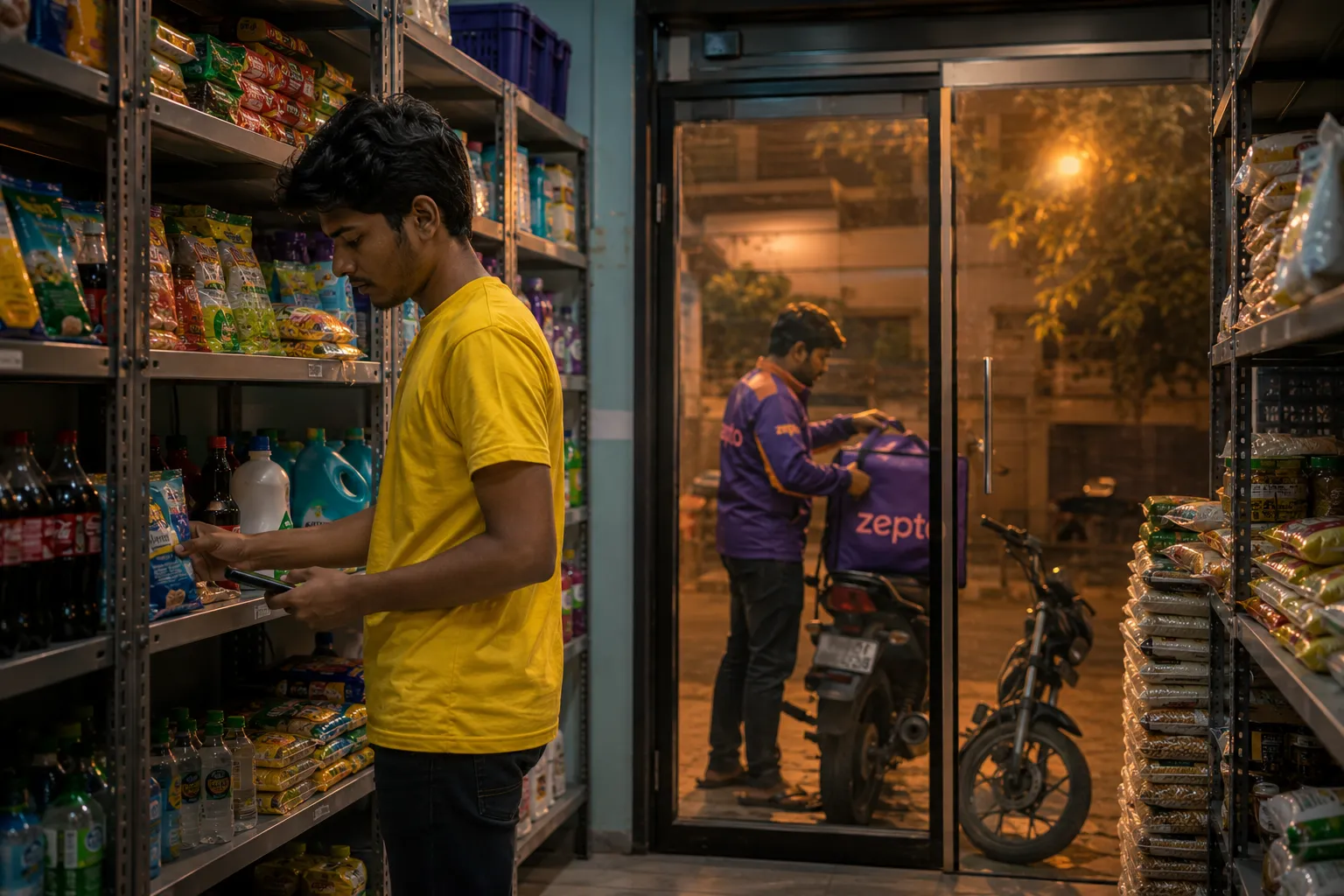
They dropped out of Stanford in 2021. They raised a seed round from Nexus Venture Partners. They began building what they called a "dark store" network—small, strategically located warehouses, invisible to customers, stocked with a curated selection of 2,000 to 6,000 high-frequency items, connected to a delivery fleet that could reach any address within a two-to-three-kilometre radius in under ten minutes. The dark store was not a new concept—it had been pioneered in China and refined in Europe—but applying it to Indian conditions, with Indian traffic, Indian infrastructure, and Indian consumer expectations, was a gamble that no logistics veteran would have taken.
The gamble worked. Zepto launched in Mumbai in early 2022 and expanded rapidly to Bengaluru, Delhi, Hyderabad, Chennai, and Pune. By mid-2024, it had captured roughly 28 to 30 percent of the quick-commerce market. The company raised over $2.4 billion from investors including Nexus Venture Partners, Lightspeed, DST Global, General Catalyst, and the California Public Employees' Retirement System (CalPERS), which co-led a $450 million round in October 2025 at a $7 billion valuation.
Today, Zepto operates approximately 1,255 dark stores across 61 cities. According to Bernstein Research's latest analysis, it has the highest dark-store concentration in the sector, with nearly 21 stores per city compared to roughly 9 stores per city for peers. It handles approximately 2.4 to 2.5 million daily orders. Its monthly active users peaked at around 60 million in August 2025 and have since settled to roughly 58 million. And it has become, by several scale metrics, the country's second-largest quick-commerce player—trailing Blinkit, which operates over 2,222 dark stores across 243 cities and handles more than 3 million daily orders, but ahead of Swiggy Instamart and a growing roster of rivals.
The Strategy That Nobody Saw Coming
The most consequential strategic decision Zepto has made over the past year is not a product launch or a marketing campaign. It is the quiet, methodical pivot to a density-over-sprawl model—a decision that has reshaped how the company thinks about growth and which Bernstein Research recently described as a "founder-led deviation from the typical startup growth playbook."
Rather than expanding aggressively into new cities—the approach favoured by Blinkit, which now operates in 243 cities—Zepto has focused on saturating a handful of high-density urban markets where quick-commerce adoption is most advanced and where dark-store economics are most favourable. Approximately 77 percent of Zepto's dark stores are concentrated in metro cities, compared to 57 percent for Blinkit and 61 percent for Instamart. Roughly 67 percent of its entire network is concentrated in just five cities: Delhi NCR, Bengaluru, the Mumbai Metropolitan Region, Hyderabad, and Chennai. Within those cities, Zepto has more than double the dark-store density of its competitors, with 21 stores per city versus roughly 9 for both Blinkit and Instamart.
The logic is that quick commerce, unlike fashion or electronics, is a frequency-driven business. The customer who orders butter every Tuesday evening does not want to comparison-shop. She wants the product to arrive, fresh and cold, within ten minutes, every single time. Density, not geographic breadth, is what enables that reliability. In a Bengaluru comparison, Bernstein found that 76 percent of Zepto's serviceable grid points showed promised delivery timelines of under 10 minutes, compared to 21 percent for Blinkit. The metric is a measure of dark-store density, not technology superiority—and it is the kind of advantage that takes years and significant capital to replicate.
The engagement data supports the thesis. Bernstein reports that sessions-per-user metrics on Zepto have increased sharply from 7.5 to 10.5 in recent months, suggesting that the habit loop is deepening. Nearly 96 percent of Zepto's serviceable locations show delivery promises below 15 minutes. The company is not acquiring new users as rapidly as it was in mid-2025—MAUs have plateaued at around 58 million, while Blinkit's have surged past 77 million—but it is extracting more value from each existing user. In a market where customer acquisition costs are rising as competition intensifies, the engagement-over-acquisition strategy is a bet that loyalty, not novelty, will determine the winner.
The Math That Makes Investors Sweat
The financials that Zepto disclosed in its draft IPO filings present a picture of a company that is simultaneously one of the most impressive growth stories in Indian business history and one of the most aggressive capital-consumption machines the country has ever produced.
Revenue of ₹9,668.8 crore in FY25—a 129 percent year-on-year leap—places Zepto among the fastest-growing consumer internet companies ever built in India. The company's mature dark stores are EBITDA-positive at the store level, and management has told investors it expects to reach company-wide post-tax profitability by fiscal 2029. For the quarter ended March 2026, Zepto's EBITDA loss narrowed to approximately ₹55–60 crore, down from roughly ₹100–110 crore in the July-September period, indicating tighter cost control and improving operational efficiency.
The problem is that the path to maturity is expensive. Opening a dark store requires real estate, inventory, technology infrastructure, and a fleet of delivery personnel. Marketing—discounts, platform fee waivers, customer acquisition campaigns—consumes an additional share of every revenue rupee. The result is a net loss that has been growing faster than revenue: ₹3,367.3 crore in FY25, a 177 percent jump from ₹1,214.7 crore the previous year. Zepto is not unusual in this regard. Swiggy lost money for years before reaching profitability. Eternal (Zomato) traded below its IPO price for eighteen months before the market rewarded its turnaround. The quick-commerce sector is structurally loss-making in its growth phase, and the bet investors are being asked to make is that Zepto's path to profitability is shorter, steeper, and more defensible than its competitors'.
The cash position tells a sobering story. Zepto had approximately ₹6,000–7,000 crore in cash on its books as of the SEBI filing—a substantial war chest. But it is dwarfed by the reserves of its listed rivals. Blinkit and Instamart together hold approximately ₹18,000 crore in cash. Amazon Now and Flipkart Minutes are backed by global parent companies with functionally unlimited capital. The IPO is not a luxury. It is a necessity. Zepto needs the capital to expand its dark store network, deepen its presence in Tier-2 cities where quick-commerce adoption is still in its infancy, and build the supply-chain technology required to compete against rivals who can subsidise losses from other business lines.
The competitive intensity is unlikely to ease. Bernstein expects competition to remain elevated through FY27, with most players targeting the same urban consumers and localities. In the sector, seven players now operate at scale, collectively processing more than 10 million orders daily. Metro dark-store penetration has crossed 106 percent, and platforms are increasingly being forced into Tier-2 and Tier-3 markets where unit economics are more challenging. Customer loyalty is fragmenting: Blinkit's monthly ordering frequency declined from 3.57 to 3.36 over the past year, while Instamart's fell from 4.22 to 4.01, even as total order volumes surged. Consumers are increasingly splitting purchases across multiple apps, comparing prices and delivery slots in real time before deciding where to order. In such an environment, the platform with the deepest local density—not necessarily the widest national footprint—may hold the advantage.
The Domicile Gambit and the Public-Market Test
One of the most telling details in Zepto's IPO preparations was the company's decision to shift its domicile from Singapore back to India—a move that has become increasingly common among venture-backed Indian startups preparing for domestic listings. The decision was not merely administrative. It was strategic. The Indian public markets have, over the past eighteen months, demonstrated an appetite for consumer technology IPOs that was absent during the previous decade. Swiggy's 2024 listing, while volatile, established that Indian retail investors would buy shares in companies they used every day. Zomato's stock, after an initial period of scepticism, has rewarded patient investors.
The investment banking syndicate that Zepto has assembled—Morgan Stanley, Axis Capital, HSBC, Goldman Sachs, JM Financial, IIFL Securities, and Motilal Oswal—is among the largest ever assembled for an Indian internet IPO. The roadshow is expected to begin within weeks. The market's response will be a litmus test for the entire Indian startup ecosystem. If Zepto can price its IPO at a valuation that reflects its growth trajectory and sustain that valuation in the aftermarket, it will open the door for a wave of venture-backed consumer internet companies that have been waiting for a credible exit window. If it cannot—if the losses prove too large, the competition too intense, the path to profitability too uncertain—it will be a signal that the public markets are not yet ready to value growth-at-all-costs companies at the multiples that private investors have assigned them.
Aadit Palicha is 22 years old. He was a teenager when he dropped out of Stanford. He will be 23 when his company lists on the National Stock Exchange. He will be responsible for a business that generates nearly ₹10,000 crore in revenue, loses more than ₹3,300 crore a year, operates 1,255 dark stores across 61 cities, and employs tens of thousands of people across India. The Stanford dropout who was told that ten-minute delivery was logistically impossible has built the infrastructure to make it routine—so routine, in fact, that 96 percent of his company's serviceable locations now promise delivery within 15 minutes. The revenue is the evidence that consumers want it. The losses are the evidence that building it is expensive. The IPO is the moment when the market decides which number matters more. The verdict is coming. The dark stores are ready.


