The 10-Minute Grocery War: How a 19-Year-Old Stanford Dropout Built a $5 Billion Empire by Betting That Indians Would Pay for Speed—and Triggered the Most Expensive Retail Battle in Indian History
BENGALURU — May 24, 2026 — In the summer of 2021, two teenagers who should have been attending lectures at Stanford University were instead hunched over laptops in a Mumbai apartment, trying to solve a problem that most logistics experts considered unsolvable. Aadit Palicha and Kaivalya Vohra, both 19, had left one of the world's most elite universities with a conviction that bordered on absurd: that Indian consumers would pay a premium to have groceries delivered not in two hours, not in one hour, but in ten minutes. Not because ten minutes was a rational delivery window—it was not—but because the pandemic had collapsed the distinction between "urgent" and "routine." Everything was urgent. Everything was now.
Four years later, Palicha is 22 years old. His company, Zepto, controls roughly 28 to 30 percent of India's quick-commerce market, operates more than 900 dark stores across the country's top cities, generated revenue of ₹9,669 crore in FY25—a 129 percent year-on-year leap—and is preparing for an initial public offering that could raise approximately ₹8,000 to ₹9,000 crore, or roughly $1 billion. The Stanford dropout who was told by multiple investors that his idea was logistically impossible is now the youngest founder in Indian history to lead a billion-dollar IPO. He will be 23 by the time the listing happens. He will be responsible for a company that lost ₹3,367 crore in FY25—up 177 percent year-on-year—and that the market will be asked to value at somewhere between $7 billion and $8 billion. The growth is breathtaking. The losses are breathtaking. The battle for India's kitchen is just beginning.
The Two Teenagers Who Bet on Speed
The origin story of Zepto has been told so many times that it has acquired the texture of myth, but the facts are remarkable enough to withstand retelling. Palicha and Vohra were childhood friends who had attended the same Mumbai school before both landing at Stanford to study computer science. When the pandemic hit in 2020, they returned to India and began volunteering with a local grocery-delivery initiative, ferrying essentials to elderly residents who could not leave their homes. The experience exposed them to the chaos of India's last-mile logistics—and to an insight that would reshape the country's retail industry.
The insight was that Indian consumers wanted groceries faster than anyone was delivering them. The incumbents—BigBasket, Grofers (later rebranded as Blinkit), Amazon Pantry—offered delivery windows of two to four hours, or next-day slots. The model was adequate for planned, bulk purchases. But the pandemic had created a new kind of consumer: someone who needed a packet of butter, a loaf of bread, or a bottle of cold medicine right now, not tomorrow morning. The existing supply chain was not built for that consumer. Palicha and Vohra thought they could build something that was.
They dropped out of Stanford in 2021. They raised a seed round from Nexus Venture Partners. They began building what they called a "dark store" network—small, strategically located warehouses, invisible to customers, stocked with a curated selection of 2,000 to 6,000 high-frequency items, connected to a delivery fleet that could reach any address within a two-to-three-kilometer radius in under ten minutes. The dark store was not a new concept—it had been pioneered in China and refined in Europe—but applying it to Indian conditions, with Indian traffic, Indian infrastructure, and Indian consumer expectations, was a gamble that no logistics veteran would have taken.
The gamble worked. Zepto launched in Mumbai in early 2022 and expanded rapidly to Bengaluru, Delhi, Hyderabad, Chennai, and Pune. By early 2024, it had captured roughly 28 to 30 percent of the quick-commerce market—roughly tied with Swiggy Instamart and within striking distance of Eternal-owned Blinkit, the market leader. The company had raised over $1 billion in private capital, including a $450 million round in October 2025 that valued it at $7 billion, with the California Public Employees' Retirement System—America's largest public pension fund—co-leading the round. The dark store count had crossed 900. The revenue was growing at triple-digit rates. The losses were growing faster.
The Dark Store Machine
The core strategic innovation of quick commerce is not the app, the delivery fleet, or the consumer brand. It is the dark store—a concept that sounds simple and is, in practice, brutally difficult to execute at scale.
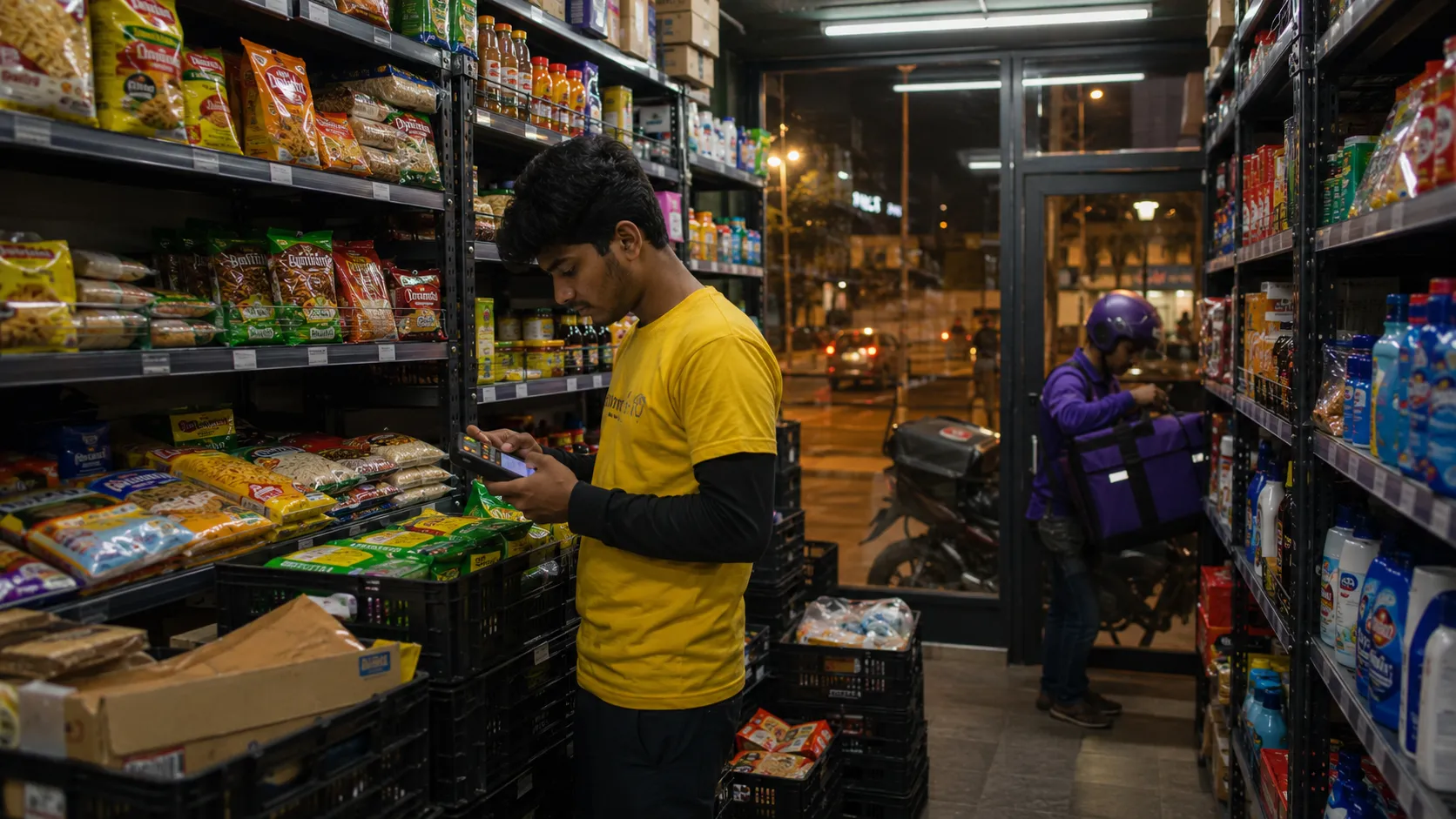
A dark store is a small warehouse, typically 2,000 to 4,000 square feet, located in a high-density residential neighbourhood. It is not open to the public. It is stocked with a carefully curated selection of products—groceries, personal care items, snacks, beverages, over-the-counter medicines—that are selected based on the consumption patterns of the surrounding neighbourhood. When a customer places an order through the Zepto app, a picker inside the dark store locates the items, packs them into a bag, and hands them to a delivery rider who is usually waiting outside. The rider delivers the order within ten minutes. The entire process, from tap to doorstep, is designed to feel instantaneous.
The dark store model is expensive to build. Each store requires real estate, inventory, technology infrastructure, and a fleet of delivery personnel. The real estate must be located in high-density urban neighbourhoods where rents are elevated. The inventory must be managed with a precision that rivals just-in-time manufacturing, because a dark store that runs out of butter at 8 a.m. has failed its customers. The delivery fleet must be large enough to handle peak demand—Sunday mornings, festival seasons, IPL final nights—without idle riders during the off-peak hours that define the rest of the week.
But the dark store model, once built, generates a competitive advantage that is extraordinarily difficult to replicate. The customer who orders butter at 7:58 a.m. and receives it at 8:06 a.m. has experienced a miracle—and she will not easily return to a platform that makes her wait two hours. The moat is not technology, brand, or pricing. It is density. The more dark stores Zepto builds, the more customers fall within the ten-minute delivery radius, and the more orders each store can fulfil per day, improving the unit economics. The flywheel is not theoretical. It is measurable: mature dark stores at Zepto are EBITDA-positive at the store level, a metric that management has emphasised in investor conversations.
The Math That Makes Investors Sweat
The financials that Zepto disclosed in its draft IPO filings present a picture of a company that is simultaneously one of the most impressive growth stories in Indian business history and one of the most aggressive capital-consumption machines the country has ever produced.
Revenue of ₹9,669 crore in FY25—a 129 percent year-on-year leap—places Zepto among the fastest-growing consumer internet companies ever built in India. The company's mature dark stores are EBITDA-positive at the store level, and management is targeting company-wide EBITDA breakeven within 12 to 15 months of the IPO. The unit economics, in theory, work: each dark store, once it reaches maturity, generates more cash than it consumes.
The problem is that the path to maturity is expensive. Opening a dark store requires real estate, inventory, technology infrastructure, and a fleet of delivery personnel. Marketing—discounts, platform fee waivers, customer acquisition campaigns—consumes an additional share of every revenue rupee. The result is a net loss that has been growing faster than revenue: ₹3,367 crore in FY25, a 177 percent jump from the previous year, driven by the cost of expanding the dark store network and the advertising expenditure required to compete against rivals with deeper pockets and longer runways.
The cash position tells a sobering story. As of March 2026, Zepto had roughly $600-700 million in cash—a substantial war chest by any standard, but dwarfed by the $1.7 billion held by Swiggy Instamart and the $1.9 billion held by Blinkit. The IPO is not a luxury. It is a necessity. Zepto needs the capital to expand its dark store network, deepen its presence in Tier-2 cities where quick-commerce adoption is still in its infancy, and build the supply-chain technology required to compete against rivals who can subsidise losses from other business lines.
The competitive landscape is the most intense in Indian retail. Blinkit, the Zomato-owned market leader, has access to the public-market capital of its parent company, which has a market capitalization that provides a virtually unlimited war chest for quick-commerce expansion. Swiggy Instamart, backed by the deep pockets of Swiggy's own public-market capital, has matched Zepto's expansion city for city. Flipkart Minutes and Amazon Now, the quick-commerce arms of India's two largest e-commerce companies, have entered the fray with the patience and capital of incumbents who can afford to lose money for years. And in the background, Reliance JioMart is building its own quick-commerce capabilities, with the advantage of India's largest retail supply chain and the backing of one of the world's most deep-pocketed conglomerates.
The battle is not a sprint. It is a siege. And the companies that survive will be those that can sustain losses longer than their competitors.
The Domicile Gambit
One of the most telling details in Zepto's IPO preparations was the company's decision to shift its domicile from Singapore back to India—a move that has become increasingly common among venture-backed Indian startups preparing for domestic listings. The decision was not merely administrative. It was strategic. The Indian public markets have, in the past eighteen months, demonstrated an appetite for consumer technology IPOs that was absent during the previous decade. Swiggy's 2024 listing, while volatile, established that Indian retail investors would buy shares in companies they used every day. Zomato's stock, after an initial period of scepticism, has rewarded patient investors. The pipeline of startups preparing for IPOs—PhonePe, Flipkart, Shadowfax, Shiprocket—suggests that 2026 and 2027 will be the years when Indian venture-backed companies finally deliver the exits their investors have been waiting for.
Zepto is positioned at the front of that pipeline, and the market will judge it accordingly. The IPO's structure—a sizeable fresh issue of approximately ₹11,000 crore, along with a smaller offer-for-sale by early investors—signals that the company is raising capital primarily to fund expansion, not to provide liquidity to insiders. The investment banking syndicate—Morgan Stanley, Axis Capital, HSBC, Goldman Sachs, JM Financial, IIFL Securities, and Motilal Oswal—is among the largest ever assembled for an Indian internet IPO. The roadshow is expected to begin in the coming weeks.
The market's response will be a litmus test for the entire Indian startup ecosystem. If Zepto can price its IPO at a $7-8 billion valuation and sustain that valuation in the aftermarket, it will open the door for a wave of venture-backed consumer internet companies that have been waiting for a credible exit window. If it cannot—if the losses prove too large, the competition too intense, the path to profitability too uncertain—it will be a signal that the public markets are not yet ready to value growth-at-all-costs companies at the multiples that private investors have assigned them.
What This Signals
The Zepto story is not primarily about groceries. It is about a structural transformation in how India shops—and about the generation of founders who are building the infrastructure to serve that transformation.
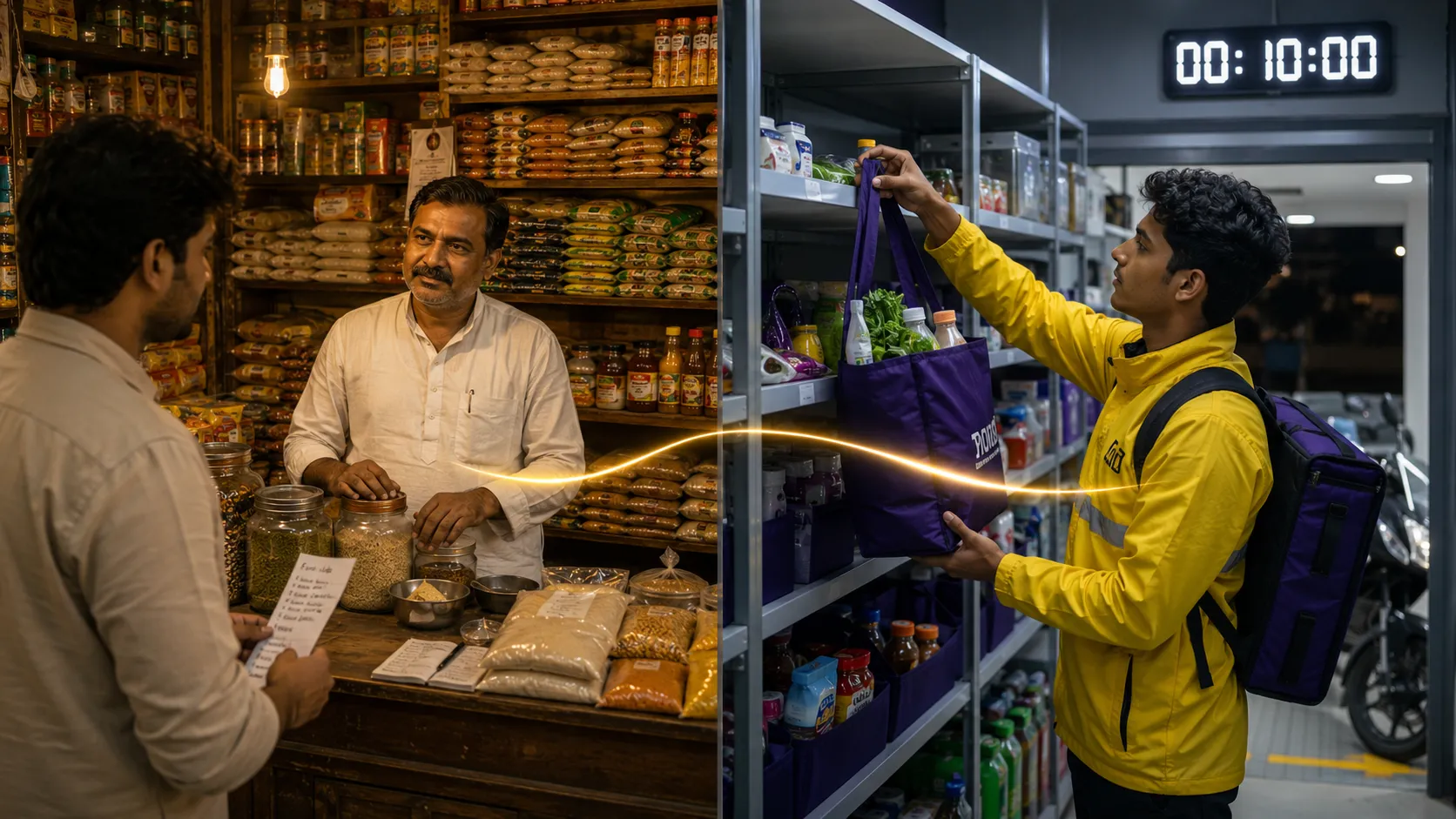
For decades, the Indian grocery market was defined by the kirana store—the small, family-owned shop that stocked a few hundred items, knew every customer by name, and extended credit to families between paychecks. The kirana was not just a retailer. It was a community institution. It survived the arrival of supermarkets, the rise of e-commerce, and the entry of the world's largest retailers into the Indian market. It was supposed to be unassailable.
Quick commerce has breached the kirana's last and most powerful competitive advantage: immediacy. When a customer can receive butter, bread, and cold medicine within ten minutes of opening an app, the kirana's location advantage—the fact that it was closer than any alternative—has been neutralised. The kirana is not going to disappear. India's grocery market is too large, too diverse, and too price-sensitive to be captured entirely by venture-backed platforms. But the share of wallet that shifts from kirana to quick commerce, even if it is only 10 or 20 percent, is measured in tens of billions of dollars. That is the prize that Zepto, Blinkit, Instamart, and the rest are fighting for.
Aadit Palicha is 22 years old. He was a teenager when he dropped out of Stanford. He will be 23 when his company lists on the National Stock Exchange. He will be responsible for a business that generates nearly ₹10,000 crore in revenue, loses more than ₹3,000 crore a year, and employs tens of thousands of people across India. The Stanford dropout who was told that ten-minute delivery was logistically impossible has built the infrastructure to make it routine. The ₹9,669 crore in revenue is the evidence that consumers want it. The ₹3,367 crore in losses is the evidence that building it is expensive. The IPO is the moment when the market decides which number matters more. The verdict is coming. The dark stores are ready.


