The $1 Billion Sovereignty Play: How Tata and JSW Are Trying to Break India's Dependence on Chinese EV Batteries
MUMBAI — May 21, 2026 — The most expensive, most technically demanding component of an electric vehicle is not the motor, the software, or the chassis. It is the battery—and for nearly every electric vehicle sold in India today, the cells inside that battery were designed and manufactured in China. India's EV penetration has surged past 8.5 percent, driven by electric two- and three-wheelers that have become a common sight on city streets. But the lithium-ion cells that power those vehicles, and the lithium-iron-phosphate chemistry that is increasingly used in stationary energy storage, remain almost entirely imported from a single country.
That dependence is now the target of the most significant private-sector battery R&D investment in Indian history. Tata Group and JSW Group, two of the country's largest conglomerates, are collectively directing nearly $1 billion toward independent electric-vehicle and battery research, aiming to build domestic expertise in next-generation battery technologies and advanced EV systems. The investments are separate but complementary, and they signal a structural shift in how India's largest industrial companies think about technology sovereignty.
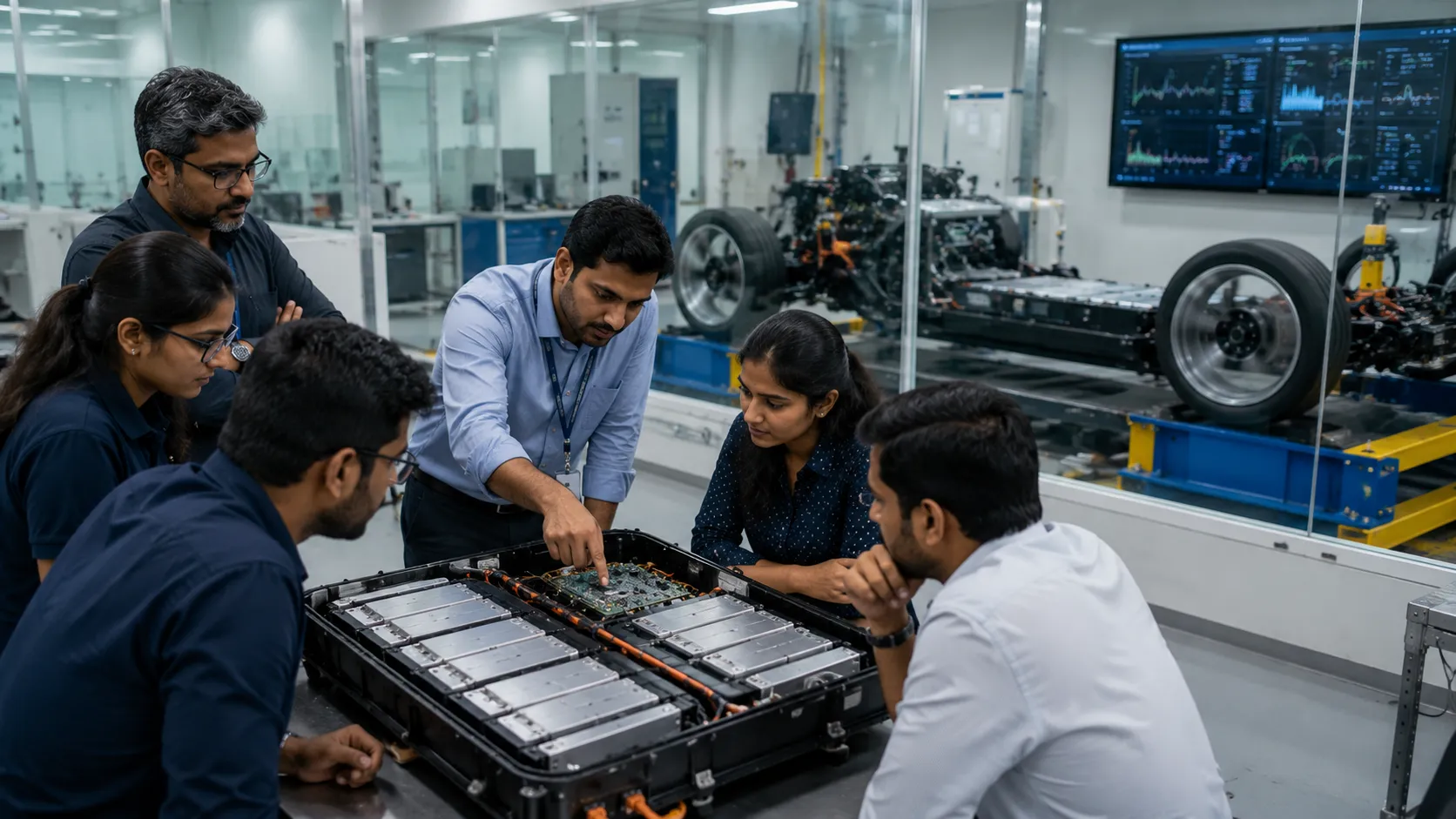
Tata's battery unit, Agratas Ltd., is spending more than $400 million on a new R&D facility in Bengaluru focused on developing lithium-iron-phosphate, or LFP, and lithium-manganese-iron-phosphate technologies—the chemistries that are rapidly becoming the global standard for affordable, long-life EV batteries. The center is designed to help Tata develop and eventually manufacture those cells at home, building intellectual property rather than licensing it from overseas partners.
JSW Motors, the passenger-vehicle arm of billionaire Sajjan Jindal's conglomerate, is pursuing a parallel track. The company plans to invest at least $500 million over five to six years in a research hub in Maharashtra. The JSW center will focus on localizing vehicles developed with global partners, building proprietary software capabilities, and advancing work on connected vehicles. The goal, JSW Motors CEO Ranjan Nayak said, is to adapt global automotive technology to Indian conditions—from road environments to price points.
The Chinese Bottleneck
To understand why Tata and JSW are spending a billion dollars on battery R&D, it helps to understand the structure of the global battery supply chain—and India's position within it. Lithium-ion cells are made by a handful of companies, concentrated almost entirely in China, South Korea, and Japan. CATL, the Chinese battery giant, alone controls more than a third of the global market. Chinese companies also dominate the upstream supply chain: the refining of lithium, the production of cathode materials, the manufacturing of the precision equipment used to coat electrodes and assemble cells.
For an Indian automaker, this concentration creates multiple vulnerabilities. Price volatility: when global demand for batteries surges—as it is surging now, driven by the AI data-center buildout and the accelerating EV transition—Chinese suppliers can raise prices. Technology access: Beijing has become more guarded about sharing critical battery and EV technologies as the U.S.-China trade war intensifies. Supply disruptions: natural disasters, geopolitical conflicts, or export restrictions can interrupt the flow of cells to Indian factories.
Several Indian firms, including Reliance Industries, have encountered friction in joint ventures as technology transfer from Chinese partners becomes harder to secure. The Tata-JSW R&D investments are a response to this structural vulnerability—an attempt to build enough technical capability to negotiate from strength with Chinese suppliers, and eventually to manufacture cells domestically without them.
The LFP Bet
The choice of lithium-iron-phosphate chemistry is strategic. LFP batteries are cheaper, safer, and longer-lasting than the nickel-manganese-cobalt chemistry that dominated the first generation of EV batteries. They do not contain cobalt, a mineral associated with human-rights abuses in the Democratic Republic of Congo and subject to volatile pricing. They are less energy-dense than NMC cells, meaning they store less energy per kilogram, but for most applications in India—electric two- and three-wheelers, stationary energy storage, entry-level passenger cars—energy density is less important than cost and durability.
Tata's Agratas unit currently has access to NMC battery technology sourced from South Korea. The Bengaluru R&D center is designed to develop LFP and LMFP technologies that Tata can manufacture domestically, creating products for which it currently depends on China. LFP cells are increasingly in demand for battery energy storage systems—a market that is expected to grow rapidly as India expands its renewable energy capacity and needs storage to manage the intermittency of solar and wind power.
JSW's approach is somewhat different. The company's Maharashtra R&D hub will focus on localizing vehicles developed with global partners—adapting platforms designed in Europe or Japan for Indian road conditions, price points, and manufacturing processes. The hub will also build proprietary software capabilities for connected vehicles, a domain where Indian engineering talent has a natural advantage. The goal, Nayak said, is to deliver products that meet global quality benchmarks at Indian cost structures.
The Sovereignty Question
The Tata-JSW battery investments are best understood not as a commercial play—though they will have commercial implications—but as a sovereignty play. India's EV transition is accelerating. The government has set ambitious targets for EV adoption. The market for electric two- and three-wheelers is among the fastest-growing in the world. And yet the single most important component of every EV—the cell—comes from a country with which India has a complex, often adversarial relationship.
The $1 billion R&D commitment will not change that overnight. Building battery manufacturing capacity takes years. Catching up to Chinese companies that have spent decades optimizing their production processes is a generational challenge. But the investments are a down payment—a signal that India's largest conglomerates are no longer content to be customers of Chinese battery technology. They want to be creators of their own.
The Reliance Industries gigafactory in Jamnagar, which is due to begin cell chemistry manufacturing in the second half of 2026, adds another piece to the puzzle. Reliance, Tata, and JSW—three of India's largest industrial groups—are now all investing in battery R&D and manufacturing. The combined effect could be the emergence of a domestic battery ecosystem that, within a decade, supplies a significant share of India's EV and energy-storage demand.
The global context reinforces the urgency. The U.S. has used the Inflation Reduction Act to attract battery manufacturing investment on a massive scale. Europe is building its own gigafactories. China continues to dominate. India, with its large and growing market, its engineering talent, and its government support, has a window to become a serious player in the global battery supply chain. The $1 billion Tata-JSW bet is the clearest signal yet that the country's industrial giants intend to seize that window.


