
The $1.64 Billion Company That Doesn't Make AI Chips — It Cools Them. Inside Frore Systems' Quiet Conquest of the Thermal Stack.
SAN JOSE, CALIF. — May 18, 2026 — Sometime in early 2024, Jensen Huang watched a technology demonstration and uttered four words that would quietly reshape a company. "Switch to liquid cooling."
The demonstration was conducted by Frore Systems, a then-obscure Silicon Valley startup that had spent years developing solid-state air cooling for smartphones and fanless electronic devices — a niche market, small but defensible, far from the roaring AI infrastructure buildout that was beginning to consume the technology industry. Huang, whose company Nvidia sits at the center of that buildout, saw something in Frore's precision manufacturing approach that the startup's founders had not yet fully exploited. Traditional cold plates, the metal blocks that circulate coolant across hot chips, were machined — cut, welded, and assembled with millimeter-level precision. Frore had developed a proprietary "micro-growth" process that built cooling structures with the precision of semiconductor fabrication. Huang's suggestion was to apply that manufacturing philosophy to the single greatest constraint on AI performance. Frore took the advice. It was, in retrospect, the moment a $1.64 billion company was born.
On March 16, 2026, Frore Systems announced a $143 million Series D funding round that valued the company at $1.64 billion, officially entering the unicorn club. The round, led by MVP Ventures with participation from Fidelity Management & Research Company, Top Tier, Mayfield Fund, Clear Ventures, Addition, Qualcomm Ventures, StepStone Group, and Alumni Ventures, brought total capital raised to $340 million. The company, founded in 2018 by Dr. Seshu Madhavapeddy — who earned his bachelor's at IIT Kharagpur and his PhD in computer science from the University of Texas at Dallas, with stints at Texas Instruments, Samsung Mobile, and Qualcomm — and Surya Ganti, had spent eight quiet years building intellectual property in a corner of the semiconductor industry that few investors considered exciting. Cooling was plumbing. The chip was the hero. In 2026, that hierarchy collapsed.
The Manufacturing Revolution
To understand why Frore is worth $1.64 billion, one must first understand the distinction the company has drawn between traditional thermal management and its own approach. The 36Kr analysis captured it precisely: "Traditional heat dissipation is mechanical processing, while Frore is micro-growth. The gap between the two is like the chasm between hand-crafted parts and the chip lithography process."
For decades, liquid cooling has been a commodity. Cold plates are machined — cut from metal blocks, with channels drilled or etched at millimeter-scale precision. Hoses are connected with fittings. Manifolds distribute coolant. The system works, but it carries the accumulated inefficiencies of a manufacturing philosophy borrowed from the mechanical age. Channel diameters between one and two millimeters create high fluid flow resistance and limit heat exchange efficiency. Mechanical connections introduce interface thermal resistance and leak risks. The entire assembly is heavy, bulky, and difficult to scale — which is why, for all its performance advantages, cold-plate liquid cooling has struggled to penetrate the data center market beyond early adopters.
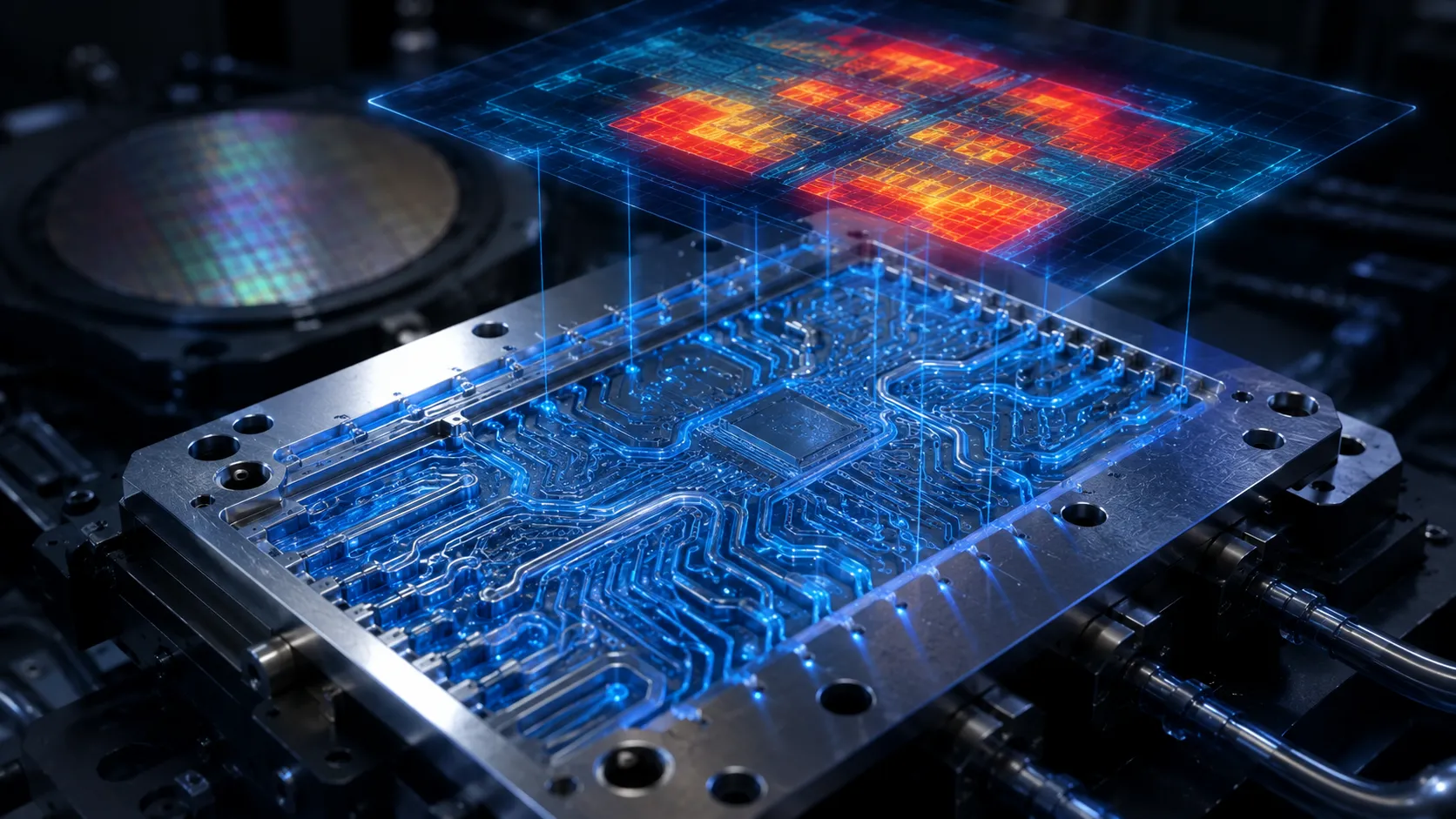
Frore's insight was to apply semiconductor manufacturing techniques to the cooling problem itself. Its proprietary micro-growth process builds cooling structures atom by atom, layer by layer, creating 3D short-loop jet channels with diameters far smaller than traditional machining can achieve. The process allows the company to map the precise thermal topography of a GPU — identifying hotspots where transistor density creates localized temperature spikes — and target those hotspots with micro-jets of coolant directed through 3D channels etched into the coldplate. A traditional cold plate is a flat block of metal. Frore's LiquidJet is a precision instrument.
The performance numbers bear out the difference. LiquidJet delivers 75 percent higher heat transfer efficiency compared to conventional liquid cooling. GPUs run 8°C cooler, which translates to a 4 percent increase in AI tokens per second — the metric that directly determines revenue for AI inference providers. Power usage effectiveness, the industry's standard measure of data center energy efficiency, improves by 10 percent. The coldplate itself is 55 percent lighter than traditional alternatives. And because the manufacturing process is built on scalable, repeatable precision methods — not custom machining — Frore can produce its cooling systems at volumes that the traditional liquid-cooling supply chain cannot match.
The Kyber Question
The timing of Frore's unicorn round is not coincidental. Nvidia's next-generation Kyber platform, expected in 2027, will push GPU power consumption past 1,950 watts per chip. A single rack of Kyber GPUs will consume more than 400 kilowatts — roughly the power demand of a small suburban block. Traditional air cooling, which blows fans across finned heatsinks, cannot handle this load. The physics simply break down: air cannot carry heat away fast enough at these densities. Conventional liquid cooling performs better but introduces complexity: hoses, connectors, manifolds, pumps, leak risks, and weight that strains data center floor-loading limits.
In March 2026, the same week it announced its unicorn round, Frore unveiled LiquidJet Nexus — an integrated coldplate system designed specifically for Nvidia Kyber ½U compute trays. Nexus integrates multiple LiquidJet coldplates into a single, lightweight assembly that eliminates every hose, connector, and manifold from the compute tray. The system is designed to cool GPUs, CPUs, DPUs, network interface cards, and DC-DC power converters simultaneously, using a unified architecture that simplifies the entire thermal stack. The system supports inlet temperatures of 53°C — removing the need for energy-intensive mechanical chillers — and reduces thermal stack weight by 65 percent while enabling twice the compute density per rack. The entire assembly weighs just 2.5 kilograms.
The Kyber compatibility is strategic. By designing specifically for Nvidia's next-generation platform, Frore has positioned itself as a co-designed component of the AI infrastructure stack, not an aftermarket add-on. The hyperscalers building Kyber-based data centers — Amazon, Microsoft, Google, Meta — will need cooling systems that can handle the thermal load. Frore's bet is that LiquidJet Nexus, with its semiconductor-grade precision and its elimination of the complexity that plagues traditional liquid cooling, will become the default choice.
From Edge to Hyperscale
Frore's product portfolio now spans the full thermal spectrum, from the edge to the hyperscale data center — a breadth of coverage that few competitors can match and that reflects the company's unusual eight-year arc from niche to mainstream.
At the edge, AirJet — the world's first solid-state active air-cooling chip — addresses a market that Frore has been developing since its founding. AirJet contains no mechanical moving parts: no fans, no bearings, no components that can wear out. It uses piezoelectric membranes vibrating at ultrasonic frequencies to generate airflow, delivering up to 1,750 pascals of back pressure — roughly 30 times that of a conventional fan — while operating at just 21 decibels, quieter than a whisper. The chip itself measures 27 by 41.5 millimeters and is 2.65 millimeters thick — small enough to fit inside a smartphone, a tablet, or a compact industrial edge device. At CES 2026, Frore demonstrated AirJet and AirJet PAK modules in Qualcomm Snapdragon X2 Elite reference platforms, industrial edge IoT gateways, and AI-enabled cameras — devices that require sustained AI processing in compact, sealed, dustproof enclosures where traditional fans cannot operate.
In the data center, LiquidJet and LiquidJet Nexus address the hyperscale AI compute market that has become the company's growth engine. The combination is unusual: most thermal companies specialize in either consumer electronics or data center infrastructure, not both. Frore's thesis is that the underlying manufacturing technology — precision micro-growth — is the same regardless of the deployment environment. The coldplate that cools a Kyber GPU is built with the same fundamental process as the AirJet chip that cools a smartphone processor. The platform spans markets, but the moat is the manufacturing.
The Taiwan Connection and the Global Manufacturing Strategy
One of Frore's most consequential strategic decisions was the location of its manufacturing operations. The company is headquartered in San Jose, California, but its core production facility is in Hsinchu, Taiwan — the epicenter of the world's advanced semiconductor and hardware manufacturing ecosystem. The decision was not about cost arbitrage. It was about capability density. Frore's micro-growth manufacturing process is closer to semiconductor fabrication than to traditional metalworking. Placing production in Hsinchu — where TSMC, the world's largest contract chipmaker, also operates — gives Frore access to the talent, the supply chains, and the precision-manufacturing ecosystem required to produce its cooling systems at scale.
The company is, in its own quiet way, a global enterprise: founded by an Indian-born engineer with deep Texas ties, headquartered in Silicon Valley, funded by American venture capital, and manufactured in Taiwan. It is a structure that reflects the geography of deep-tech entrepreneurship in 2026 — and a structure that provides resilience against the supply-chain disruptions and geopolitical tensions that increasingly define the semiconductor industry. Navin Chaddha, managing partner at Mayfield and a Frore board member, articulated the thesis directly: "We're witnessing a fundamental shift in AI infrastructure, where thermal performance is critical for compute performance and reducing operating costs. What excites us is how Frore Systems is reimagining the thermal stack by building a 3D short-loop jetchannel coldplate and applying scalable manufacturing to cooling, unlocking the performance and efficiency required for the next generation of AI platforms."
The Series D funding will accelerate the global scale-up of Frore's three product lines — LiquidJet, LiquidJet Nexus, and AirJet — across data center and edge markets. The company plans to expand its manufacturing operations to meet demand that is growing in lockstep with the AI infrastructure buildout.
What This Signals
Frore's emergence as a $1.64 billion unicorn is not a story about a single technology. It is a story about the redefinition of thermal management from a commodity afterthought into foundational infrastructure for the AI era. The company's positioning is unusually resilient: it does not bet on the success or failure of any single chip manufacturer. Nvidia, AMD, Qualcomm, and their competitors all generate heat. The more intense the competition among chipmakers, the larger Frore's addressable market becomes.
Global AI compute demand and data-center capacity requirements are projected to grow more than threefold by 2030. Heat has emerged as a major — arguably the major — constraint on AI performance. The thermal stack — the integrated cooling architecture that extracts heat from computing hardware and rejects it into the atmosphere — has become a foundational infrastructure layer that directly determines compute density, energy efficiency, and operational cost. Frore's bet is that the companies that control the thermal stack will capture a disproportionate share of the value created by the AI buildout.
The bet is not without risk. The liquid cooling market is attracting intense competition, and traditional thermal-management incumbents with decades of data center relationships are developing their own advanced coldplate technologies. Nvidia's Kyber platform, while a massive opportunity, also represents a moving target: chip architectures evolve, and cooling solutions must evolve with them. And Frore's ability to scale manufacturing to meet hyperscaler demand will determine whether the $1.64 billion valuation translates into durable revenue.
But the direction of travel is unmistakable. AI is getting hotter. The physics of heat transfer are not subject to Moore's Law. The gap between what chips can compute and what cooling systems can handle is widening, and Frore is positioned directly in that gap. The company that started with solid-state air coolers for smartphones — a niche so small that few investors bothered to look — is now building the thermal infrastructure of the AI era. Jensen Huang's four words, offered after a product demonstration two years ago, have become the strategy of a unicorn. The chip is the hero. The cooling is no longer the janitor. The cooling is the foundation.


