The $1.64 Billion Company That Doesn't Make AI Chips—It Cools Them
SUNNYVALE, CALIF. — May 2026 – The chip is the hero. The cooling system is the janitor. That is the hierarchy that has governed computing since the first vacuum tubes glowed hot in a Pennsylvania basement. Nvidia designs the GPUs that power the AI revolution and gets a $3 trillion market cap. Intel and AMD design the CPUs that run the cloud and get headlines. The companies that cool those chips—the fan makers, the heatsink manufacturers—get commodity margins and zero glory. The chip is the brain. The cooling is the plumbing.
Seshu Madhavapeddy thinks this hierarchy is about to collapse. His company, Frore Systems, just raised $143 million at a $1.64 billion valuation in a Series D round led by MVP Ventures with participation from Fidelity, Mayfield, Qualcomm Ventures, and StepStone Group. Total funding now stands at $340 million. Frore has achieved unicorn status not by building a better chip, but by building a better way to stop chips from melting. And in the era of Nvidia's Kyber platform—next-generation AI servers expected in 2027 that will push power densities beyond anything the data center industry has ever managed—cooling is no longer plumbing. It is existential infrastructure.
The Chip That Could Not Be Cooled
To understand why Frore is worth $1.64 billion, one must understand what is happening inside a next-generation AI server rack. Nvidia's current H100 GPU draws up to 700 watts under full load. The upcoming Kyber platform is expected to push past 1,950 watts per chip. A single rack of Kyber GPUs will consume more power than a small suburban block. And all that power becomes heat—heat that must be removed continuously, efficiently, and reliably, because a single thermal runaway event can destroy millions of dollars of hardware in seconds.
Traditional air cooling—fans blowing across finned heatsinks—cannot handle this load. The physics simply break down. Air cannot carry heat away fast enough. Conventional liquid cooling, which circulates coolant through plates attached to chips, performs better but introduces complexity: hoses, connectors, manifolds, pumps, leak risks, and the inherent inefficiency of cooling a flat plate attached to a chip whose hotspots are unevenly distributed. The result is a data center industry that is spending an ever-increasing share of its capital budget on thermal management, even as chip performance continues to scale.
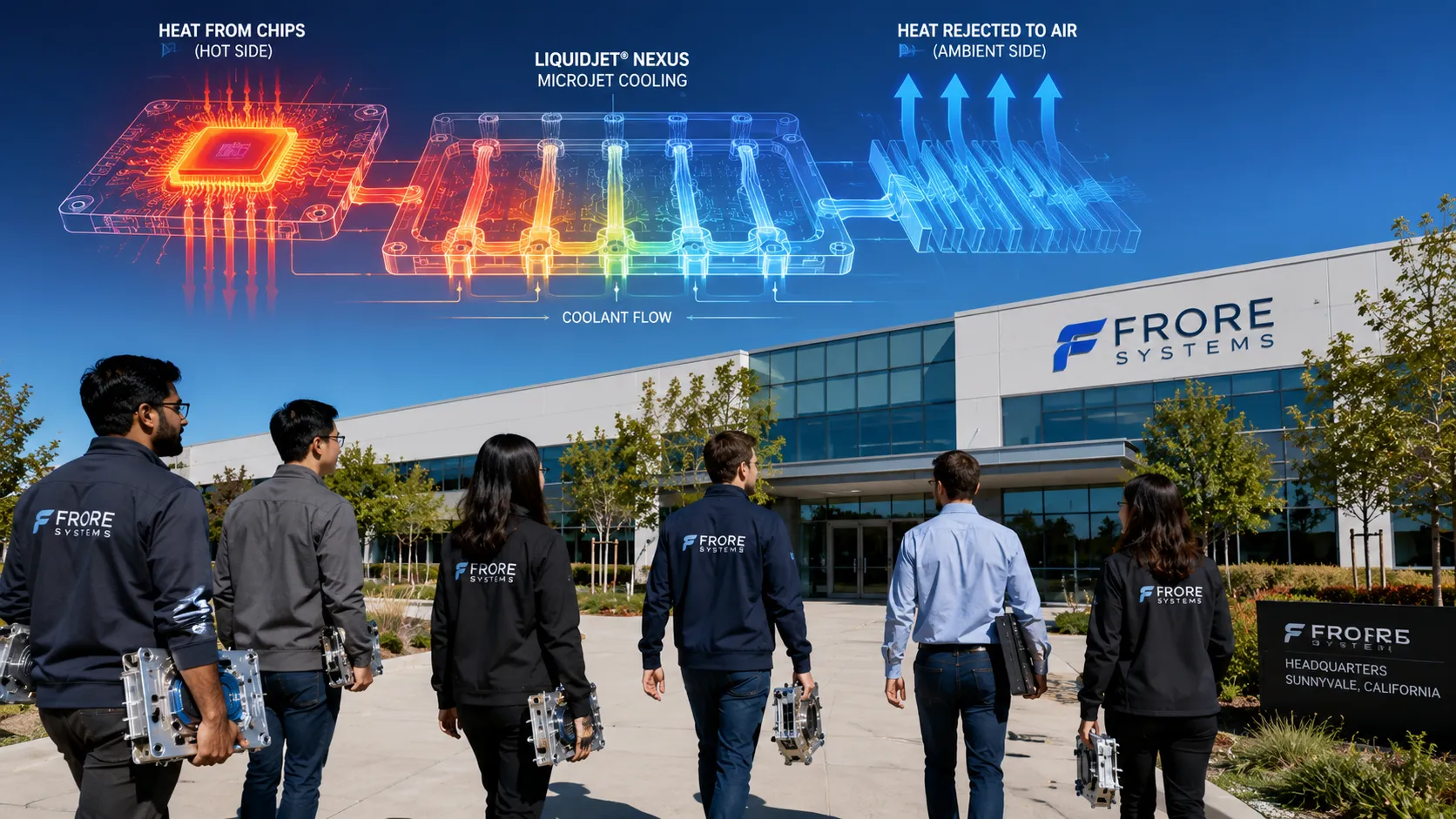
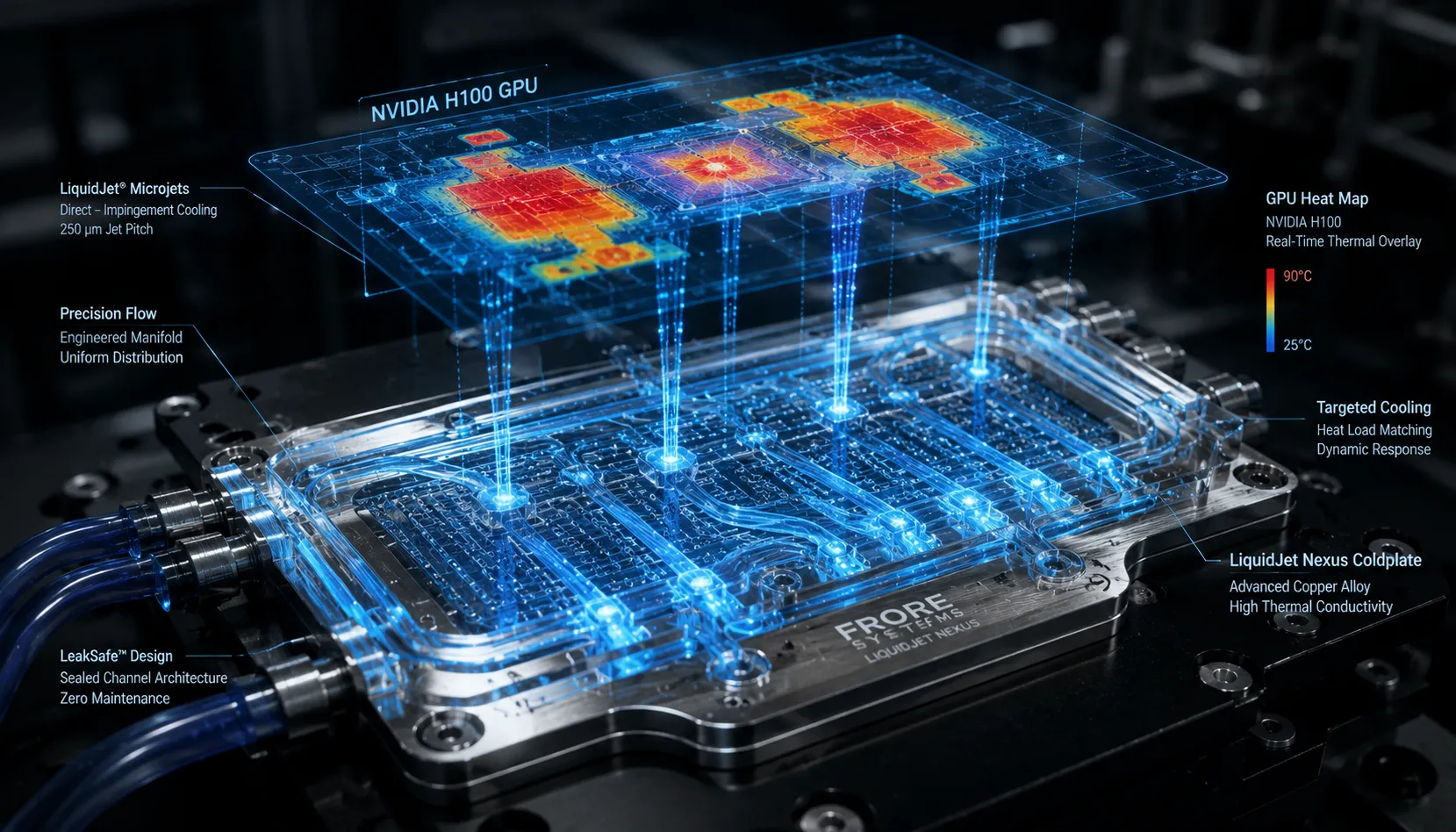
Frore's insight was to apply semiconductor manufacturing techniques to the cooling problem itself. The company's LiquidJet Nexus coldplate is fabricated using processes borrowed from the chip industry, allowing it to map the precise thermal topography of a GPU. Hotspots—regions where transistor density and activity create localized temperature spikes—are targeted with micro-jets of coolant directed through 3D channels etched into the coldplate. The result is a 75% improvement in heat transfer efficiency and an 8°C reduction in component temperatures compared to conventional liquid cooling, while eliminating 65% of the system weight. The cooling system is no longer a commodity add-on. It is a co-designed component of the chip architecture.
Frore's technology portfolio extends beyond the data center. The company's AirJet product, roughly the size of two stacked credit cards, uses piezoelectric membranes vibrating at ultrasonic frequencies to generate airflow in edge devices where traditional fans are too large, too noisy, or too fragile. AirJet delivers up to 1,750% higher back pressure than conventional fans. It is designed for laptops, tablets, smartphones, and the vast array of AI-enabled edge devices that will proliferate as inference moves out of the cloud and into the physical world. The company's thermal platform spans from the edge to the hyperscale data center, a breadth of coverage that few competitors can match.
The Taiwan Connection and the Indian Mind
Frore's origin story is a global one, and it matters because it reflects the geography of deep-tech entrepreneurship in 2026. Seshu Madhavapeddy earned his bachelor's degree from IIT Kharagpur and his PhD in computer science from the University of Texas at Dallas. He spent years in senior product leadership at Texas Instruments, Samsung Mobile, and Qualcomm—deeply embedded in the mobile device ecosystem, where thermal constraints are as unforgiving as they are invisible to the consumer. His co-founder and CTO, Surya Ganti, brought complementary expertise in hardware systems.
When the time came to manufacture, the company made a strategic decision that was unconventional for a Silicon Valley startup. It established its core production facility in Hsinchu, Taiwan, in 2019, placing its manufacturing operations in the heart of the world's most advanced semiconductor and hardware ecosystem. The decision was not about cost arbitrage. It was about capability density. Taiwan is where the world's most advanced chips are made, and Frore's cooling technology is, at its core, a precision fabrication challenge that benefits from being close to the people who understand precision fabrication at scale. The company is headquartered in Silicon Valley, designed by an Indian-born engineer with deep Texas ties, and manufactured in Taiwan. It is a global company in the truest sense.
What Every Entrepreneur Can Learn
Frore's emergence as a $1.64 billion company offers lessons that are unusually clean.
First, solve the bottleneck that everyone else has accepted. The AI industry has spent a decade obsessing over compute—more transistors, more cores, more matrix multipliers. It has spent almost no time rethinking cooling. The result is a thermal bottleneck that is now the single greatest constraint on AI performance. Frore identified a problem so fundamental that the entire industry had learned to work around it rather than solve it. The most valuable companies are often not the ones that build the thing everyone wants, but the ones that remove the thing that prevents the thing everyone wants from working properly.
Second, apply advanced manufacturing techniques to "boring" problems. Cooling has been a commodity because it has been built using commodity processes. Frore applied semiconductor-grade fabrication to the coldplate, transforming a piece of machined metal into a precision instrument. The lesson is transferable: in any industry, the application of a more sophisticated manufacturing or design methodology to a component that has been treated as commodity can unlock enormous value.
Third, the infrastructure layer is where durable value lives. Nvidia's GPUs are extraordinary, but they are a product category subject to intense competition, shifting architectures, and the ever-present threat of commoditization. The thermal management layer that keeps those GPUs running is, by contrast, a necessity that no chip architecture can eliminate. Infrastructure businesses are harder to build but harder to displace.
The Road Ahead
Frore's valuation will face tests. The liquid cooling market is attracting capital and competition, and the incumbents—traditional thermal management companies with decades of relationships in the data center industry—are not standing still. The company's ability to scale its manufacturing operations to meet hyperscaler demand will determine whether the unicorn valuation translates into a durable business. And Nvidia's Kyber platform, while a massive opportunity, also represents a moving target; chip architectures change, and cooling solutions must change with them.
But the direction of travel is clear. AI is getting hotter. The physics of heat transfer are not subject to Moore's Law. The gap between what chips can compute and what cooling systems can handle is widening, and Frore is positioned directly in that gap. The company that started with piezoelectric air coolers for smartphones is now building the thermal infrastructure of the AI era. The chip is the hero. The cooling is no longer the janitor. The cooling is the foundation.


