The ₹1,150 Crore Startup That India's Venture Capitalists Forgot to Notice: How Three IIT Friends Spent 16 Years Building a Profitable Climate-Tech Giant While Everyone Chased Quick Commerce
PUNE — May 24, 2026 — In 2010, three friends from IIT Kharagpur stood at the threshold of a decision that would define the rest of their lives. Devendra Gupta had a job offer from a multinational corporation. Prateek Singhal had an offer from a prestigious foreign university. Vivek Pandey had a path that looked, to everyone who knew him, like the safe, sensible, upward trajectory of an engineering graduate from one of India's finest institutions. The offers were good. The paths were clear. The alternative was to start a company that made solar-powered pumps for farmers—a category that did not exist, in a market that had never heard of it, with no venture capital, no government incentives, and no guarantee that anyone would buy what they built.
They chose the farmers.
Sixteen years later, the three friends run Ecozen, a Pune-based climate-tech company that has become something almost unheard of in Indian startup lore: a profitable, rapidly growing, venture-backed hardware business that builds physical products for rural India—and is now quietly preparing to take its technology to Africa and Southeast Asia. The company posted revenue from operations of ₹1,150 crore in FY25, a 2.5-fold leap from ₹458 crore the previous year. Profit after tax surged nearly fivefold to ₹95 crore. The company's return on capital employed reached 28.92 percent. Its EBITDA margin touched 13.17 percent. It spent 90 paise to earn every rupee. It held ₹228 crore in cash and bank balances at year-end, up from ₹96 crore a year earlier.
These are not the financials of a startup searching for product-market fit while burning venture capital. They are the financials of a mature, disciplined manufacturing company that has spent sixteen years building the kind of business that venture capitalists claim to want—and that the Indian startup ecosystem, with its relentless focus on food delivery, quick commerce, and consumer internet, has largely ignored.
The Foundry Years
The founding story of Ecozen is not the story of a brilliant insight that struck in a dorm room. It is the story of three engineers who built things with their hands before they ever wrote a business plan—and who learned, through years of patient trial and error, that the hardest problems in Indian agriculture could not be solved by an app.
Gupta, Singhal, and Pandey met at IIT Kharagpur in the late 2000s, sorted into the same Hall of Residence. They were not natural business partners. They were engineers who liked building things together—a power-harnessing device during their college years, then various projects during internships at IISc Bengaluru, Siemens, and the Burj Khalifa construction site. "Over the course of one year, we were part of various projects and sports teams, and that is how the bonding really started," Gupta recalled. By 2009, while still on campus, they were already working together on energy-driven projects. Every weekend, they would travel to Kolkata to work in a foundry, learning the gritty, physical craft of manufacturing that would later become the foundation of their company.
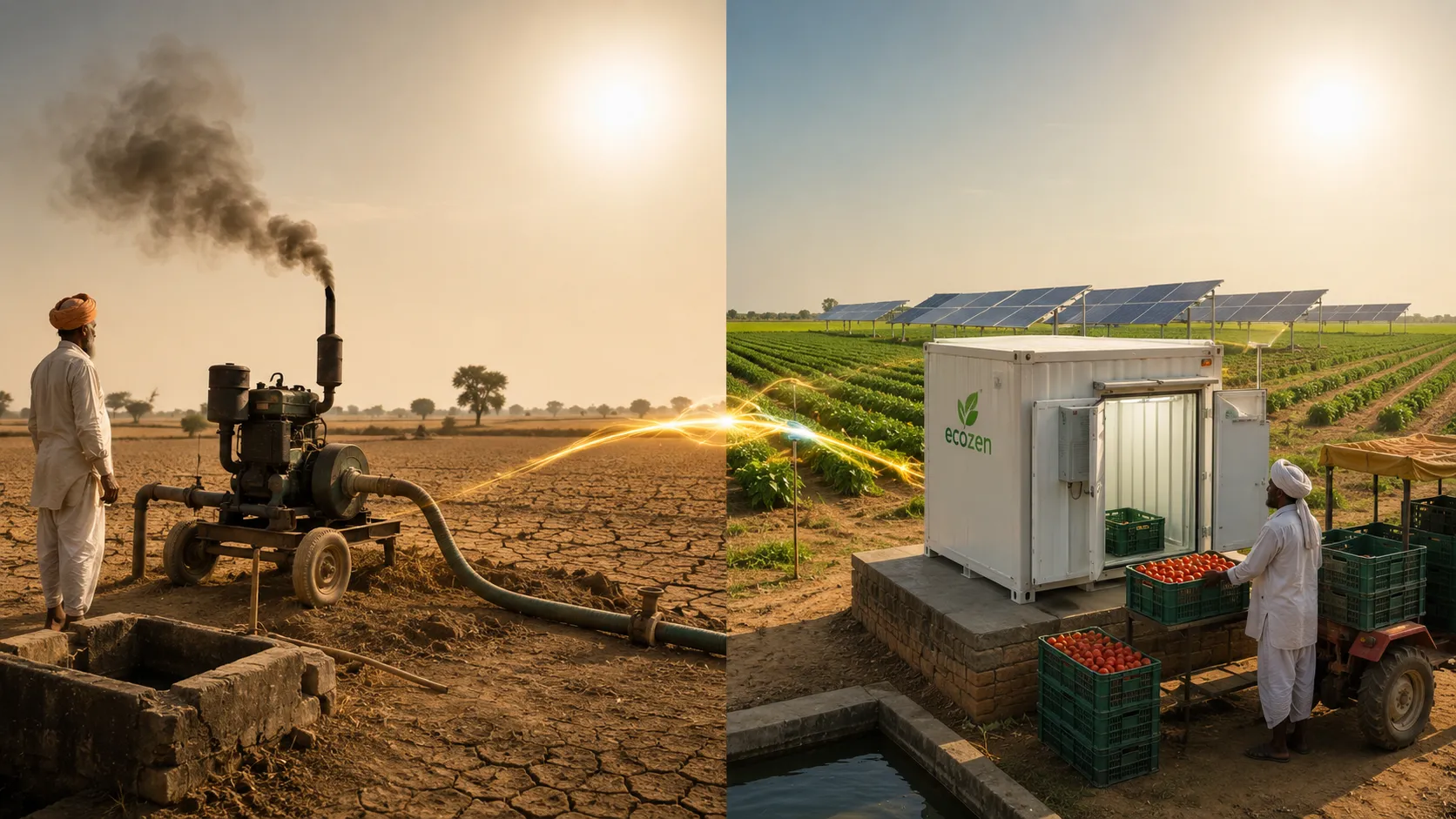
The early years after graduation were brutal. The trio had turned down job offers and academic placements to build what was then called Ecozen Solutions—a solar energy company that sold lanterns, rooftop panels, and LED street lighting. The pivot to agriculture was not a strategic insight. It was a response to what they saw in the fields. While installing solar pump controllers for farmers who lacked reliable grid electricity, Gupta noticed something that the market had missed. The same farmers who were grateful for the irrigation boost were still losing a significant portion of their harvest to spoilage. The pumps helped them grow more. The pumps could not help them sell more. The bottleneck was not production. It was preservation.
"Working closely with marginal farmers with small landholdings helped us realise that while they were benefiting by increasing productivity through innovative irrigation methods, they were unable to improve income," Gupta told The Better India. A farmer who could grow three harvests instead of one still had to sell those harvests within days of picking, at whatever price the local mandi offered. If the price was too low, the produce rotted. If the mandi was too far, the produce rotted. If the power went out—and in rural India, the power always goes out—the produce rotted. The cold chain that connected the farm to the market was a fiction for the vast majority of Indian growers, and the cost of that fiction was measured in the tens of thousands of crores of produce lost annually.
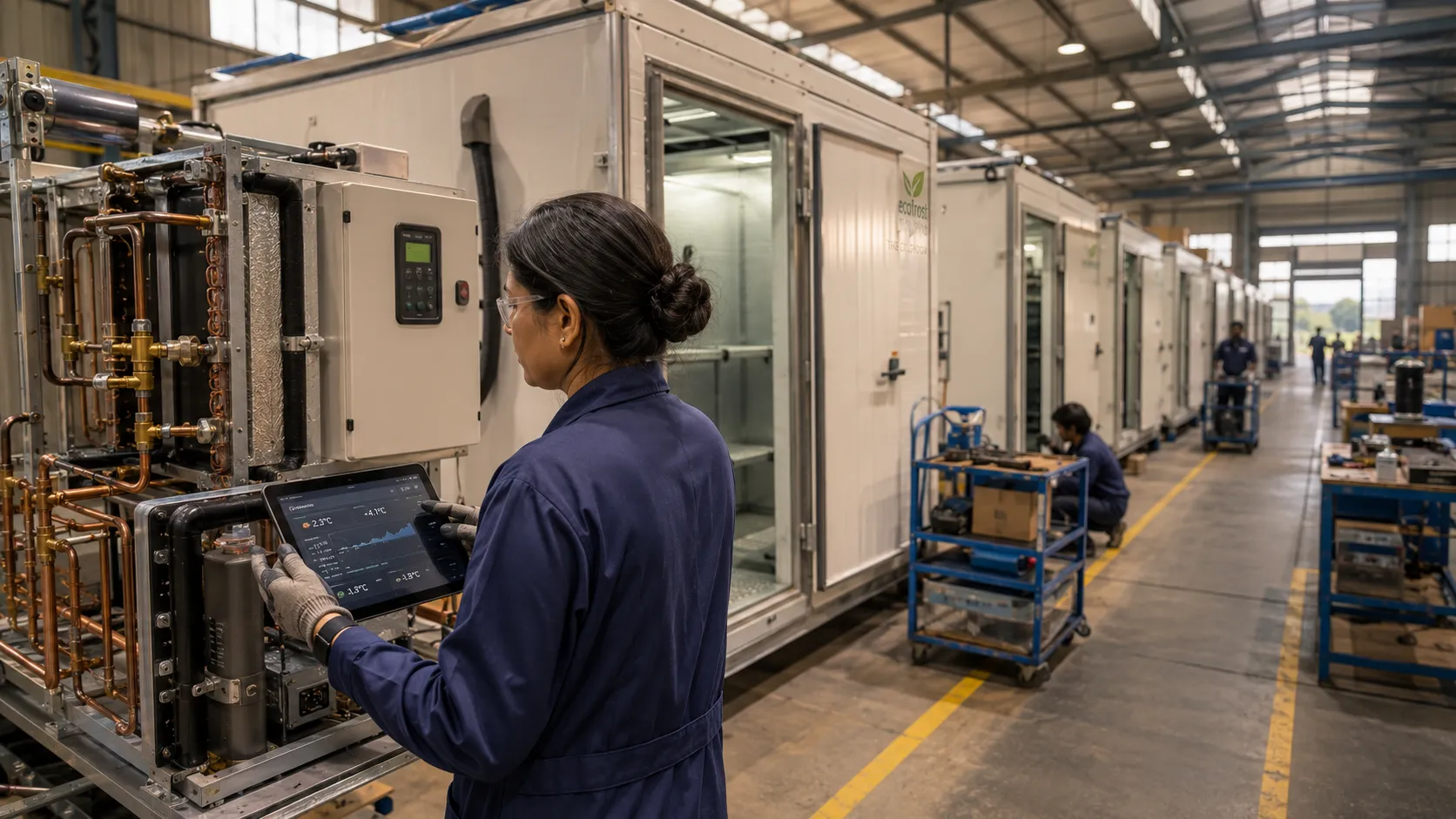
In 2014, the trio built their first Ecofrost unit—an AI-equipped, portable, solar-powered standalone cold room that could be monitored and controlled via a mobile app. It was a 20-foot container with five tonnes of capacity, running on solar panels and thermal storage technology that provided 30 hours of batteryless backup. It could be placed at the farm gate. It could pre-cool produce within hours of harvest. It could keep spinach, tomatoes, capsicum, and flowers fresh for days—long enough for the farmer to negotiate, to wait for a better price, to transport the produce to a market that would pay more. It was not merely a refrigerator. It was a bargaining chip—a machine that shifted power from the buyer to the grower, one cold room at a time.
The market responded. By 2023, Ecozen had deployed more than 250 Ecofrost cold rooms across Maharashtra, Telangana, Tamil Nadu, Andhra Pradesh, Jharkhand, Chhattisgarh, and Karnataka, serving close to 72,000 farmers and 40 farmer producer companies. By 2026, the number had crossed 850 units, with each additional deployment improving the unit economics of the network. The Ecotron solar pump controller—the product that had started it all—had captured approximately 20 percent of the Indian market. Ecofrost had captured roughly 50 percent. The three friends who had turned down job offers to build things in a foundry had built, over sixteen years, the dominant cold-chain platform in Indian agriculture—and almost no one in the consumer venture-capital world had noticed.
The Profit That Nobody Predicted
The financial transformation of Ecozen over the past two years is the kind of story that venture capitalists tell on stage but rarely achieve in practice: a hardware startup that achieved escape velocity, turning a modest profit into a significant one while revenue more than doubled.
In FY23, Ecozen reported revenue of approximately ₹293 crore and a modest net profit of ₹5.77 crore—the first year the company had crossed into the black. In FY24, revenue jumped to ₹458 crore and profit rose to ₹20 crore. In FY25, revenue exploded to ₹1,150 crore and profit surged to ₹95 crore—a fivefold increase in the bottom line in a single year. The company's return on capital employed reached 28.92 percent, a figure that would be respectable for a software company and is extraordinary for a manufacturer of physical infrastructure. The EBITDA margin of 13.17 percent reflects the operating leverage of a business whose fixed costs are increasingly being spread across a growing base of deployed assets.
The unit economics are compelling in their simplicity. Ecozen spends 90 paise to earn every rupee. The cost of materials—the solar panels, the compressors, the thermal storage units, the IoT controllers—constitutes 64 percent of total expenditure, a share that will decline as the company scales its procurement and brings more component manufacturing in-house. Employee costs are a modest ₹49 crore for a company with nearly 500 employees—roughly ₹10 lakh per employee, a figure that reflects the company's Pune base and its ability to attract engineering talent without paying Silicon Valley salaries. The company held ₹228 crore in cash at the end of FY25, up from ₹96 crore a year earlier, giving it the balance-sheet strength to fund expansion without desperate fundraising.
The growth has been driven by both product lines. The sale of solar and related products accounted for 77 percent of collections, rising 2.3-fold to ₹889 crore. The installation of solar pumping systems and other services contributed the remaining ₹261 crore, up 23 percent. The company's tech stack—advanced motors and controls, thermal energy storage, AI and IoT devices—has created a platform that can be extended beyond agriculture into electric vehicles, a diversification that Gupta confirmed the company is actively exploring. A portion of the recent $30 million capital raise will go toward building products for the EV sector, leveraging the same core competencies in motor control and thermal management that power the agricultural business.
The company has raised over $76 million to date through a mix of debt and equity, with Nuveen Global and Omnivore as lead investors. The most recent round—$30 million announced in April 2026—included debt from the InCred Credit Fund and the U.S. International Development Finance Corporation, alongside equity from Nuveen. The presence of the DFC, America's development finance institution, on the cap table is a signal: Ecozen's technology is not just commercially viable. It is strategically significant, aligned with the global push to decarbonise agricultural supply chains and build climate resilience in the Global South.
The company is now targeting a doubling of revenue in the current fiscal year, driven by strong domestic demand and the first wave of international expansion. Pilot projects are underway in Kenya, where irrigation penetration is below 15 percent and the economic value of cold-chain solutions is extraordinarily high. The infrastructure challenges—poor roads, unreliable logistics, high commodity prices—are significant, but so is the opportunity. "We feel that the economic solutions that our technology can deliver in Africa are quite high," Gupta said. "We are trying to demonstrate that using smart and sustainable solar-based solutions for irrigation and cold storage will help improve livelihoods in Africa."
The Quiet Giant of Indian Deeptech
The Ecozen story is not occurring in isolation. It is part of a broader structural shift in Indian venture capital—a migration of serious, patient money from consumer internet toward sectors that require deep technical expertise, long gestation periods, and a tolerance for the slow, incremental progress that defines hardware businesses.
The same week that Ecozen's FY25 financials were being analysed by industry observers, the Technology Development Board announced it had funded 22 deeptech projects under the ₹1 lakh crore Research Development and Innovation Fund. Shastra VC launched a $100 million fund targeting early-stage deeptech startups. A Campus Fund report revealed that deep tech had become the single largest category among student-led startups in India for the first time. The alignment of policy, capital, and talent is unmistakable: India's startup ecosystem is pivoting from the shallow end of consumer internet to the deep end of hard technology.
Ecozen is both a beneficiary and a proof point of that shift. The company raised its early capital from Omnivore, a venture firm that specialises in agricultural technology—a category that was, for most of the 2010s, considered uninvestable by the mainstream venture community. It built its manufacturing base in Pune, not Bengaluru. It sold its products to farmers and farmer producer companies, not to urban millennials. It measured its success in tonnes of produce saved and litres of diesel displaced, not in monthly active users or gross merchandise value. And it did all of this while the Indian startup ecosystem was pouring billions into food delivery, ride-hailing, and quick commerce—industries that, for all their consumer visibility, have yet to produce a single company with Ecozen's combination of scale, profitability, and capital efficiency.
The numbers tell the story of a company that has crossed the threshold from startup to scaled enterprise. Revenue of ₹1,150 crore. Profit of ₹95 crore. Return on capital employed of nearly 29 percent. Cash reserves of ₹228 crore. A dominant market share in solar cold storage and a strong position in solar irrigation. A technology platform that can be extended into electric vehicles. An international expansion that is already in pilot phase. And a founding team that has been working together for sixteen years—longer than most Indian startups have existed—and that shows no sign of slowing down.
Devendra Gupta, Prateek Singhal, and Vivek Pandey are no longer the three friends who turned down job offers to build solar pumps in a Kolkata foundry. They are the founders of India's largest climate-tech company by revenue—a business that has saved millions of tonnes of produce from spoilage, displaced millions of litres of diesel, and generated hundreds of crores in profit while doing it. The venture capitalists who spent the 2010s chasing food delivery apps and quick-commerce platforms are now, belatedly, turning their attention to the kinds of businesses that Ecozen has been quietly building for sixteen years. The irony is not lost on anyone who has been paying attention. The quiet giant of Indian deeptech was hiding in plain sight, in the fields of Maharashtra, keeping tomatoes cold and farmers solvent, while the rest of the startup world looked the other way. It is no longer quiet. The numbers are too loud to ignore.


