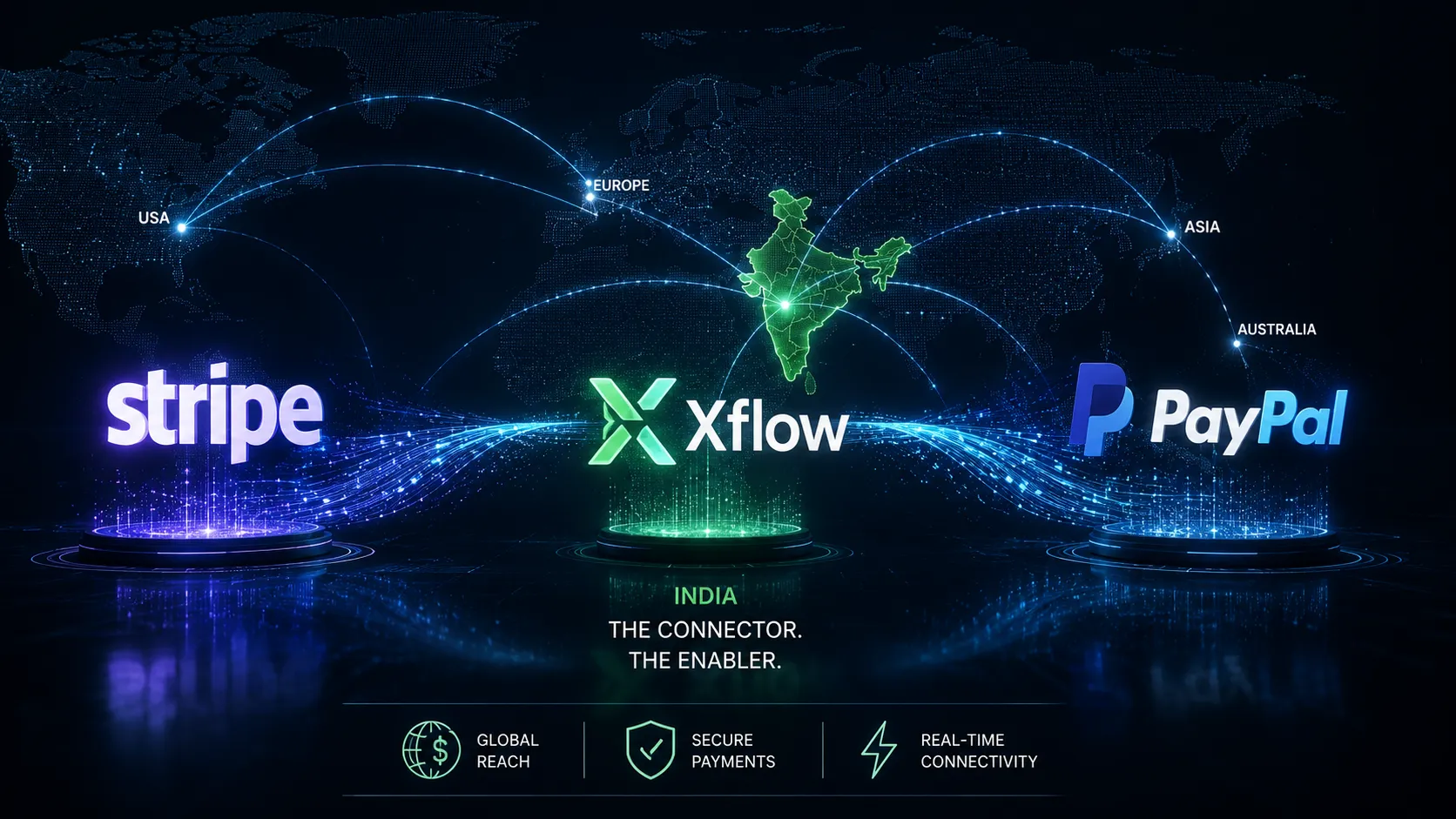
Stripe and PayPal Just Bet on India's Xflow. Here's Why Cross‑Border B2B Payments Is the Next $70 Billion Frontier
The Two Giants That Never Agree on Anything
Stripe and PayPal do not co‑invest. The two global payments titans have spent two decades competing for merchants, consumers and mindshare. They rarely appear on the same term sheet.
In February 2026, they did.
Bengaluru‑based Xflow announced a $16.6 million Series A round led by General Catalyst, with participation from existing investors Square Peg, Stripe, Lightspeed, Moore Capital — and PayPal Ventures joining as a new investor. The all‑equity round valued the startup at $85 million post‑investment, bringing its total funding to more than $32 million. With this, Xflow became the first Indian fintech backed by both Stripe and PayPal Ventures — the world's two largest payments infrastructure platforms.
Why did two bitter rivals write cheques to the same startup? Because cross‑border B2B payments are a $59 trillion global market that remains stuck in the era of fax machines and manual bank transfers. And India, with its booming exports, SaaS economy and global capability centres (GCCs), is ground zero for fixing it.
The Number That Explains Everything: $59 Trillion
Let us start with the raw size of the problem.
The global cross‑border payments market for B2B transactions is projected to increase from $39.3 trillion in 2023 to $59.2 trillion by 2031, driven by procurement digitisation, e‑invoicing mandates and the explosion of international trade. In India alone, the B2B payments market reached $41.9 billion in 2025 and is expected to hit $84.2 billion by 2034, growing at a CAGR of 7.64%. The India Cross‑Border Payments Market specifically is forecast to grow at a CAGR of 14% during 2026‑2032.
Yet, despite rapid digitisation in domestic payments — India's UPI processed over 23 billion transactions in May 2026 alone — cross‑border B2B transfers remain heavily reliant on banks, often with limited visibility into fees, settlement timelines and the final amount received in rupees. The friction is particularly acute for Indian exporters moving millions of dollars into the country to fund salaries and local operations.
PULL QUOTE #2 “We didn't want to build the next Wise — we want to power the next thousand Wises.” — Anand Balaji, Co‑founder, Xflow, February 2026
Xflow: The Stripe Alumni Who Decided to Fix Global Payments
Xflow's founding story is almost too perfect. Co‑founder Anand Balaji previously helped build out Stripe's India business. He founded Xflow with fellow former Stripe colleagues Ashwin Bhatnagar and Abhijit Chandrasekaran. Their insight was brutally simple: if India could build UPI for domestic payments — instant, interoperable and nearly free — why couldn't the same be done for global B2B money movement?
Unlike consumer‑focused payment aggregators, Xflow built API‑first infrastructure that allows platforms and exporters to embed cross‑border payments into their own products. The startup serves nearly 15,000 businesses spanning SaaS firms, GCCs, IT services exporters, goods exporters, freelancers and fintech platforms.
The numbers are staggering. In 2025, Xflow enabled Indian businesses to collect payments from more than 100 countries across 25 currencies. The company processed close to $1 billion in annualised cross‑border payment volume, marking roughly tenfold growth from the same period in 2024. It has also grown its top line 10× in the first nine months of FY26 compared to the previous year's operating revenue of ₹30 crore.
Transaction sizes vary widely by segment: GCCs average about $1‑2 million per transaction, goods exporters around $30,000‑40,000, and freelancers roughly $3,000. Xflow's portfolio processes transactions ranging from a few hundred dollars to as high as $6‑7 million in a single transfer.
The AI Edge: Earning an Extra 8‑10 Paise Per Dollar
What truly sets Xflow apart is its FX AI Analyst, an AI‑based foreign exchange tool that helps finance teams optimise the timing of currency conversions. The tool allows businesses to set target conversion rates rather than accepting prevailing bank rates, helping exporters make data‑driven treasury management decisions. According to the company, customers earn an extra 8‑10 paise per dollar on average by using this tool.
Beyond money movement, Xflow offers a compliance help desk to support users with post‑payment regulatory requirements, and integrations with accounting platforms such as Zoho and Tally to automatically reconcile cross‑border transactions. The startup also provides its international payments infrastructure to marquee fintechs like Drip Capital and Easebuzz.
The Regulatory Milestone: A Rare Double Licence
In a quiet but significant development, Xflow also secured the final Payment Aggregator Cross‑Border (PA‑CB) authorisation for both exports and imports from the Reserve Bank of India. This makes Xflow one of a handful of companies to hold both licences. While the PA‑CB‑Exports licence strengthens its existing product offering, the PA‑CB‑Imports licence opens up a new segment of overseas merchants and payment aggregators.
With this final authorisation in place, Xflow is now planning to soon launch services that allow Indian businesses to also send money abroad, in addition to collecting payments from overseas. This moves the company from a one‑way street to a two‑way global payments superhighway.
Mysa: The AI‑Powered Operating System for Mid‑Market Finance
While Xflow tackles cross‑border payments, another Bengaluru‑based B2B fintech is solving a different problem: the fragmented, manual chaos of domestic finance operations for mid‑sized Indian businesses.
In January 2026, Mysa raised $3.4 million in a pre‑Series A funding round co‑led by Blume Ventures and Piper Serica, with participation from Ikemori Ventures, Raise Financial Services, QED Innovation Labs, and existing investors Antler, IIMA Ventures and Neon Fund. This brought its total funding to $6.2 million.
Founded in 2023 by Arpita Kapoor (CEO) and Mohit Rangaraju, Mysa targets a precise and underserved segment: businesses with annual revenues between ₹10 crore and ₹300 crore. These companies are typically too large for basic accounting software, yet not large enough to afford expensive enterprise‑grade ERP systems. The result is a patchwork of disconnected tools for banking, payments and accounting — leading to inefficiencies, errors and operational blind spots.
PULL QUOTE #3 “Finance teams today are expected to move faster while managing more complexity, but the underlying infrastructure hasn't evolved.” — Arpita Kapoor, Co‑founder & CEO, Mysa, January 2026
Mysa's AI‑powered platform addresses exactly this gap. It integrates with over 15 banks — including Axis Bank, YES Bank, IDFC First Bank, ICICI Bank, HDFC Bank and HSBC — allowing finance teams to initiate payments, monitor balances and reconcile transactions from a single dashboard. The platform also supports ERP integrations with Tally, Zoho Books, ERPNext, Odoo, NetSuite and Microsoft Dynamics.
The traction has been remarkable. In less than a year since its public launch, Mysa reports processing over $183 million in annualised transaction volume (₹1,500 crore) and facilitating payments to more than 40,000 unique bank accounts across India. Its client base spans quick commerce, manufacturing, hospitality, fintech and real estate, including customers such as Dhan, Wint Wealth, Swish, DrinkPrime, Vaaree and Material Depot.
The Broader B2B SaaS Wave
Xflow and Mysa are not outliers. They are the leading edge of a much larger structural shift.
In January 2026, Bengaluru‑based Prosperr.io raised $4 million in seed funding to build an AI‑powered tax management platform for individuals and enterprises, delivering 5× revenue growth and 80‑100 per cent retention. In March 2026, Efficient Capital Labs secured $7 million in pre‑Series A funding for B2B SaaS‑focused fintech solutions. And in May 2026, Silicon Road Ventures announced a ₹150 crore ($15+ million) India‑focused fund to back early‑stage startups building agentic AI solutions for B2B commerce and enterprise technology sectors.
As Cedar Hill Capital's Sahil Anand noted in February 2026, Indian fintech funding is undergoing a structural reset: the era of easy capital for consumer fintech is over, with investors now prioritising revenue visibility, enterprise traction and sustainable SaaS metrics.
The global B2B SaaS market is projected to grow from $370 billion in 2025 to $998 billion by 2032, exhibiting a CAGR of 13.37%. India, with its deep engineering talent, cost advantage and English‑first business culture, is poised to capture an outsized share of this growth.
The Global Indian Takeaway
For the Indian diaspora, the B2B SaaS fintech wave offers three clear pathways.
First, invest via syndicates and funds. Xflow, Mysa, Prosperr.io and Efficient Capital Labs are still at early‑stage valuations. Follow‑on rounds and new entrants offer compelling entry points for accredited investors.
Second, build distribution bridges. Indian B2B SaaS startups need US and European customers. Diaspora professionals with corporate networks can become channel partners or referral sources.
Third, talent placement. These startups are hungry for experienced sales, compliance and product talent with global exposure. A placement agency bridging Indian B2B SaaS with diaspora professionals could capture significant fees.

The Final Word
The Xflow story is a masterclass in positioning. Founded by Stripe alumni. Backed by Stripe and PayPal. Regulated by the RBI with a rare double licence. Processing billion‑dollar volumes. It is not a fluke. It is a blueprint.
Mysa is a different story — quieter, more domestically focused, but equally transformative. By building the AI‑powered operating system for mid‑market finance teams, it is modernising the financial plumbing of thousands of Indian businesses that have been left behind by both basic accounting software and expensive ERPs.
Together, these two startups are proof that India's next great fintech wave is not consumer‑facing apps competing for your next ₹500 payment. It is the invisible infrastructure powering global trade, automating legacy finance workflows, and finally bringing B2B money movement into the 21st century.
Stripe and PayPal rarely agree on anything. But they both agreed on Xflow. That should tell you everything you need to know about where the future of fintech is being built.
CHART: "India's B2B SaaS Fintech Wave — At a Glance (2026)"
Metric | Data | Source |
|---|---|---|
Global cross‑border B2B payments market (2023 → 2031) | $39.3T → $59.2T | GII Research |
India B2B payments market (2025 → 2034) | $41.9B → $84.2B (7.64% CAGR) | IMARC Group |
India Cross‑Border Payments Market CAGR (2026‑2032) | 14% | 6W Research |
Xflow Series A funding (Feb 2026) | $16.6M (led by General Catalyst) | PayPal Newsroom |
Xflow post‑money valuation | $85 million | Inc42 / YourStory |
Xflow total funding to date | $32M+ | Yahoo Finance |
Xflow 2025 annualised volume | ~$1 billion (10× YoY) | TechCrunch via Yahoo |
Xflow FY26 top‑line growth | 10× (first nine months) | Inc42 |
Xflow customer base | ~15,000 businesses (SaaS, GCCs, ITeS, goods exporters) | Inc42 |
Xflow currencies supported | 25+ currencies, 100+ countries | PayPal Newsroom |
Xflow FX AI Analyst benefit | +8‑10 paise per dollar | PayPal Newsroom |
Xflow team size | 60+ | Inc42 |
Mysa pre‑Series A funding (Jan 2026) | $3.4M (Blume Ventures, Piper Serica) | Inc42 |
Mysa total funding | $6.2M | IBS Intelligence |
Mysa annualised transaction volume | $183M+ (₹1,500 Cr) | IBS Intelligence |
Mysa unique bank accounts reached | 40,000+ | TechStory / Enablers |
Mysa bank integrations | 15+ (Axis, YES, IDFC, ICICI, HDFC, HSBC) | IBS Intelligence |
Mysa target segment | ₹10 Cr – ₹300 Cr annual revenue | TechStory |
Global B2B SaaS market (2025 → 2032) | $370B → $998B (13.37% CAGR) | MarkNtel Advisors |
Prosperr.io seed funding | $4M (5× revenue growth) | FinTech Global |
Efficient Capital Labs pre‑Series A | $7M | VCCircle |
Silicon Road Ventures AI fund | ₹150 crore ($15M+) for B2B agentic AI | IBS Intelligence |


