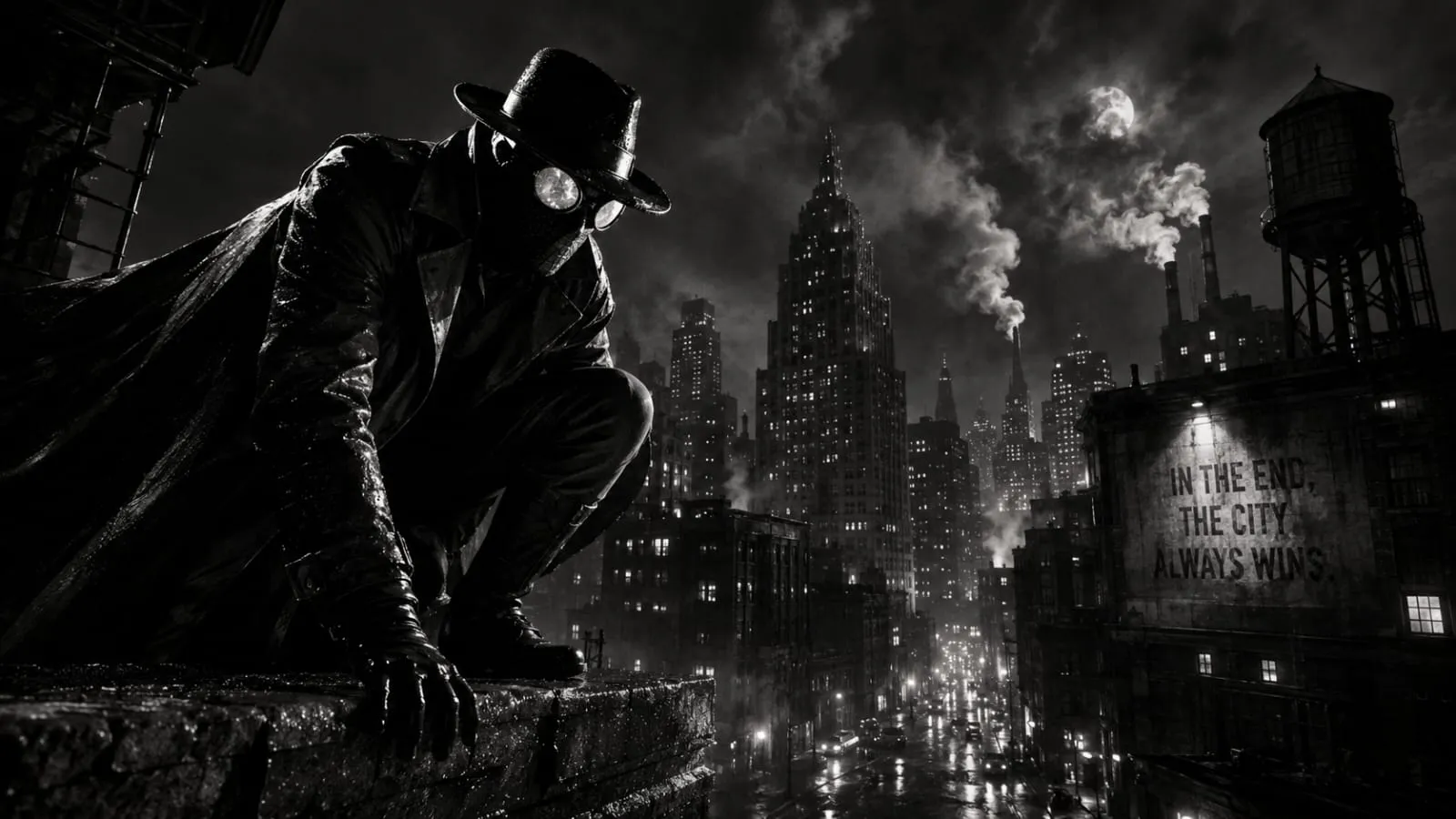
On May 27, 2026, an eight-episode series landed on Prime Video. It was shot mostly in black and white. It starred Nicolas Cage as a grizzled, chain-smoking private investigator in Depression-era New York. There were no Avengers. No multiverse cameos. No quippy teenage Peter Parker. By every metric of modern superhero storytelling, Spider-Noir should have been a beautiful, expensive disaster. Instead, it became a global phenomenon.
Within days of its release, the show hit number one in 23 countries and cracked the top three in 50 territories worldwide . On Rotten Tomatoes, it secured a 92% critic score and a 94% audience score . On IMDb, it held a steady 8.2/10 rating . This is not just a show. It is a case study in how to save a dying cinematic universe by doing the exact opposite of everything Hollywood has taught us about superhero content.
The Funding Angle: Sony's Most Expensive Gamble
To understand Spider-Noir, you must first understand Sony's desperation. The Sony Spider-Man Universe (SSU)—the live-action franchise without Tom Holland's Peter Parker—had been in financial and critical freefall. Madame Web bombed. Morbius became a joke. Kraven the Hunter barely registered. Each failure cost the studio tens of millions, but Sony could not stop. To retain the lucrative film and television rights to the Spider-Man IP, they must continually produce content featuring Marvel characters .
Enter Spider-Noir. Industry insiders have tracked the series as one of the most expensive Spider-Man projects to date, with a budget reportedly exceeding $200 million when marketing costs are included. Sony executives were reportedly "incredibly nervous" about the ballooning production costs during filming. The show became a pivot bet: instead of another theatrical flop, Sony poured movie-level money into a streaming series produced in partnership with Amazon MGM Studios .
The business logic was razor-sharp. Amazon needed prestige content to justify Prime Video subscriptions. Sony needed to keep the IP alive without another box-office disaster. Together, they built a show that cost as much as a summer blockbuster but carried none of the theatrical risk —because on streaming, there is no opening weekend to fail.
The executive producer roster reads like a who's who of successful franchise architects: Phil Lord, Christopher Miller, and Amy Pascal—the team behind the Spider-Verse animated films—joined Oren Uziel and Steve Lightfoot (showrunner of Netflix's The Punisher) to develop the series . This was not a B-team assignment. This was Sony sending their strongest creative assets to save their most valuable property.
The One-Season Financial Reality
But here is the uncomfortable business truth that industry analysts are already whispering: despite the glowing reviews, a second season is far from guaranteed. The economics of streaming do not favor $200 million shows that do not drive massive subscriber growth. Amazon has not released viewership numbers, but the show's rapid ascent to number one in over 20 countries suggests strong initial engagement .
The question is whether that engagement translates into new subscribers or simply satisfies existing ones. Premium content is expensive. If Spider-Noir does not drive a measurable spike in Prime Video sign-ups, the rational business decision would be to declare it a successful "one-and-done" prestige object rather than a recurring expense.
Actor Nicolas Cage himself confirmed the show's eight-episode, 45-minute-per-episode format, noting that it is "the equivalent of four films in five months" . That is a lot of Cage. Whether audiences will return for more—and whether Amazon will pay for it—remains the central unanswered question of the series' business future.
The Creative Angle: Noir Over Superhero
So why did the critics embrace Spider-Noir so enthusiastically? The answer lies in what the show refused to do. It refused to wink at the audience. It refused to set up a multiverse. It refused to apologize for being weird.
The series follows Ben Reilly (Nicolas Cage), a down-on-his-luck private investigator in 1933 New York, who is forced to grapple with his past life as the city's one and only superhero, The Spider . This is not a coming-of-age story. Reilly is "cynical, jaded, and absolutely hilarious," a man who has lost his wife to a tragedy and now spends his nights chain-smoking and muttering to himself . "With no power comes no responsibility" —the show's tagline—captures its inverted moral universe.
The supporting cast is equally remarkable. Lamorne Morris plays Robbie Robertson, a journalist hilariously drawn into the chaos. Brendan Gleeson is magnificent as the brutal mob boss Silvermane. Li Jun Li plays Cat Hardy, a club singer and femme fatale . Karen Rodriguez serves as Ben's sharp-tongued secretary, the voice of reason grounding his madness .
The villains are given bizarre, 1930s makeovers. Flint Marko (Sandman), Tombstone, and a new character called Megawatt all appear, reimagined as pulp-fictional archetypes rather than CGI spectacles . One episode, titled "Nightmare On A Gurney," has been described as "Buñuelian madness" —a hallucinatory deep dive into psychological horror that no other Spider-Man story has dared to attempt .
The Black-and-White Choice: Gimmick or Revelation?
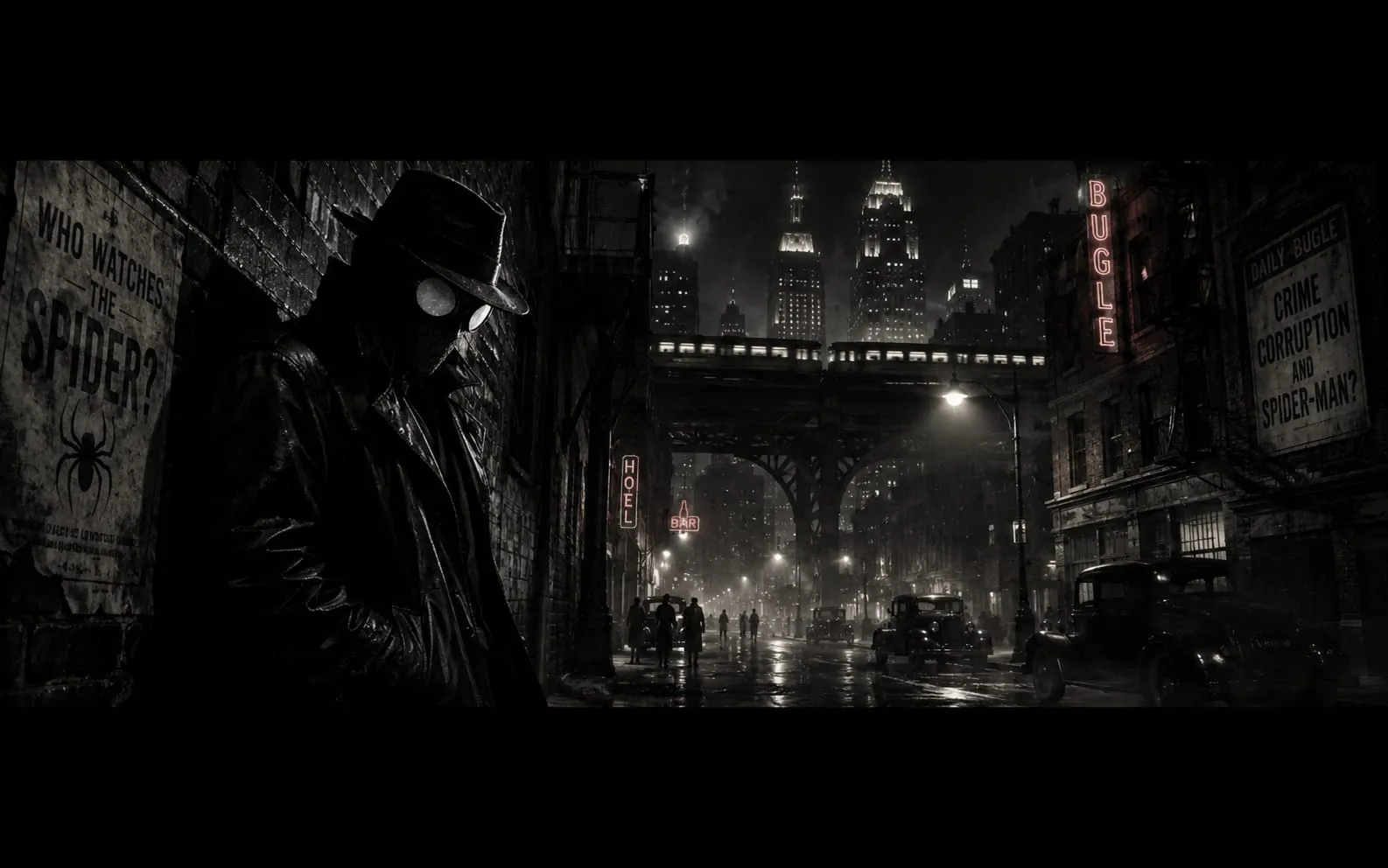
The show's most-discussed feature is entirely optional. Prime Video offers viewers two versions of every episode: "true-hue full color" or "authentic black and white" . The critical consensus is overwhelming: watch it in black and white.
The monochrome presentation is not a filter applied after filming. The show was shot with noir aesthetics in mind —sharp Dutch angles, Venetian-blind lighting, rain-slicked streets, and inky shadows that swallow entire rooms . Lamorne Morris told the BBC that the production team would sometimes stop a scene because "your pocket square looks a lot better in black and white" . Karen Rodriguez, who plays secretary Janet, added that the black-and-white presentation "enriches the storytelling" by emphasizing the show's thematic binaries: "We're playing with good and bad, heroes and villains. So who's in the shadows, who's in the light?"
Not everyone is convinced. The Hollywood Reporter called the dual-format option "at the very least, irritating," arguing that optimizing for both color and black-and-white means the show "hasn't really been optimized for anything" . Variety described the series as a "beautiful bore" . But these voices are in the minority.
Film student Alice Garland told the BBC that the black-and-white option is a "great way" to introduce younger audiences to classic noir aesthetics . Cast member Abraham Popoola agreed, noting that black and white gives the show "a gravitas… a sort of more dramatic, serious energy" . For fans, the choice is obvious. As one IMDb reviewer put it: "Authenticity mattered, which is why I chose the black-and-white version, as it does far more justice to both the setting and the adaptation itself" .
What the Critics Are Saying
The review aggregation tells a story of near-universal acclaim with a few notable dissenters. Empire Magazine gave the show a five-star review, calling it "an absurdly brilliant, brilliantly absurd concoction" . The Financial Times awarded it 4 out of 5, writing: "Audiences have had enough of the churn of movie sequels and their declining quality. But shows like this are well-crafted enough, adult enough, and just about original enough" .
The Daily Telegraph also gave it 4 out of 5, describing it as "as much a tribute to the golden era of sleuthing flicks as it is to caped crusaders getting their tights in a twist" . The San Francisco Chronicle praised producers Phil Lord and Christopher Miller for bringing "the same energy inventive energy" from the Spider-Verse films to this live-action project .
The dissenters, however, made valid points. The AV Club gave the show a C-, calling it "a noble, but ultimately failed experiment" . The Hollywood Reporter labeled it an "inconsistent disappointment" . A common critique is that the show's pacing drags and that some characters remain underdeveloped . As one IMDb reviewer noted: "The story feels somewhat thin… the series focuses so heavily on recreating classic noir conventions instead of pushing beyond them" .
But even the critics acknowledge the power of Cage's performance. Radio Times called his work "pitch-perfect" . DiscussingFilm wrote that Cage "goes off the rails in the best way possible" . Vulture was more measured, calling the show "just another disposable exercise in IP maintenance, but in the end, it's best remembered as one more stop on the endlessly fascinating Nic Cage train" .
What Spider-Noir Teaches Us
The success of Spider-Noir offers three critical lessons for the entertainment industry.
First, genre hybridity works when executed with conviction. The show is not a superhero series that dabbles in noir. It is a noir series that happens to feature a superhero. By committing fully to its 1930s aesthetic—in dialogue, costume, cinematography, and pacing—it earned the right to be taken seriously as a genre piece rather than a gimmick.
Second, streaming allows for risk that theatrical cannot stomach. No studio would have financed a $200 million black-and-white noir detective series for cinemas. But on Prime Video, where the marginal cost of an additional viewer approaches zero, the show could find its audience organically. The streaming model does not require a hit. It requires a cult. And Spider-Noir has found one.
Third, IP maintenance does not have to mean creative bankruptcy. Sony was legally required to produce more Spider-Man content. They chose to interpret that requirement as an opportunity rather than a burden. By hiring Lord, Miller, and Lightfoot, by trusting Nicolas Cage to be Nicolas Cage, by offering viewers an authentic black-and-white option, they turned a contractual obligation into an artistic statement. That is not desperation. That is strategy.
The Final Frame
Will there be a second season of Spider-Noir? The answer depends on numbers that Amazon has not released. But the show has already achieved something more valuable than a renewal announcement. It has proven that superhero fatigue is not audience fatigue with the genre—it is audience fatigue with mediocrity.
Give them something weird. Give them something beautiful. Give them something that does not look like everything else on their screen. Give them Nicolas Cage in black and white, chain-smoking his way through 1933 New York, growling about responsibility he never asked for. And they will show up.
"The only thing more powerful than spider-senses," one fan wrote, "is a man absolutely committed to chewing the scenery" . Spider-Noir is that commitment, stretched across eight episodes, and it is a miracle that it works at all. That is not just good television. That is good business.


