Silicon Sovereignty: How India's First Chip Fab Is Rewriting Global Supply Chains (And Breaking Taiwan's Monopoly)
Picture this: a single earthquake in Taiwan, a single naval blockade in the South China Sea, or a single trade restriction from Washington could bring the world's most advanced economies to a screeching halt. Why? Because over 90% of the world's most advanced logic chips are manufactured on a single island.
This is not a hypothetical. In 2021, a drought in Taiwan threatened to shutter chip fabs. In 2023, geopolitical tensions over the South China Sea sent shockwaves through global supply chains. In 2024, US export controls forced China's largest chipmaker to curtail production. Every single time, the world held its breath.
For India, that vulnerability is existential. The country imports almost all of its semiconductors, spending billions annually on chips that power everything from its indigenously built aircraft carriers to UPI servers to electric vehicles. In 2025 alone, India's semiconductor imports exceeded an estimated $20 billion, making it one of the largest chip importers in the world.
But 2026 is the year that calculus changes.
The Milestone: February 28, 2026
On that date, Prime Minister Narendra Modi inaugurated the Micron ATMP (Assembly, Test, Marking, and Packaging) facility in Sanand, Gujarat. It was a modest ceremony, but the implications were seismic. For the first time in India's history, a commercial semiconductor facility—albeit one focused on packaging rather than fabrication—began commercial production on Indian soil.
Union Minister Ashwini Vaishnaw was uncharacteristically emotional. "The promise he (PM Modi) made to the country that the semiconductor industry has to be brought to India, he fulfilled that promise. This is the first step," he said.
The Sanand facility, a ₹13,000 crore investment, is the first of what promises to be a cascade. But it is only the beginning.
The Crown Jewel: Dholera's $11 Billion Fab
If Sanand is the appetizer, Dholera is the main course.
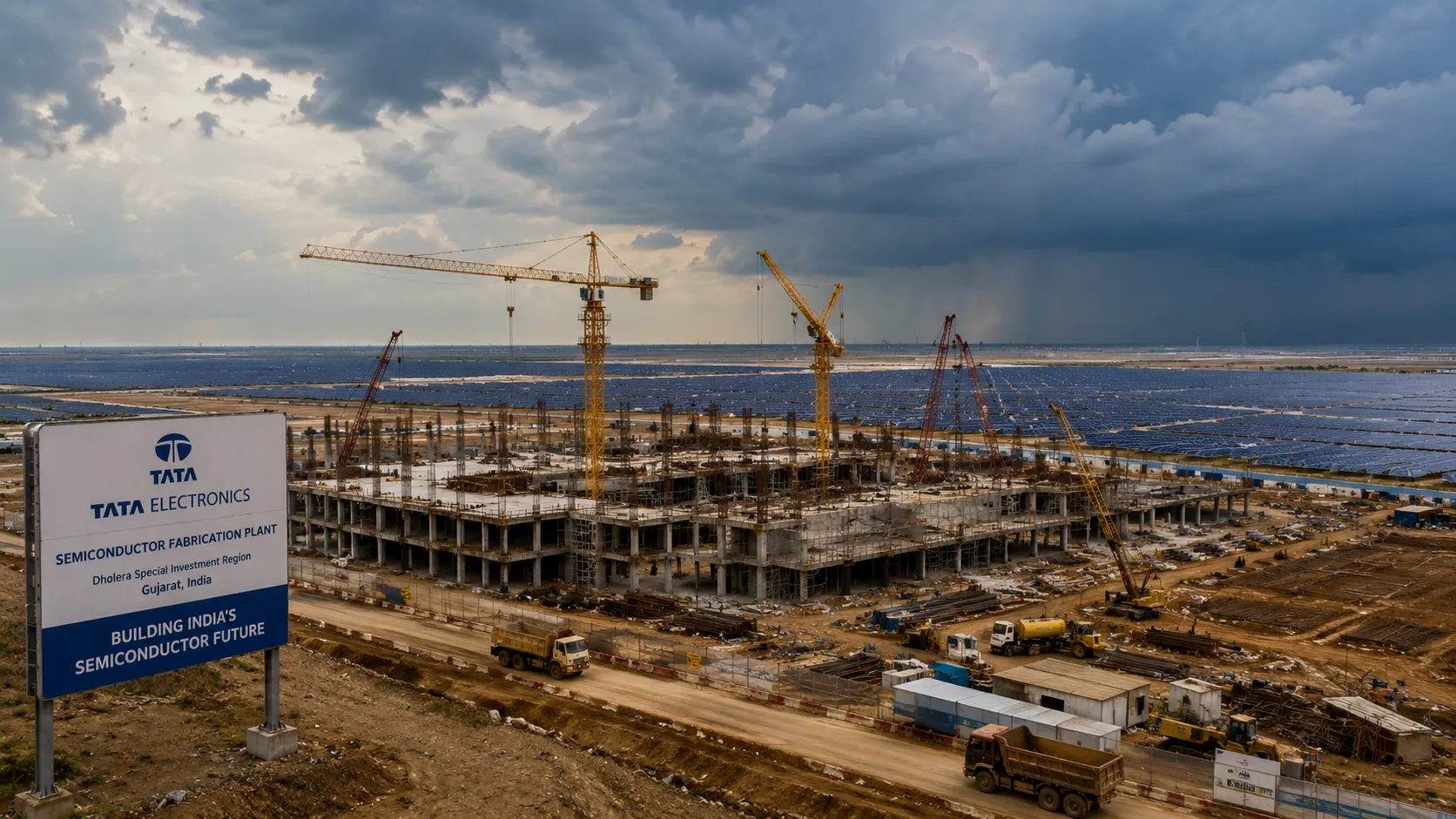
Spread across 66 hectares in Gujarat's ambitious Dholera Special Investment Region, Tata Electronics is building India's first commercial 300 mm (12-inch) semiconductor wafer fabrication plant—known colloquially as a "fab"—with an investment of ₹91,000 crore (approximately $11 billion). The facility will manufacture chips for automotive applications, mobile devices, artificial intelligence, and other critical segments, serving customers globally.
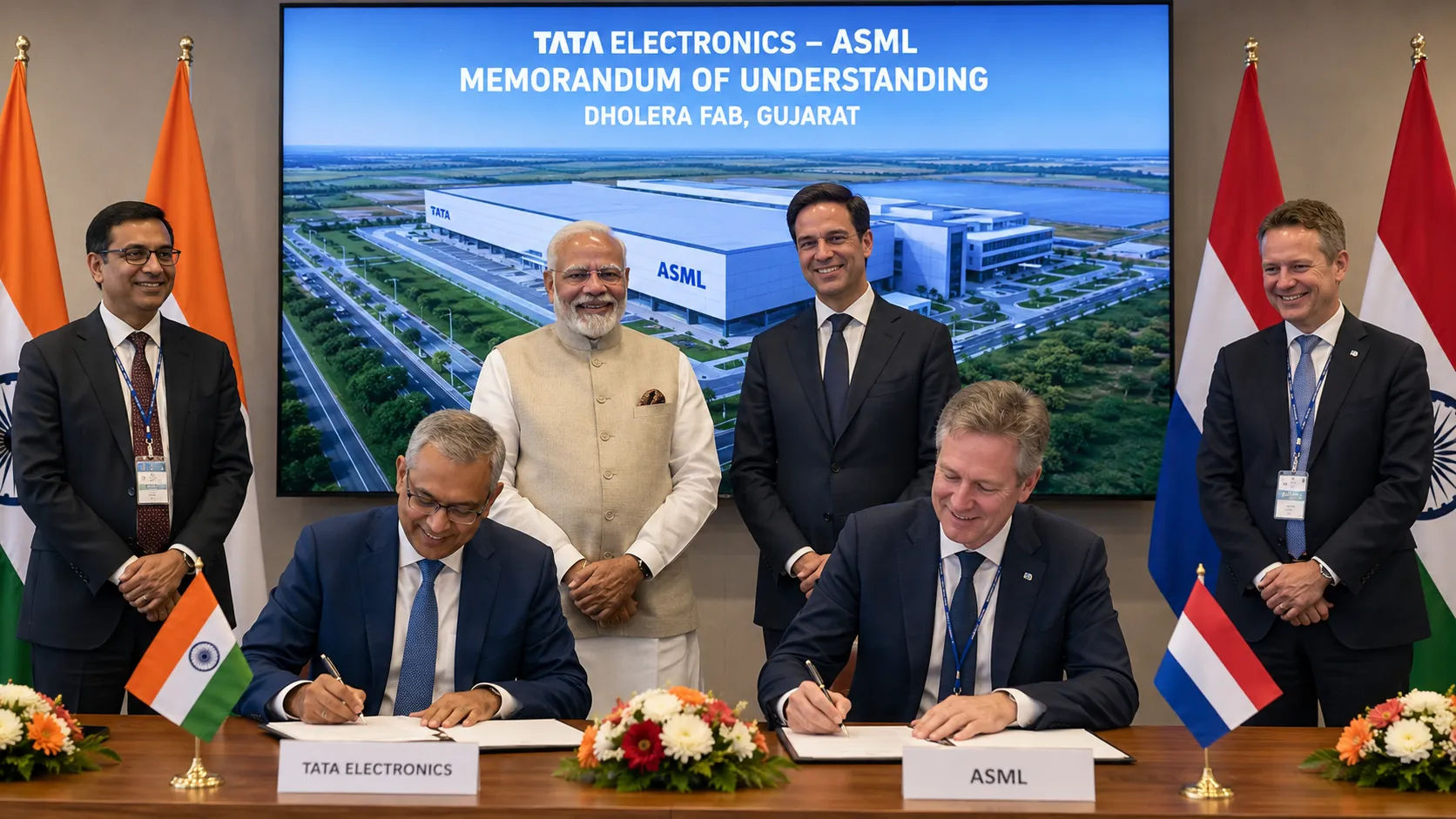
In May 2026, the project achieved a monumental milestone. During Prime Minister Modi's visit to the Netherlands, Tata Electronics signed a strategic partnership agreement with ASML, the Dutch company that holds a near-monopoly on the advanced lithography systems required for cutting-edge chip manufacturing. Dutch Prime Minister Rob Jetten witnessed the signing alongside PM Modi.
Under the agreement, ASML will deploy its suite of advanced lithography tools and solutions for the Dholera Fab, support the training of local talent, and help develop semiconductor supply chains and R&D infrastructure in India. The facility is expected to be ready for production by 2028, positioning India as the newest member of an exclusive club—nations capable of producing their own advanced logic chips.
The Full Stack: Four Plants in 2026
India is not putting all its wafers in one basket. As of May 2026, India has approved 12 semiconductor units under the India Semiconductor Mission (ISM), spanning fabrication plants, ATMP/OSAT facilities, compound semiconductor units, and advanced packaging projects across Gujarat, Punjab, Andhra Pradesh, Rajasthan, Assam, and Karnataka.
The rollout schedule is aggressive:
Two plants were already in commercial production as of May 2026
A third plant is scheduled to begin commercial production in July 2026
A fourth plant is slated to begin production in November or December 2026
Two more plants are expected in 2027
Collectively, these projects represent an investment of approximately ₹1.60 lakh crore ($19 billion) across six states.
The Rajasthan Surprise: Exports from the Desert
While Gujarat dominates headlines, Rajasthan has quietly emerged as India's first semiconductor export hub. On May 15, 2026, Sahasra Semiconductors inaugurated an ATMP/OSAT facility in Bhiwadi, Rajasthan—the country's 13th semiconductor unit.
The facility, operating from a 57,000-square-foot complex, has an initial annual packaging capacity of 60 million units, with plans to expand to 400–600 million units within two to three years. But the real headline is that 60% of its production is already being exported to the United States, Germany, France, Eastern Europe, China, and Nepal.
This is a proof-of-concept for India's semiconductor export ambitions: Indian-packaged chips are already flowing into some of the world's most sophisticated electronics supply chains.
The Taiwan Bridge: A Golden Decade of Cooperation
The most significant supply chain shift, however, involves a long and fraught relationship.
In June 2026, four Indian state governments sent high-level delegations to Taiwan for the 2026 Taiwan-India Investment Partnership Forum. Andhra Pradesh, Telangana, Tamil Nadu, and Karnataka participated, with Uttar Pradesh joining virtually. Over 100 companies and 130 industry representatives attended, and 40 one-on-one business meetings were facilitated.
Speaking at the forum, Ninad Deshpande, Director General of the India-Taipei Association, underscored the deepening relationship. "The core issue in our industry is no longer just technology R&D, but where a product is manufactured and who we partner with to manufacture it. Cost is no longer the only metric; resilience and trust are now key," he said.
This marks a profound pivot. For decades, the semiconductor supply chain has been heavily concentrated in Taiwan, South Korea, and China. India is now positioning itself as a trusted "Plus One" alternative—offering a massive domestic market, a stable democratic government, and a workforce hungry for precision manufacturing.
The India Semiconductor Mission 2.0 (ISM 2.0), announced in the 2026 Union Budget, reflects this strategic shift. With a renewed allocation and a sharpened focus on equipment localization, material self-sufficiency, full-stack Indian IP development, and supply chain fortification, the mission is designed to transform India from a passive chip importer into an active node in the global semiconductor network.
What This Means for the Global Indian
For the Global Indian reading this in New York, London, or Singapore, the semiconductor story is not merely an industrial policy—it is a generational wealth opportunity.
For investors: The semiconductor supply chain is now a rare case of government-backed, capital-intensive manufacturing with global demand. The $19 billion already committed is likely just the down payment.
For entrepreneurs: Every chip fab requires a surrounding ecosystem—specialty chemicals, industrial gases, ultra-pure water systems, packaging materials, testing equipment, and EDA software. Most of these are currently imported. The "made in India" opportunity is enormous.
For professionals: The semiconductor industry is among the highest-paying manufacturing sectors globally. As the ecosystem matures, demand for Indian talent in lithography, process engineering, and fab management will skyrocket.
For the diaspora: Indian expertise in semiconductor design (already world-class) now meets Indian expertise in semiconductor manufacturing (just beginning). The cross-pollination between Indian design centers in Bengaluru and Indian fabs in Dholera could create a virtuous cycle unmatched outside of Taiwan.
The Road Ahead
India is not pretending to challenge TSMC's 2nm dominance overnight. The Dholera fab is expected to operate in the 28nm–110nm range—mature nodes used in automotive chips, microcontrollers, power management ICs, and a host of other "non-glamorous but absolutely essential" components. These chips are exactly what India's rapidly growing electronics, automotive, and defense sectors need.
And from that foundation, a true ecosystem can grow. Once the first fab is up and running, once the first cohort of Indian process engineers is trained, once the first specialty chemical plant is built to supply the fab—the flywheel will begin turning.
For now, the journey from "chip importer" to "chip maker" is officially underway. India has turned on its first machines. The wafers are in motion.
The era of Silicon Sovereignty has begun.
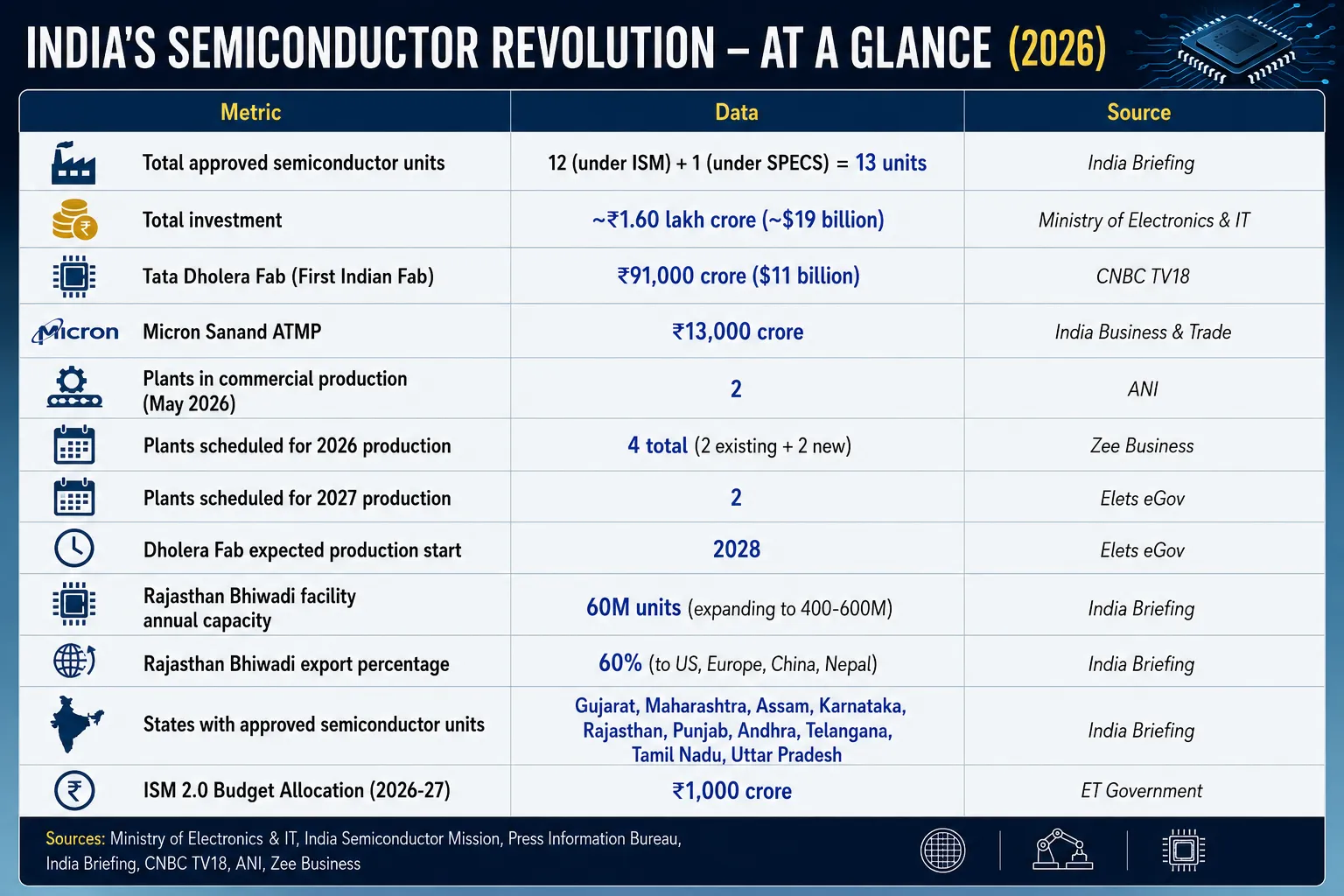
CHART: "India's Semiconductor Revolution – At a Glance (2026)"
Metric | Data | Source |
|---|---|---|
Total approved semiconductor units | 12 (under ISM) + 1 (under SPECS) = 13 units | India Briefing |
Total investment | ~₹1.60 lakh crore (~$19 billion) | Ministry of Electronics & IT |
Tata Dholera Fab (First Indian Fab) | ₹91,000 crore ($11 billion) | CNBC TV18 |
Micron Sanand ATMP | ₹13,000 crore | India Business & Trade |
Plants in commercial production (May 2026) | 2 | ANI |
Plants scheduled for 2026 production | 4 total (2 existing + 2 new) | Zee Business |
Plants scheduled for 2027 production | 2 | Elets eGov |
Dholera Fab expected production start | 2028 | Elets eGov |
Rajasthan Bhiwadi facility annual capacity | 60M units (expanding to 400-600M) | India Briefing |
Rajasthan Bhiwadi export percentage | 60% (to US, Europe, China, Nepal) | India Briefing |
States with approved semiconductor units | Gujarat, Maharashtra, Assam, Karnataka, Rajasthan, Punjab, Andhra, Telangana, Tamil Nadu, Uttar Pradesh | India Briefing |
ISM 2.0 Budget Allocation (2026-27) | ₹1,000 crore | ET Government |
Sources: Ministry of Electronics & IT, India Semiconductor Mission, Press Information Bureau, India Briefing, CNBC TV18, ANI, Zee Business


