The Question Behind the Fundraise
In the spring of 2026, a quiet but consequential conversation is taking place in the corridors of Indian technology. It is a conversation about sovereignty — not of borders or currency, but of intelligence. Who should build the AI systems that will increasingly mediate how over a billion Indians access information, make decisions, understand their health, interact with government, educate their children, and interpret the world? The answer to this question will determine, in significant ways, whether the enormous productivity gains that AI promises will accrue equitably to Indian society — or whether they will be captured primarily by the foreign companies that build the models, and the Indian elites who can most readily access them.
Sarvam AI, a Bengaluru-born startup founded by researchers from India's premier technical institutions, has a clear and urgent answer to this question. India must build its own. And sophisticated investors appear to agree: the company is in advanced discussions to raise between $300 million and $350 million in a funding round that would value it at $1.5 billion, making it one of the most significant AI investments ever made in an Indian-origin company. The investor consortium includes names that understand both the technical challenge and the market opportunity at a level of depth that casual observers cannot match.
The Case for Sovereign AI: Beyond Nationalism
The argument for building Indian AI models is not primarily nationalistic, though the national pride dimension is real and not unimportant. The argument is practical, linguistic, cultural, and ultimately about justice.
Large language models trained primarily on English-language internet data — the Wikipedia corpus, Common Crawl, GitHub, Reddit, and the vast digital archive of English-medium global publishing — reflect the cultural assumptions, social norms, knowledge hierarchies, and worldview of the English-speaking, Western-educated communities that produced that data. When such a model encounters a question about ayurvedic medicine and its interactions with contemporary pharmaceutical treatments, it answers from a framework shaped by the biomedical literature, not the Charaka Samhita. When it encounters a legal question about personal law under the Hindu Succession Act or the Muslim personal law, it draws on frameworks developed in common-law jurisdictions, not on the actual jurisprudence of Indian courts. When it is asked about caste dynamics, regional political histories, or the specific economic conditions of Indian agricultural communities, its understanding is filtered through Western academic frameworks that may be fundamentally inadequate.
These are not edge cases. They are the everyday questions that hundreds of millions of Indians will ask AI systems as those systems become integrated into daily life. The quality of the answers — not measured against some abstract benchmark, but measured against whether they are actually useful to the human being asking them in the context of their actual life — will determine whether AI delivers on its transformative promise for India's majority population.
The Language Gap Is a Chasm, Not a Crack
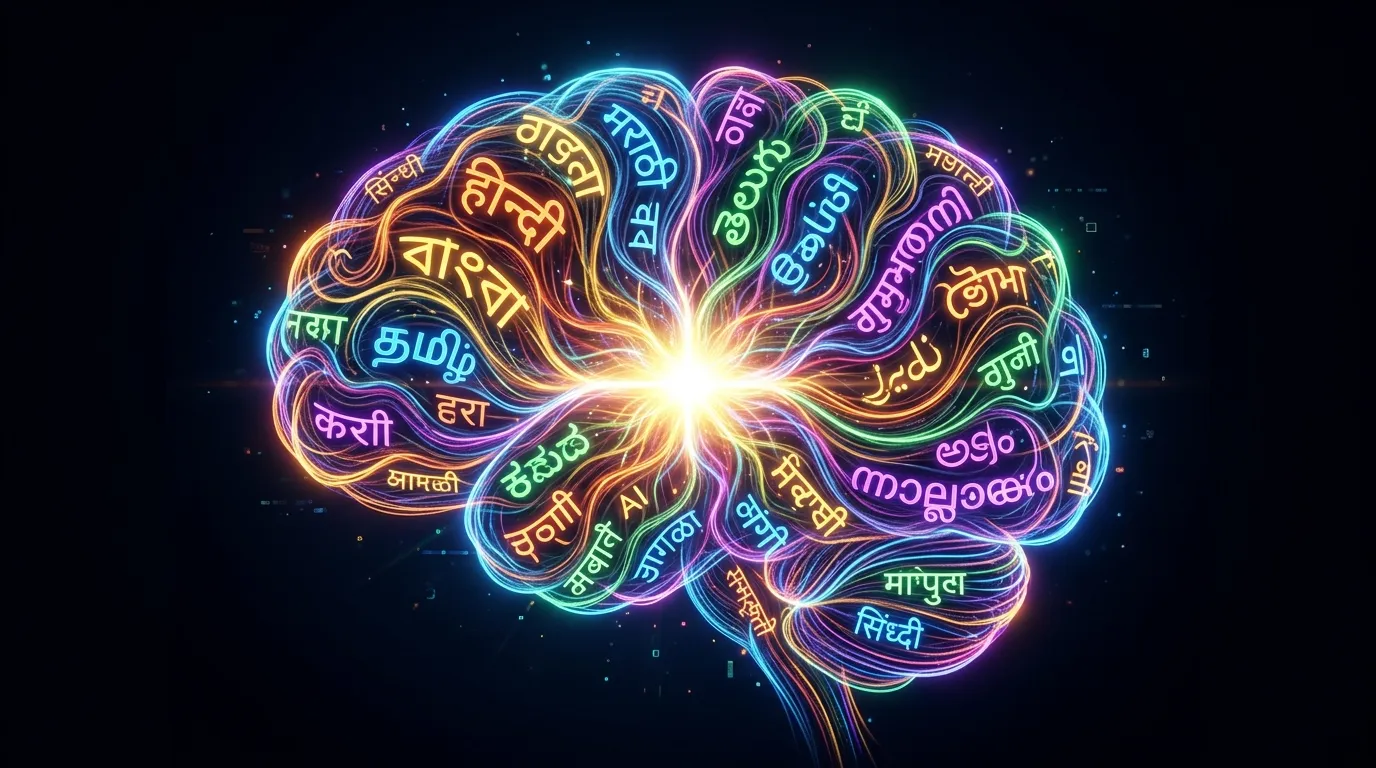
Sarvam's most central ambition is to build AI that thinks in Indian languages — not merely translates into them. This distinction is profound and technically demanding. Translation produces text in another language. Thinking in a language means that the underlying representations, the conceptual structures through which meaning is organized and retrieved, are native to that language rather than mapped from another.
India is home to twenty-two constitutionally recognized languages and hundreds of dialects, representing some of the world's oldest and most sophisticated literary traditions. Tamil has a written literary history stretching back over two millennia. Sanskrit's grammatical analysis, systematized by Panini in the 4th century BCE, anticipated concepts that modern linguistics would not independently develop for another two thousand years. The conceptual vocabulary of Hindi, Urdu, Bengali, and Marathi encodes distinctions and relationships that have no precise equivalent in English.
An AI that truly understands these languages — that can engage with the full depth of their literary traditions, the subtleties of their social registers, the nuances of their regional variants — is not simply a better product. It is a more just product. It extends the democratizing power of artificial intelligence to the hundreds of millions of Indians who are fluent in languages other than English — who are, in many cases, more educated, more articulate, and more intellectually sophisticated in their mother tongue than they could ever be in an adopted language. Currently, these citizens are systematically disadvantaged in their interactions with AI systems. Sarvam is working to change that.
The Technical Mountain Sarvam Is Climbing
Building a competitive frontier AI model is one of the most technically demanding and capital-intensive endeavors in contemporary technology. The engineering challenges are formidable: assembling high-quality training data in Indian languages at sufficient scale, designing model architectures that perform well across linguistically diverse inputs, managing the computational costs of training at the scale required to produce genuinely capable models, and building the evaluation frameworks needed to measure performance in languages for which standard benchmarks may not exist.
Sarvam's founding team, which combines deep expertise in machine learning research with practical experience building and deploying AI systems, is well-positioned to navigate these challenges. The company has already demonstrated working AI models for several Indian languages, providing proof-of-concept evidence that the technical approach is sound. The $300 to $350 million it is seeking to raise will fund the next phase: scaling model training to the parameter counts and data volumes needed to achieve competitive performance across the full range of Indian languages and domains.
The competitive landscape is formidable but not insurmountable. OpenAI, Google, Anthropic, and Meta are all working to improve their multilingual capabilities. But these companies, for all their resources, have a fundamental disadvantage in building deeply Indian AI: they are building from the outside in, adding Indian languages to models whose core representations were formed in English. Sarvam is building from the inside out — starting with the data, the cultural knowledge, and the linguistic intuitions native to India. This is a structural advantage that cannot be purchased or replicated by writing larger checks.

The Market Waiting to Be Served
Beyond the philosophical and justice arguments for sovereign Indian AI, there is a simply enormous commercial opportunity. India's 1.4 billion people represent one of the world's largest potential markets for AI-powered products and services. The use cases span the full spectrum of human activity: healthcare, education, financial services, agriculture, government services, entertainment, and the countless productivity applications that AI is beginning to transform in more developed markets.
The majority of this market speaks Indian languages as its primary mode of communication. Products that can only be accessed in English — or that provide a degraded, translation-based experience in Indian languages — will never fully serve this market. The company or companies that build genuinely capable, natively multilingual Indian AI will have an almost unassailable advantage in the largest consumer market in the world.
For investors, this market size calculation is the foundation of the Sarvam thesis. The $1.5 billion valuation being discussed in the current fundraising round reflects not the company's current revenue but its potential share of the value created when AI genuinely penetrates the Indian mass market — a market that has historically been underserved by technology precisely because the technology was not built for it.
For The Impactful Global Indian, Sarvam's journey is more than a funding story. It is a philosophical declaration — that the Indian mind, shaped by millennia of thought across dozens of languages and hundreds of traditions, deserves an AI built in its own image. That this declaration is being backed by serious capital suggests that the world is beginning to understand what India has always known: that intelligence is not the exclusive property of any single language or culture, and that the most capable and beneficial AI will be built by those who take that truth seriously.