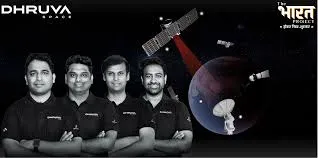
Sanjay Nekkanti & Co‑founders — From a Student Satellite to India’s Most Ambitious Space Tech Venture
The Satellite Dream That Began in a Chennai Classroom
In 2011, Sanjay Nekkanti was a final‑year engineering student at SRM University in Chennai. He was part of SRMSat — India’s first student nanosatellite project, built in collaboration with ISRO. When the satellite launched aboard ISRO’s PSLV‑C18, Sanjay watched it soar into orbit. But instead of celebration, he felt a burning question: Why has no private Indian company built a satellite yet?
That question became an obsession. India had a world‑class space agency, but the private sector was completely absent from satellite manufacturing. Sanjay decided to change that. After graduation, he pursued the prestigious Erasmus Mundus SpaceMaster programme in Sweden and France, gaining a global perspective on spacecraft design and the commercial space industry. Upon returning to India, he reunited with three like‑minded engineers — Chaitanya Dora Surapureddy, Abhay Egoor, and Krishna Teja Penamakuru — and together, in 2012, they founded Dhruva Space in Chennai.
The name “Dhruva” means the Pole Star — a guiding light. It was a fitting metaphor for a company that would navigate India’s uncharted private space sector.
The Decade of Persistence: 162 Rejections
The early years were brutal. India had no regulatory framework for private space companies. There were no dedicated funds for space tech startups. Investors had no risk appetite for a sector where success could take a decade. Sanjay and his co‑founders approached 162 investors over seven years. Every single one said no.
One investor famously asked Sanjay: “What you’re trying to do is amazing. But nobody in India is going to believe that you’ll be able to pull this off. You’re asking for four crore. I’m going to give you 400 crore. What are you going to do with that?” Sanjay had no answer. He went back, reflected, and realized he needed to think bigger — not just build a product, but build an entire ecosystem.
The team pivoted from a narrow product focus to a full‑stack vision: they would not just build satellites; they would provide end‑to‑end solutions — satellite platforms, launch integration, ground stations, and mission operations. This vertically integrated model would reduce costs and turnaround times for customers, making space accessible for a wider range of applications.
Finally, in 2019 — seven years after founding — they secured their first investment from the 163rd investor they approached: the Indian Angel Network. “We got lucky with the 163rd investor we approached,” Sanjay recalls. “But that luck was built on seven years of grinding”.
The Technology: Full‑Stack Space Engineering
Dhruva Space’s core offering is full‑stack space engineering — a comprehensive suite covering three segments:
Space Segment: Modular satellite platforms including P‑DoT (pocket‑class), P‑30 (30 kg class), and P‑Nu (100‑250 kg microsatellite). These platforms are designed for versatility across rocket launchers and payload types.
Launch Segment: DSOD family of orbital deployers, launch integration services, and mission management.
Ground Segment: Ground‑station‑as‑a‑service (GSaaS) and the proprietary Integrated Space Operations & Command Suite (ISOCS) for real‑time mission control.
This “full‑stack” approach is Dhruva’s competitive moat. While other space startups focus on a single component (e.g., launch vehicles or payloads), Dhruva offers an integrated solution — customers get a satellite platform, launch services, and ground infrastructure from a single provider.
The company has built a network of over 550 space‑qualified vendors across India, creating a domestic supply chain that reduces dependence on foreign imports.

The Breakthrough: Thybolt and India’s First Private Satellite
On November 26, 2022, Dhruva Space made history. Its two Thybolt satellites launched aboard ISRO’s PSLV‑C54, marking India’s first private satellites to reach orbit. The mission was a technology demonstrator, proving that Dhruva’s satellite platforms and orbital deployers were space‑qualified.
Between June 2022 and January 2024, Dhruva achieved a remarkable run: eight successful missions across four launches — a record in India’s private space sector. These included the LEAP‑TD mission (January 2024) which space‑qualified the P‑30 platform aboard ISRO’s PSLV‑C58.
The company’s efforts have been recognized nationally: it won the National Startup Award (2020), the PDU Telecom Skill Excellence Award (2022), and received accolades such as Fortune India’s 40 Under 40 (2022) and Forbes India DGEMS 200 (2023).
The Funding: From Bootstrapping to Series A
In April 2024, Dhruva Space announced the successful closure of its Series A funding at INR 123 Crores (approx. $15 million) . The round saw participation from Indian Angel Network Alpha Fund, Blue Ashva Capital, Silverneedle Ventures, IvyCap Ventures, Mumbai Angels, Blume Founders Fund, and others. The Series A also included venture debt from SIDBI and the Technology Development Board.
The funding is being deployed towards:
A 280,000 sq. ft. satellite mass production facility in Shamshabad, Telangana — one of India’s largest — capable of building satellites up to 500 kg in class.
Expansion of full‑stack product offerings to global markets.
Strategic business acquisitions.
Team growth and infrastructure development.
In 2025, Dhruva raised an additional INR 51.76 Cr in a pre‑Series B round, followed by a ₹105 Cr grant under the government’s Research, Development & Innovation Fund (RDIF) for Project Garud — a standardized, production‑ready satellite platform for large‑scale deployments across telecom, Earth observation, and national security use cases. Project Garud aims to support high‑volume manufacturing of 500‑600 satellites annually and reduce dependence on foreign satellite systems.
By late 2025, Dhruva had secured a ₹450 crore order book — a testament to growing customer confidence in its capabilities.
The Global Leap: LEAP‑1 and SpaceX Falcon 9
In August 2025, Dhruva Space launched its first commercial satellite mission, LEAP‑1, aboard SpaceX’s Falcon 9 — a significant Indo‑Australian collaboration. The mission carried two payloads:
Nexus‑01 by Akula Tech (Australia): an AI module for on‑orbit data processing, real‑time geospatial analytics, and AI model re‑training.
OTR‑2 by Esper Satellites (Australia): a hyperspectral imager for Earth observation, capturing data for defence, agriculture, mining, and disaster response.
The mission used Dhruva’s indigenously developed P‑30 platform, successfully qualified during the LEAP‑TD mission.
In January 2026, Dhruva launched Polar Access‑1 (PA‑1) from ISRO’s Satish Dhawan Space Centre in Sriharikota — a coordinated programme delivering 4 satellites, 5 separation systems, and multiple ground stations for 10 space missions serving 6 Indian states and 2 nations (Nepal and Sweden). PA‑1 marks the industrialisation of satellite manufacturing in India.
The Tamil Nadu Connection: Chennai’s Space Tech Ecosystem
Sanjay Nekkanti’s Tamil Nadu roots run deep. He completed his undergraduate studies at SRM University in Chennai, and Chennai remains the spiritual home of Dhruva’s founding vision. The city’s strong engineering talent pool — fueled by IIT Madras, Anna University, SRM, and other institutions — provided the early human capital that made Dhruva possible.
Dhruva has also partnered with Tamil Nadu‑based academic institutions for satellite missions, including the Polar Access‑1 programme which includes satellites from universities across India. The company works closely with the Tamil Nadu Industrial Development Corporation (TIDCO) and has supported the state government’s Tamil Nadu Space Industrial Policy 2025, which aims to make the state a global destination for space tech talent and infrastructure.
“Chennai gave us the patience to build a hard tech company,” Sanjay has said. “In a city that knows how to manufacture, we learned that space hardware is just the next frontier.”
Leadership Philosophy: Patience, Perseverance, and Thinking Big
Sanjay Nekkanti’s leadership philosophy is built on three pillars:
Solve hard problems first. Dhruva focused on the most difficult part of the space value chain — satellite platforms and full‑stack integration — before worrying about sales and marketing.
Build for India first, then the world. By proving its capabilities with ISRO and domestic customers, Dhruva earned the credibility to go global.
Perseverance is non‑negotiable. “There’s a lot of silence before liftoff,” Sanjay told Forbes India. “Thirteen years is a long journey. But if you must build anything foundational, you can’t do that without strong perseverance”.
The co‑founder team has maintained remarkable cohesion over a decade — Chaitanya Dora Surapureddy is CFO and co‑founder, Abhay Egoor is CTO, and Krishna Teja Penamakuru rounds out the founding quartet. This stability has been a key differentiator in an industry where teams often fragment under pressure.
Challenges and Critiques
Dhruva’s journey has been anything but smooth:
Regulatory vacuum: For the first seven years, there was no clear policy for private space companies in India. The creation of IN‑SPACe (Indian National Space Promotion and Authorisation Centre) in 2020 provided much‑needed regulatory clarity and access to ISRO’s facilities.
Investor skepticism: 162 rejections before the first yes. Even after funding, some investors questioned the capital‑intensive nature of hardware manufacturing vs. asset‑light software.
Supply chain dependence: While Dhruva has built a network of 550+ vendors, critical components still rely on global supply chains. Geopolitical disruptions remain a risk.
Competition: Other Indian spacetech startups — Agnikul Cosmos, Skyroot Aerospace, Pixxel, Digantara — are also well‑funded and ambitious. Dhruva’s response is to focus on its unique “full‑stack” positioning and satellite platform specialization.
Some critics also point out that Dhruva’s largest manufacturing facility is in Telangana, not Tamil Nadu. However, Sanjay has clarified that Chennai remains a key talent base and that the company works closely with the Tamil Nadu government to support the state’s emerging space ecosystem.
The Future: Solar Arrays, Constellations, and Global OEM Status
As of 2026, Dhruva Space is on an ambitious trajectory:
Solis+ solar arrays: Advanced space‑grade solar panels for satellite power systems.
Constellation readiness: With Project Garud and the new manufacturing facility, Dhruva is preparing to build satellites at scale for telecom, Earth observation, and defence constellations.
Global OEM status: The company is positioning itself as a globally competitive spacecraft OEM and subsystem supplier, with partnerships across France, Italy, Sweden, Austria, and Australia.
Export growth: Over the past three years, Dhruva has secured export orders for satellite platforms and space‑grade solar panels to Austria, France, Australia, and the Middle East.
The Indian government has set a target of growing the space economy from $8.4 billion (2022) to $44 billion by 2033, with India capturing 8‑10% of the global space market by 2040. Dhruva Space is positioned to be a key enabler of that vision.


