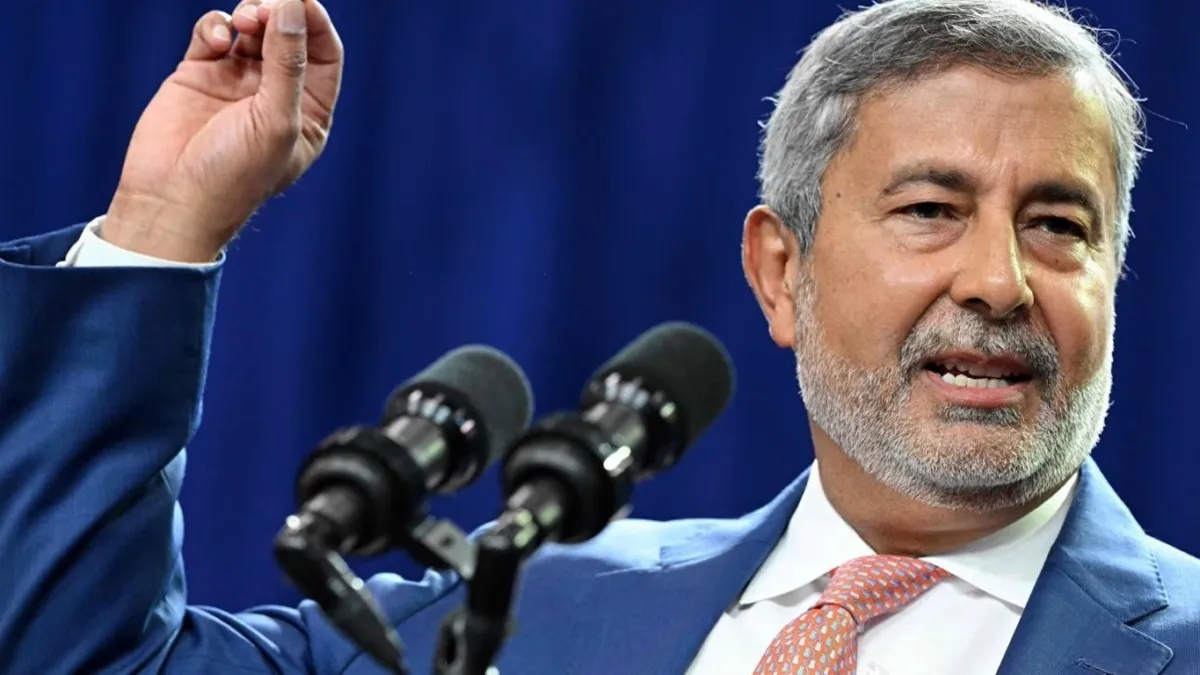
His Father Spoke to the Consul Personally. That Conversation Changed the Course of Semiconductor History.
In 1976, Sanjay Mehrotra was a 17-year-old engineering student from Kanpur — the youngest of four siblings in a middle-class family whose father worked as a liaison officer in the cotton industry. He had attended Sardar Patel Vidyalaya in New Delhi, one of the city's most academically respected schools. He had been admitted to BITS Pilani, one of India's premier engineering institutions. And he had his sights set on Berkeley — specifically on the University of California, Berkeley's programme in Electrical Engineering and Computer Science, one of the best in the world.
The US Embassy said no. Three times.
Each rejection was a potential end to a dream that his father had long nurtured for him. The path from Kanpur to California — from a cotton industry liaison officer's household to one of the world's great engineering universities — was narrowing with every stamped denial. But after the third rejection, his father took a step that most people in that situation would not think to take. He went to the US Embassy personally. He spoke directly to the consul. He explained who his son was, what he had achieved academically, and what he intended to do in America.
The fourth attempt succeeded.
Sanjay Mehrotra arrived in the United States at 18 years old. He enrolled at Berkeley. He earned his Bachelor's and Master's degrees in Electrical Engineering and Computer Science between 1976 and 1980. He started a career that would span more than four decades, produce more than 70 patents, create the company that made flash memory ubiquitous, and eventually place him in the CEO's chair of one of the most strategically important semiconductor companies on earth.
The Making of a Semiconductor Pioneer — Intel, SEEQ, and the Road to SanDisk
The professional formation of Sanjay Mehrotra is worth tracing in some detail because it shows how deep technical expertise and commercial ambition developed together in a person who would eventually express both through entrepreneurship.
After Berkeley, he joined Intel — the company that had defined the semiconductor industry's early decades — as a Senior Design Engineer. From Intel he moved to SEEQ Technology, where he worked as an EEPROM Design Project Manager and European Applications Engineering Manager. EEPROM — Electrically Erasable Programmable Read-Only Memory — was the technology foundation from which flash memory would eventually emerge, and Mehrotra was working at the technical frontier of its development.
The path continued through Integrated Device Technology and Atmel, each role adding depth in memory design and systems architecture that would prove foundational to the company he would eventually co-found.
In 1988, Mehrotra co-founded SanDisk Corporation alongside Eli Harari and Jack Yuan. The timing was deliberate and the insight was precise: flash memory technology — a form of non-volatile storage that retained data without a power supply and could be electrically erased and reprogrammed — had the potential to replace magnetic disk storage in a wide range of applications if the technology could be made affordable and the form factors made small enough. SanDisk's founding thesis was that this was possible, and that building the company to prove it was worth doing.
It was. Over the next quarter century, flash memory became the storage technology inside every digital camera, every smartphone, every USB drive, every solid-state laptop, and eventually every data centre in the world. SanDisk grew from a startup to a global brand, went public in 1995, and became one of the semiconductor industry's most important companies. Mehrotra served in a series of increasingly senior roles — Director of Memory Design, VP of Product Development, SVP of Engineering, EVP and Chief Operating Officer — before becoming President and CEO in 2011.
The SanDisk era ended in 2016, when Western Digital acquired the company in a deal valued at approximately $19 billion — one of the largest acquisitions in the history of the semiconductor industry and a financial validation of the founding insight that Mehrotra and his co-founders had pursued for nearly three decades.
In 2006, he, Harari, and Yuan received the IEEE Reynold B. Johnson Data Storage Device Technology Award for their leadership in the development and commercialisation of Flash EEPROM-based data storage products — the technical recognition that preceded the commercial validation by a decade.
Taking Over Micron — and What He Found When He Got There
When Mark Durcan announced his retirement as Micron CEO in February 2017, Sanjay Mehrotra was the choice to succeed him. Micron was in a different situation from SanDisk — not a startup, but a long-established American semiconductor company with a global manufacturing footprint and a history of cyclical boom and bust that was endemic to the memory chip industry.
Mehrotra moved to stabilise and improve Micron's operational performance immediately. Manufacturing efficiency, technology development cadence, and customer relationships were the first priorities. The longer-term priority was to position Micron for the shift that he could see coming — a shift in computing architecture driven by artificial intelligence that would fundamentally change the demand profile for memory and storage.
High-bandwidth memory — HBM — is the specific technology that has defined Micron's most recent and most significant period of growth. AI accelerators, including the NVIDIA GPUs that power the training of large language models, require memory that can move data between the processor and storage at extraordinarily high speeds. Standard DRAM is too slow. HBM — memory chips stacked in three dimensions and placed in close proximity to the processor — provides the bandwidth that AI inference and training require. Micron has become a critical supplier of HBM chips used in AI accelerators, positioning it at the very centre of the AI infrastructure buildout that is the defining commercial technology story of the 2020s.
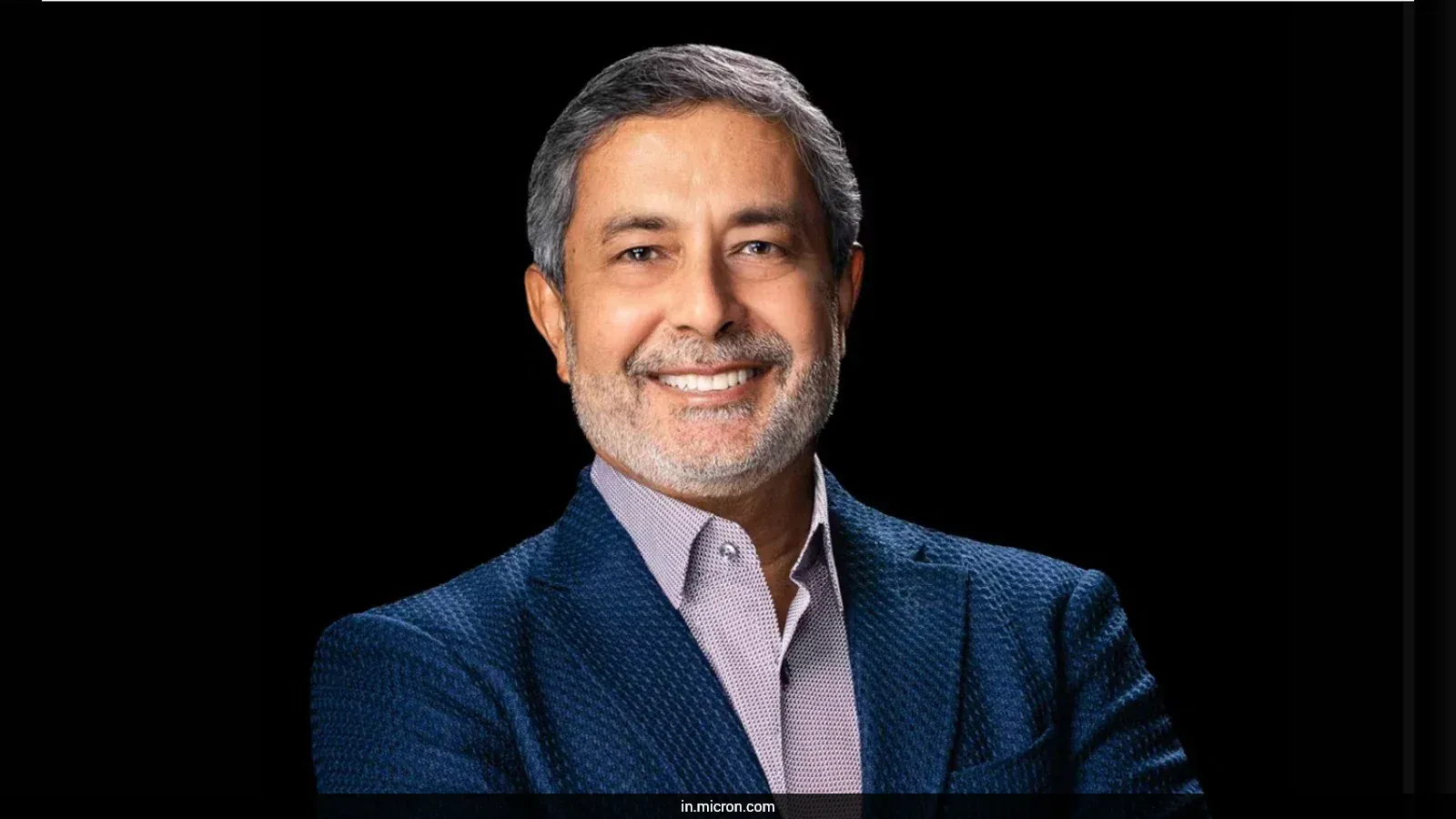
In fiscal year 2025, Micron reported record revenue of $37.4 billion — a 49 per cent increase from the prior year — driven by surging demand from AI data centres. The company that Mehrotra took over in 2017 is now one of the most strategically important suppliers in the global AI supply chain.
The India Dimension — Sanand, Gujarat, and the Make in India Moment
Sanjay Mehrotra's leadership of Micron has a specific and consequential connection to India that goes beyond his personal biography.
The Micron semiconductor assembly and testing facility being built in Sanand, Gujarat, represents one of India's largest and most significant chip manufacturing investments. The facility is supported by India's India Semiconductor Mission and represents Micron's first manufacturing presence in India. Mehrotra has said publicly that the plant could eventually produce multiple hundreds of millions of chips annually — a scale that would make it a meaningful contributor to both Micron's supply chain and India's ambitions as a semiconductor manufacturing nation.
The Sanand investment is happening at a moment when the global semiconductor industry is actively diversifying manufacturing away from its historical concentration in Taiwan, South Korea, and China — a diversification driven by geopolitical risk, supply chain vulnerability lessons from the COVID-19 period, and government incentives in the United States (the CHIPS and Science Act), Europe, Japan, and India. Micron's decision to invest in Indian manufacturing reflects both the government's attractiveness as a manufacturing destination and Mehrotra's own understanding of the strategic importance of supply chain diversification.
BITS Pilani, his undergraduate institution, awarded him an honorary doctorate — one of the full-circle moments in a career that has taken him from an engineering student in Rajasthan to the Chairman, President, and CEO of a company that is helping determine what the AI-powered future of computing looks like.
The Honours That Tell the Career's Story
The accumulation of recognition over four decades reflects a career that has operated at the highest level of both technical and commercial achievement simultaneously.
Inducted into the National Academy of Engineering in 2022 — one of the highest honours in engineering, recognising his contributions to nonvolatile memory design and architecture enabling multilevel cell NAND flash products. Winner of the Semiconductor Industry Association's Robert N. Noyce Award in 2023 — the industry's highest honour, recognising top industry leaders. 2019 Flash Memory Summit Lifetime Achievement Award. IEEE Reynold B. Johnson Data Storage Device Technology Award with SanDisk co-founders in 2006. Honorary doctorates from Boise State University, Rochester Institute of Technology, and BITS Pilani. IIM Mumbai's Lakshya Business Visionary Award in 2023.
More than 70 patents, several of which are foundational to enabling high-capacity flash memory.
The career that began with a father speaking to an embassy consul and a fourth-attempt visa approval has produced technical contributions that appear in practically every digital device on earth and leadership that is shaping how the world's AI infrastructure gets built.
What the Journey Actually Means
Sanjay Mehrotra is not a figure who became important because AI happened to arrive on his watch. He is a figure who helped build the technical foundation on which AI now runs — the flash memory in every device, the NAND architecture that his patents helped enable, the HBM chips that the most powerful AI accelerators now require.
The three visa rejections in 1976 are remembered as the opening adversity in what became an extraordinary career. But the more important part of the story is not the adversity. It is what the determination to overcome it produced: a physicist-engineer who spent four decades building on the frontier of memory technology, who co-founded the company that democratised digital storage, who led the company to a $19 billion exit, and who is now steering one of the most important companies in the global AI supply chain at the moment when memory technology has never mattered more.
His father's dream was to see him study in America. The consul who finally granted the visa, after the father's personal appeal, could not have known what they were approving.
Neither, probably, could Mehrotra himself.


