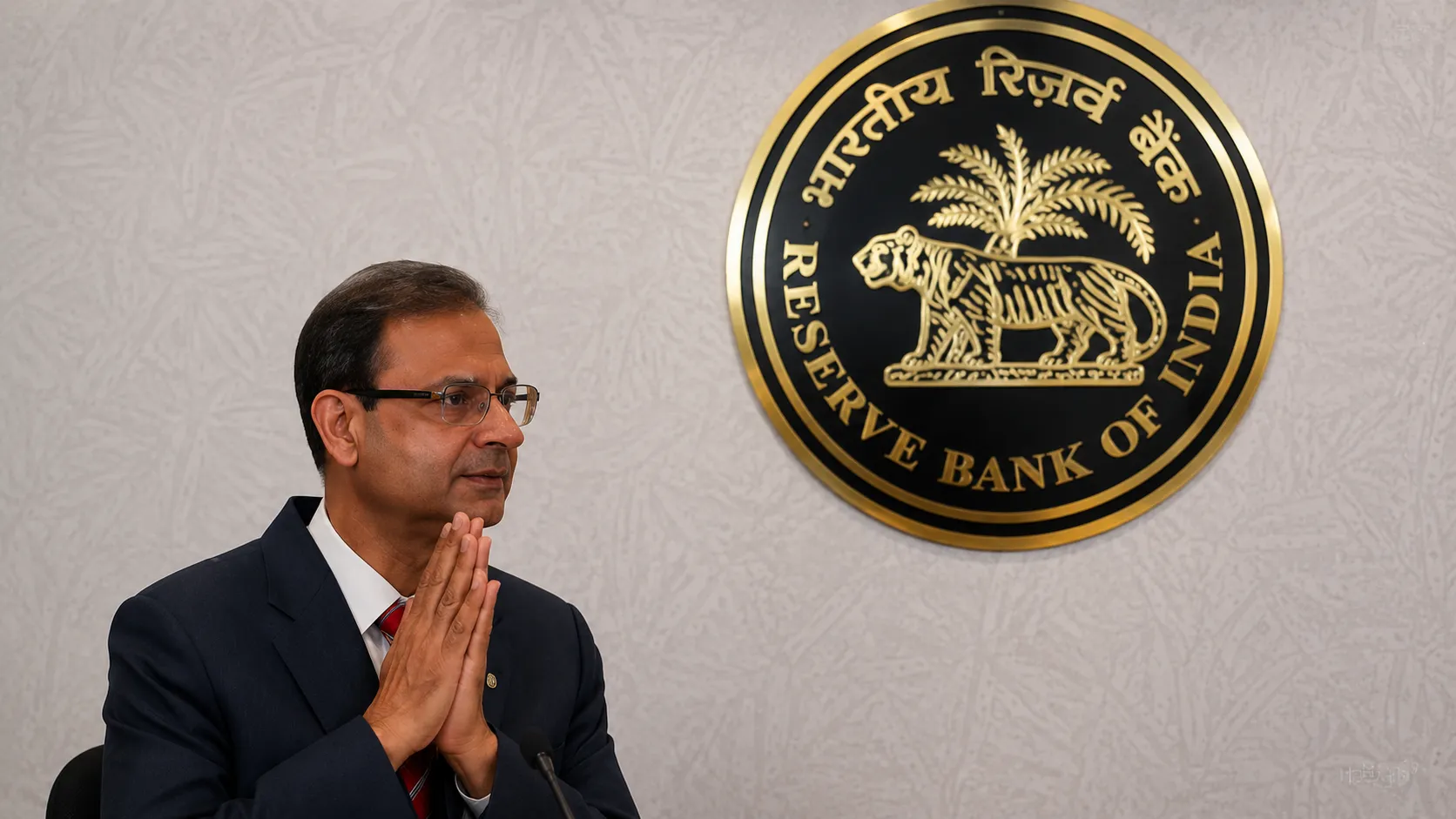
India's Monetary Policy Committee will reconvene in just a matter of days — its three-day meeting scheduled for August 3 to 5, 2026 — for what shapes up as one of the more genuinely uncertain rate decisions the six-member panel has faced in recent memory. At its previous meeting on June 5, 2026, the MPC, chaired by RBI Governor Sanjay Malhotra, unanimously voted to keep the benchmark repo rate unchanged at 5.25 percent and retained its neutral policy stance — but paired that decision with a notably less comfortable macroeconomic backdrop than the central bank had been describing just months earlier, trimming its FY27 GDP growth forecast to 6.6 percent from 6.9 percent while simultaneously raising its inflation forecast to 5.1 percent from 4.6 percent.
That combination — growth revised down, inflation revised up — is precisely the kind of scenario that makes a central bank's job genuinely difficult, since the conventional monetary policy playbook calls for opposite responses to each half of the equation: cutting rates to support flagging growth, while holding or raising rates to contain rising inflation. Malhotra, explaining the RBI's reasoning at the June policy press conference, attributed the deteriorating outlook to a specific combination of external shocks largely outside the central bank's own control: the impact of the West Asia conflict, elevated global energy prices, and genuine uncertainty surrounding the southwest monsoon and broader El Niño-linked weather conditions that directly affect India's agricultural output and, by extension, food price inflation — historically one of the most volatile and politically sensitive components of India's overall inflation basket.
Despite the more cautious growth and inflation projections, Malhotra was careful to balance that caution with genuine confidence in the underlying strength of India's domestic economy, noting that domestic economic activity remains resilient, supported by strong demand, healthy bank balance sheets, sustained credit growth and infrastructure spending — language that reads less like a central bank preparing markets for an imminent, defensive rate cut, and more like one signalling confidence that the current 5.25 percent rate, alongside the cumulative 100-plus basis points of easing already delivered since February 2025, remains appropriately calibrated for an economy that continues expanding at a healthy pace even as specific external cost pressures complicate the near-term inflation picture.
The RBI's June policy meeting also came bundled with a broader package of measures explicitly aimed at strengthening India's capital account and supporting the rupee — moves that several market analysts interpreted as at least as significant as the headline rate decision itself. The central bank expanded the Fully Accessible Route to include all newly issued 15-, 30- and 40-year government securities, entirely removed investment and concentration limits for foreign portfolio investors under the General Route, increased equity investment caps for non-resident Indians and Overseas Citizens of India, and introduced new tactical liquidity facilities designed to smooth short-term funding conditions. Fund managers tracking the announcement characterised the combined package as a highly significant, coordinated effort to attract foreign capital and ease pressure on India's balance of payments — measures that, notably, worked alongside rather than through the traditional interest-rate lever, giving the RBI additional tools to manage currency and capital-flow pressures without necessarily needing to move the headline repo rate itself. The government complemented those RBI measures with its own parallel step, removing capital gains and withholding taxes on certain categories of foreign investment in government securities — a coordinated fiscal-and-monetary policy push that several economists described as unusually well-synchronised even by the standards of India's typically closely coordinated finance ministry and central bank relationship.
Understanding how the RBI arrived at 5.25 percent requires tracing the full arc of its easing cycle over the preceding eighteen months. The central bank began cutting rates from a peak of 6.5 percent in February 2025 under newly appointed Governor Malhotra's very first policy meeting, delivering a 25 basis point cut as inflation showed early signs of aligning with the RBI's target band. That initial cut was followed by additional reductions through the remainder of 2025, including a larger-than-expected 50 basis point cut delivered in June 2025, taking the cumulative reduction since the start of the cycle to roughly 125 basis points before the RBI moved to a more cautious, pause-oriented stance beginning around August 2025, when the central bank held rates steady even as the broader economic conversation increasingly turned toward managing the fallout from the newly imposed US tariffs rather than continuing an aggressive domestic easing cycle. Since that pivot to a more measured pace, the RBI has held the repo rate steady across multiple consecutive meetings, with June 2026's decision continuing that now well-established pattern of stability rather than continued cutting.
Independent economist commentary heading into the August meeting has reflected genuine division about the most likely path forward, reflecting how finely balanced the underlying growth-versus-inflation calculus genuinely is. Some economists have pointed to the RBI's own explicitly stated inflation concerns — the upward revision to 5.1 percent, well above the central bank's 4 percent medium-term target — as strong evidence the MPC is likely to hold rates steady again in August, prioritising inflation containment over any further growth-supportive easing, particularly with food price risks tied to monsoon performance still not fully resolved at the time of the upcoming meeting. Others have argued the growth downgrade to 6.6 percent, representing a meaningful step down from the 6.9 percent the RBI had been projecting as recently as April, provides genuine justification for at least one further rate cut, particularly if incoming data through July continues to show the kind of external-shock-driven softness — elevated energy costs, tariff-related export sector stress — that the central bank explicitly cited as the primary driver of its own downgraded outlook.
The RBI's decision to maintain a neutral, rather than explicitly accommodative or restrictive, policy stance throughout this period is itself a meaningful signal worth unpacking for readers less familiar with central bank communication conventions. A neutral stance formally signals that the committee's future rate decisions will be driven flexibly by incoming data — growth and inflation prints, external developments, currency movements — rather than committing in advance to a predetermined direction of further easing or tightening. That flexibility has, in practice, allowed the RBI to hold rates steady for an extended stretch without formally signalling an end to its broader easing cycle, preserving optionality to cut further if growth data deteriorates more sharply, while equally preserving the credibility to hold firm, or even reverse course, should inflation prove more persistent than currently projected.
For India's banking sector and broader credit markets, the practical consequence of the RBI's extended pause at 5.25 percent has been a period of relative stability in lending rates, allowing banks to continue the gradual transmission of the substantial cumulative easing already delivered since February 2025 through to actual borrower-facing loan pricing — a transmission process that, as is typically the case in India's banking system, tends to lag the RBI's own headline rate decisions by several months as individual banks adjust their marginal cost of funds-based lending rates and other pricing benchmarks. Borrowers with floating-rate home loans, auto loans and business credit have, over the course of the RBI's roughly eighteen-month easing cycle, seen meaningful cumulative relief in EMI burdens, even though the pace of that relief has slowed considerably as the central bank has moved from active cutting to sustained pausing over the past year.
Looking specifically toward the August 3-5 meeting, market participants will be parsing incoming data through the final days of July and first days of August with particular care — inflation prints, any further clarity on monsoon performance and its implications for the agricultural output that anchors food price inflation, and the evolving trajectory of global crude oil prices, which the RBI has repeatedly flagged as one of the most significant swing factors shaping its own inflation outlook, particularly given the West Asia-linked shipping disruptions that have already shown up meaningfully in India's June trade data. Whether the committee opts to hold steady for a further consecutive meeting, prioritising the inflation risks it has itself highlighted, or delivers a further cut in response to the growth concerns embedded in its own downgraded FY27 projection, the August decision will offer the clearest signal yet of how the RBI is ultimately choosing to weigh two genuinely competing pressures that, for the first time in some months, are now pulling in meaningfully different directions.
The composition and functioning of the Monetary Policy Committee itself is worth understanding for readers less familiar with how India's rate-setting process actually works. The six-member MPC comprises three RBI officials, including the Governor as chairperson, alongside three external, independent members appointed by the central government specifically to bring outside academic and market expertise into the rate-setting process — a structure explicitly modelled on international best practice for insulating monetary policy decisions from short-term political pressure, even though the government retains the authority to appoint the external members. Each member votes independently on both the rate decision and the broader policy stance, with decisions determined by simple majority and, crucially, made public through detailed voting records that allow markets and analysts to assess not just the headline decision but the degree of consensus or division underlying it — a transparency mechanism the RBI has consistently maintained since the MPC framework's introduction, giving genuine insight into how finely balanced individual meetings, including the upcoming August decision, might ultimately prove to be.
For currency markets specifically, the RBI's rate decision will land alongside continued scrutiny of the rupee's own trajectory, given how directly interest rate differentials between India and other major economies — the US Federal Reserve's own policy path chief among them — influence the relative attractiveness of rupee-denominated assets to global capital. A further RBI hold, maintaining India's currently attractive real interest rate differential relative to developed-market alternatives, would generally be read as modestly supportive for the rupee, while a fresh rate cut, though justified on domestic growth grounds, could introduce at least some incremental currency pressure — a trade-off the central bank's own broader package of capital-account liberalisation measures announced in June appears specifically designed to help offset, regardless of which way the actual rate decision ultimately breaks in August.
The stakes of the August decision extend well beyond financial markets into the everyday economics of Indian households and businesses. Homebuyers with floating-rate mortgages, small business owners reliant on working-capital credit lines, and corporate treasurers managing debt servicing costs across India's broader economy all have a direct, tangible stake in whichever way the MPC ultimately votes — a further cut would extend the EMI relief borrowers have gradually experienced since the easing cycle began in February 2025, while a continued hold would signal the central bank's priority remains anchoring inflation expectations even at some near-term cost to borrowing costs remaining exactly where they currently sit rather than easing further.
Ratings agencies and international financial institutions monitoring India's monetary policy trajectory have, for their part, generally characterised the RBI's approach through this entire cycle — aggressive initial easing followed by a measured, data-dependent pause — as a broadly credible, well-communicated example of central bank policy-making under genuinely difficult, externally-driven uncertainty, a characterisation that stands in useful contrast to the more volatile, less predictable monetary policy communication some other major central banks have delivered while navigating their own post-pandemic inflation and growth challenges. Whatever the MPC ultimately decides on August 5, the committee's now well-established pattern of pairing clear rate decisions with detailed, transparent reasoning is likely to continue giving markets and businesses alike a reasonably clear window into the central bank's evolving thinking, even when the underlying growth-inflation trade-off itself remains genuinely difficult to resolve.


