
For decades, one of Indian banking's quietest open secrets has been the phenomenon insiders call the "set-piece" — a defaulting borrower who deliberately lets a loan slide into default, allows the bank to seize the underlying property, and then, months or years later, buys the very same asset back at a steep discount through a relative, a business partner, or an anonymous shell entity bidding at the eventual auction. On July 16, 2026, the Reserve Bank of India moved decisively to shut that loophole, issuing a sweeping new prudential framework that, for the first time, explicitly and unambiguously prohibits banks from selling repossessed immovable property back to the original defaulting borrower or anyone connected to them — even after the asset has technically left the special regulatory category the new rules create for it.
The framework arrives through the RBI (Commercial Banks – Resolution of Stressed Assets) Third Amendment Directions, 2026, which introduces an entirely new chapter dealing with what the central bank terms "Specified Non-Financial Assets," or SNFAs — a formal classification covering land, residential and commercial buildings, factories and other physical, immovable collateral that banks, non-banking financial companies, small finance banks, cooperative banks, regional rural banks and other regulated lenders acquire in full or partial settlement of loans that have gone bad. The directions will come into force on October 1, 2026, giving the banking system a roughly ten-week runway to update internal policies, retrain recovery teams and, in many cases, renegotiate standard operating procedures that have governed asset seizure and disposal for years.
At the heart of the new framework sits a straightforward but consequential principle: banks are fundamentally financial institutions, not property companies, and are not expected, in the ordinary course of their business, to become long-term owners of non-financial assets like land and buildings. When a bank is forced into ownership of a property as an exceptional measure during loan recovery, the RBI's position is now unambiguous — that ownership must be temporary, transparent, and structured, rather than open-ended, opaque and subject to informal negotiation with the very borrower whose default created the situation in the first place.
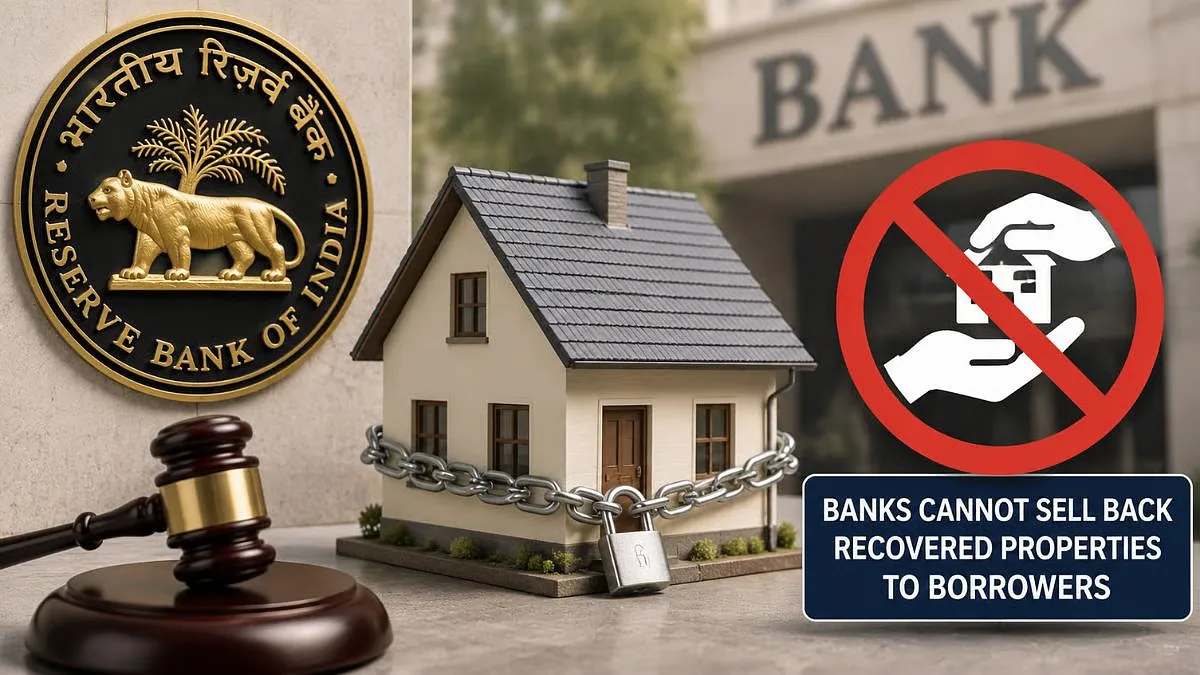
The prohibition on selling seized assets back to defaulters is the provision that has attracted the most attention, and for good reason — it directly targets a practice regulators, recovery professionals and forensic auditors have long identified as one of the more persistent forms of soft corruption within India's loan-recovery ecosystem. Under the new rules, a bank that has acquired an immovable asset through the recovery process cannot sell that asset back to the original borrower, nor to any related party — a definition the RBI has drawn broadly enough to capture relatives, business partners, and entities under common control or beneficial ownership with the defaulter. Notably, the prohibition persists even if the property subsequently ceases to be classified as an SNFA, closing an obvious potential workaround where a bank might have waited for an asset to exit the special category before quietly arranging its return to the original owner through informal channels. The central bank's own reasoning, laid out in the directions, is explicit about the moral-hazard risk this creates: permitting such sales could create a moral hazard and weaken credit discipline by giving defaulting borrowers a preferential opportunity to regain ownership of the very asset they had failed to pay for in the first place — effectively allowing a wealthy or well-connected defaulter to treat a loan default as a discounted, government-mediated purchase mechanism rather than a genuine financial failure with genuine consequences.
Alongside the buy-back prohibition, the RBI has introduced a hard ceiling on how long banks can hold onto seized properties. Lenders must now dispose of SNFAs within a timeline specified in their own board-approved internal policy — but that internal timeline cannot exceed a maximum of seven years from acquisition under any circumstances. This addresses a separate, longstanding problem in Indian banking: properties seized during loan recovery that simply sit on bank balance sheets indefinitely, generating no return, tying up capital that could otherwise support fresh lending, and in many cases physically deteriorating for want of maintenance while ownership remains in regulatory limbo. Banks with particularly large inventories of such repossessed properties — a category that includes several public-sector lenders with legacy exposure to stressed corporate and real-estate loans from the 2010s NPA crisis — are now expected to accelerate disposal to comply with the seven-year outer limit, a process several banking analysts have suggested could meaningfully free up both balance-sheet capital and, in aggregate, a non-trivial supply of real estate that could enter the open market over the coming several years.
The mandated disposal mechanism is equally significant: the RBI has directed that banks must make all reasonable efforts to dispose of SNFAs through public auction, following the auction principles already established under the SARFAESI Act — India's primary legal framework for secured-asset enforcement. This is a deliberate design choice aimed at maximising transparency and genuine price discovery. Public auctions, unlike negotiated private sales, create a competitive environment where the eventual sale price is more likely to reflect genuine market value, reducing the scope for the kind of opaque, preferentially-priced transactions that have historically allowed connected insiders — including, in some documented cases, the original defaulters themselves operating through intermediaries — to acquire seized assets well below fair value.
On valuation, the RBI has also introduced a standardised methodology designed to prevent banks from either overstating or understating the worth of seized assets on their books. Upon acquisition, an SNFA must be recorded in the bank's balance sheet at whichever figure is lower: the net book value of the loan that was extinguished by the acquisition, or the distress sale value as independently determined by at least two external valuers. Requiring two independent valuations, rather than relying on a single appraisal, is intended to reduce the risk of valuation manipulation — whether inflated to minimise the apparent loss a bank books on a bad loan, or deflated to facilitate an eventual below-market sale to a connected party.
The reporting and disclosure architecture around SNFAs has also been substantially strengthened. Critically, these seized assets will not be folded into a bank's Gross NPA, Net NPA, overall stressed-exposure, or provisioning-coverage-ratio calculations — figures that investors, credit rating agencies and the RBI itself use as the primary lens for assessing a bank's asset quality and financial health. Instead, SNFAs will be disclosed as a distinct, separately identified line item on bank balance sheets, described as "non-banking assets acquired in satisfaction of claims." Banks will additionally be required to report granular details on these holdings — including new acquisitions, disposals during the period, the ageing profile of assets still on the books, and any properties a bank has elected to put to its own operational use rather than sell — through the RBI's Centralised Information Management System, or CIMS, portal, giving the regulator an ongoing, near-real-time window into a category of bank assets that has historically received comparatively little scrutiny relative to its potential scale and risk.
Recognising that a hard, immediate cutover would create significant operational strain for banks sitting on large existing inventories of repossessed property, the RBI has built in a transition mechanism. Any SNFA already on a bank's books as of September 30, 2026, must be brought into full compliance with the new framework by September 30, 2027 — a one-year grace period intended to give lenders time to complete valuations, update internal policies and, where necessary, begin the disposal process for legacy holdings without triggering a disorderly, compressed sell-off that could itself distort local property markets in regions where individual banks hold concentrated portfolios of seized assets.
Banking-sector analysts have broadly welcomed the framework as a governance-strengthening measure, though several have flagged practical questions the directions leave open — including how strictly the definition of "related party" will be enforced in practice, given the creativity Indian corporate structures have historically shown in obscuring beneficial ownership through layered holding entities, and whether banks will genuinely have the internal capacity and market access to conduct the volume of public auctions the seven-year disposal deadline could eventually require, particularly for illiquid industrial or semi-urban commercial properties where buyer interest can be thin. Some analysts have also pointed to a potentially significant second-order effect: as banks accelerate disposal of legacy SNFA inventories to comply with the new timeline, a meaningful supply of previously seized real estate could enter the market over the next one to two years, a dynamic property-market watchers in cities with historically high concentrations of stressed corporate and real-estate lending will likely be tracking closely.
For ordinary borrowers, the practical message from the new framework is unambiguous, if sobering: if your property is ever seized by a bank following a loan default, there is now no formal mechanism — however well-connected you might be, and however patient you might be prepared to wait — through which you can arrange to buy it back directly, whether in your own name or through a relative or associate. The RBI has explicitly and firmly rejected industry suggestions that defaulting borrowers be given a formal, structured opportunity to repurchase their own seized assets, framing the change as a necessary step to eliminate a longstanding and quietly corrosive practice, restore genuine credit discipline across the banking system, and ensure that recovered assets, once in a bank's possession, are disposed of through processes that are demonstrably fair to the broader public rather than quietly convenient to the borrower who defaulted in the first place.

To appreciate why the RBI felt the need to legislate this issue so explicitly, it helps to place the new framework against the backdrop of India's broader, decade-long struggle with stressed corporate assets. The country's banking system spent much of the 2015-2022 period working through an enormous pile of non-performing loans, much of it concentrated in infrastructure, steel, power and real-estate lending extended aggressively in the boom years of the mid-2000s. The Insolvency and Bankruptcy Code, introduced in 2016, gave lenders a structured legal mechanism to resolve corporate stress through time-bound insolvency proceedings, and public-sector banks in particular spent years cleaning up balance sheets that had ballooned with bad loans. But the IBC framework, focused as it is on structured corporate insolvency resolution, always left a parallel category of smaller, individually seized properties — homes, shops, small factories acquired through more conventional recovery action under SARFAESI rather than through full insolvency proceedings — governed by a comparatively thin and inconsistent set of internal bank policies rather than any uniform, RBI-mandated framework. It is precisely that gap the new SNFA directions are designed to close, extending the same spirit of transparency and time-bound resolution that reshaped large corporate insolvency to the more granular, and in aggregate no less consequential, world of individually repossessed properties.
For India's urban and semi-urban property markets, the practical effects of the new framework are likely to unfold gradually rather than all at once, but they are worth watching closely over the coming eighteen to twenty-four months. As banks work through both their transition-period legacy inventories and any fresh SNFA acquisitions under the tighter seven-year disposal clock, a steady, auction-driven supply of previously distressed residential and commercial property is likely to enter local markets in cities and towns where individual lenders hold concentrated exposure. Real-estate analysts have suggested this could, at the margin, exert modest downward pressure on prices in specific micro-markets with unusually high concentrations of repossessed inventory, even as it simultaneously offers genuine buyers — as opposed to the connected insiders the old system often favoured — a more transparent and accessible route to purchasing distressed property at fair, competitively-discovered auction prices. For a banking system that has spent much of the past decade rebuilding credibility around asset quality and recovery discipline following the NPA crisis of the previous decade, the new SNFA framework represents a further, if quieter, step toward the kind of transparent, rules-based recovery infrastructure that regulators, rating agencies and international investors have long identified as a prerequisite for Indian banks to be judged by the same governance standards as their global peers. As October 1 approaches, bank boards, internal audit committees and recovery teams across the sector will be working through the operational detail of implementation — updating internal valuation panels, revising board-approved disposal policies, and building out the CIMS reporting infrastructure the RBI now expects — the unglamorous but consequential groundwork behind what is, in substance, one of the more significant governance reforms Indian banking regulation has introduced this year.


