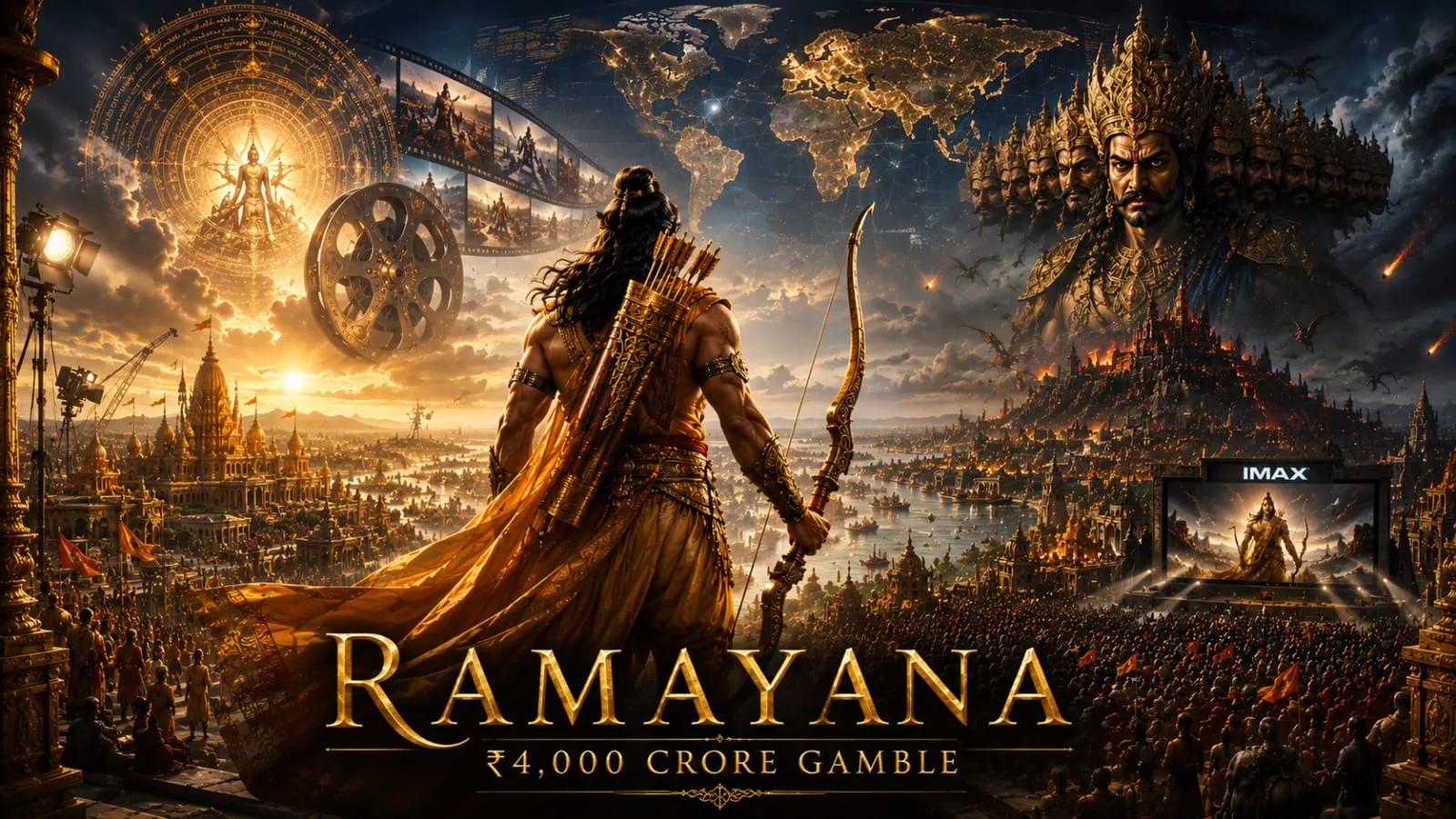
Before a single frame of Nitesh Tiwari's Ramayana has been projected on a cinema screen, the business of the film has already rewritten the economics of Indian filmmaking. With a reported budget of approximately ₹4,000 crore (roughly $500 million) for the two-part saga, it is being positioned as the most expensive Indian film ever made . But the staggering budget is only the beginning of the story. From a rejected ₹700 crore streaming offer to a potential ₹450 crore theatrical distribution deal, from real gold jewellery to a strategic IMAX release plan, Ramayana has become a business case study in how to build a global franchise without compromising on theatrical ambition. This is not just a film. It is a ₹4,000 crore gamble on the proposition that Indian mythology, mounted at global scale, can travel anywhere—and pay for itself along the way.
The scale of the project is unprecedented. Producer Namit Malhotra, speaking about the film's budget, revealed the ambition behind the numbers. "When we set out to make this six or seven years ago, people thought I was a lunatic because no Indian film comes close to this scale," he said . "Put simply, the budget will be around $500 million for both parts combined, which is over ₹4,000 crore. We're making the largest film in the world for the greatest epic that deserves to be seen globally. And yet, I believe we're doing it more efficiently than some of the biggest Hollywood films. We're not being irresponsible—we're being ambitious, but grounded" .
The cast assembled for this ambition matches the financial scale. Ranbir Kapoor, playing Lord Ram, is reportedly earning ₹75 crore per part—a total of ₹150 crore for both films . That represents a significant leap from his previous paydays of ₹25-35 crore for films like Brahmastra and Animal. Kannada superstar Yash, stepping into the role of Ravana, is charging approximately ₹100 crore for both parts, along with a profit-share as a co-producer . Sunny Deol, as Hanuman, is earning an estimated ₹40-50 crore, while Sai Pallavi, playing Sita, commands roughly ₹12 crore—a substantial increase from her South Indian project fees of ₹2.5-3 crore . Industry estimates suggest the total cast fees alone could cross the ₹500 crore mark .
The business of recouping this massive investment has already begun, and the numbers are staggering. Reports indicate that the makers are seeking a record-breaking ₹450 crore for the Hindi theatrical distribution rights alone . To put this in perspective, the current record for a Hindi film distribution deal belongs to Shah Rukh Khan's upcoming film King, which was recently acquired for approximately ₹250 crore . If producer Namit Malhotra secures even ₹300 or ₹400 crore, it would set a massive new benchmark that the industry has never seen before. Major players like Dharma Productions, AA Films, and Pen Studios are currently in talks, though distributors have reportedly urged for a more commercially viable price .
The rejection of a massive streaming offer signals the team's confidence in theatrical returns. According to multiple reports, the makers have turned down a ₹700 crore (£65 million) offer from Netflix for the combined OTT rights of both parts . The decision reflects a strategic choice to prioritize a wider theatrical strategy over a single upfront sale. By holding back from an early streaming deal, the producers appear to be aiming for sustained revenue across theatrical, satellite, and eventual digital windows rather than a single upfront payout . A separate report suggests an even more ambitious goal: a landmark deal touching ₹1,000 crore for digital rights alone, with the makers believing that digital sales should recover about 25 percent of the massive investment .
Trade experts are already projecting a historic theatrical run for the film. Some estimates suggest domestic net collections could range between ₹1,000 crore and ₹1,500 crore, with a potential worldwide gross exceeding ₹2,500 crore . If achieved, Ramayana would become the first non-sequel film to earn ₹1,000 crore net in India—a feat that has only been accomplished by sequels like Baahubali 2 and Pushpa 2 . The two-part structure is another strategic decision: the first instalment is slated for release on Diwali 2026, while the second is planned for Diwali 2027, allowing sustained marketing momentum and franchise-building .
The global ambitions for Ramayana are equally massive. Rumors suggest that Warner Bros. might handle distribution in the USA and Canada, while the China Film Group could oversee promotion in China . The makers are reportedly targeting a global footprint of over 42,000 screens with dubs in more than 45 languages . This level of international coordination is unprecedented for an Indian production and signals a clear intent to compete with Hollywood tentpoles on their own turf.
The release strategy has been carefully calibrated for maximum returns. According to reports, the first part is now expected to release on October 30, 2026—a week before Diwali—rather than on the festival day itself . A source explained the rationale: Namit Malhotra wants the film to establish itself before the Diwali period, allowing word of mouth to spread so that business peaks in the second week during the festive period . There is another strategic reason behind the preponement: the IMAX factor. Ramayana has been specifically designed for the IMAX experience, and another major biggie is set for release around the same time . Theatre owners in North America are confident about attracting large crowds for competing films, so the makers of Ramayana are planning their IMAX allocations carefully to secure premium screens across international territories . Once the release date is officially locked, the IMAX screen count across North America will be finalized immediately—a move expected to play a key role in the film's overseas performance .
The attention to detail extends to the film's craftsmanship. Tribe by Amrapali is the official jewellery partner for Ramayana, and the production team reportedly requested real gold in the making of the jewellery to support accuracy in visual representation . The development of the jewellery reportedly took over 18 months, covering design, prototyping, and execution, involving research into temple art and historical design systems .
According to an analysis of the mega-budget trend, Ramayana represents a structural shift in how Indian cinema is positioning itself globally . Producer Anand Pandit offered a sobering perspective: "This is a business of resilience where success is not guaranteed, and every film is a strategic bet. Even streaming platforms are becoming very selective about the films they pick. Chances are if a film fails at the box office, it will lose out on lucrative streaming deals. You cannot rely only on satellite rights and international distribution to recover money" .
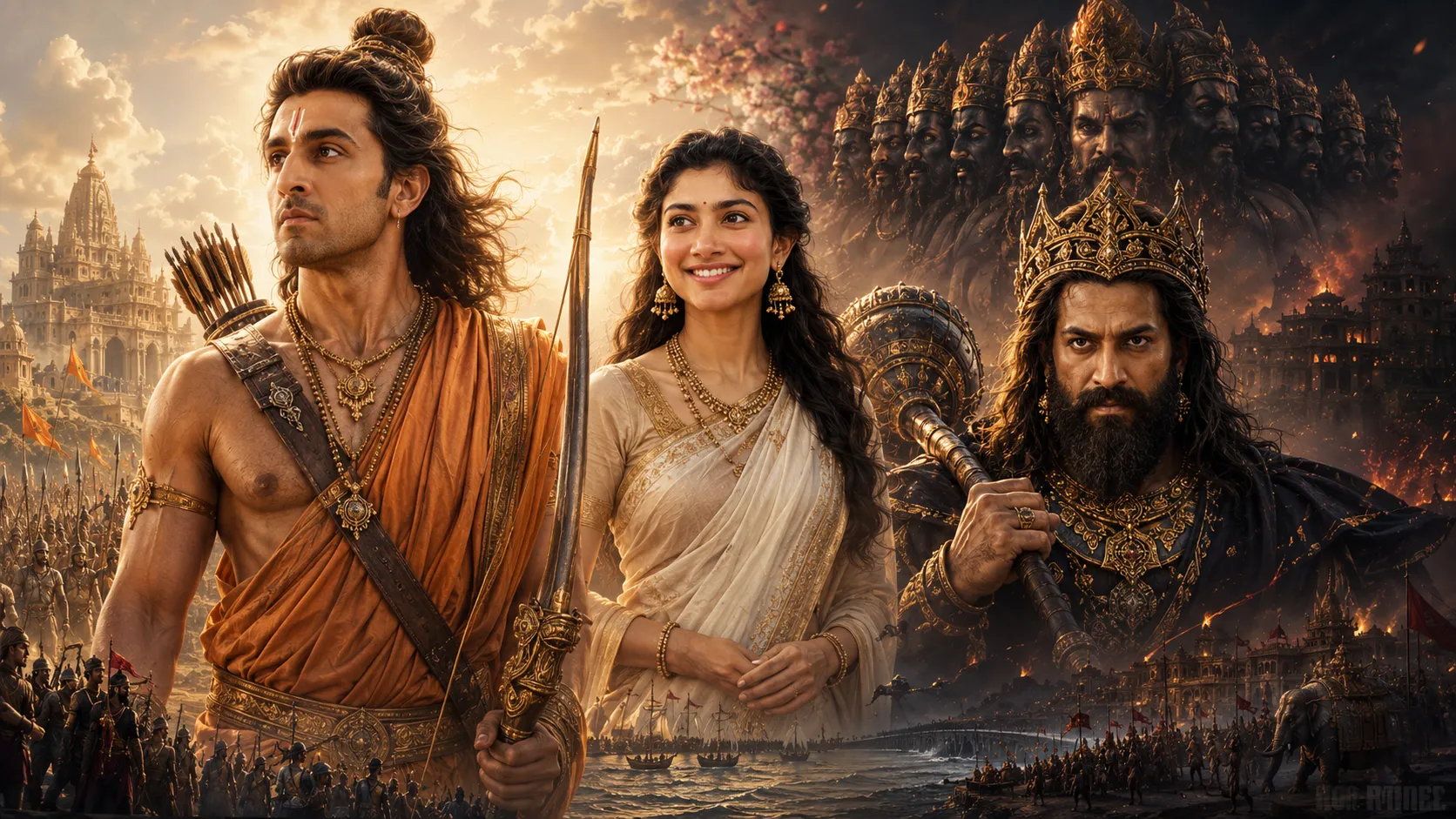
But the architects of Ramayana are betting that this time will be different. The film's advanced dubbing technology, Brahma AI developed by DNEG, promises seamless language conversion with accurate lip sync, helping the film connect with global audiences . According to the developers, this technology removes traditional language barriers, ensuring natural expressions while adapting dialogues—a significant advantage for international reach .
The 2026 cinematic landscape presents both opportunity and challenge. While Ramayana enjoys a rare solo window during Diwali in the Indian market, the country currently houses fewer than 30 IMAX screens, meaning the domestic premium market acts more like a boutique showcase than a heavy-duty recovery engine . For a film of this magnitude to reach its breakeven point, it must function as a global event, pulling in high-ticket revenue from international hubs where IMAX and premium large-format screens are the standard .
Whether Ramayana lives up to its business projections remains to be seen. But one thing is already certain: before a single ticket has been sold, before a single review has been published, Ramayana has already changed the conversation around Indian cinema. It has proven that Indian producers can think at Hollywood scale, negotiate with global distributors, and reject nine-figure streaming offers in pursuit of a larger theatrical vision. The film is not just an adaptation of an epic. It is itself an epic—a ₹4,000 crore wager on the idea that India's stories belong on the world's biggest screens. And for that alone, it is already one of India's biggest entertainment business stories.


