QUANTUM COMPUTING'S "TENSORFLOW MOMENT"
Why the long‑promised revolution is finally real – and how startups are making it programmable
BOULDER, Colorado – For decades, quantum computing has been the tech industry's most tantalizing promise – and its most frustrating tease.
Every few years, a headline would scream: "Quantum Breakthrough!" Then, nothing. The machines remained too noisy, too expensive, too impossible to program. Skeptics called it a forever‑away technology.
But something has shifted.
Over the past eighteen months, quantum computing has left the physics lab and entered the software era. The arrival of mature abstraction layers – toolkits and compilers that allow ordinary programmers to write quantum code without a physics PhD – is being called the industry's "TensorFlow moment," a reference to the library that democratized classical AI.
The result is a startup gold rush. According to PitchBook, quantum software and services startups raised $2.7 billion in 2025 – up 80% from 2024. For the first time, software funding now exceeds hardware funding in quantum. And the applications are no longer theoretical.
"We have moved from 'if' to 'when' to 'now,'" says Jay Gambetta, IBM's vice president of quantum computing. "The hardware is not perfect, but it is good enough. The software is ready. And the customers are showing up."
What Changed? The Software Stack Arrived
The single biggest barrier to quantum adoption was always programmability. Classical computers run on bits (0 or 1). Quantum computers run on qubits (0 and 1 simultaneously, thanks to superposition). Programming qubits requires a completely different mental model – linear algebra, complex amplitudes, and error correction that sounds like magic.
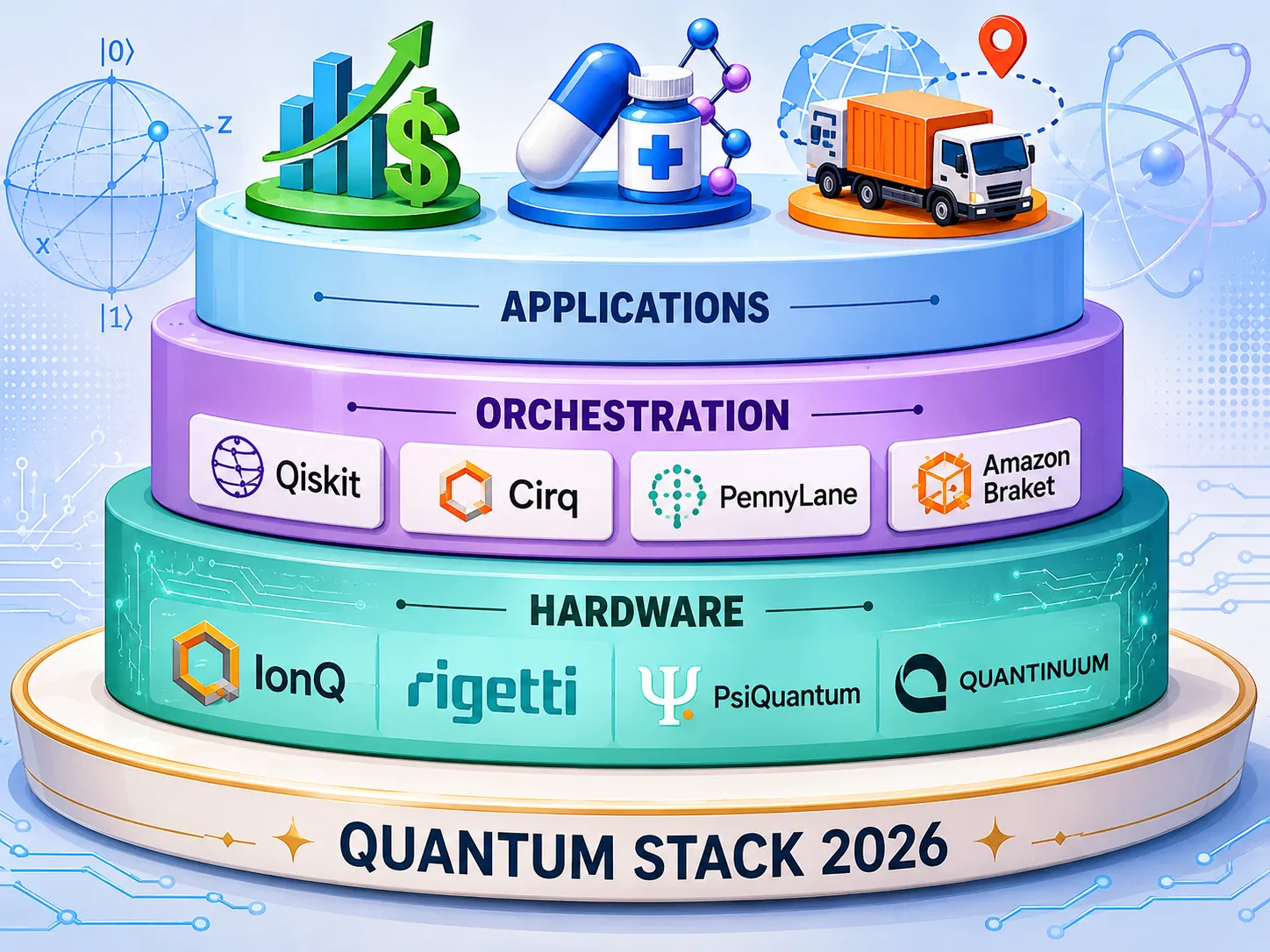
For years, the only people who could write quantum code were physicists with tenure. That changed when Qiskit (IBM), Cirq (Google), PennyLane (Xanadu), and Amazon Braket matured into production‑ready SDKs. These toolkits allow developers to write quantum circuits using familiar Python syntax, then run them on real quantum hardware or simulators.
"The goal was to lower the barrier to entry from 'Nobel laureate' to 'CS undergrad,'" says Nathan Killoran, co‑founder of Xanadu, which builds PennyLane. "We are almost there. Thousands of developers are now building quantum algorithms without understanding the underlying physics."
The second breakthrough was hybrid classical‑quantum computing. Most useful quantum algorithms do not run entirely on qubits; they run on classical computers that offload specific sub‑problems to quantum coprocessors. This hybrid approach works today, even with imperfect hardware.
"Classical computers are good at some things; quantum computers are good at others," says Peter Chapman, CEO of IonQ. "The winning strategy is to use each for what it does best. That is what our customers are doing right now, not in five years."
The Startup Landscape: From Hardware to Software to Services
The quantum ecosystem has fractured into three distinct layers, each with its own startups.
1. Hardware: The Qubit Makers
Hardware startups are still racing to build stable, scalable qubits. The leading approaches:
IonQ (College Park, Maryland) uses trapped ions – charged atoms held in place by lasers. The company went public via SPAC in 2021 and now has a market cap over $5 billion. Its latest machine, Forte, has 32 qubits and is available via Amazon Braket.
Rigetti Computing (Berkeley, California) builds superconducting qubits, similar to Google and IBM. The company recently emerged from Chapter 11 bankruptcy with a new focus on hybrid quantum‑classical systems.
PsiQuantum (Palo Alto, California) is building a photonic quantum computer using light, not matter. The company is famously secretive but has raised over $700 million from BlackRock and others. It claims to be on track for a million‑qubit system by 2029.
Quantinuum (Broomfield, Colorado) – a merger of Honeywell's quantum division and Cambridge Quantum – uses trapped ions with a focus on enterprise customers. The company just announced a $300 million round led by JPMorgan Chase.
2. Software: The Abstraction Layers
Software startups are building the tools that make quantum programming accessible.
Classiq (Palo Alto, California) generates optimized quantum circuits from high‑level algorithmic descriptions. Instead of hand‑coding qubit operations, you describe what you want to compute, and Classiq's engine figures out the most efficient quantum implementation. The company has raised over $100 million.
Horizon Quantum (Singapore / San Francisco) automatically translates classical code into hybrid quantum‑classical code. You write a function in Python or C++; Horizon's compiler identifies which parts could run faster on a quantum coprocessor. The company recently opened a San Francisco office.
QPerfect (Paris / Boston) focuses on quantum error mitigation – the art of getting useful answers from noisy qubits. The company's software can reduce error rates by 100x without requiring additional physical qubits. It just raised a $30 million Series A.
3. Applications: The Industry Solvers
The most exciting startups are those applying quantum computing to real industry problems.
QC Ware (Palo Alto, California) builds quantum algorithms for chemistry, materials science, and optimization. The company has partnerships with BMW, Airbus, and Goldman Sachs. Its quantum‑inspired classical solvers are already generating revenue.
Terra Quantum (Zurich / New York) focuses on quantum machine learning – using qubits to find patterns that classical computers miss. The company claims to have outperformed classical benchmarks on financial fraud detection and drug discovery.
Entropica Labs (Singapore / Boston) builds error‑corrected quantum algorithms for logistics and supply chain. The company just won a contract with a major shipping line to optimize fleet routing.

The Use Cases That Actually Work Today
Despite the hype, quantum computers are not yet breaking encryption or inventing miracle drugs. But they are solving real problems in three areas.
1. Portfolio Optimization
Financial firms are using hybrid quantum‑classical algorithms to optimize trading portfolios with hundreds of assets. Classical computers struggle with this combinatorial explosion; quantum annealers (a specialized type of quantum computer) excel at it.
"We have a production system that uses quantum‑inspired algorithms to rebalance our quantitative funds every hour," says a managing director at JPMorgan Chase who spoke on condition of anonymity. "It is not fully quantum, but it is quantum‑informed. And it is beating our classical benchmarks."
2. Molecular Simulation
Simulating a molecule with more than a few dozen electrons is exponentially hard for classical computers. Quantum computers naturally simulate quantum systems, making them ideal for drug discovery and materials science.
Moderna and Pfizer have both partnered with quantum startups to model mRNA interactions and protein folding. "We are not ready for prime time," says a Moderna researcher. "But we are seeing correlations that classical models miss. That alone is valuable."
3. Logistics and Routing
Optimizing delivery routes, supply chains, and air traffic control are classic "combinatorial optimization" problems. Quantum annealing – a specialized approach from D‑Wave – has shown particular promise.
Volkswagen used a D‑Wave quantum computer to optimize bus routes in Lisbon, reducing fleet size by 20%. FedEx has partnered with QC Ware to explore quantum‑optimized package sorting.
The Skeptics: Still Too Noisy?
Not everyone is convinced. Critics point out that today's quantum computers are still NISQ (Noisy Intermediate‑Scale Quantum) devices – meaning they produce errors that must be mitigated by software. True fault‑tolerant quantum computing, with error correction baked into the hardware, is still years away.
"A NISQ computer is like a car with square wheels," says Gil Kalai, a Yale mathematician and prominent quantum skeptic. "You can drive it, but it will never be practical. We are still waiting for the real breakthrough."
Startups counter that hybrid classical‑quantum algorithms work perfectly well with NISQ devices, and that error mitigation software is improving faster than hardware.
"Perfection is the enemy of progress," says Classiq's CEO, Nir Minerbi. "If we waited for fault‑tolerant quantum, we would wait another decade. Instead, we are building useful applications today on imperfect hardware. That is how every technology matures."
The Bottom Line: Programmable, Not Perfect
Quantum computing has entered its software era. The hardware is not done evolving – and may never be "finished." But the tools to program it are good enough for early adopters to build real applications.
For startup founders, the opportunity is clear: build the software, services, and algorithms that make quantum useful. The hardware will catch up. It always does.
"The TensorFlow moment for quantum was not a single day," says IonQ's Chapman. "It was a slow, steady democratization of access and programming. That democratization is now complete. Anyone with Python can run a quantum circuit. That is a miracle. And it is only the beginning."


