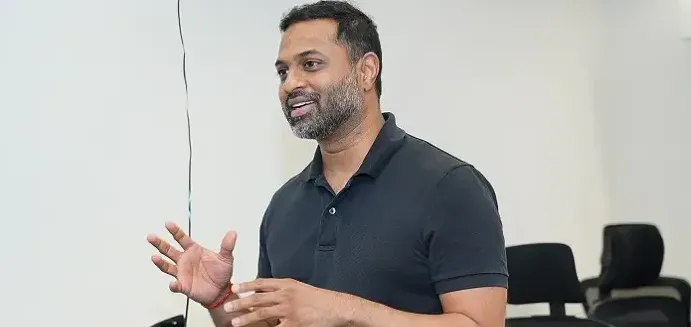
Prashanth Ranganathan — The Tech Entrepreneur Who Built a Global Digital Engineering Firm and Powered Chennai’s Angel Ecosystem
The Engineer Who Wanted More Than a Job
Prashanth Ranganathan grew up in Chennai, the son of a banker and a homemaker. He was good at math and science, but his real passion was building things — not just in theory, but in practice. After earning a degree in computer science, he took a job as a software engineer at a multinational IT services firm. Within months, he was restless.
“I was writing code for someone else’s product, and I had no idea if it ever made a difference,” he later recalled. “I wanted to build something I could own, something where I could see the impact.”
In 2004, at the age of 25, he quit his job and founded Payoda in Chennai. The name was inspired by a Tamil word meaning “river” — symbolising flow, continuity, and nourishment. The initial office was a small rented room in Chennai’s T. Nagar neighbourhood. Prashanth was the only employee.
The early years were typical of a services startup: small projects, tight budgets, and constant hustle. But Prashanth had a differentiating vision. Instead of competing with large IT services companies on low‑cost manpower (the “body‑shopping” model), he positioned Payoda as a digital engineering partner — a firm that could not only code but also architect solutions, integrate emerging technologies, and provide strategic product consulting.
That positioning gradually paid off. By 2010, Payoda had a team of 50 engineers, a growing portfolio of US clients, and a reputation for solving complex technical problems that larger firms avoided.
From Services to Products: The Digital Engineering Pivot
While many Indian IT services firms remained content with staff augmentation, Prashanth pushed Payoda toward product engineering — building software products for clients from scratch, not just maintaining legacy systems. This required a different skill set: product management, user experience design, agile development, and continuous deployment.
Payoda invested heavily in training its engineers in emerging technologies:
Artificial Intelligence & Machine Learning — building predictive models for retail and healthcare clients.
Internet of Things (IoT) — developing connected device platforms for industrial automation.
Cloud Native — migrating legacy applications to AWS, Azure, and GCP.
Blockchain — pilot projects in supply chain traceability.
This deep‑tech focus became Payoda’s moat. While other firms competed on rates, Payoda competed on capability. Clients stayed for years — not months — because Payoda’s engineers could solve problems that their in‑house teams couldn’t.
By 2015, Payoda had expanded to the United States, opening a delivery centre in New Jersey and a sales office in California. The company’s revenue crossed ₹100 crore, with a client roster that included Fortune 500 companies in retail, healthcare, logistics, and financial services.
Today, Payoda employs over 1,000 engineers across Chennai, Coimbatore, and the US, and is recognized as a leading digital engineering firm in the mid‑tier segment.
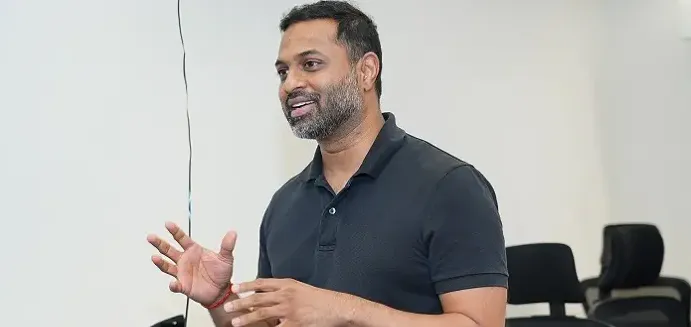
Building Chennai Angels: The Ecosystem Catalyst
Prashanth’s entrepreneurial journey gave him a front‑row seat to the challenges faced by early‑stage startups in Chennai. Access to capital was limited. Mentorship was scarce. Unlike Bengaluru, where venture capital flowed freely, Chennai had a fragmented, risk‑averse angel network.
In 2008, along with a group of like‑minded entrepreneurs and professionals, Prashanth co‑founded Chennai Angels — one of India’s first organized angel networks. The model was simple: pool capital from high‑net‑worth individuals, evaluate startups through a structured process, and invest small cheques (₹25 lakh – ₹2 crore) in early‑stage companies.
Over the past 18 years, Chennai Angels has funded over 100 startups across sectors including SaaS, fintech, healthtech, agritech, and D2C. Notable portfolio companies include:
Uniphore (conversational AI, now a unicorn)
Vayana Network (trade finance, valued over $500M)
Rivigo (logtech, though now pivoted)
Aqgromalin (agritech)
Karkinos (healthtech)
Prashanth has personally mentored dozens of founders — not just with capital, but with strategic advice, customer introductions, and recruitment support. His philosophy: “Angel investing is not charity. It’s patient capital. You back the founder, not just the idea, and you stay with them through the ups and downs.”
The “Chennai First” Philosophy
Unlike many successful entrepreneurs who move their headquarters to Bengaluru or Mumbai for ecosystem access, Prashanth kept Payoda and his angel activities firmly rooted in Chennai. He argues that Chennai offers unique advantages:
Talent stability: Engineers in Chennai stay longer (average tenure 4–5 years) compared to Bengaluru (2–3 years). Lower attrition means better product continuity.
Cost efficiency: Real estate and operational costs are 30–40% lower, allowing startups to extend runway.
Focus on building, not hype: Chennai’s quieter ecosystem allows founders to concentrate on product rather than networking events and valuation games.
He has been a vocal advocate for Tamil Nadu’s startup policy, working with the state government on initiatives like:
TANSIM (Tamil Nadu Startup and Innovation Mission)
Startup TN — a dedicated fund for early‑stage ventures
Chennai Innovation Center — a proposed deep‑tech incubator
In 2024, he was appointed to the Tamil Nadu Startup Policy Advisory Council, where he advises on measures to attract venture capital, simplify compliance, and promote women entrepreneurship.
Technology Trends: Where Payoda Is Betting
Under Prashanth’s leadership, Payoda has identified three technology megatrends that will define the next decade:
1. Generative AI for Enterprise
Payoda has built a practice around integrating large language models (LLMs) into business workflows — customer support automation, document summarization, code generation, and sales intelligence. The company has developed proprietary tools that reduce the cost of LLM deployment by 40% compared to building from scratch.
2. Edge AI and Computer Vision
For manufacturing and logistics clients, Payoda is deploying AI models at the edge — on cameras, sensors, and industrial controllers — enabling real‑time defect detection, inventory tracking, and predictive maintenance without cloud latency.
3. Legacy Modernization as a Service
Many large enterprises are stuck with legacy systems (COBOL, mainframes, outdated databases). Payoda’s “modernization factory” uses automated code conversion tools to migrate these systems to modern stacks (Java, Python, cloud) with minimal business disruption.
These bets have paid off. Payoda’s revenue from AI and digital engineering services has grown at 35% CAGR over the past three years, outpacing the broader IT services industry.
Leadership Philosophy: The “River” Mentality
Prashanth’s leadership is shaped by the metaphor of a river — the meaning of “Payoda.” A river flows steadily, nourishes everything along its path, and adapts to obstacles without losing its direction.
This translates into:
Long‑term client relationships: Payoda has clients who have been with the firm for over a decade. Prashanth rejects the “project‑to‑project” churn model.
Employee growth over utilisation: Unlike many services firms that measure billable hours, Payoda invests 20% of engineering time in upskilling and internal R&D.
Ecosystem over ego: His work with Chennai Angels is about lifting the entire startup community, not just his own brand.
He is also famously accessible. Any Payoda employee can schedule a 1‑on‑1 with him. He personally responds to emails from founders seeking advice, even those he hasn’t invested in.
Challenges and Critiques
No journey is without friction. Payoda has faced:
Margin pressure: Digital engineering commands higher rates than traditional IT services, but clients still negotiate aggressively. Prashanth has responded by moving up the value chain — offering outcome‑based pricing rather than time‑and‑materials.
Talent competition: Large tech firms and global capability centres in Chennai have raised salaries, making it harder for mid‑size firms to attract top talent. Payoda’s answer is culture and learning opportunities, not just compensation.
Succession: At 47, Prashanth is thinking about leadership transition. He has identified internal candidates and is gradually handing over operational responsibilities.
As an angel investor, he has faced criticism for being too conservative, often passing on high‑risk, high‑reward ideas. His defence: “I invest in what I understand. I’d rather miss a few unicorns than lose my capital on 100 moonshots.”
The Tamil Nadu Legacy
Prashanth Ranganathan has quietly built one of Tamil Nadu’s most enduring tech success stories — not a unicorn, but a profitable, growing, globally respected engineering firm. More importantly, he has channelled his success back into the ecosystem, funding and mentoring the next generation of Chennai founders.
His impact is visible in the dozens of startups that have graduated from Chennai Angels, in the engineers who have grown from junior developers to tech leads at Payoda, and in the policy changes he has influenced at the state level.
“Chennai doesn’t need to become another Bengaluru,” he says. “We need to become the best version of ourselves — a city that builds deep technology, supports its founders patiently, and creates lasting value. That’s the Chennai I believe in.”


