Pet Parents of Bharat: How D2C Pet Care Grew 300% in 2 Years
The Birthday Party That Changed Everything
In a modest apartment in Lucknow, a 34-year-old bank manager named Priyanka recently threw a birthday party for her three-year-old Labrador, Bruno. The guest list included four other neighbourhood dogs. The menu featured a custom-made peanut butter and banana cake (eggless, naturally). Party favours included chew toys and organic treats. The total bill: ₹4,500.
Three years ago, this scenario would have been unthinkable outside of South Delhi's crème de la crème. Today, it is quietly playing out in thousands of Tier 2 and 3 Indian cities.
The Indian pet parent has grown up. And with them, a D2C pet care economy that has exploded from virtually nothing to a $1 billion market in just two years.
The Numbers That Bark
India's pet care market—spanning food, accessories, grooming, healthcare, and insurance—was valued at approximately $0.9 billion in 2023 and is projected to reach $3.5 billion by 2027, growing at a CAGR of around 40%.
But the real headline is the D2C surge. According to a January 2026 report by SGA PR, D2C pet care startups have grown over 300% in the last two years (2023-2025), driven by increased pet adoption during the pandemic, rising disposable incomes, and the humanization of pets—treating animals as family members rather than guard animals.
The pet population in India is estimated at 32 million, with dogs and cats dominating. An estimated 5-7 million new pets were adopted during the COVID-19 lockdowns, creating a massive cohort of first-time pet parents who are now in their prime spending years.
Online penetration in pet care has jumped from under 10% in 2020 to nearly 40% in 2026, with D2C brands capturing the lion's share of new customer acquisition. Tier 2 and 3 cities now account for 55% of orders for leading pet D2C platforms—a statistic that would have been laughable just three years ago.
The Market Leaders: Who Is Walking the Walk?
Supertails: The Unicorn-in-Training
The most aggressive player in India's D2C pet care space is Supertails. Founded in 2021 by Vineet Khanna, Aman Tekriwal, and Aashika Jain, the Bengaluru-based platform offers a one-stop shop for pet food, supplies, treats, grooming products, and even teleconsultations with veterinarians.
In June 2026, Supertails raised $50 million in a Series C round led by Left Lane Capital, with participation from existing investors RPSG Capital Ventures and Sauce VC. The round valued the company at approximately $350 million, bringing its total funding to $85 million.
The growth metrics are staggering. Supertails claims to have grown 8x over the past two years, serving over 1.5 million pet parents across 1,200+ cities, with a catalog of 15,000+ products from 500+ brands. The company has expanded its veterinary teleconsultation services to over 100,000 consultations monthly.
Co-founder Aashika Jain told TIGI: "Today, 55% of our orders come from non-metros. The 'Bharat' pet parent is real, and they spend just as much on their fur babies as someone in South Mumbai. The only difference is they are more value-conscious—but once they trust a brand, they are actually more loyal."
Heads Up For Tails: The Omnichannel Veteran
While Supertails is the D2C darling, Heads Up For Tails (HUFT) is the legacy player that has successfully pivoted to omnichannel dominance. Founded in 2008 by Rashi Narang, HUFT was one of the first brands to recognize India's pet parent premiumization. The company has raised approximately $87 million in total funding, including a $37 million Series C from Verlinvest in 2022 and a $30 million Series D in 2024.
What sets HUFT apart is its offline presence. The brand operates over 110 exclusive retail stores across 30+ cities, each designed as a pet-friendly experiential space. However, its D2C channel has grown rapidly, contributing an estimated 40% of total revenue.
HUFT reported revenue of ₹250 crore in FY24 and is on track to cross ₹350 crore in FY26. The brand's private label products—food, accessories, grooming—enjoy healthy margins and deep customer loyalty.
Wiggles: The Health-First Challenger
Wiggles, founded in 2019, has taken a different approach: focus on pet health and insurance. In January 2026, Wiggles raised $11 million in Series B led by CapX Partners, bringing its total funding to approximately $20 million.
Wiggles has built a tech-enabled preventive healthcare ecosystem that includes vaccinations, diagnostic tests, grooming, and a proprietary pet insurance product underwritten by Bajaj Allianz. The company has serviced over 500,000 pets across India.
The insurance product is particularly notable. With pet healthcare costs rising—a single surgery can cost ₹50,000-1,00,000—insurers are finally taking notice. Wiggles claims to have processed over ₹5 crore in claims in 2025 alone.
The Premiumization Wave: From Pedigree to Freeze-Dried Raw
The most dramatic shift in Indian pet care is the flight to premium. The traditional market was dominated by Pedigree (Mars) and Drools (local giant), with cheap kibble and biscuits. Today, pet parents are demanding:
Grain-free, high-protein formulations (Labrador diets now mirror human keto trends)
Freeze-dried raw food (preserves nutrients without refrigeration)
Therapeutic diets (for allergies, kidney issues, obesity)
Organic, preservative-free treats (often made in human-grade kitchens)
D2C brands like Dogsee Chew (Himalayan cheese chews, exported to 20+ countries), Bombay Bakery (artisanal dog treats), and The Whole Truth (human food brand that now has a pet line) have capitalized on this trend.
The Service Economy: Grooming, Daycare, and Cremation
The D2C pet care boom is not limited to products. Services are the next frontier.
Swaggle (a pet supplies subscription box) has pioneered the "Amazon Prime for pets" model. PetBacker (pet sitting and walking) has raised funding and expanded to 15 cities. Creature of Habit (pet accessories) has built a cult following.
Even end-of-life services are seeing D2C disruption. Startups like Pawsitive Cremation and Furry Farewell offer at-home cremation services with personalized urns and memorials—a service that would have been taboo a decade ago.
The Tier 2/3 Explosion: Why Bharat Loves Its Pets
The most counterintuitive finding in India's pet care boom is its geographic spread. Conventional wisdom held that pet premiumization was a metro-only phenomenon. The data tells a different story.
55% of Supertails orders now come from non-metros.
HUFT's fastest-growing store locations are not Mumbai or Delhi but Lucknow, Nagpur, and Coimbatore.
Pet insurance adoption is actually higher in Tier 2 than in Tier 1 (smaller cities have fewer emergency veterinary hospitals, making insurance more attractive).
What explains the "Bharat" pet parent?
Work-from-home persistence: Many Tier 2/3 professionals who returned home during COVID kept their pets—and their metro spending habits.
Social media influence: Instagram and YouTube have made premium pet care aspirational across all geographies.
UPI and logistics: The same infrastructure that enabled D2C fashion and protein has made premium pet food accessible in remote pin codes.
The "companion" shift: In smaller cities, where joint families are still common, pets are increasingly seen as emotional companions rather than guard animals.
The Investment Frenzy: $200 Million and Counting
Venture capital has noticed. In the last 24 months, D2C pet care startups have raised over $200 million, with the largest rounds being:
Supertails: $50 million Series C (June 2026), $15 million Series B (Feb 2024)
Heads Up For Tails: $30 million Series D (2024), $37 million Series C (2022)
Wiggles: $11 million Series B (Jan 2026), $9 million Series A (2023)
Pawfectly: $6 million (2025)
Dogsee Chew: $4.5 million (2025)
The investor thesis is simple: India's pet care market is where China's was in 2015. Over the next decade, it will 5x. The early movers will become category kings.
The Challenges: Supply Chain and Standardization
No growth story is without thorns. Indian D2C pet care faces three major hurdles.
First, supply chain cold storage. Premium pet food often requires temperature-controlled logistics. India's cold chain infrastructure remains patchy outside metro hubs.
Second, regulatory ambiguity. The pet food industry in India is lightly regulated. There is no mandatory nutritional standard comparable to AAFCO (US) or FEDIAF (Europe). This creates room for bad actors and erodes consumer trust.
Third, returns and waste. Unlike apparel, returned pet food cannot be resold for safety reasons. The return-to-origin rates, while lower than fashion, still represent a significant cost.
The Global Indian Takeaway
For the diaspora, the D2C pet care boom offers several entry points.
Invest through VC funds: Funds like Sauce VC, RPSG, and Verlinvest are actively deploying capital in this sector. Follow-on rounds are likely.
Start a pet services franchise: Grooming salons, daycare centers, and boarding facilities have fragmented supply. A branded, D2C-integrated service chain could scale rapidly.
Export Indian pet products: Dogsee Chew already exports Himalayan cheese chews to 20 countries. The "Made in India" pet accessory and treat category has massive white-label potential for US and European markets.
The Final Word
The image of a Lucknow Labrador enjoying a vegan birthday cake is not an outlier. It is a symbol of a deeper shift: Indians are finally allowing themselves to love their pets the way the West has for decades. And that love is being monetized—by D2C brands that understand the fur parent's heart, and by a logistics network that can deliver a freeze-dried raw food meal to a Tier 2 doorstep in 48 hours.
The pet care market in India is not just growing. It is evolving from a functional necessity (guard dogs, stray feeding) to an emotional economy (fur babies, birthday parties, health insurance). And that evolution is just getting started.
The next time you see a Labrador in a bandana, know this: behind him is a ₹1,000 crore industry—and a pet parent who would do anything for his best friend.
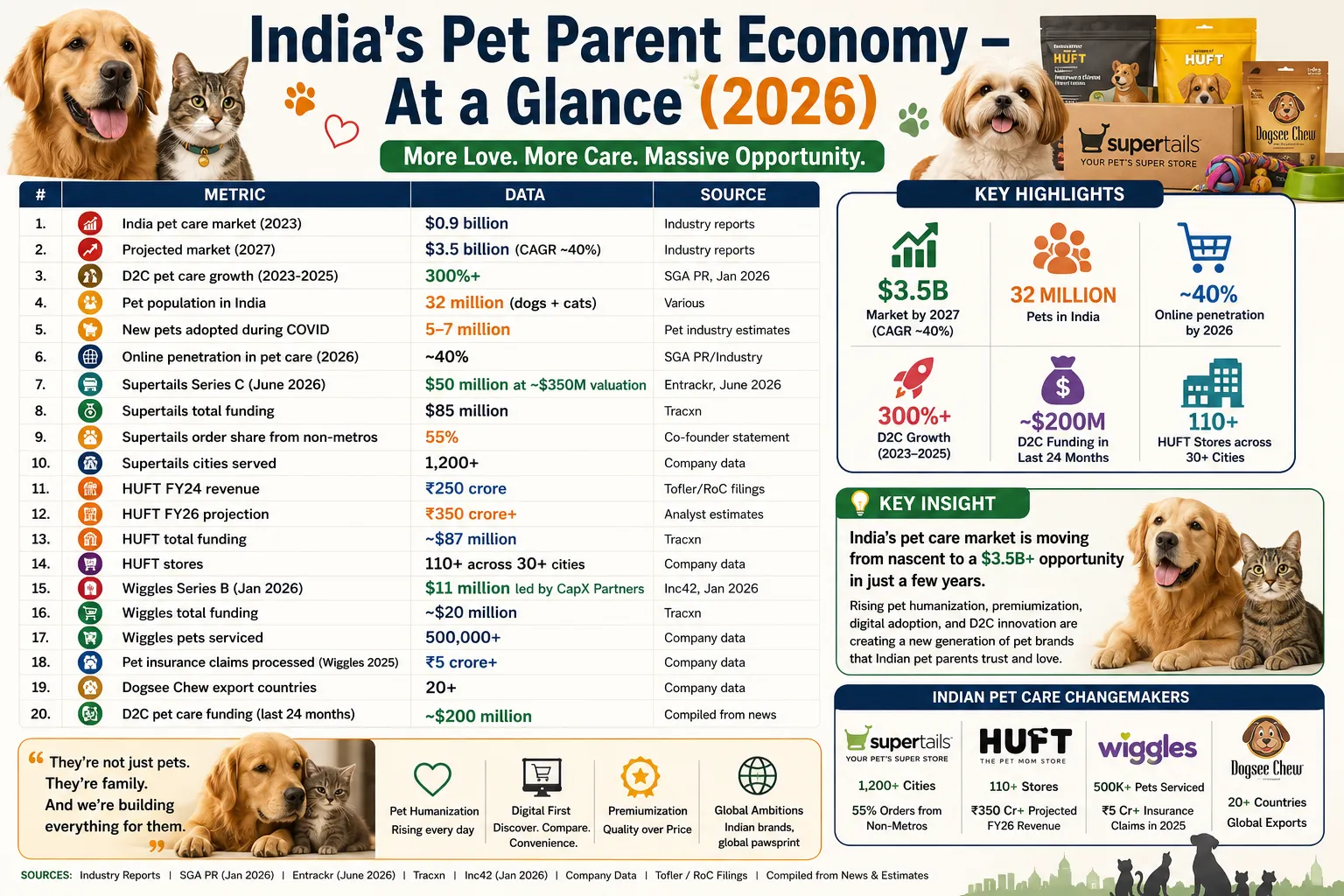
CHART: "India's Pet Parent Economy – At a Glance (2026)"
Metric | Data | Source |
|---|---|---|
India pet care market (2023) | $0.9 billion | Industry reports |
Projected market (2027) | $3.5 billion (CAGR ~40%) | Industry reports |
D2C pet care growth (2023-2025) | 300%+ | SGA PR, Jan 2026 |
Pet population in India | 32 million (dogs + cats) | Various |
New pets adopted during COVID | 5-7 million | Pet industry estimates |
Online penetration in pet care (2026) | ~40% | SGA PR/Industry |
Supertails Series C (June 2026) | $50 million at ~$350M valuation | Entrackr, June 2026 |
Supertails total funding | $85 million | Tracxn |
Supertails order share from non-metros | 55% | Co-founder statement |
Supertails cities served | 1,200+ | Company data |
HUFT FY24 revenue | ₹250 crore | Tofler/RoC filings |
HUFT FY26 projection | ₹350 crore+ | Analyst estimates |
HUFT total funding | ~$87 million | Tracxn |
HUFT stores | 110+ across 30+ cities | Company data |
Wiggles Series B (Jan 2026) | $11 million led by CapX Partners | Inc42, Jan 2026 |
Wiggles total funding | ~$20 million | Tracxn |
Wiggles pets serviced | 500,000+ | Company data |
Pet insurance claims processed (Wiggles 2025) | ₹5 crore+ | Company data |
Dogsee Chew export countries | 20+ | Company data |
D2C pet care funding (last 24 months) | ~$200 million | Compiled from news |


