The Central Board of Indirect Taxes and Customs has taken a concrete step toward addressing one of Indian industry's longest-standing compliance grievances, constituting a high-level 11-member working group to examine whether businesses operating across multiple states under the same Permanent Account Number could, in future, be administered by a single, centralised GST authority rather than being required to engage separately with tax offices in each state where they hold a registration. The panel, headed by Chief Commissioner Vinayak Chandra Gupta, has been tasked with analysing the legal, administrative, and technological changes that would be required to implement such a framework, and has been given a 30-day window to submit its findings — a comparatively tight timeline that signals the government's evident intent to move quickly on a reform that has, by most industry accounts, been under discussion for several years without decisive action.
To understand why this proposal matters, it helps to look back at how GST compliance has actually worked in India since the tax's introduction in July 2017. Before GST replaced the earlier system of excise duty and service tax, service providers operating across the country had access to a facility known as centralised registration, which allowed a business with operations in multiple states to deal with a single tax authority for compliance, audits, and assessments, rather than engaging separately with the tax administration in every state where it maintained a physical presence. This facility — along with a related mechanism known as the Large Taxpayer Unit, or LTU, system — was discontinued when GST was rolled out, replaced by a requirement that businesses obtain separate GST registrations in every state where they operate, and correspondingly deal with multiple, distinct field formations for audits, investigations, and routine assessments tied to each individual state registration.
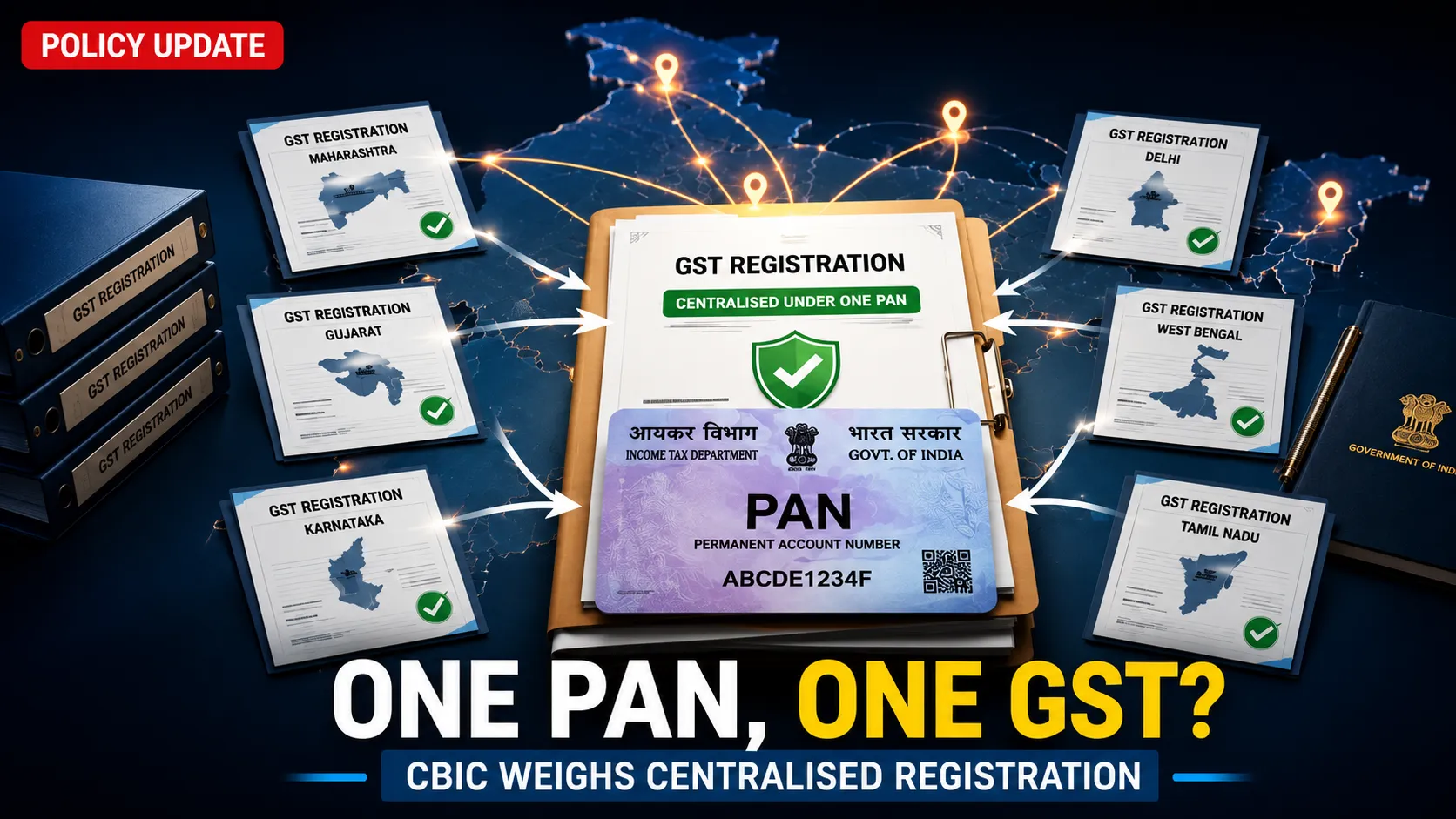
For businesses with a genuinely pan-India footprint — a category that today spans everything from large e-commerce operators and logistics companies to manufacturing conglomerates and professional services firms — this state-by-state registration requirement has translated into a considerable multiplication of compliance burden. Rather than managing a single relationship with one tax authority, such businesses must instead coordinate potentially dozens of separate registrations, each subject to its own local audit cycles, assessment timelines, and administrative quirks, even though all of these registrations ultimately trace back to the same underlying corporate entity and the same PAN. Industry stakeholders have consistently argued that this fragmented structure increases compliance costs and administrative complexity substantially, without delivering a corresponding improvement in the overall efficiency or effectiveness of tax administration — a critique that appears to have finally gained sufficient traction within the tax bureaucracy to prompt the formation of a dedicated working group.
The panel's mandate, as outlined by the CBIC, is deliberately broad in scope. Beyond simply assessing the feasibility of the core centralisation proposal, the working group has been asked to examine the erstwhile centralised registration and Large Taxpayer Unit mechanisms that operated under the pre-GST excise and service tax regime, drawing on that historical experience to inform how a modern equivalent might be structured. The group will also review international practices in comparable tax jurisdictions, presumably looking at how other large federal or quasi-federal tax systems — where sub-national or state-level tax administration coexists with national businesses — have balanced the competing demands of local tax authority autonomy against the compliance simplification benefits of centralised administration for large, multi-jurisdictional taxpayers.
Perhaps most significantly from an implementation standpoint, the panel has also been tasked with recommending whether any eventual centralised registration framework should be structured as optional or mandatory for eligible businesses. This distinction carries real practical weight: an optional framework would allow businesses to choose centralised administration where it suits their operational structure while retaining the existing state-wise registration model where that remains preferable, whereas a mandatory framework would represent a more sweeping structural change to how GST administration functions for any business meeting the relevant multi-state operation criteria. Given the scale of change either approach would represent, the panel's recommendation on this specific question is likely to be one of the most closely watched aspects of its eventual report.
The technological dimension of the proposal should not be understated either. Implementing genuinely centralised GST administration would require significant changes to the underlying tax administration systems that currently route compliance, audit, and assessment functions through state-specific jurisdictional structures. The panel has been explicitly tasked with examining what technology changes would be needed to support a centralised model — an acknowledgment that the current GST Network infrastructure, built around the existing state-wise registration architecture, would likely require meaningful re-engineering to support a fundamentally different administrative model without introducing new compliance gaps or operational friction during any transition period.
Reaction from tax professionals and industry bodies to the panel's formation has, by most accounts, been positive, reflecting the extent to which this has been a long-standing item on industry's wish list for GST reform. One tax expert, commenting on the development, noted that moving to a centralised administration model for GST taxpayers with operations spanning multiple states would represent a significant step toward reducing the compliance and audit challenges such businesses currently face — language that captures the essential logic behind why industry groups have continued to press for this change even as GST itself has, in other respects, matured considerably since its 2017 introduction. Service providers in particular, who had access to the pre-GST centralised registration facility until 2017, are seen as likely to benefit disproportionately from any eventual reintroduction of a comparable mechanism, given that many service businesses — from consulting and financial services firms to IT companies — often maintain a genuinely pan-India client base and operational footprint that does not map neatly onto state-by-state administrative boundaries.

The panel's 30-day reporting deadline, along with its mandate to submit a detailed implementation roadmap and draft proposals alongside its core recommendations, suggests the CBIC is aiming to move from analysis to concrete policy action relatively swiftly, rather than allowing this review to become another protracted, multi-year study of an issue that industry has already extensively documented and advocated on. Whether that ambition translates into an actual policy change — and if so, whether that change takes the form of an optional pilot programme or a more sweeping mandatory restructuring of GST administration — will depend heavily on what the working group concludes once its 30-day review period draws to a close. For now, though, the mere constitution of a dedicated, time-bound panel represents the clearest signal yet that India's tax administration apparatus is taking seriously a reform that businesses with genuinely national operations have been requesting, in one form or another, since shortly after GST's introduction eliminated the centralised registration facility they had previously relied upon.