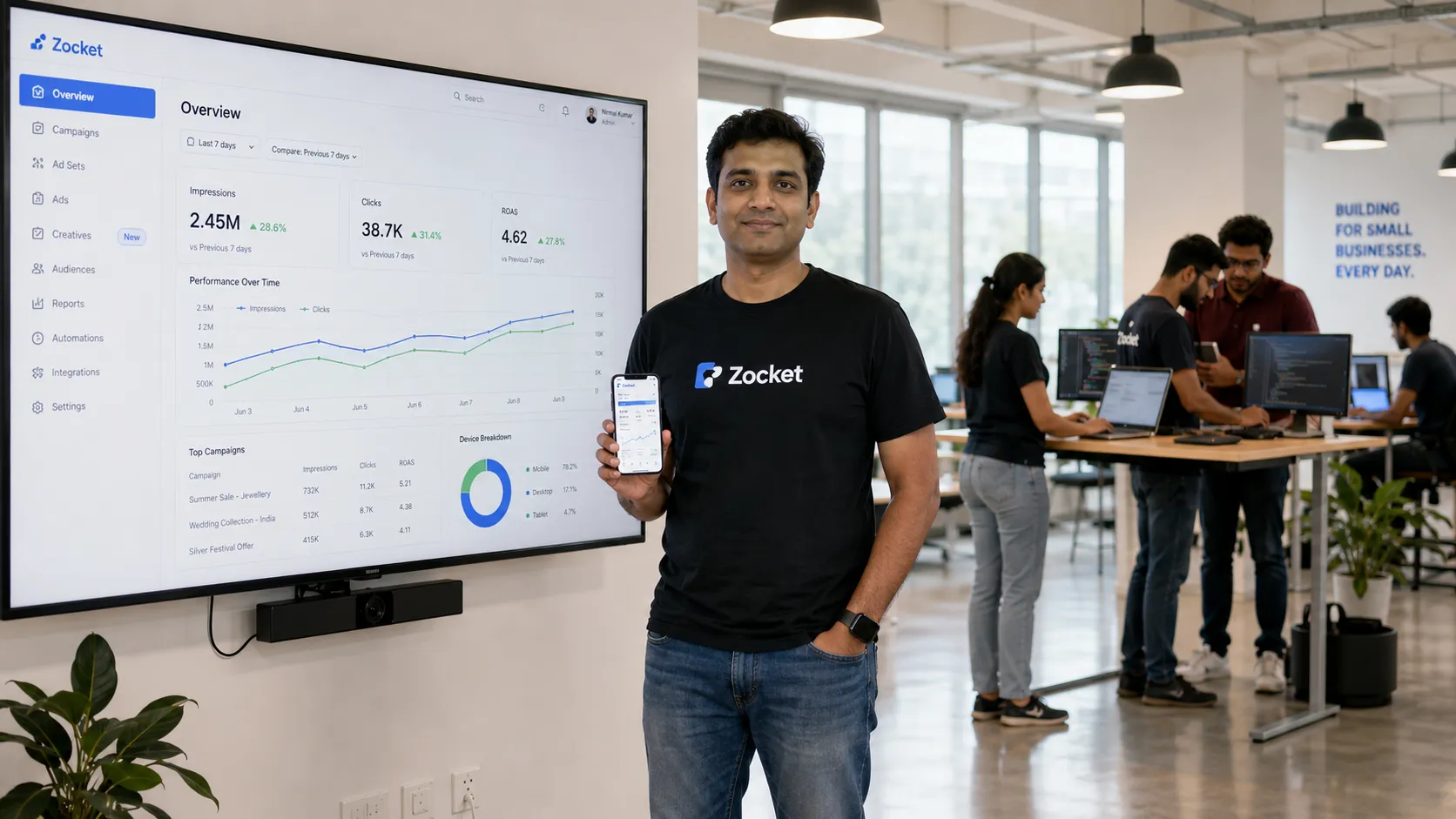
Nirmal Kumar — The Chennai Techie Who Built an AI Adtech Startup That’s Democratising Digital Advertising
The Freshworks Alumnus Who Saw a Gap in Ads
Nirmal Kumar grew up in Chennai, the son of a small business owner. His father ran a textile shop in T. Nagar, one of Chennai’s busiest commercial districts. Nirmal watched as his father struggled to attract customers in an increasingly digital world. “Papa would ask me to ‘do something with Facebook’ to get more footfall,” Nirmal recalls. “But the moment I opened the Ads Manager, we both got overwhelmed. Targeting, bidding, creatives, pixels — it was too complex.”
That frustration stayed with him. After earning a degree in computer science, Nirmal joined Freshworks as a software engineer. At Freshworks, he learned how to build scalable SaaS products for SMBs — the very segment his father belonged to. He also saw how powerful product‑led growth could be when you solve a genuine pain point.
In 2020, during the COVID‑19 lockdown, Nirmal quit his job and decided to solve the problem he had experienced firsthand. He founded Zocket — a name derived from “pocket” + “socket” (power in your pocket). The idea: an AI platform that would allow any business owner to create and run social media ads in under two minutes, with no prior experience.
He started coding in his Chennai apartment, building the first version of the engine. His initial capital came from savings and a small loan from his father — the same small business owner who had inspired the idea.
The Technology: Generative AI for Ad Creatives and Targeting
Zocket’s core innovation is a generative AI engine that automates the entire ad creation workflow:
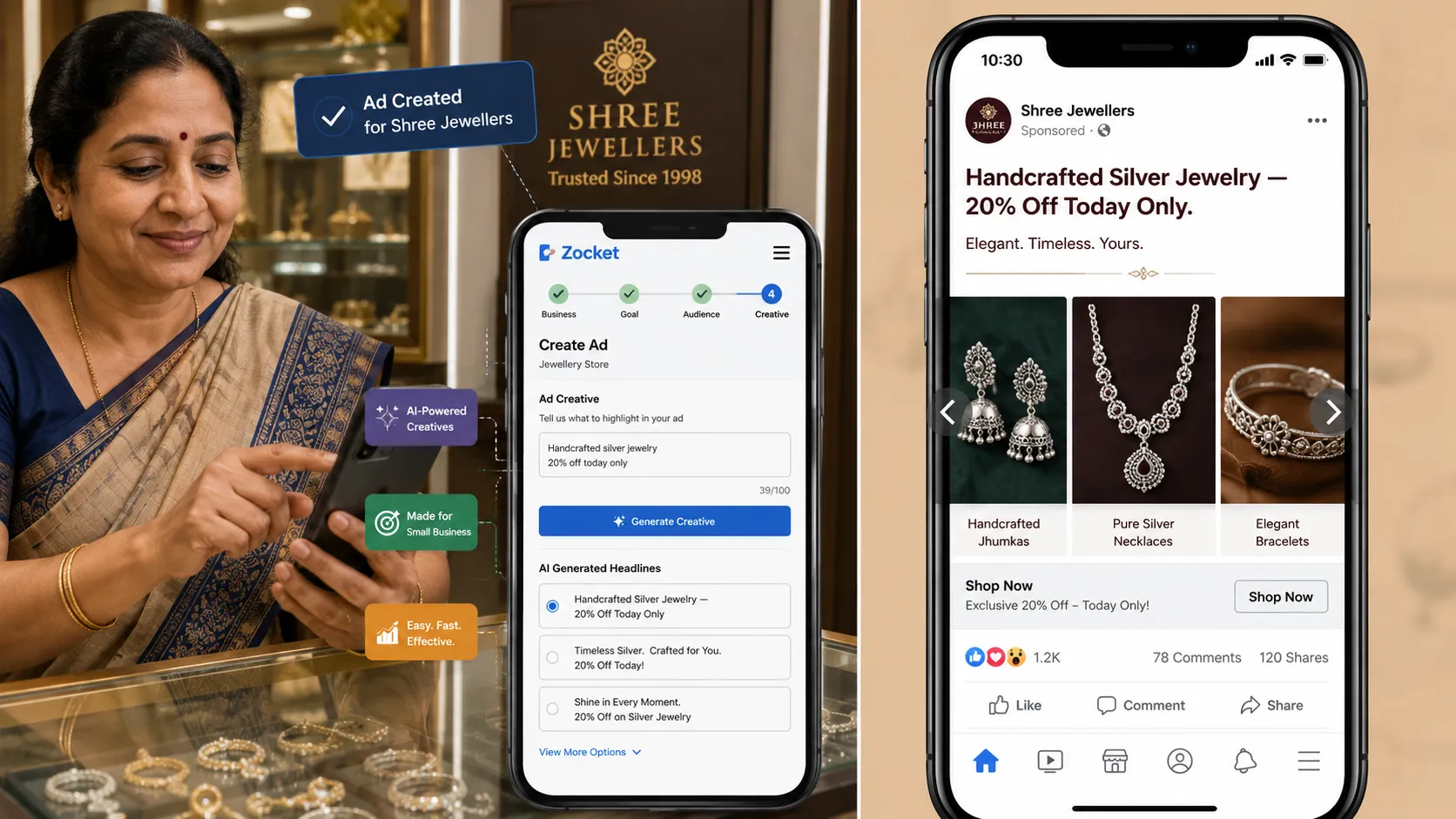
Ad creative generation: The user provides a few inputs — product name, category, key features, target audience (e.g., “women aged 25–40 in Chennai interested in ethnic wear”). Zocket’s AI then generates multiple ad creatives: headlines, body text, call‑to‑action buttons, and even image suggestions (with integration to stock photo and generative image APIs).
Audience targeting: Instead of asking users to define complex targeting parameters, Zocket’s AI recommends audiences based on the product description and historical performance data from similar campaigns. The engine learns from every campaign run on the platform, continuously improving its recommendations.
Budget optimisation: Users set a daily budget (as low as ₹250). Zocket’s algorithm automatically allocates spending across platforms (Facebook, Instagram, Google, LinkedIn) and ad formats to maximise return on ad spend (ROAS). The system can pause underperforming ads and shift budget to winning ones in real time.
Performance dashboard: A simple, visual dashboard shows key metrics — impressions, clicks, cost per click (CPC), conversions, and ROAS — without the jargon of traditional ad platforms. The dashboard also provides actionable recommendations (“Try increasing budget by 20% — your ad is performing above average”).
The result is a self‑serve ad platform that lowers the barrier to entry for SMBs, freelancers, and even individual creators. Users report spending 80% less time managing ads compared to using native platforms like Facebook Ads Manager, while achieving comparable or better ROAS.
From Chennai to the Nation: Scaling Zocket
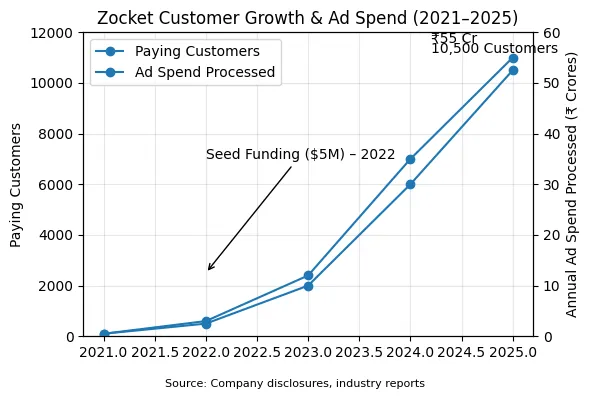
Zocket launched in early 2021 with a closed beta of 100 small businesses in Chennai. Nirmal personally onboarded each user, sat with them to understand their pain points, and iterated the product weekly. The feedback loop was intense but invaluable.
By mid‑2021, Zocket had 500 active users and was seeing strong retention (80% month‑on‑month). The platform was generating measurable results: a textile shop in Coimbatore increased footfall by 40% after running Zocket‑optimised Facebook ads; a restaurant in Madurai saw a 3x return on ad spend for a weekend buffet offer.
In 2022, Zocket raised a $5 million seed round led by Accel Partners and Titan Capital, with participation from several angel investors including Freshworks alumni. The funding was modest by unicorn standards, but Nirmal was deliberate: “We don’t need a billion dollars. We need enough to build a great product and serve our customers profitably.”
The funding enabled Zocket to expand beyond Chennai to 20 Indian cities, add support for multiple languages (Hindi, Tamil, Telugu, Kannada, Bengali), and integrate with WhatsApp Business for conversational commerce ads.
By 2024, Zocket had crossed 10,000 paying customers and was processing over ₹50 crore in annual ad spend on behalf of SMBs. The company became profitable at the operating level, with a net revenue retention (NRR) of 110% — meaning existing customers were spending more over time.
The Chennai Advantage: Building Deep Tech in a Tier‑2 Ecosystem
Unlike many founders who move to Bengaluru for “ecosystem benefits,” Nirmal kept Zocket’s headquarters in Chennai. The company’s engineering, product, and data science teams are all based in the city, with a small sales office in Mumbai.
Why Chennai? Nirmal cites three reasons:
Talent depth with lower churn: Chennai has world‑class engineering talent from institutions like IIT Madras, Anna University, and SRM. Engineers in Chennai stay longer (average 4+ years) compared to Bengaluru (2–3 years), which is critical for a deep‑tech product.
Customer proximity: Zocket’s target customers — small business owners — are everywhere in Tamil Nadu. Being in Chennai allows the team to conduct regular customer visits, observe usage patterns, and iterate quickly.
Cost efficiency: Operational costs are 30% lower in Chennai, allowing Zocket to extend runway and invest more in R&D rather than office perks.
Nirmal is also a mentor at Tamil Nadu’s startup incubators — including the IIT Madras Incubation Cell and TANSIM — and actively encourages young founders to build in their home state. “You don’t need to move to Bengaluru to build a global product. Chennai has everything you need — talent, customers, and a supportive government.”
Leadership Philosophy: Simple Product, Deep Tech
Nirmal’s leadership style is shaped by his engineering background and his father’s small business pragmatism. His philosophy rests on three pillars:
Hide the complexity: The AI should work in the background. The user should see only what they need — a simple interface, clear results, and actionable insights.
Profitability over hype: Zocket has never chased “growth at all costs.” The company grew through word‑of‑mouth and product‑led acquisition, not expensive performance marketing. “We want to build a company that lasts 50 years, not a unicorn that implodes in 5.”
Customer‑obsessed iteration: Nirmal still personally reads customer support tickets and conducts monthly user interviews. Every feature on Zocket’s roadmap is tied to a specific customer request.
He is also known for his frugality. Zocket’s Chennai office is modest, travel is economy class, and the team uses open‑source tools wherever possible. “We spend money on GPUs and engineers — not on fancy chairs.”
Challenges and Critiques
Zocket has faced several hurdles:
Platform dependency: Zocket’s ads run on Facebook, Instagram, Google, and LinkedIn. Any change in these platforms’ APIs or policies can disrupt Zocket’s service. Nirmal mitigates by maintaining close relationships with platform partners and diversifying across multiple channels.
Ad fraud and quality: Some competitors have been accused of using bots to generate fake clicks. Zocket has invested in proprietary fraud detection algorithms that identify invalid traffic and automatically exclude it from billing.
Competition: Other Indian adtech startups (e.g., AdPushup, Tyroo) and global tools (e.g., Hootsuite, Buffer) offer overlapping features. Zocket’s differentiator is its deep integration of generative AI and its focus on the Indian SMB segment, which global tools often ignore.
Some customers have complained that Zocket’s AI recommendations are not always accurate for niche products. Nirmal acknowledges this: “AI is not magic. It learns from data. The more campaigns we run, the smarter it gets. We’re improving every day.”
The Road Ahead: International Expansion
As of 2026, Zocket is preparing to launch in the Middle East (UAE and Saudi Arabia) — markets with high digital ad spend and a large population of SMBs. The company has hired a local team in Dubai and localised the platform for Arabic.
Zocket is also developing an AI video ad generator — using generative video models (like Runway and Pika) to create short, engaging video ads from still images and text prompts. This could be a game‑changer for SMBs that cannot afford professional video production.
Nirmal’s longer‑term vision is to make Zocket the operating system for SMB advertising — a single platform that manages ads across all channels (social, search, display, connected TV, and even offline channels like digital billboards), powered by a unified AI engine.
The Tamil Nadu Legacy
Nirmal Kumar is part of a new generation of Tamil Nadu entrepreneurs who are building deep‑tech products — not just services — from the state. His success with Zocket has inspired other Chennai‑based AI founders to tackle hard problems in adtech, martech, and automation.
He remains actively involved in the local ecosystem, hosting monthly “AI Office Hours” where any student or founder can ask questions about machine learning, product development, or fundraising. He has also invested small cheques in five Chennai‑based AI startups through his family office.
“Tamil Nadu has always been an engineering powerhouse,” Nirmal says. “Now it’s becoming a product powerhouse. We are building the next generation of AI companies — from Chennai, for the world.”


