The Hardest Problem in Food Retail — and the Company That Has Spent a Decade Solving It.
There is a reason that fresh produce has historically been the last category that organised retail gets right. Every other category — packaged food, electronics, clothing, pharmaceuticals — has supply chains that tolerate variability. A box of cereal that sits in a warehouse for two weeks is identical to one that was shipped yesterday. A blueberry that sat in an uncontrolled environment for two weeks is compost.
Fresh produce requires precision at every node simultaneously: the right variety sourced from the right farm, at the right stage of ripeness, transported at the right temperature, delivered to the right retailer within the right time window, at a price point that leaves margin for every party in the chain. Getting any one of those variables wrong produces waste. Getting all of them right, consistently, across hundreds of products and thousands of farm-to-market journeys every day, requires a different kind of operational capability from any other supply chain.
Ninjacart has been building that capability since 2015.
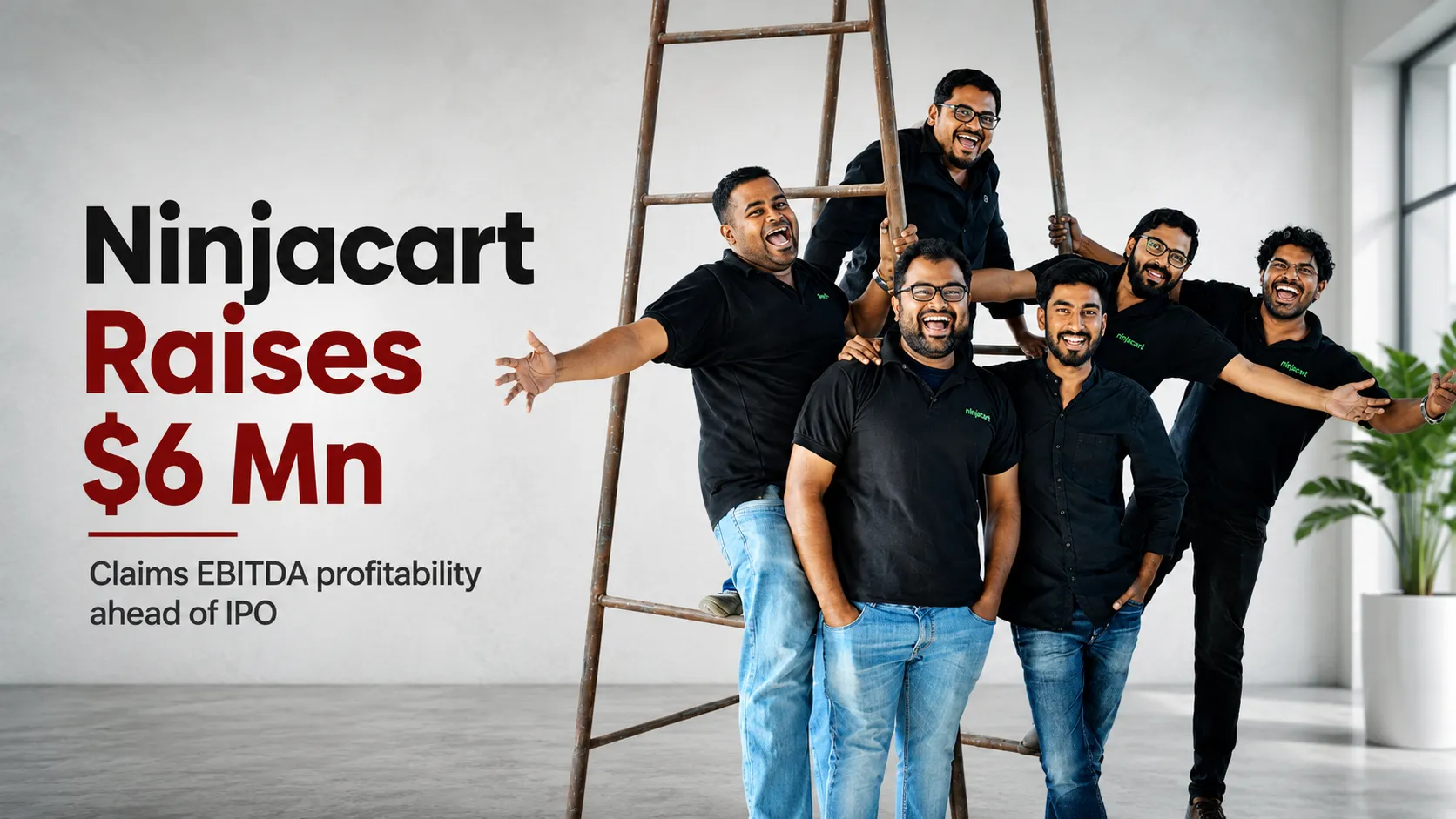
Founded in Bengaluru by Kartheeswaran KK, Thirukumaran Nagarajan, Sharath Loganathan, Sachin Jose, and Vasudevan Chinnathambi, Ninjacart started as a B2C business and pivoted to the B2B model that has defined its growth: a full-stack supply chain for fresh produce connecting farmers directly with quick commerce companies, modern trade chains, traditional retailers, exporters, and HoReCa (hotels, restaurants, and catering) businesses.
On July 3, 2026, the company announced it had turned EBITDA-profitable and was beginning preparations for a public listing within the next two years — alongside the close of the first $6 million of a larger multi-tranche funding round led by existing investors Accel, Tiger Global, and Infosys co-founder Nandan Nilekani. The company's existing investor base, which also includes Walmart, Flipkart, Syngenta Group Ventures, and Steadview Capital, reflects a decade of institutional confidence in the company's model.
What Ninjacart Has Built — Scale, Operations, and the Quick Commerce Edge
The scale of Ninjacart's operations in 2026 is the clearest expression of the decade of building that preceded this moment.
The company moves more than 1,500 tonnes of fresh produce every day across more than 40 cities in India. It manages a portfolio of more than 150 products — from the everyday staples that constitute the core of Indian household consumption, including onions, potatoes, and tomatoes, to the premium imported and exotic produce that urban consumers are increasingly purchasing through quick commerce apps: blueberries, avocados, cherries, and apples.
It works with more than 150,000 farmers, 30,000 retailers, and 5,000 resellers — a three-sided marketplace that creates value simultaneously for the farmers who need predictable buyers for their produce, the retailers who need reliable supply at consistent quality, and the end consumers who need the products on the shelves or at their doors when they want them.
The quick commerce dimension is the most commercially significant part of the current business. Ninjacart is the largest fresh produce supplier to India's quick commerce industry — the sector that has grown from zero to serving tens of millions of urban Indian consumers in roughly five years, and that has created a structural demand for consistent, high-quality, rapidly deliverable fresh produce that no previous retail format had required.
Blinkit, Zepto, Swiggy Instamart — the major quick commerce platforms that collectively constitute India's most important new consumer channel — are all sourcing fresh produce through Ninjacart's supply chain. This makes Ninjacart the backend infrastructure of India's most rapidly growing food retail channel, a position that is both commercially important and operationally defensive.
The Profitability Story — How an Operations-Intensive Business Got Its Unit Economics Right
Kartheeswaran KK described the path to EBITDA profitability with the clarity of someone who had thought through the problem precisely and executed against the solution systematically.
The margin improvement came from two directions simultaneously. On the category and channel side, the company optimised its product mix — focusing resources on the categories and customer segments where the margin per unit was highest relative to the operational complexity of serving them. On the sourcing side, the company went backwards — building deeper relationships with farmers and farm-level infrastructure that gave Ninjacart more control over input costs and quality at the point of origin.
On the operational side, technology and data were deployed to address the waste problem that is the biggest financial risk in any fresh produce business. Every tonne of produce that is wasted between the farm and the retailer represents both a margin loss and an operational cost that was incurred without producing revenue. Minimising that wastage through better demand forecasting, better inventory management, and better logistics optimisation is the highest-leverage efficiency improvement available in the category — and Ninjacart has systematically invested in the technology to pursue it.
The result: 3x growth in core businesses in the last year, alongside the EBITDA positive result that positions the company for a credible path to a public listing.
Subrata Mitra, Partner at Accel, captured the investor's assessment of what Ninjacart has achieved with a directness that reflects genuine conviction rather than standard LP communication. Ninjacart has quietly become one of the most important companies in the quick commerce space, he said, being a multi-city strategic supplier for several of the biggies. Very few businesses have shown their kind of discipline, turning a hard, operations-intensive model into a profitable one. With supply-side ownership, capital discipline and margin focus, he said Accel is excited to back the team again.
The Financial Context — Revenue and Losses
The FY25 financial results that have been publicly reported give the context for the EBITDA profitability claim. Ninjacart's operating revenue declined from ₹2,007 crore in FY24 to ₹1,634 crore in FY25 — approximately an 18.5 per cent year-on-year decline — while net losses held largely stable at ₹256 crore in FY25 versus ₹260 crore in FY24.
The revenue decline reflects the deliberate strategic shift that the profitability focus required: exiting lower-margin business or customer relationships that were generating revenue but not contributing to EBITDA improvement. This is the trade-off that a company focused on unit economics makes when it prioritises contribution margin over top-line growth — a trade-off that the company's own framing, and the EBITDA profitable outcome, validates.
The company did not share specific FY26 revenue or profitability figures at the time of the funding announcement, but the 3x core business growth claim across the fiscal year suggests a meaningful step-up from the FY25 ₹1,634 crore base in the channels and categories that the company is prioritising.
The Investor Base — and What It Says About the IPO Path
The composition of Ninjacart's existing investor base is as significant as the $6 million first tranche of the new round.
Walmart — the world's largest retailer — is a Ninjacart investor. Flipkart — India's largest e-commerce company, itself majority-owned by Walmart — is an investor. Accel, one of India's most successful venture capital firms. Tiger Global, one of the most active technology investors in India over the past decade. Nandan Nilekani, the Infosys co-founder who also architected Aadhaar and has been the most influential voice in India's digital public infrastructure development. Syngenta Group Ventures, the investment arm of one of the world's largest agricultural input companies. Steadview Capital, one of the most respected India-focused hedge funds.
That list is not assembled by accident. The Walmart and Flipkart investments reflect strategic interest in the fresh produce supply chain from the two companies most exposed to the quality of that supply chain in their retail operations. The Nilekani investment reflects conviction about technology-enabled agricultural transformation from the person who understands India's digital infrastructure most deeply. The Accel and Tiger Global investments are the long-term venture bets that have persisted through multiple rounds and now, with EBITDA profitability, are approaching the liquidity horizon they were always structured around.
When the investors who know a company best — who have the most detailed view of its operations, its competitive position, its management team, and its trajectory — choose to put more capital in as a pre-IPO round, it is the strongest available signal that the IPO story is credible.
The IPO in Two Years — and What the Market Is Watching
The two-year IPO timeline that Ninjacart has articulated positions a public listing in the 2027-2028 window — a window that, if India's public market trajectory continues, is likely to be receptive to the kind of profitable, large-scale, technology-enabled supply chain business that Ninjacart is building.
The Indian public market has in recent years demonstrated appetite for companies that combine technology differentiation with large and growing market opportunities and with financial metrics that are moving in the right direction. The ₹100 billion-plus fresh produce market, the quick commerce supply chain leadership, the EBITDA profitable trajectory, and the institutional investor validation from Walmart, Flipkart, Accel, Tiger Global, and Nilekani together constitute the narrative that a public market listing will need to sustain.
What the market will watch closely in the months before any listing is the revenue trajectory in FY26 — whether the 3x core business growth claim translates into top-line recovery alongside the EBITDA improvement, and whether the company can demonstrate that profitability is structural rather than cost-cut-driven.
That story is still being written. The $6 million first tranche of the multi-tranche pre-IPO round is the opening line.


