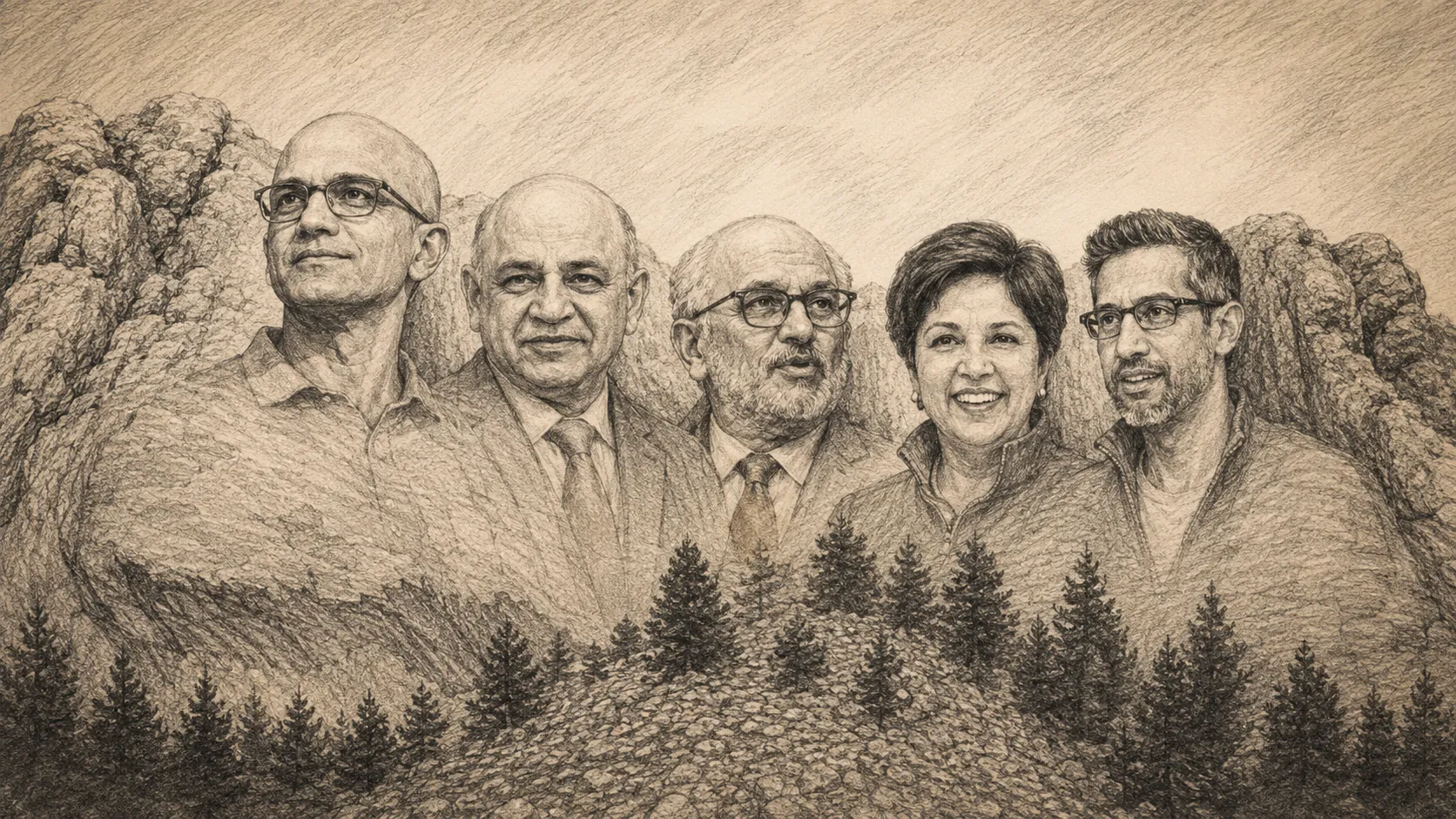
Every year, as regularly as the calendar itself, a fresh round of business lists appears ranking the most powerful and influential Indian-origin executives across corporate America. And every year, with a consistency that has by now become its own kind of story, three names appear near the very top: Satya Nadella at Microsoft, Sundar Pichai at Alphabet and Google, and Arvind Krishna at IBM. In 2026, a year defined in American public life by the 250th anniversary of the country's independence, that consistency carries a particular weight — a reminder that what once looked like a series of remarkable individual breakthroughs has, over the past decade, hardened into something closer to a structural feature of how corporate America is actually run.
It would be easy to treat the continued presence of these three familiar names as simply old news, a story that stopped being genuinely newsworthy years ago once each executive settled comfortably into his role. That reading misses something important. The fact that Nadella, Pichai, and Krishna remain fixtures — not because no one has managed to unseat them, but because each continues to deliver the kind of sustained performance that keeps a board and a shareholder base satisfied year after year — is itself a more interesting story than any single dramatic appointment could be.
Satya Nadella: The Turnaround That Never Really Ended
Nadella's tenure at Microsoft, stretching back to 2014, is often described in business coverage as one of the most successful corporate turnarounds in modern technology history — a company written off by some analysts at the time as a legacy software giant steadily losing relevance to mobile-first competitors, transformed under his leadership into a cloud computing and enterprise software powerhouse whose market capitalization now ranks among the highest of any public company in the entire world. What gets less attention, more than a decade into his tenure, is how consistently Nadella has managed to identify and lead Microsoft's next strategic pivot, repeatedly, well past the point where a single successful turnaround would have secured his legacy on its own.
The company's aggressive, early, and well-funded positioning in generative artificial intelligence — anchored by its deep partnership with OpenAI and rapid integration of AI capabilities across its entire product suite — represents at least the second major strategic pivot Nadella has successfully navigated during his tenure, following the initial cloud-computing transformation that first defined his leadership. Few technology executives manage even one such transformation during their time at the top of a major company; managing two, sequentially, across more than a decade of sustained leadership, is a considerably rarer feat that helps explain why Nadella continues to anchor these lists year after year without any real competition for his position.
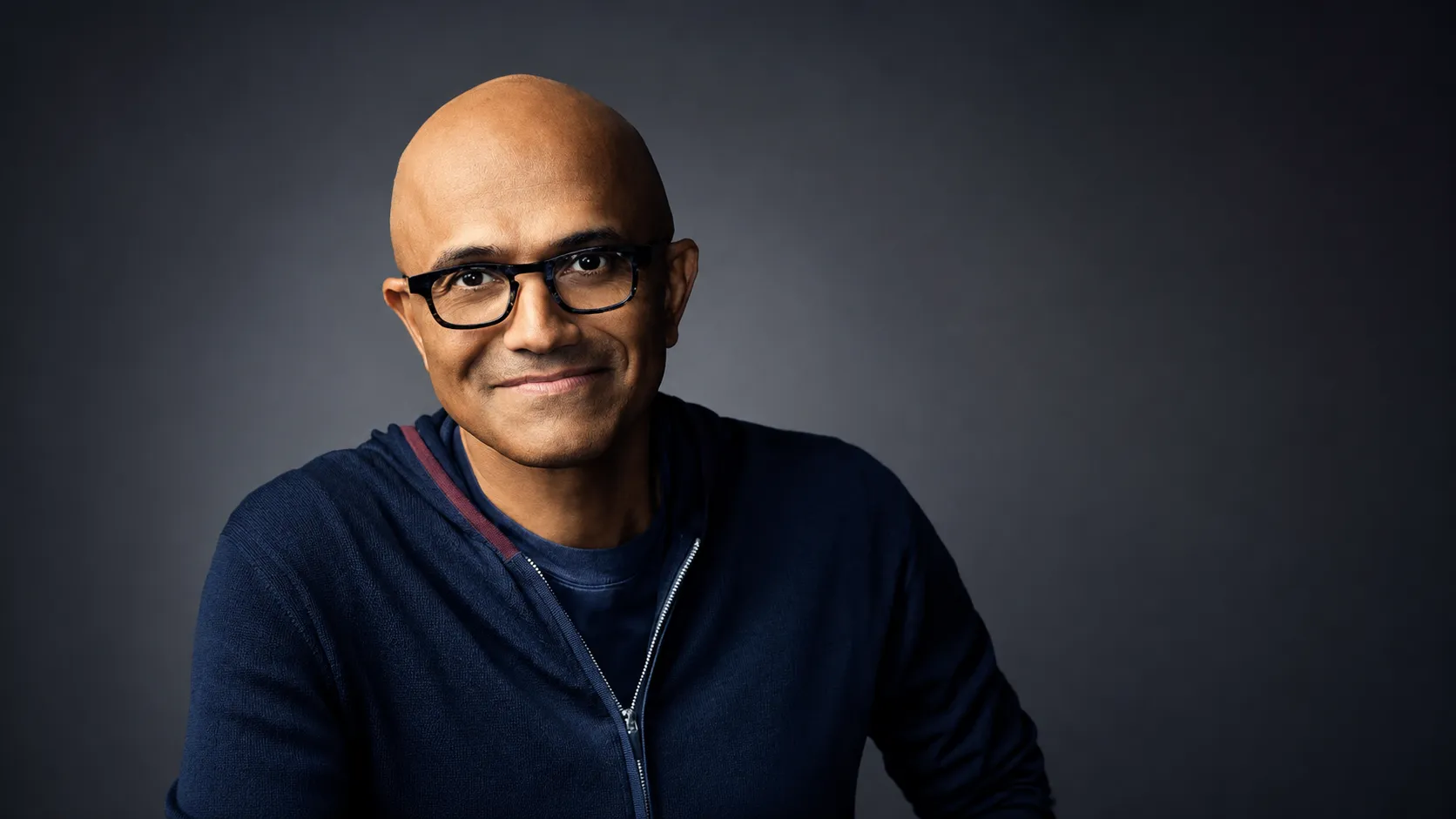
Sundar Pichai: Steering Alphabet Through Its Most Contested Era
Pichai's position atop Alphabet and Google arrives at a moment of genuine strategic peril for the company he leads, which makes his continued presence on these lists considerably more consequential than a simple continuation of an already comfortable status quo. Google's core search advertising business — still the overwhelming majority of Alphabet's revenue — faces its most serious competitive threat in decades from AI-powered alternatives that increasingly answer user queries directly, rather than directing users toward the ranked list of links that has defined Google's business model since its founding. Simultaneously, Alphabet faces sustained regulatory and antitrust pressure across multiple jurisdictions, adding legal and structural uncertainty to the competitive threat already reshaping its core business.
Navigating that particular combination of pressures — an existential threat to the core business model from the very AI technology Google itself helped pioneer, layered on top of serious antitrust exposure — requires a different kind of leadership than the growth-management challenge Pichai faced earlier in his tenure, when Google's dominant market position was considerably more secure. His continued presence at the top of Alphabet through this period reflects, at minimum, a board's judgment that his leadership remains the right fit for navigating a genuinely uncertain strategic landscape, rather than a case of institutional inertia simply keeping an incumbent in place because change feels riskier than continuity.
Arvind Krishna: The Quietest Transformation of the Three
Krishna's leadership of IBM since 2020 has generated considerably less mainstream media attention than either Nadella's or Pichai's tenures, in part because IBM itself occupies a less consumer-visible position in the technology landscape than either Microsoft or Google currently does. IBM does not run a search engine or an operating system that hundreds of millions of consumers interact with daily; its business operates primarily in enterprise technology, cloud infrastructure, and increasingly, artificial intelligence services sold directly to other large corporations rather than to individual consumers.
That lower public visibility, however, has not made Krishna's strategic challenge any less significant. He inherited a company that had, by most external assessments, lost considerable strategic direction in the years before his appointment, struggling to articulate a clear identity in a technology landscape increasingly dominated by cloud-native competitors that IBM's older enterprise technology business model was poorly positioned to compete with directly. Krishna's tenure has focused on repositioning IBM around hybrid cloud infrastructure and enterprise AI services, a considerably less flashy strategic bet than the consumer-facing AI products dominating headlines elsewhere, but one aimed squarely at IBM's actual competitive strengths within the enterprise technology market it has served for decades.
What Their Continued Presence Actually Signals
The persistence of these three names atop essentially every list of prominent Indian-origin executives published in 2026 reflects something more structurally significant than any individual's continued job security alone. It reflects the fact that the initial wave of Indian-origin executives who rose to lead major American technology companies over the past decade and a half has now had enough time in those roles to demonstrate sustained, rather than initial, competence — weathering multiple strategic inflection points, multiple economic cycles, and, in the current moment, the single most significant technological disruption to hit the industry in a generation, all without losing their board's confidence or their company's competitive position in the broader market.
That sustained track record matters enormously for how the broader story of Indian-origin executive leadership gets told and properly understood going forward. An initial appointment can always be read, by skeptics, as a single data point — proof that one particular executive succeeded, without necessarily proving anything more general about the broader phenomenon of Indian-origin leadership in American technology. A decade or more of sustained performance across multiple companies, multiple industries within technology, and multiple entirely different sets of strategic challenges is considerably harder to dismiss as anything other than genuine, demonstrated structural change in who leads America's most consequential companies.
The 250th Anniversary Framing
The timing of this year's renewed attention to Nadella, Pichai, and Krishna's continued prominence, arriving alongside America's 250th anniversary of independence, adds a layer of symbolic context that makes their staying power worth noting explicitly rather than simply taking for granted. Anniversary coverage of this kind tends to invite retrospective assessment — not just where America stands today, but how it got there, and which stories best illustrate the sweep of change across two and a half centuries. That three of the most consistently cited names in any such retrospective assessment of corporate American leadership are Indian-origin executives, none of whom trace their family history in the United States back more than a generation or two, says something notable about how rapidly the composition of American corporate leadership has shifted relative to the much longer arc of the country's history.
Beyond the Big Three
It is worth noting that Nadella, Pichai, and Krishna's continued prominence exists alongside, rather than instead of, a broader and increasingly diverse roster of Indian-origin executives now appearing across American corporate leadership — from Shailesh Jejurikar's rise to the top of Procter & Gamble, to Kunal Shah's appointment as WhatsApp's global CEO, to Shankh Mitra's record-setting compensation at Welltower, each representing achievement in industries considerably removed from the technology sector these three names have long anchored. The persistence of Nadella, Pichai, and Krishna at the top of these lists should not obscure how much that broader roster has expanded around them in just the past year alone.
If anything, their continued presence functions less as the entirety of the Indian-origin executive story in 2026 and more as its stable, well-established foundation — proof of concept, sustained now well over a decade, upon which an increasingly varied set of newer stories, spanning consumer goods, real estate, fintech, and messaging platforms, continues to be built. Whatever comes next for each of their individual companies, and however each of their own tenures eventually concludes, Nadella, Pichai, and Krishna have already secured a specific kind of legacy: proof that Indian-origin leadership at the very top of corporate America is no longer a novelty worth remarking upon for its rarity, but a sustained, demonstrated, and now thoroughly unremarkable fact of how the country's most consequential companies are actually run.
The Institutions That Made This Possible
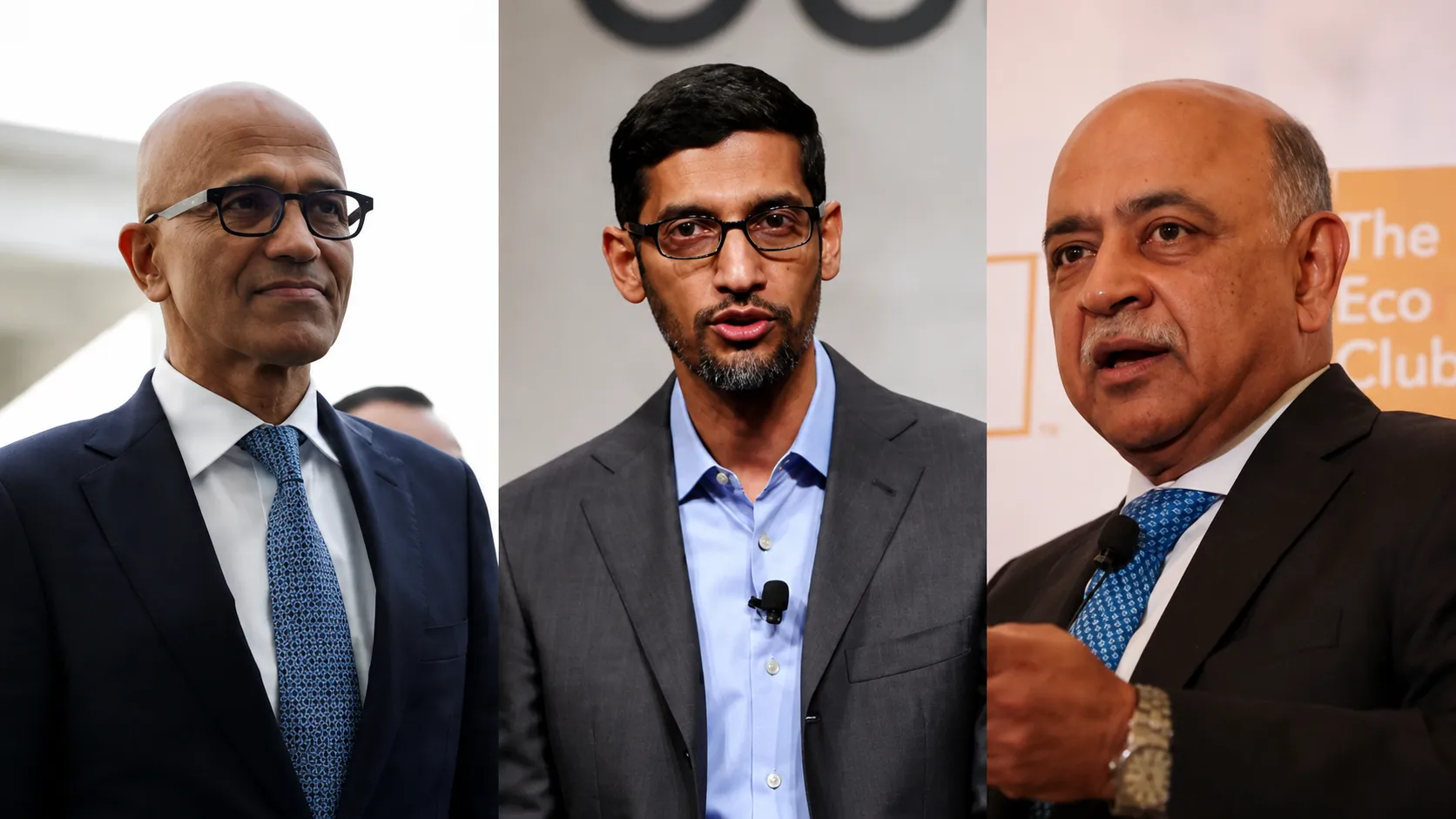
None of this happened in a vacuum, and it is worth acknowledging the institutional infrastructure that produced this particular generation of Indian-origin technology leadership. Each of the three men built the technical foundation of his career at an elite Indian engineering institution before continuing his education in the United States — Nadella at the Manipal Institute of Technology before an MS at the University of Wisconsin-Milwaukee, Pichai at IIT Kharagpur before graduate studies at Stanford and Wharton, and Krishna at IIT Kanpur before a PhD at the University of Illinois Urbana-Champaign. That shared educational pathway, repeated across dozens of other prominent Indian-origin technology executives beyond just these three, reflects a specific, decades-long pipeline connecting India's most selective engineering institutions directly to American graduate programs and, eventually, to American corporate leadership itself.
That pipeline did not emerge by accident or by coincidence. It required India's own historical investment in a small number of elite technical institutions capable of producing globally competitive engineering talent, combined with America's own immigration policy choices — particularly the Immigration and Nationality Act of 1965, which eliminated national-origin quotas and opened a pathway for skilled professionals from countries like India to pursue graduate education and eventually employment in the United States at a scale that would have been impossible under the earlier, more restrictive immigration regime. Nadella, Pichai, and Krishna are, in that sense, direct beneficiaries of policy choices made in both countries decades before any of them individually rose to corporate prominence, a reminder that even the most celebrated individual success stories rarely unfold entirely independent of the broader structural conditions that made them possible in the first place.
What Happens When the Novelty Wears Off
There is a particular kind of significance in a story becoming, over time, less remarkable rather than more. When Pichai and Nadella first ascended to their respective CEO roles, their appointments generated genuine surprise and extensive commentary specifically because Indian-origin leadership at the very top of major American technology companies remained, at that point, a relatively unusual occurrence worth explaining and contextualizing at length. A decade later, in 2026, a list of top Indian-origin CEOs that includes their names alongside Krishna's, and increasingly alongside names from well outside the technology sector entirely, generates comparatively routine coverage — not because the achievement matters less, but because it has become sufficiently normalized that it no longer requires the same degree of explanation or justification it once demanded from business journalists encountering it for the first time.
That normalization is, in its own quiet and understated way, the most significant part of this entire story. A truly structural shift in who leads major institutions is rarely announced with fanfare or a single dramatic milestone; it is instead confirmed gradually, through the accumulation of unremarkable repetition, until a pattern that once required extensive explanation becomes simply an ordinary feature of the landscape, worth noting briefly in an anniversary retrospective but no longer worth treating as a standalone headline in its own right, deserving of its own dedicated news cycle.


