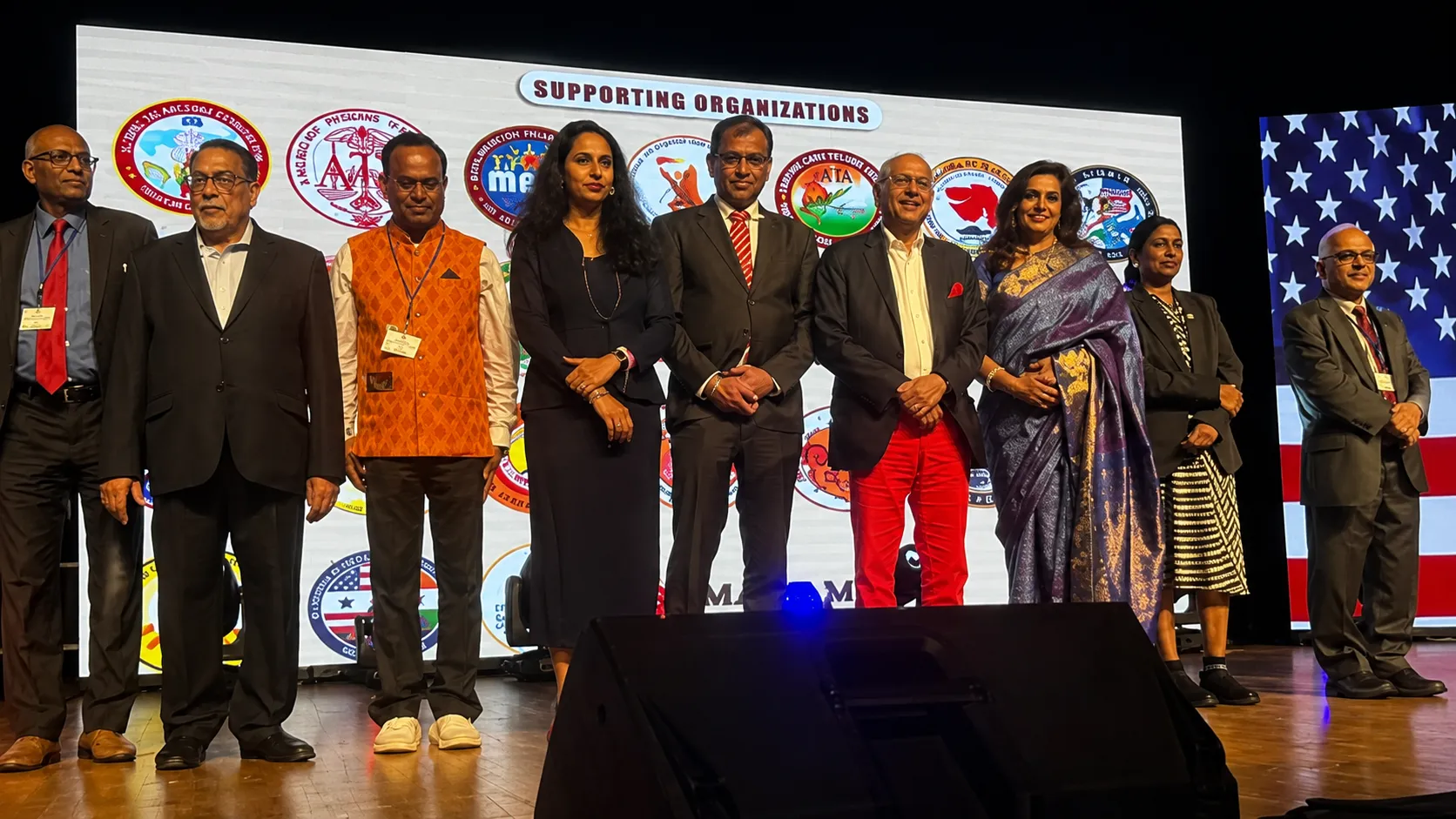
The Indian-American Committee, in partnership with more than 40 Indian American organizations from across the United States, successfully hosted a landmark celebration commemorating America's 250th anniversary on July 25, 2026, at DAR Constitution Hall in Washington, D.C. — an event organizers are now describing not as a singular, self-contained celebration but as the opening chapter of a deliberate, sustained national effort to unify the Indian American community's civic voice under a single coordinated platform.
The gathering brought together an unusually broad cross-section of American public life, drawing Members of Congress, foreign diplomats, senior government officials, prominent business leaders, physicians, military veterans, academics, and community leaders from across the country, all convened to celebrate shared values of freedom, democracy, and opportunity alongside a specific focus on recognising the Indian American community's contributions to American society. The sheer scale of organizational participation — more than 40 distinct Indian American organizations coordinating under a single event platform — was, according to organizers, itself a significant marker of the community's growing unity, influence, and civic engagement.
In an official statement following the celebration, the Indian-American Committee framed the event's significance in explicitly forward-looking terms, stating that America has given the community extraordinary opportunities to grow, contribute, and succeed, and that the celebration of 250 years of American independence carries with it a corresponding responsibility for Indian Americans to give back, serve, and stand together. The statement went further, explicitly characterising the July 25 gathering as the beginning rather than the culmination of a broader national movement aimed at uniting Indian American organizations under one collective umbrella — an ambitious institutional goal extending well beyond the scope of any single commemorative event.
The programme opened with Medha Shanbhag performing the United States National Anthem, before a roster of high-profile speakers addressed the gathering, including Illinois Congressman Raja Krishnamoorthi, who served as Congressional Co-Chair of the celebration, and Michigan Congressman Shri Thanedar. Senior government officials in attendance included Uttam Dhillon, former Acting Administrator of the U.S. Drug Enforcement Administration and former Deputy Counsel and Deputy Assistant to President Donald Trump; Arjun Mody, Deputy Commissioner of the Social Security Administration; and Ashok Pinto, a senior technology executive who has held leadership positions supporting both the White House and the U.S. Congress.
The event also featured a notable convergence of scientific, medical, and aerospace leadership, with former NASA Administrator Dr. Michael D. Griffin and aerospace leader Dr. Vivek Lall among the attendees, alongside Padma Bhushan recipient and renowned oncologist Dr. Dattatreyudu Nori, recognised previously with the American Cancer Society's prestigious Tribute to Life Award, and Dr. Meher Medavaram, President of the American Association of Physicians of Indian Origin. Representatives from business and academia rounded out the programme, including Rahul Patel, chairman of the Asian American Hotel Owners Association, and Prof. Rajendra Srivastava, a recognised academic and business leader, while veterans' representation came through Chris Aryan, founder and president of the Indian American Veterans Association, and Arun Ayyagari, a U.S. Air Force Auxiliary Pilot.
Perhaps the evening's most striking marker of the Indian American community's accumulated diplomatic and civic capital was the participation of more than fifteen serving and former ambassadors and senior diplomats, an unusually large diplomatic presence for a single community celebration, coordinated specifically by Ambassador Pradeep Kapur. That scale of diplomatic participation reflects the depth of relationships the Indian American community's civic and diplomatic leadership has cultivated over recent decades, spanning both formal U.S. government diplomatic postings and India's own diplomatic community within the United States.
Ramesh Viswanath Kapur, Co-Founder and Co-Chair of the Indian-American Committee, used his remarks to address the broader challenges currently facing the community, emphasising the pressing need to build a stronger and more positive public image at a moment of heightened scrutiny around immigration issues. Kapur announced plans to engage a professional public relations firm specifically tasked with promoting the contributions of Indian Americans through both mainstream and digital media channels, an initiative explicitly aimed at helping construct what he described as a more accurate and positive narrative for the community going forward.