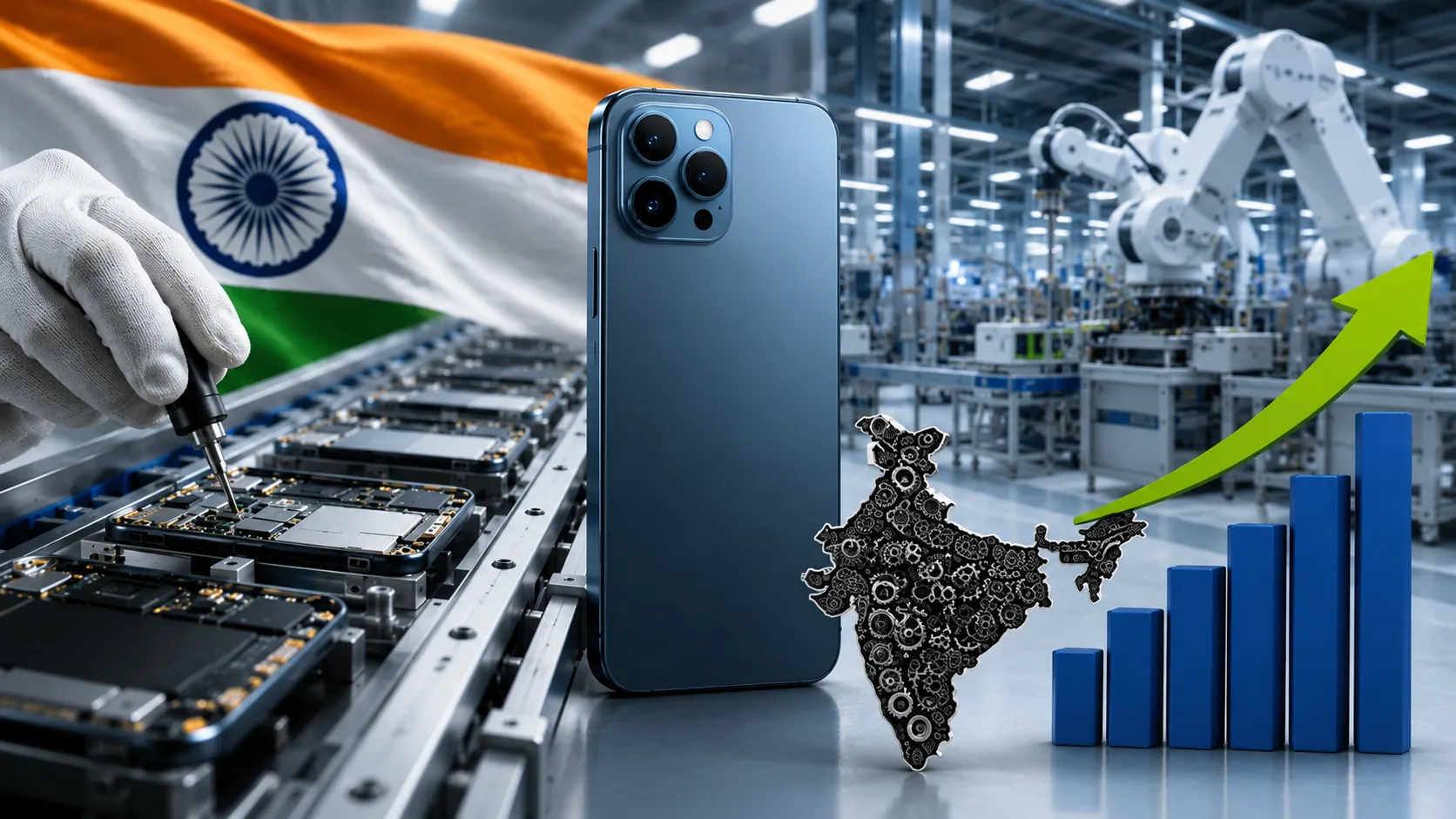
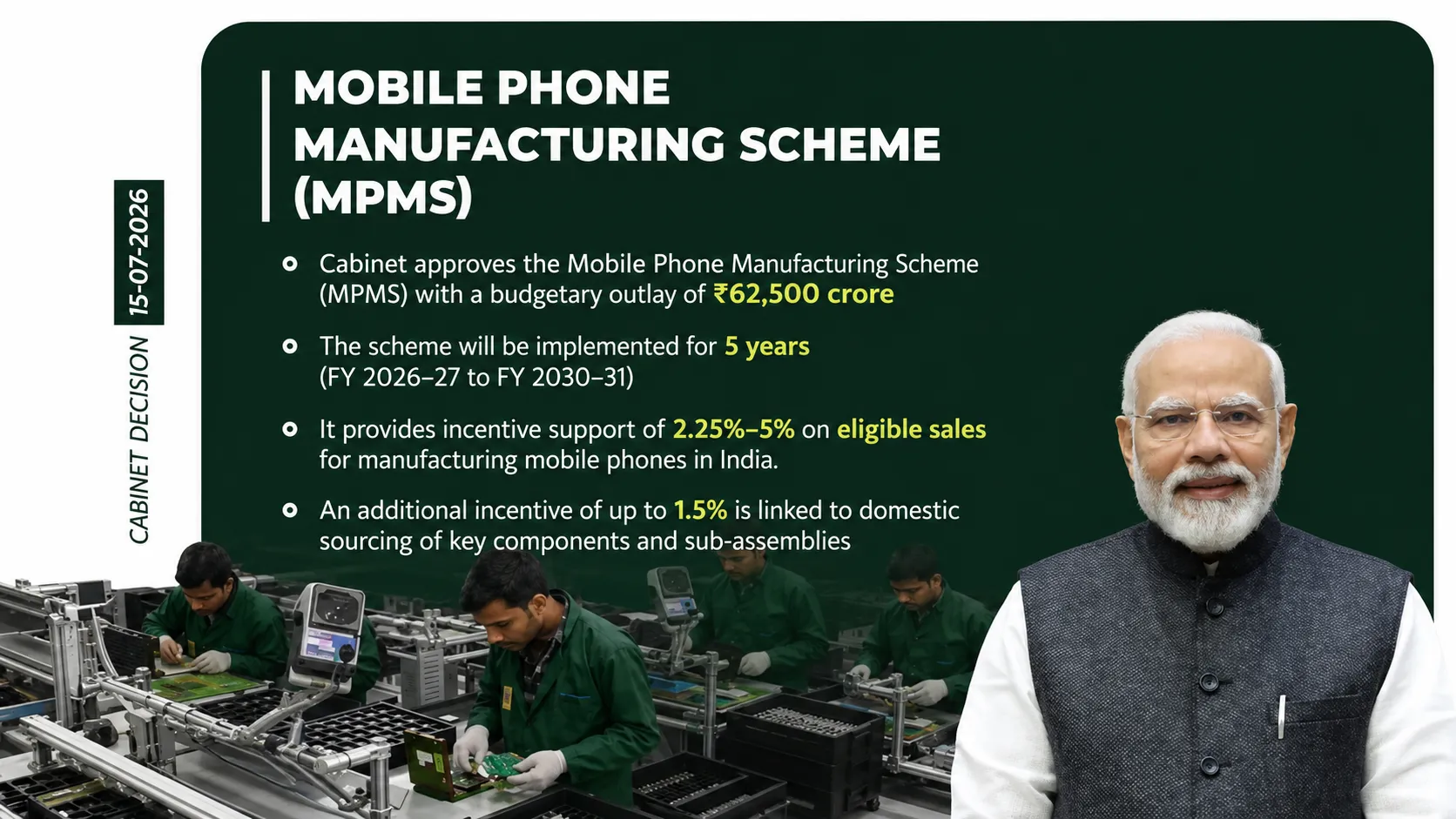
The Union Cabinet has formally rolled out the Mobile Phone Manufacturing Scheme, a substantial ₹62,500 crore initiative aimed at deepening India's domestic electronics value chain and pushing the country's cumulative electronics production toward an ambitious ₹39 lakh crore target. The scheme represents a deliberate evolution in India's approach to smartphone manufacturing policy, moving beyond the assembly-led growth model that characterised the country's earlier production-linked incentive schemes toward a framework explicitly designed to reward genuine domestic value addition across the full smartphone component supply chain, rather than simply incentivising the final assembly of devices built substantially from imported parts.
To appreciate the significance of this shift, it helps to understand how India's smartphone manufacturing sector evolved over the preceding several years. Earlier production-linked incentive programmes succeeded remarkably in transforming India into one of the world's largest smartphone manufacturing bases by volume, attracting major global device makers and their contract manufacturing partners to establish substantial assembly operations across the country. That success, however, came with an important structural limitation: much of the actual value embedded in a modern smartphone — camera modules, display assemblies, semiconductor components, and other high-value inputs — continued to be manufactured overseas and imported into India for final assembly, meaning the country captured a comparatively modest share of each device's total value even as headline manufacturing and export volumes grew substantially.
The newly rolled-out scheme is explicitly designed to address this structural gap. Rather than continuing to reward companies primarily for assembly volume, the incentive structure has been calibrated to reward manufacturers that demonstrably increase the proportion of components sourced and manufactured domestically, creating a direct financial incentive for both device makers and their component suppliers to localise increasingly sophisticated parts of the smartphone manufacturing process within India. This recalibration reflects lessons learned from the initial phase of India's electronics manufacturing incentive programmes, during which policymakers observed that headline production and export figures, while impressive, masked a comparatively shallow depth of genuine domestic value creation across the broader supply chain.
Component manufacturers, both existing domestic suppliers looking to scale up their operations and global component makers considering establishing Indian manufacturing operations to serve the device-makers already present in the country, are expected to be among the primary beneficiaries of this recalibrated incentive architecture. Camera module manufacturing, printed circuit board assembly, battery production, and display component manufacturing have all been identified by industry participants as categories where the new scheme's incentive structure is likely to catalyse fresh domestic investment, as component suppliers position themselves to capture a share of the financial incentives now specifically tied to deepening rather than merely maintaining existing domestic content levels.
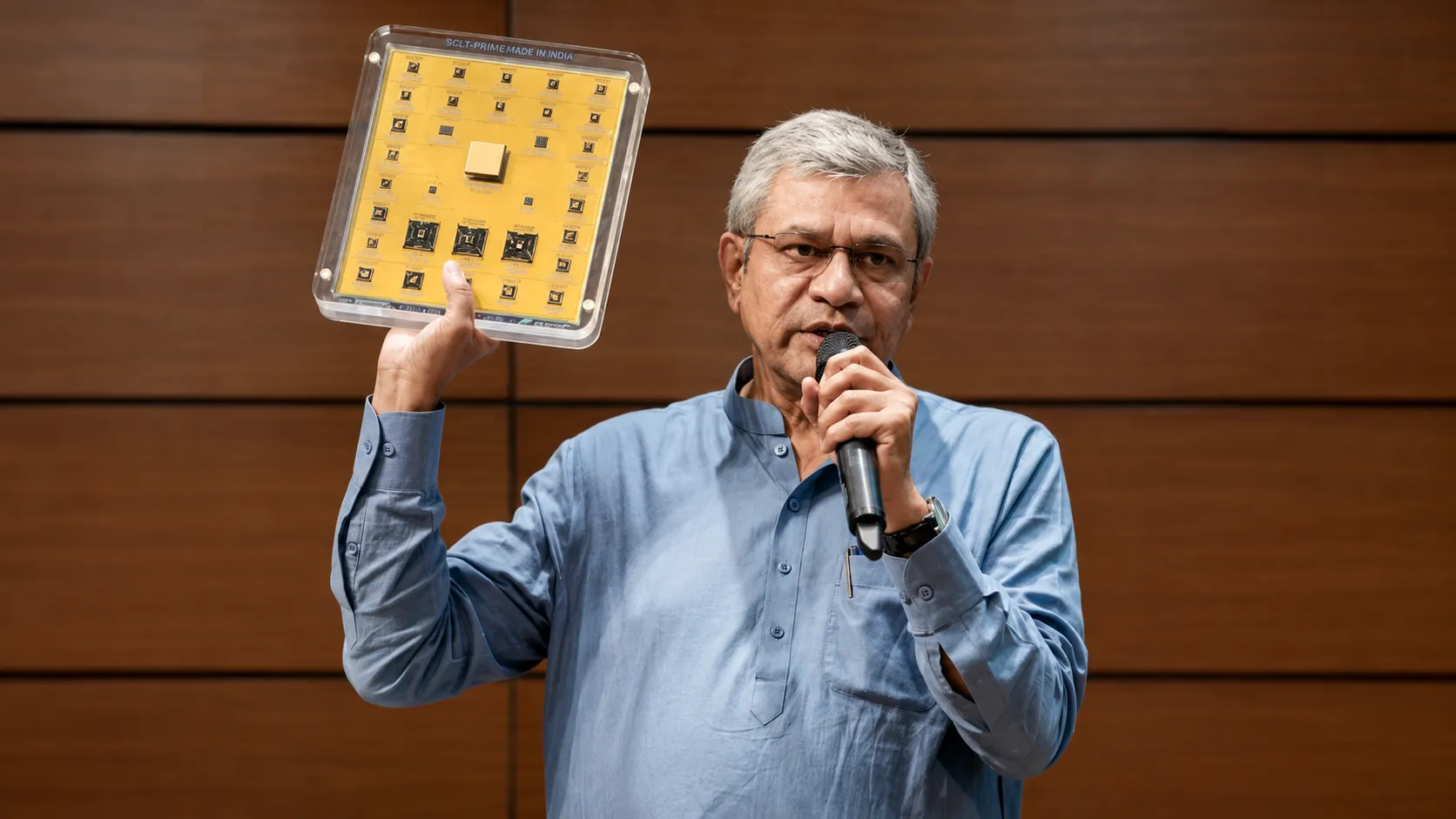
The ₹62,500 crore scheme forms one half of a considerably larger, ₹1.9 trillion combined electronics and semiconductor manufacturing push approved by the Cabinet, with the remaining ₹1.27 trillion allocated to India Semiconductor Mission 2.0, the next phase of the government's flagship chip manufacturing initiative. Together, these two complementary schemes are designed to address different but interconnected layers of India's electronics manufacturing ecosystem — semiconductor fabrication and design capability on one hand, and downstream device and component manufacturing value addition on the other — reflecting a policy recognition that a genuinely competitive, resilient domestic electronics industry requires strength across the full manufacturing stack, from raw chip fabrication through to finished consumer devices.
Industry bodies representing India's electronics manufacturing sector have broadly welcomed the scheme's rollout, framing it as a necessary and overdue recognition that pure assembly-led growth, however impressive in headline volume terms, cannot on its own deliver the kind of deep, resilient manufacturing ecosystem capable of weathering future global supply chain disruptions or shifts in device-makers' sourcing preferences. Existing suppliers to India's smartphone assembly ecosystem have already signalled intentions to scale up local production of higher-value components in anticipation of the new incentive structure, while several global device brands with existing Indian manufacturing operations are expected to accelerate their own domestic sourcing and localisation efforts to take fuller advantage of the scheme's specifically calibrated value-addition incentives.
The cumulative electronics production target of ₹39 lakh crore embedded within this policy push represents a considerable scaling-up ambition relative to India's current electronics manufacturing output, and would, if achieved, mark a genuinely transformative shift in the composition of India's broader manufacturing sector, embedding electronics and mobile device production as a pillar of the economy alongside more traditional areas of manufacturing strength including textiles, pharmaceuticals, automobiles and steel. Achieving that target will require sustained execution across multiple dimensions simultaneously: continued device-maker investment in India-based assembly capacity, successful catalysing of domestic component manufacturing investment through the new value-addition incentive structure, and the parallel build-out of semiconductor fabrication capability under Semiconductor Mission 2.0 that can eventually supply at least a portion of the chips required by India's expanding electronics manufacturing base.
Looking ahead, market participants and industry analysts will be watching closely for the specific investment announcements that emerge from device makers and component suppliers over the coming months as they assess how best to position themselves within the new incentive framework. Given the scale of the fiscal commitment now formally in place and the clear policy signal it sends about the government's priorities for India's electronics manufacturing trajectory, the coming quarters are widely expected to bring a fresh wave of localisation announcements across India's smartphone and broader electronics component supply chain, as manufacturers move to capture the financial incentives now specifically tied to building deeper, more value-added domestic manufacturing capability rather than continuing to rely primarily on imported components for final assembly within India.
The scheme's disbursement architecture has been designed with specific milestones and verification mechanisms intended to ensure that incentive payments genuinely correspond to demonstrated increases in domestic value addition, rather than being claimed based on assembly volume alone as had been a criticism of some elements of earlier incentive programmes. Companies participating in the scheme will be required to submit periodic documentation verifying the domestic content share of their manufactured devices, with incentive disbursements calibrated against independently verifiable value-addition thresholds rather than self-reported production figures alone — a design choice that reflects lessons learned from the implementation challenges encountered during the rollout of India's earlier production-linked incentive schemes across various sectors.