
Mumbai, July 31, 2026 — Amid a June-quarter earnings season crowded with headline-grabbing results from India's largest conglomerates, one relatively quieter performer has quietly delivered one of the more impressive scorecards of the reporting period. Mazagon Dock Shipbuilders, the Mumbai-based defence public sector undertaking responsible for building a significant share of the Indian Navy's frontline warships and submarines, reported a 22% year-on-year jump in net profit to ₹550 crore for the April-June quarter of FY27, up from ₹452 crore in the corresponding period last year. Revenue from core operations climbed 12% year-on-year to ₹2,943 crore, from ₹2,626 crore a year earlier, according to the company's regulatory filings with the National Stock Exchange.
For a company whose fortunes are closely tied to the multi-decade cycle of India's naval procurement and defence indigenisation programmes, this quarter's results offer a clear signal that the broader tailwinds propelling India's defence manufacturing sector — increased government capital expenditure on indigenous defence production, a policy push toward self-reliance in critical naval platforms, and a steadily expanding export opportunity in select shipbuilding segments — continue to translate into tangible, bottom-line financial performance.
Understanding Mazagon Dock's role in India's naval strategy
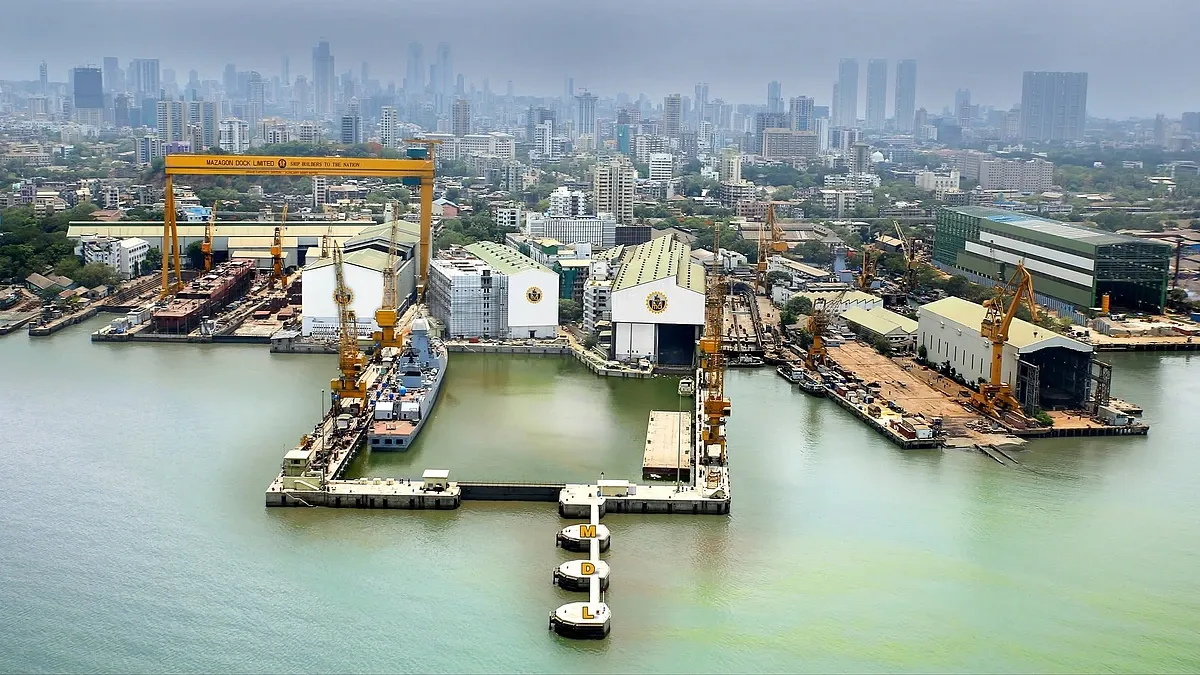
Mazagon Dock occupies a uniquely strategic position within India's defence industrial base. As one of the country's oldest and most capable shipyards, with a history stretching back over two centuries, the company has built and delivered a significant proportion of the Indian Navy's most sophisticated warships, including Scorpene-class conventional submarines built under technology-transfer arrangements with international defence partners, as well as a range of frigates, destroyers and other frontline naval vessels. This central role in submarine and warship construction places Mazagon Dock at the very heart of India's naval modernisation programme — a multi-decade effort aimed at building a blue-water navy capable of projecting power across the Indian Ocean region amid an increasingly complex and contested regional security environment.
The company's order book, built up over successive naval procurement cycles, provides Mazagon Dock with a degree of revenue visibility that few other Indian industrial companies enjoy, given the long-gestation, multi-year nature of major warship and submarine construction contracts. This structural characteristic — large, government-backed orders executed over extended timelines — helps explain why the company has been able to deliver consistent, if occasionally lumpy, revenue and profit growth even through periods when other segments of Indian industry have faced more pronounced cyclicality tied to domestic consumption trends or global trade conditions.
The defence indigenisation tailwin
Mazagon Dock's strong quarter cannot be understood in isolation from the broader policy push toward defence indigenisation that has gathered significant momentum in India over the past several years. Successive government initiatives aimed at reducing India's historical dependence on imported defence equipment — and instead building a robust domestic defence manufacturing base capable of both meeting the armed forces' own requirements and, increasingly, competing for export orders — have translated into a steady pipeline of new contract awards for capable domestic shipyards like Mazagon Dock.
This indigenisation push has been reinforced by specific policy measures designed to prioritise domestically manufactured defence platforms over imported alternatives wherever technically feasible, alongside dedicated defence capital expenditure allocations that have grown as a share of the overall government budget in recent fiscal years. For a specialised, capital-intensive shipbuilder like Mazagon Dock, this translates directly into a stronger, more visible multi-year order pipeline — the kind of visibility that supports sustained margin improvement as the company achieves greater capacity utilisation and operational efficiency across its yards.
Margin trajectory and operational execution
The disparity between Mazagon Dock's 22% profit growth and its 12% revenue growth this quarter — with profit expanding nearly twice as fast as the topline — points to meaningful margin improvement, a trend that industry analysts attribute to a combination of improving execution efficiency on existing contracts, a more favourable project mix as higher-margin submarine and specialised vessel work forms a growing share of overall order execution, and the kind of operating leverage that naturally emerges as a capital-intensive manufacturing business scales its output against a largely fixed cost base of shipyard infrastructure and skilled labour.
This margin expansion trend, if sustained across coming quarters, would represent a meaningfully positive signal for a sector — defence public sector shipbuilding — that has historically faced periodic criticism over project delays, cost overruns and execution challenges relative to private sector manufacturing benchmarks. A company consistently translating revenue growth into disproportionately stronger profit growth suggests genuine operational discipline is taking hold, rather than simply riding a favourable order-book cycle without corresponding improvements in underlying execution quality.
How Mazagon Dock fits into the broader Q1 FY27 earnings mosaic
Mazagon Dock's results arrived as part of an unusually dense single-day earnings block on July 30, alongside more than 100 other listed Indian companies reporting June-quarter results, including large-cap names such as Bajaj Finance, Mahindra & Mahindra, Tata Steel and Adani Ports. Within that crowded reporting calendar, Mazagon Dock's 22% profit growth stood out as one of the stronger performances of the day, comparing favourably even against several larger, more widely tracked companies that reported more modest or mixed results in the same window.
This strong showing reinforces a broader narrative that has gained traction among sector analysts over the past several quarters: India's listed defence public sector undertakings, encompassing shipbuilders, aerospace manufacturers and ordnance producers, have increasingly delivered earnings performance that outpaces many traditional industrial and infrastructure names, benefiting from the dual tailwind of guaranteed government demand and a structural policy shift toward domestic defence manufacturing self-sufficiency.
The export opportunity
Beyond its core role serving the Indian Navy's requirements, Mazagon Dock and India's broader defence shipbuilding sector have increasingly begun exploring export opportunities, as India's growing reputation for cost-competitive, technically capable naval construction attracts interest from friendly foreign navies seeking to diversify their own defence procurement away from traditional Western or Russian suppliers. While export contracts remain a smaller share of Mazagon Dock's overall order book compared to domestic naval procurement, the company's management has previously signalled ambitions to grow this segment over the coming years, viewing it as a natural extension of the technical capabilities and manufacturing scale the company has built up in service of the Indian Navy's own requirements.
Should this export ambition materialise at meaningful scale, it would represent a further diversification of Mazagon Dock's revenue base beyond its historical near-total dependence on Indian government defence contracts — a development that credit rating agencies and equity analysts alike would likely view favourably from a long-term business-risk perspective, even as domestic naval procurement remains, and is likely to remain for the foreseeable future, the company's core revenue driver.
Market reaction and analyst perspective
Mazagon Dock's stock has, over the past several quarters, increasingly attracted attention from both institutional and retail investors drawn to the broader "Make in India" defence manufacturing theme, a category that has seen substantial re-rating across several listed defence public sector companies as investors have grown more confident in the durability of India's defence indigenisation policy commitment across successive government budget cycles. This quarter's strong results are likely to reinforce that positive investor sentiment, even as some analysts caution that valuations across the broader defence manufacturing theme have already begun to price in a substantial degree of continued execution success, leaving somewhat less room for multiple expansion purely on the back of strong quarterly results without accompanying positive revisions to longer-term order book visibility.
Looking ahead
As Mazagon Dock moves through the remainder of FY27, the key variables likely to determine whether this quarter's strong performance proves representative of a sustained trend include the pace of new contract awards under India's ongoing naval modernisation programme, continued execution efficiency improvements across the company's existing project portfolio, and the extent to which the nascent export opportunity begins contributing more meaningfully to overall revenue. For a company operating at the intersection of India's strategic naval security priorities and its broader industrial policy push toward defence self-reliance, this quarter's 22% profit jump offers a strong signal that both dimensions of that opportunity continue to translate into genuine, measurable financial performance — a track record that, if sustained, should keep Mazagon Dock firmly in focus for investors tracking India's broader defence manufacturing renaissance.
The submarine programme and its long-term significance
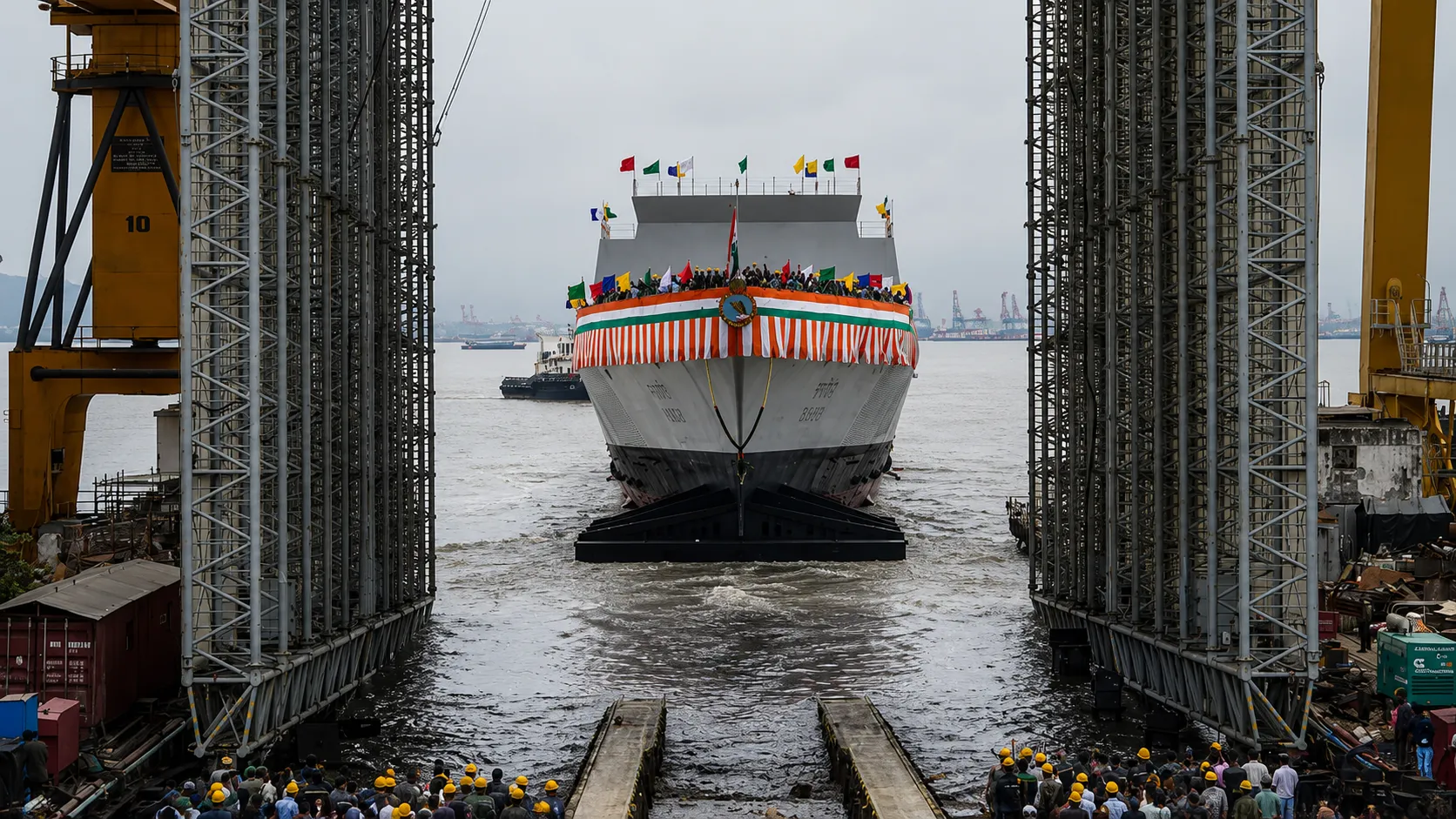
Central to Mazagon Dock's strategic importance within India's defence industrial base is its role in the country's conventional submarine construction programme, executed in partnership with international technology providers under license-production and technology-transfer arrangements. Submarine construction represents among the most technically demanding forms of naval manufacturing, requiring precision engineering, specialised welding and metallurgical capabilities, and rigorous quality assurance processes given the extreme operating conditions submarines must withstand. Mazagon Dock's sustained execution on this programme over multiple vessels has, over time, built a genuine base of indigenous technical capability that extends well beyond simple assembly of imported components, positioning the company as a credible long-term partner for increasingly sophisticated future submarine programmes as India's naval modernisation ambitions continue to expand.
This accumulated technical capability matters enormously for India's broader defence self-reliance ambitions, since submarine technology has historically been among the most closely guarded categories of military technology transfer between nations, given its direct relevance to strategic deterrence and undersea warfare capability. Every additional vessel Mazagon Dock successfully delivers adds to a body of institutional knowledge and workforce expertise that would be extremely difficult and time-consuming for any competing domestic or foreign entity to replicate, providing the company with a structural competitive moat within India's naval shipbuilding sector that few other companies, domestic or international, can meaningfully challenge.
Comparing Mazagon Dock to global shipbuilding peers
Positioned against major international naval shipbuilders in countries including South Korea, Japan, France and the United States, Mazagon Dock's scale remains considerably smaller in absolute terms, reflecting India's later start in developing a comprehensive indigenous naval shipbuilding industrial base relative to these more established international competitors. However, the trajectory of growth in both order book depth and execution capability over the past several years suggests a company, and by extension a broader Indian naval shipbuilding ecosystem, moving steadily up this global capability curve, aided considerably by sustained government policy commitment and a large, assured domestic order pipeline that provides a degree of revenue and investment certainty that shipbuilders in some other countries, more dependent on volatile export order cycles, do not always enjoy.
Employment and skill development impact
Beyond its direct financial performance, Mazagon Dock's expanding order book carries meaningful implications for skilled employment and technical training within India's broader defence manufacturing ecosystem. Shipbuilding of the complexity Mazagon Dock undertakes requires a deep bench of specialised welders, marine engineers, electrical systems technicians and quality assurance professionals, and the company's sustained order pipeline has supported continued investment in workforce training and skill development programmes designed to build and retain this specialised talent base over time — an important secondary economic benefit that complements the company's direct financial contribution to India's defence industrial and broader economic output.
The ancillary and MSME ecosystem effect
Large defence shipyards like Mazagon Dock do not operate in isolation; their expanding order books support an extensive network of ancillary suppliers, component manufacturers and specialised service providers, many of them small and medium enterprises, that together form the broader defence manufacturing supply chain. As Mazagon Dock's own order execution has accelerated, industry bodies representing defence ancillary manufacturers have reported a corresponding uptick in demand for specialised components, sub-systems and precision engineering services, extending the economic benefit of the company's strong quarter well beyond its own balance sheet and into a wider ecosystem of smaller Indian manufacturing enterprises that increasingly form an integral part of India's defence indigenisation success story. This multiplier effect is, in many respects, precisely the kind of broad-based industrial ecosystem development that India's defence self-reliance policy architects have long identified as a core strategic objective, extending well beyond the narrower goal of simply reducing import dependence for finished naval platforms.


