Manoj Kumar & Naveen — The Tamil Nadu Duo Powering India’s EV Revolution from Chennai
The Garage‑Grown Battery Startup
In 2017, Manoj Kumar and Naveen were both working as engineers at a solar energy company in Chennai. They had known each other since college (both studied electrical engineering at Anna University) and shared a growing obsession with electric vehicles. India’s EV market was still nascent — fewer than 50,000 electric two‑wheelers were sold that year — but they sensed a wave coming.
Their insight was simple: the most critical component of any EV is the battery pack. And most Indian EV manufacturers were importing battery packs from China, which were expensive, had long lead times, and offered no local support. If they could build reliable, affordable, locally manufactured battery packs, they could capture a significant market.
They quit their jobs, pooled their savings (about ₹15 lakh), and rented a small garage in Chennai’s Ambattur industrial area — a neighbourhood known for tooling and auto components. They bought lithium‑ion cells from Chinese suppliers, designed their own battery management system (BMS) circuit boards, and started assembling packs by hand.
The first year was brutal. They had no customers, no reputation, and little capital. They built battery packs for free for any EV maker willing to test them, often sleeping in the garage next to piles of cells. Manoj handled design and BMS programming; Naveen managed sourcing, assembly, and quality control.
The breakthrough came in 2019 when Kinetic Green, a Pune‑based EV manufacturer, agreed to test Neuron’s battery pack for its electric three‑wheeler. The pack outperformed the Chinese import in range and thermal stability, and cost 20% less. Kinetic placed an order for 500 units. Neuron Energy was officially in business.
The Technology: BMS and Thermal Management
Neuron Energy’s core intellectual property is its battery management system (BMS) — a custom‑designed circuit board that monitors each lithium‑ion cell’s voltage, temperature, and current, and balances the cells to maximize life and safety. Unlike Chinese BMS boards (which are generic and often fail in Indian conditions), Neuron’s BMS is designed specifically for Indian roads: high dust, high humidity, and temperature variations from 10°C to 45°C.
Key features of Neuron’s BMS include:
Active cell balancing: Extends battery life by up to 30% compared to passive balancing.
Real‑time diagnostics: The BMS sends data to a cloud dashboard (via a small IoT module), allowing fleet operators to monitor battery health, temperature, and charge cycles remotely.
Thermal runaway protection: If any cell overheats, the BMS cuts off the pack instantly — a critical safety feature for Indian conditions.
Neuron also developed a modular battery architecture: instead of a single monolithic pack, their batteries are built from smaller modules that can be replaced individually. This reduces repair costs by 60% and allows customers to upgrade to newer cell chemistries (e.g., from NMC to LFP) without replacing the entire pack.
By 2022, Neuron had filed 12 patents (granted for BMS design and modular architecture) and had become the preferred battery supplier for several EV OEMs, including Omega Seiki Mobility (electric cargo three‑wheelers), Gayam Motor Works (electric auto‑rickshaws), and Hero Electric (for select models).
Battery‑as‑a‑Service: Enabling the Last‑Mile Revolution
While selling battery packs to OEMs was profitable, Manoj and Naveen realized that the real opportunity was in fleet operations. Last‑mile delivery companies (Zomato, Swiggy, Amazon, Flipkart) were adopting EVs rapidly, but the upfront cost of the battery (₹40,000–₹60,000) was a barrier for individual delivery partners.
So Neuron launched Neuron Charge — a battery‑as‑a‑service (BaaS) model. Delivery partners pay a monthly subscription (₹1,500–₹2,500) instead of buying the battery outright. In return, Neuron provides:
The battery pack (owned by Neuron)
Unlimited swapping at Neuron’s swap stations
24/7 roadside assistance and battery replacement
The model works because:
Delivery partners save on upfront capital and can scale easily.
Neuron retains ownership of the battery, capturing lifetime value (a battery lasts 3–4 years, so subscription revenue exceeds the cost of the battery after 12–18 months).
Neuron started with 10 swap stations in Chennai (2022), expanded to 50 in Tamil Nadu (2023), and now has 200+ swap stations across Chennai, Coimbatore, Madurai, Trichy, and Salem. Over 10,000 delivery partners use Neuron Charge, and the BaaS vertical now accounts for 40% of Neuron’s revenue.
Scaling Manufacturing: From Garage to Factory
By 2023, Neuron had outgrown its Ambattur garage. The company raised a ₹50 crore Series A from Agnikul Capital (a Chennai‑based cleantech fund) and Lighthouse India. The funding allowed Neuron to build a 50,000 sq. ft. automated battery assembly line in the Sriperumbudur industrial corridor (near Chennai), creating 300+ jobs.
The factory produces:
100,000 battery packs per year (capacity to scale to 500,000)
BMS boards (in‑house PCB assembly)
IoT modules (for remote monitoring)
Unlike many “assemblers” who simply import Chinese cells and repackage them, Neuron also invests in cell‑level testing and grading, ensuring that only the top 20% of cells (by capacity and internal resistance) go into their premium packs. The rest are sold for lower‑intensity applications (solar storage, e‑rickshaws).
Neuron has also started local sourcing of cells. In 2025, they signed an agreement with Log9 Materials (Bengaluru‑based cell manufacturer) to use India‑made lithium‑ion cells, reducing dependence on China and qualifying for government production‑linked incentive (PLI) subsidies.
Chennai as an EV Component Hub
Manoj and Naveen are vocal advocates for Tamil Nadu’s EV ecosystem. They note that Chennai already has a strong auto component supply chain (due to Hyundai, Ford, Nissan, and BMW factories), and EV battery manufacturing is a natural extension.
They have lobbied the Tamil Nadu government for:
Subsidized electricity for battery manufacturing (energy‑intensive process)
Common testing facilities for BMS and thermal management
Skill development programs for battery assembly technicians
The government has responded positively. In 2025, Tamil Nadu announced an EV policy 2.0, which includes capital subsidies for battery pack assembly and a “Tamil Nadu Battery Alliance” to connect cell makers, pack assemblers, and OEMs.
Neuron is also mentoring a new generation of EV battery entrepreneurs through the Tamil Nadu Startup and Innovation Mission (TANSIM) , offering free access to their testing lab and BMS design tools.
Challenges and Critiques
Neuron’s journey has not been smooth:
Cell price volatility: Lithium‑ion cell prices fluctuated wildly in 2021–2023 (from $110/kWh to $160/kWh and back), squeezing margins. Neuron hedged by holding inventory and signing long‑term contracts.
Swap station economics: Swap stations require high utilization to break even. In smaller cities (Salem, Trichy), adoption has been slower than expected. Neuron is now partnering with petrol pumps to share real estate costs.
Competition: Startups like Battery Smart (swap stations) and Octillion (battery packs) are well funded. Neuron’s response is to focus on Tamil Nadu depth before national breadth.
Some customers have complained about swap station wait times during peak hours (7–9 AM, 6–8 PM). Neuron has responded by adding mobile swap vans and predictive stocking algorithms.
Leadership Philosophy: Engineers Who Build
Manoj and Naveen are rare among startup founders: they are both still deeply involved in engineering. Manoj personally reviews every BMS firmware update; Naveen still visits swap stations to talk to delivery partners.
They are frugal. The company’s office is above their factory, furnished with IKEA desks. Neither owns a luxury car — they drive electric scooters powered by their own batteries.
“We don’t want to be a billion‑dollar startup that forgets its roots,” Naveen told YourStory in 2025. “We are battery engineers first. The business is just a way to get our batteries on the road.”
The Road Ahead
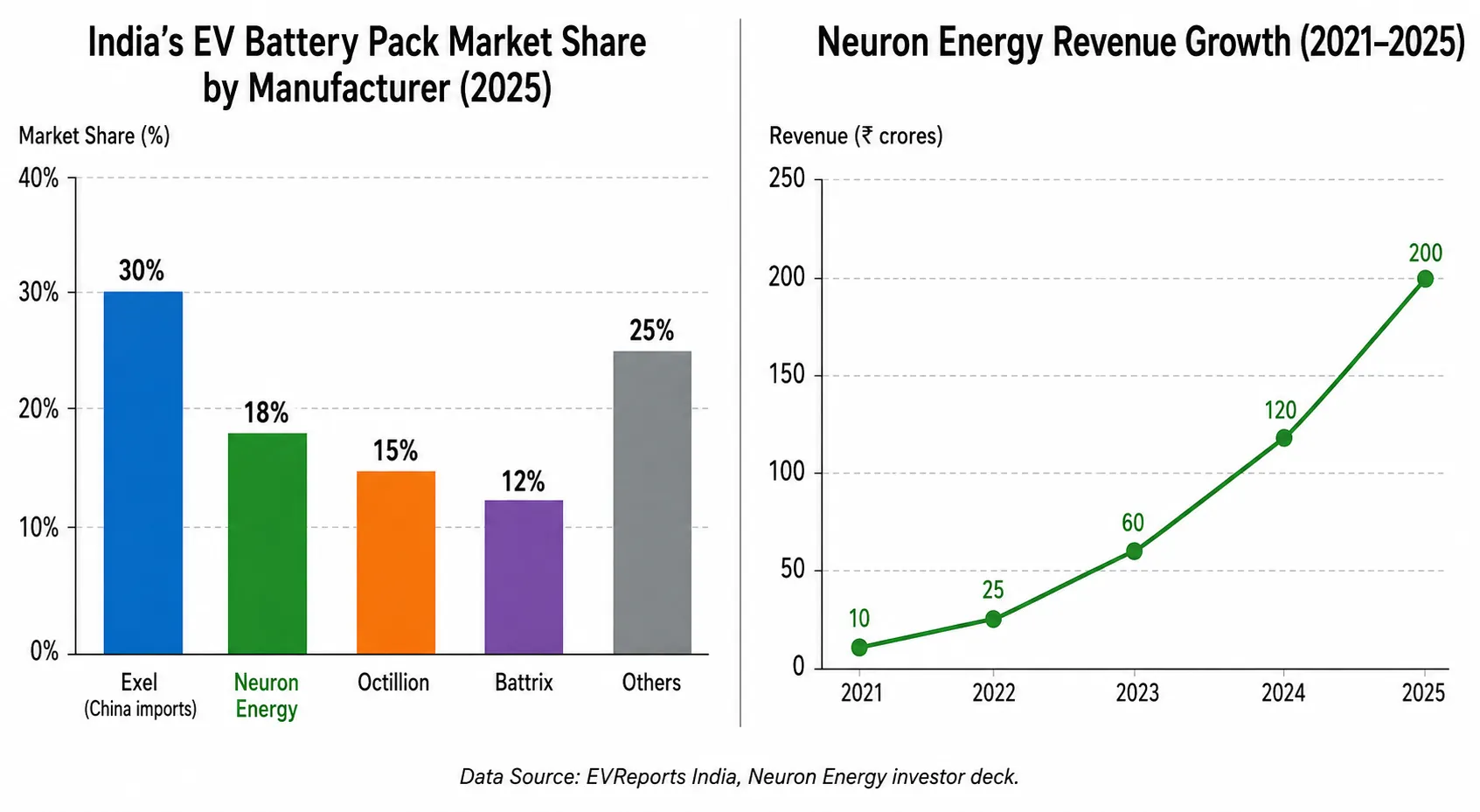
As of 2026, Neuron Energy has crossed ₹200 crore in annual revenue (70% battery pack sales, 30% BaaS subscriptions). The company is profitable with EBITDA margins of 12%. It plans to expand swap stations to all districts of Tamil Nadu by 2027 and launch a consumer‑facing battery subscription for personal e‑scooter owners.
Manoj and Naveen are also developing a second‑life battery product — using retired EV batteries for solar energy storage. This extends battery life by 3–5 years and reduces e‑waste.
Their ultimate ambition? “Make Chennai the battery capital of India,” Manoj says. “We have the talent, the industry, and the will. We just need to keep building.”