He Built BigBasket Into a Grocery Giant. Two Days After Tata Bought It, He Started Something New.
In May 2021, Tata Digital acquired a majority stake in BigBasket — one of the most significant corporate acquisitions in the history of Indian e-commerce, validating years of building by the company's founding team. Most founders would have taken a breath. Celebrated. Taken some time.
Abhinay Choudhari left BigBasket two days later.
Not in conflict, and not in crisis. In clarity. He had seen what was next, and what was next was not a continuation of what he had been building. What was next was a problem he had been thinking about for a long time — one that seemed unglamorous by the standards of venture capital but was, on inspection, one of the largest unorganised service markets in the country.
Laundry.
India's laundry market was valued at approximately $11.3 billion in 2019. Redseer projected it would grow to $15 billion by 2025. It is a daily necessity for every household in the country, and yet it is served, at scale, primarily through a network of local dhobis, small independent services, and household help — fragmented, inconsistent in quality, and entirely unorganised at the institutional level. The same man who had watched digital technology reorganise the grocery industry from the inside now looked at laundry and saw an identical opportunity: an enormous market, a clear consumer pain point, and a structural absence of anyone doing it at scale with genuine infrastructure and technology behind it.
In October 2022, LaundryMate launched in Bengaluru.
What LaundryMate Built First — and How It Built It
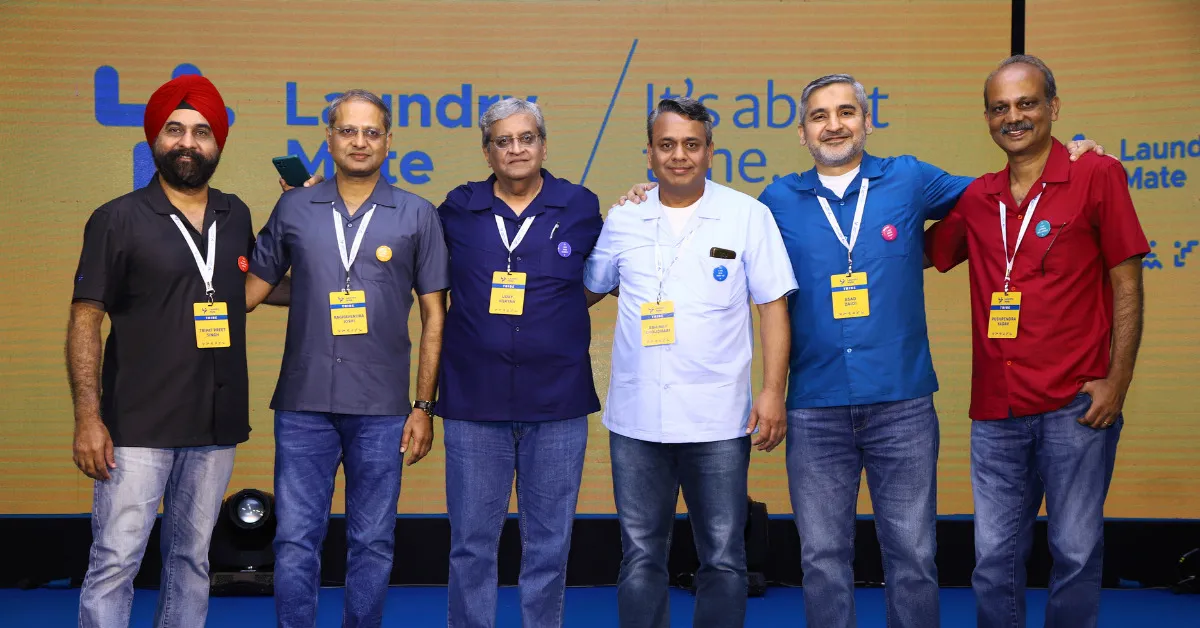
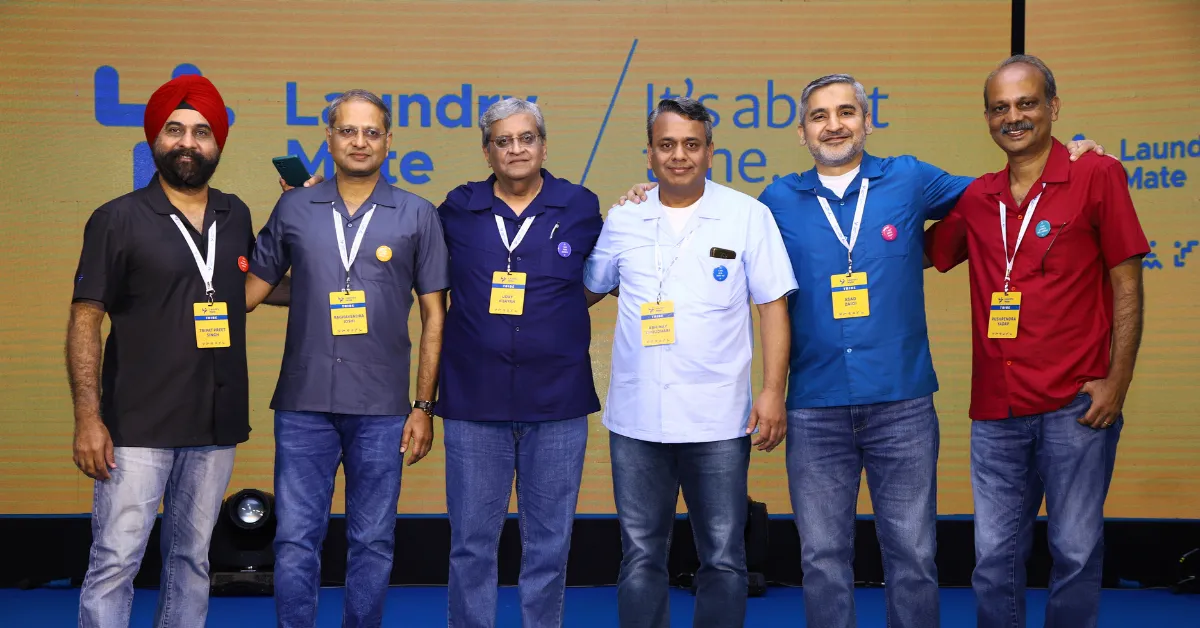
The founding team Choudhari assembled reflects the seriousness of the infrastructure ambition. Alongside him: Raghavendra Joshi, Tripat Preet Singh, Uday Vijayan, Asad Zaidi, and Pushpendra Yadav. Together they built not a marketplace or an aggregation layer but an integrated service operation — a company that owns the backend and the last-mile delivery simultaneously.
The centrepiece is what LaundryMate has described as India's largest laundry facility, built in Bengaluru and capable of processing 65,000 garments per day. The facility's equipment was sourced from Belgium, Italy, Turkey, the United States, and Dubai. The water treatment and recycling solution was imported from the Netherlands. This is not the infrastructure profile of a startup cutting corners to move fast. It is the infrastructure profile of a team that has decided to build the thing properly from the beginning — with the machines, the water management, and the process discipline that industrial-scale garment care requires.
The consumer experience is deliberately frictionless. LaundryMate's technology stack — built entirely in-house, including the consumer app, delivery app, and proprietary laundry ERP — enables ordering, tracking, and 24-hour doorstep pickup and delivery. The service covers wash and iron, steam iron, and dry cleaning. It serves both B2C households and B2B institutional clients, giving it two revenue channels that complement rather than compete with each other.
The ₹50 Crore Round — and the Investors Who Backed It
In May 2023, LaundryMate announced it had raised ₹50 crore, approximately $6.25 million, in a Pre-Series A funding round led by Blume Founders Fund — the pre-seed, seed, and pre-Series A investment arm of Blume Ventures, one of India's most respected early-stage venture capital firms.
The angel investor list that accompanied the Blume Founders Fund investment is notable for both its scale and its composition. Ola co-founder Ankit Bhati, BCG Managing Partner Deepak Goyal, Trilegal co-founder Karan Singh, Nutanix India MD Sankalp Saxena, Cilix Capital MD Charudatta Deshpande, Broad Peak Investment Advisors Singapore MD Sandeep Gupta, and Molecular Connections CEO Jignesh Bhate all participated. These are not passive cheque writers. They are operators and executives with deep domain knowledge across mobility, consulting, professional services, enterprise technology, and financial services — precisely the network that a company trying to build nationwide service infrastructure needs around it.
Sarita Raichura of Blume Founders Fund articulated the investment thesis with the precision that the category deserves: a strong belief in the untapped potential of the industrialisation of laundry for everyday consumers, and a vision of a future where LaundryMate's expansive reach saves valuable time for urban families while making a positive environmental impact through water conservation.
The water conservation dimension is not a token sustainability claim. Industrial-scale laundry, done well, uses dramatically less water per garment than household washing — partly because of machine efficiency and partly because of the water recycling and treatment systems that a properly capitalised facility can install. LaundryMate's Netherlands-sourced water treatment infrastructure is a genuine competitive advantage and a genuine environmental claim, not a marketing attachment.
The Vision — and the Ambition Behind It
Choudhari has been specific and public about where LaundryMate is going.
The immediate milestone after the Pre-Series A is becoming the leader and preferred laundry brand in Bengaluru — a goal that the funding and the scale of the Bengaluru facility support within a 6 to 9 month horizon from the funding announcement.
The medium-term goal is a $10 to $15 million Series A to fund national expansion. Thirty cities in ten years is the geographic ambition. And the long-term revenue target is as striking as it is specific: $1 billion in annual revenue run rate by 2033.
That target — ten years from the company's launch — is the marker of a founder who has built at scale before and understands what it takes to get from a single-city operation to a nationally dominant consumer service brand. At BigBasket, Choudhari watched a grocery delivery platform grow from a Bengaluru experiment into a national infrastructure that served millions of households. The trajectory is familiar. The category is different. The conviction that the same journey is possible in laundry is the thesis that the ₹50 crore round is backing.
His founding motivation was stated with the kind of directness that comes from having lived the problem personally.
He wanted to solve the laundry chore for millions of Indian households — to save the unproductive time currently being spent on this activity.
Unproductive time. For the co-founder of BigBasket, that phrase carries a specific weight. BigBasket was itself built on saving unproductive time — the time spent in a grocery queue, in a market, planning and executing the weekly shop. LaundryMate applies the same logic to a different daily chore, with the same conviction that if the infrastructure is good enough and the technology is frictionless enough, millions of Indian households will pay for the time it gives back to them.
Why This Market — and Why Now
The laundry services market in India has several characteristics that make it both attractive and difficult to capture at scale.
Attractive: it is large, daily, recurring, and underserved by organised players. The household that outsources its laundry does not do so occasionally — it does so as a habitual, recurring purchase that creates exactly the kind of sticky, high-frequency customer relationship that builds durable businesses. Once a household has integrated a reliable pickup and delivery service into its routine, the switching cost is the friction of finding an alternative rather than a price decision.
Difficult: the quality bar is high and immediately visible. A stained shirt returned from a laundry service is not a forgivable product failure in the way that a slightly late grocery delivery might be. The physical object comes back changed — better or worse than when it left — and the customer knows immediately. Building consistent quality at 65,000 garments per day, across the full range of fabrics, care requirements, and finishing standards that urban Indian households bring to a laundry service, is exactly the operational challenge that the imported machinery and the proprietary ERP are designed to solve.
LaundryMate's bet is that industrialisation — the systematic application of scale, technology, and process discipline to a market that has historically been artisanal and fragmented — is the thing that unlocks both the quality and the economics. What Belgium and the Netherlands and Italy provide in the form of equipment is not a luxury indulgence. It is the infrastructure of consistency. And consistency, in a service business where the product comes back visible and tangible to the customer, is the only durable competitive advantage.
From BigBasket to LaundryMate. From groceries to garments. From digital infrastructure for what you eat to digital infrastructure for what you wear.
Abhinay Choudhari is building the second chapter of the same story. And he knows how long it takes to write it.


