Chandrayaan‑3 lasted 14 days on the Moon. ISRO's next lunar lander — built with the Department of Atomic Energy — will survive for 200.
The Moon is a brutal place.
The lunar day lasts about 14 Earth days. During that time, temperatures at the equator hit a scorching 121 degrees Celsius — hot enough to boil water, melt some plastics, and fry most electronics if they are not properly shielded. Then comes the lunar night. Another 14 Earth days of darkness and cold that plunges to minus 129 degrees Celsius. That is colder than any place on Earth, colder than the surface of Mars, cold enough to make batteries fail and circuits shatter.
Chandrayaan‑3's Vikram lander, powered entirely by solar energy, operated for exactly one lunar day. It landed on August 23, 2023, conducted experiments for two weeks, and then, when the sun set and the temperatures dropped, it froze. It has not woken up since. The mission was a spectacular success — India became the fourth nation to land on the Moon and the first to land near the south pole — but the lander's lifespan was measured in weeks, not months.
Now ISRO has a solution so audacious it sounds like science fiction: a nuclear‑powered artificial heating system developed in collaboration with the Department of Atomic Energy that will keep a lunar lander alive for up to 200 days.
"We have collaborated with the Department of Atomic Energy to develop an advanced artificial heating system that can protect a lunar lander from the freezing weather of the Moon," ISRO Chairman V. Narayanan announced at the CSIR‑RISE Conclave in Bengaluru.
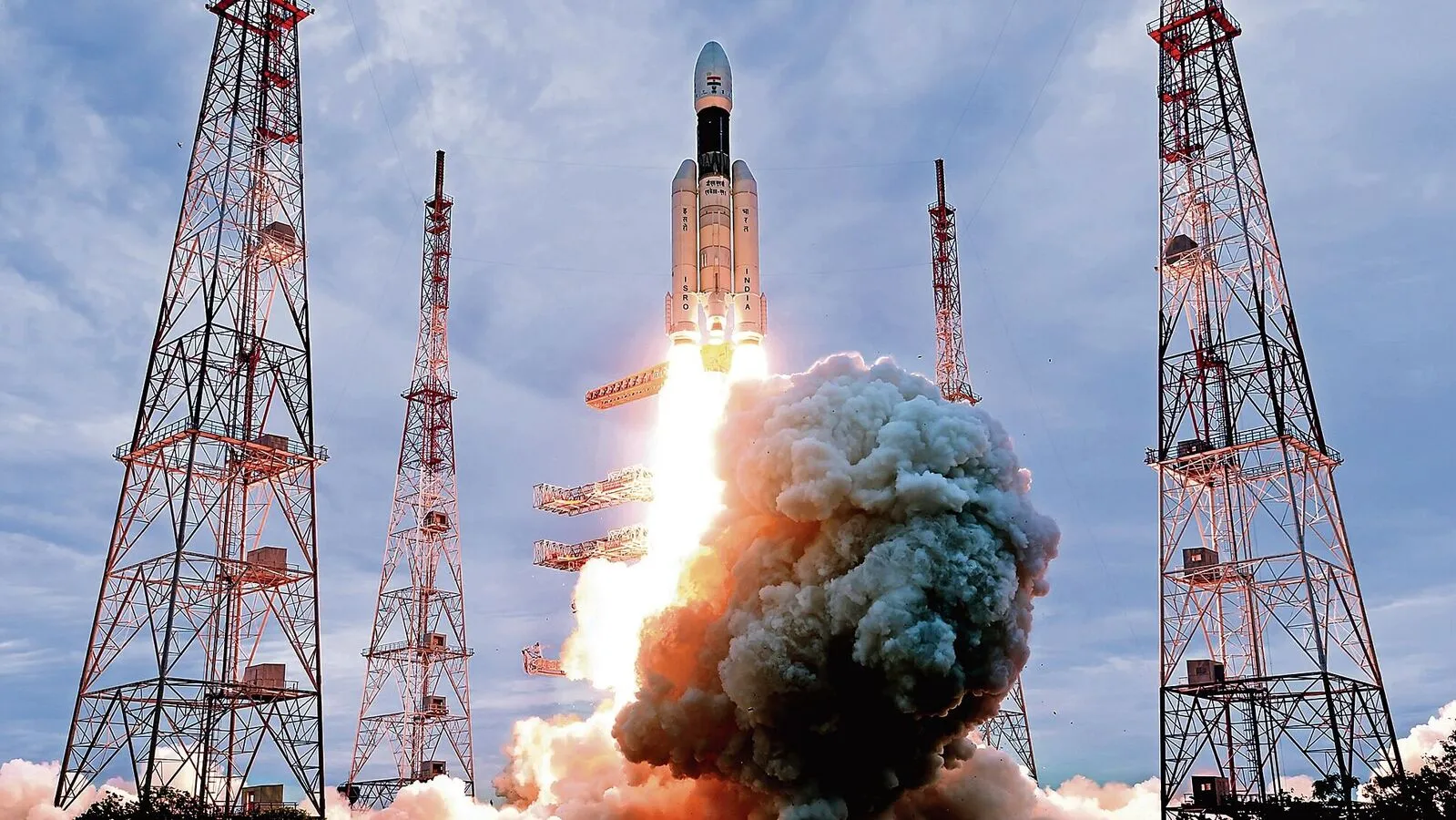
The new lander will carry artificial heaters capable of generating sustained warmth through the long lunar nights, enabling long‑duration lunar exploration for future missions. This marks a significant leap from the 14‑day operational lifespan achieved by Chandrayaan‑3 — the difference between a short visit and a permanent presence.
The Nuclear Heater: How It Works
The technology is a miniaturised radioisotope heater unit (RHU) — a device that uses the natural decay of a radioactive isotope, typically plutonium‑238 or americium‑241, to generate heat. No fission, no chain reaction, no control rods. Just the steady, predictable warmth of atoms falling apart.
RHUs have been used in space exploration for decades. NASA's Mars rovers — Spirit, Opportunity, Curiosity, Perseverance — all carry RHUs to keep their electronics warm during cold Martian nights. The Voyager probes, launched in 1977, use larger radioisotope thermoelectric generators (RTGs) that produce both heat and electricity. They are still operating, more than 45 years later, billions of kilometres from Earth.
India has never used radioisotope heaters in space before. The collaboration with the Department of Atomic Energy represents a significant expansion of ISRO's technical capabilities, as well as a bureaucratic and regulatory achievement. Handling radioactive materials for space launch requires approvals from multiple agencies, as well as compliance with international treaties governing the use of nuclear sources in outer space.
"The radioisotope heater is a mature technology globally, but it's new for India," said a space scientist at the Physical Research Laboratory in Ahmedabad. "The challenge is not just building the heater — it's building the safety case for launching it. If a launch vehicle fails and scatters radioactive material across the atmosphere, that's a problem. ISRO and the DAE have spent years developing the protocols to make that safe."
The heater units are small — about the size of a AA battery — and produce only a few watts of heat each. But on the Moon, where ambient temperatures are brutally cold, a few watts of sustained warmth can mean the difference between life and death for sensitive electronics. The new lander will carry multiple RHUs, distributed across the spacecraft to keep batteries, processors, and scientific instruments above their minimum operating temperatures.
Beyond the Heater: A Broader Partnership
Narayanan's announcement at the CSIR‑RISE Conclave was not limited to lunar heaters. He also disclosed that ISRO and the Council of Scientific and Industrial Research (CSIR) have identified 40 areas of technological cooperation, with 17 already approved for implementation.
The areas range from materials science — developing lighter, stronger alloys for rockets and satellites — to advanced manufacturing techniques like 3D printing of spacecraft components. CSIR's network of 37 national laboratories, spread across the country, brings a depth of scientific and engineering expertise that complements ISRO's mission‑focused culture.
Similar research partnerships have been forged with the Department of Science and Technology and private sector players to develop space medicines for the Gaganyaan human spaceflight mission. Gaganyaan, India's first crewed spaceflight, is scheduled for 2028, and keeping astronauts healthy in microgravity is a complex medical challenge. The partnership is working on everything from countermeasures for bone density loss to compact water recycling systems.
"What you're seeing is a deliberate strategy to broaden ISRO's supplier base and technology base," a former ISRO official said. "For decades, ISRO did almost everything in‑house — design, fabrication, testing. That worked when the mission rate was low. But as the mission rate increases — more satellites, more launches, more interplanetary missions — ISRO needs partners. CSIR, DAE, DST, and private industry are those partners."
The Student Hackathon
While the nuclear heater announcement grabbed headlines, ISRO also launched something quieter but perhaps equally significant for the long term: the third edition of the Bharatiya Antariksh Hackathon (BAH) 2026.
The hackathon invites student innovators to tackle 15 problem statements across space science and technology. The problems are real and difficult: AI‑powered digital twins of India's climate, identifying exoplanets from noisy light curves, autonomous navigation for lunar rovers, debris tracking algorithms, and more.
Selected finalists will receive mentorship from ISRO scientists and may be considered for official internship opportunities. Previous editions of the hackathon have produced several innovations that have been incorporated into ISRO's operational workflows.
"The hackathon is a talent identification pipeline," the former ISRO official said. "India produces tens of thousands of engineering graduates every year. Most of them are good. A few are exceptional. The hackathon helps ISRO find the exceptional ones before they get snapped up by Google or Microsoft."
The third edition has already received more than 5,000 registrations from engineering colleges across India, from premier institutes like the IITs and NITs to smaller regional colleges. The final round will be held at ISRO headquarters in Bengaluru later this year.
The Strategic Context
ISRO's push toward longer‑duration lunar missions is not happening in a vacuum. The Moon is once again a strategic destination, with multiple nations and private companies planning missions.
China's Chang'e program has successfully landed on the Moon multiple times, including a sample return mission from the far side. NASA's Artemis program aims to return astronauts to the Moon by 2027, including the first woman and the first person of colour. Russia, despite its post‑invasion isolation, continues to develop lunar landers. Private companies like Intuitive Machines and Astrobotic are offering commercial lunar delivery services.
India, with Chandrayaan‑3, demonstrated that it can land on the Moon reliably and cheaply — the mission cost roughly $75 million, a fraction of what NASA or China spends. But landing is not enough. To be a serious player in lunar exploration, India needs to operate on the Moon for extended periods, conducting science, testing technologies, and potentially preparing for human landings.
"The 14‑day lander is a technology demonstrator," the space scientist said. "The 200‑day lander is an operational asset. It can survive multiple lunar day‑night cycles. It can conduct long‑term experiments. It can serve as a communications relay. It can test in‑situ resource utilisation — using lunar soil to make oxygen, water, or building materials. That's the next frontier."
The nuclear heater is the enabling technology for all of that. Without it, any lander is dead as soon as the sun goes down. With it, the Moon becomes a place where India can stay.
What Comes Next
The 200‑day lander is still in development. Narayanan did not announce a launch date at the conclave, but informed sources suggest a target of 2028 or 2029 for the first mission.
Before that, ISRO has a packed manifest. Chandrayaan‑4, a joint mission with Japan, will attempt to land in the lunar south polar region and deploy a rover. Chandrayaan‑5, a more ambitious mission, may include a sample return. The nuclear‑heated lander could be Chandrayaan‑6 or a dedicated mission.
In parallel, ISRO is working on the technology for human landings. Gaganyaan, the crewed orbital mission, is the first step. Lunar landings will require much larger spacecraft, more powerful rockets, and life support systems that can operate for weeks or months. The nuclear heater technology — keeping humans warm during lunar nights — will be directly applicable.
"The Moon is a proving ground," the former ISRO official said. "If you can live and work on the Moon, you can live and work anywhere — on Mars, on asteroids, in deep space. ISRO's leadership understands that. The nuclear heater is not an end in itself. It's a stepping stone."
The Bottom Line
Chandrayaan‑3 lasted 14 days on the Moon. It was a triumph. It made India a lunar nation. But it was also a reminder of the Moon's harshness — the brutal cold of the lunar night that kills unprotected electronics.
ISRO's next lunar lander will carry a nuclear‑powered artificial heating system developed with the Department of Atomic Energy. It will survive for 200 days — more than 14 times longer than its predecessor. It will operate through multiple lunar day‑night cycles, conducting science, testing technologies, and opening the door to sustained Indian presence on the Moon.
The technology is not new globally, but it is new for India. The collaboration between ISRO and the DAE is a significant institutional achievement, bringing together two of the country's most technologically sophisticated organisations. The hackathon is a reminder that India's space ambitions are not just about hardware — they are about people, talent, and the next generation of scientists and engineers.
For a country that was launching its first rocket from a fishing village in Kerala in the 1960s — using a bicycle to transport the payload and a church as a control centre — the path to a nuclear‑heated lunar lander has been long and improbable. But ISRO has made the improbable routine. And with this announcement, it has signalled that it is not done yet.
The Moon is brutal. India's space agency is learning to be brutal too.


