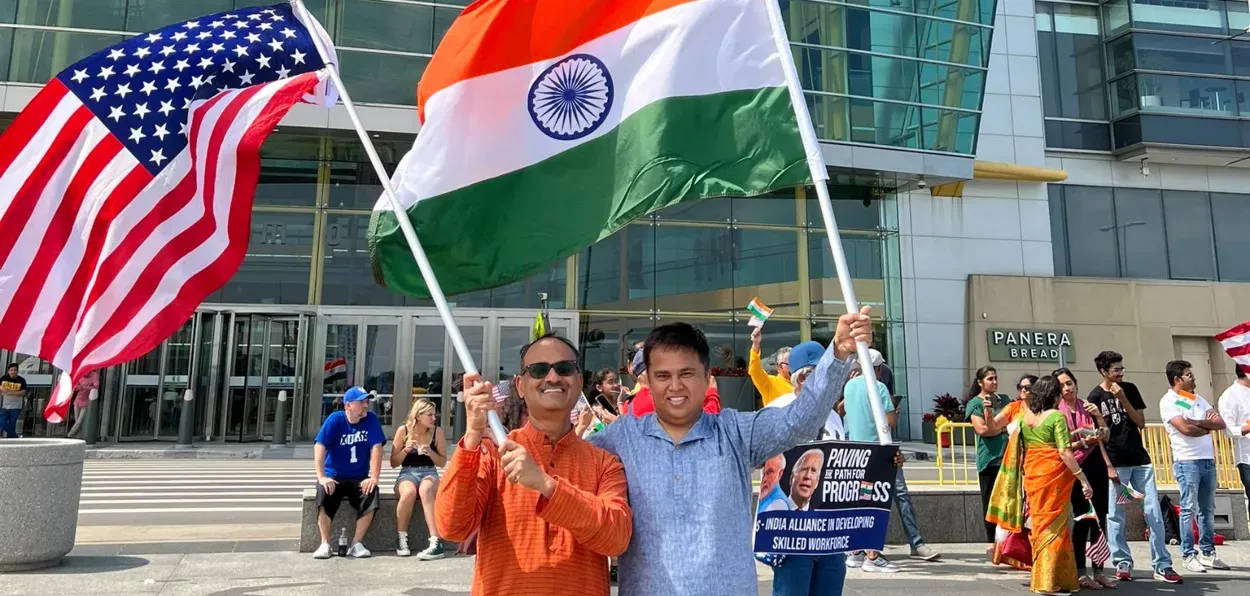
For sixty years, the Indian professional's life script has been remarkably consistent. Study hard. Get into a good engineering college or medical school. Secure a visa. Go to America. Build a life there. Send money home. Succeed.
This script was not imposed on anyone. It was earned through decades of accumulated evidence: Indian engineers who went to Silicon Valley and thrived, Indian doctors who transformed American healthcare, Indian academics who populated American universities, and eventually Indian executives who rose to run some of the most consequential companies on earth. The script worked. America was the destination because America delivered.
But in 2025 and 2026, something has changed. The script is under pressure from two directions simultaneously. And the question it produces is one that previous generations of Indian professionals never had to seriously ask: is there another version of this story?
The America That Is Changing
The change on the American side is visible and documented. The Trump administration introduced a $100,000 fee on every new H-1B visa applicant, creating chaos for thousands of Indians mid-process. The policy came with no notice and was later narrowed, but the signal it sent was unmistakable: America's welcome has conditions that can change without warning. The immigration environment that previous generations navigated with predictable difficulty has become unpredictable in a more fundamental way.
The statistics that describe the Indian presence in America are staggering in their scale. <cite index="35-1">India is the world's largest country of emigration, with approximately 18.5 million Indians residing outside their country of birth, and the United States hosts 3.2 million Indians.</cite> <cite index="35-1">71% of all U.S. H-1B visas are awarded to Indian nationals.</cite> <cite index="36-1">India received $137 billion in remittances in 2024, making it the world's top remittance recipient since 2010.</cite>
These numbers represent decades of human effort, family sacrifice, and professional achievement. They also represent a dependency that runs in both directions. The American technology industry depends on Indian talent at a structural level. And millions of Indian families depend on remittances from the United States at a personal level. A policy environment that disrupts that flow — suddenly, unpredictably — causes real and immediate pain that no amount of geopolitical framing makes less real.
The India That Is Changing
The change on the Indian side is less visible but more consequential.
India in 2026 is a categorically different proposition from India in 2000, or even India in 2015. The country has the world's fastest-growing major economy. It is the third-largest startup ecosystem on earth. It has the world's most active real-time payments infrastructure. It has a government that has committed billions to AI, semiconductor manufacturing, clean energy, and digital infrastructure. It has a venture capital ecosystem that is generating world-class exits. It has a consumer market of 1.4 billion people that is rapidly joining the formal digital economy.
The opportunities that Indian professionals went to America to access — capital markets, venture funding, world-class research infrastructure, exposure to global customers, the ability to build something that mattered at scale — are increasingly available in India itself. Not in the same form. Not with the same certainty. But with a proximity to home, a relevance to a billion people's lives, and an upside that America's more mature markets cannot match.
Tamil Nadu has launched one of the most ambitious reverse migration schemes in the country's history, offering globally competitive pay, startup research grants, relocation allowances, and a Tamil Talents Plan connecting returning scholars with state universities. The national government's IndiaAI Mission is building the infrastructure of the AI economy. Amazon has committed $48 billion to India's cloud and AI infrastructure through 2030. OpenAI just appointed its first India managing director. The global technology community is not treating India as a market to be served. It is treating India as a place to be built.

The Question This Creates
None of this is an argument that Indian professionals should not go to America, or that those who are already there should come back. Individual circumstances, family situations, professional opportunities, and personal preferences are all legitimately different. The Indian engineer building frontier AI models at Google in Mountain View is not making a wrong choice. The cardiologist who trained at AIIMS and is now practising at Johns Hopkins is not betraying India.
The argument is different and more specific. For the generation of Indians who are now making these decisions — who are 22, or 25, or 28, and deciding what their lives will look like — the calculation has changed in ways that matter.
The version of India that exists today is not the version their parents were leaving when they decided to go to America. It is not the India of limited opportunity, of bureaucratic frustration, of a market too small to sustain ambitious careers. It is a country that is building things, at scale, in almost every domain simultaneously. The frustrations are real. The infrastructure gaps are real. The institutional weaknesses are real. But the trajectory is also real, and the trajectory is the one that matters most for someone deciding where to spend the most productive decades of their professional life.
Reinventing the Script
What does it mean to reinvent the American Dream for the Indian diaspora?
It does not mean abandoning the aspiration to excellence that the original script contained. The Indian professional's determination to work harder, learn faster, and build better than anyone else in the room is not a product of the American context. It is a product of Indian culture, Indian families, and Indian education. It travels.
What it means is expanding the geography of ambition. The American Dream was always about the specific premise that somewhere, on the other side of an ocean, a person could build a life and a career and a contribution that their country of origin could not accommodate. That premise was true for sixty years. It may still be true for many people today.
But for a growing number of Indians, the equivalent opportunity is no longer separated by an ocean. It is in Bengaluru, in Hyderabad, in Chennai, in Mumbai, in a government programme, in a startup, in a research institution, in the problem of building something that works for a billion people who have never had it work for them before.
The American Dream was the promise that opportunity was available to those willing to go find it. The Indian version of that promise, in 2026, is that opportunity is available at home. Not instead of the world. As part of it.
The question the diaspora is beginning to ask is the right one: not whether America has failed them, but whether India is ready to offer something that was never on offer before. The evidence says yes. The decision is, as it has always been, deeply personal.


