The Quiet Takeover
For most of the last decade, “AI in movies” meant one thing to most audiences: a chatbot villain, or a sci-fi premise. In 2026, it means something far less cinematic and far more consequential — the software quietly running underneath almost every frame of almost every major production, from the first concept sketch to the final colour grade.
This isn't the robot-uprising version of AI in film. It's AI as infrastructure: denoising algorithms baked into every major renderer, generative tools sketching entire worlds before a single set is built, and foundation models trained on a studio's own back catalogue to generate VFX elements that match a show's exact visual style. The result is a film industry that looks, on screen, much like it always has — but that is being built, behind the scenes, in an almost entirely different way than it was even three years ago.
This piece looks at four things: where AI has already embedded itself into the moviemaking pipeline, whether it has genuinely “taken over” modern movie graphics, the controversies and labour fights that have come with it, and where the money — and the industry — is heading next.
Where AI Already Lives in the Pipeline
Industry analysts now describe 2026 as the year AI in filmmaking stopped being a collection of separate “point tools” and became something closer to an integrated layer running across every stage of production — pre-production, production, and post.
Pre-production: from script to digital backlot
AI-assisted script breakdown tools now feed directly into budget modelling, rather than running as a separate process. Generative pre-visualisation tools let directors and production designers turn a script into photorealistic sequences in days rather than the months traditionally required for storyboards and animatics — letting a director explore ten visual directions for a scene in the time it once took to execute one. Generative 3D tools, which exploded onto the scene in 2024 and matured through 2025, are increasingly used to rough out environments and assets early, even if studios haven't abandoned traditional asset pipelines for final-quality work.
Production: virtual sets become economical
Virtual production — filming actors against massive LED-screen “volumes” displaying real-time digital environments rendered in engines like Unreal Engine — has been called “the future” for years. In 2026, the economics have finally caught up: hardware costs have dropped roughly 40% since 2022, and AI-driven real-time rendering has crossed the quality threshold needed for genuine production use. Crucially, this is no longer just for $200 million tentpoles — LED volume stages in locations like the UK, Hungary, and Abu Dhabi are now viable for mid-budget productions, provided the AI-assisted pre-visualisation work feeds directly into how the stage is used.
Post-production: the part that's already changed the most
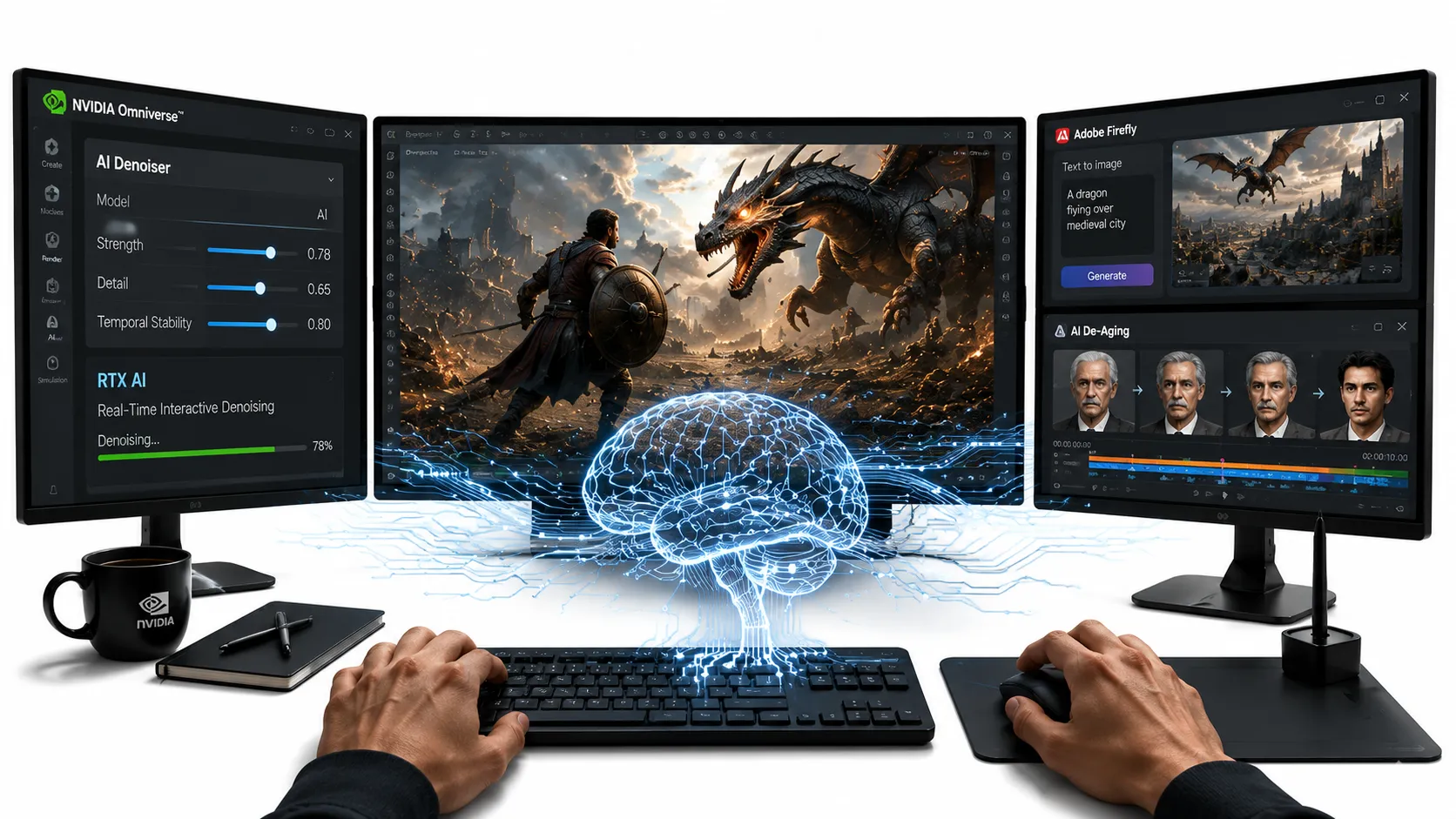
This is where AI's footprint is largest and least visible to audiences. AI denoising — using tools like NVIDIA's OptiX AI Denoiser and Intel's Open Image Denoise — is now standard across every major production renderer, including V-Ray, Arnold, Redshift, Cycles, and Karma. NVIDIA's Omniverse platform, used by effects houses including ILM and Weta Digital, accelerates VFX rendering by roughly 4x on productions including Disney films. Adobe Firefly's generative tools now manage more than a billion VFX assets every month, with reported accuracy improvements of up to 90% on tasks like inpainting and compositing.
Beyond rendering, AI is now handling: automated colour-grading consistency across episodes of a series, dialogue cleanup and background-noise removal, AI-driven dubbing and lip-sync for international releases (with India's Neural Garage, via its VisualDub tool, demonstrated as a proven example), and — most strikingly — de-aging and digital-double work that used to require painstaking frame-by-frame manual effort.
The Deals That Show How Serious This Has Gotten
Two announcements from late 2025 and early 2026 capture just how far this has moved from experimentation to infrastructure investment.
• Netflix x Interpositive Technologies (January 2026). Described as the largest single investment in AI filmmaking infrastructure to date, this five-year deal covers AI-assisted VFX — including custom foundation models trained on Netflix's own footage library to generate environments, crowds, weather effects, and set extensions that match a specific production's visual style — alongside automated post-production for colour, dialogue, and noise. As part of the build-out, Netflix opened a 32,000-square-foot “generative virtual effects” facility, Eyeline Studios, in Hyderabad, India, in March 2026.
• Amazon MGM Studios' “AI Studio” (2025–2026). Created in summer 2025 under Chief Digital Officer Albert Cheng, this internal unit began closed-beta testing of proprietary AI production tools in March 2026, focused on three areas: maintaining character consistency across shots, accelerating pre-production, and supporting VFX pipelines — built on AWS infrastructure and drawing on external large language models.
Not everyone is on board. Steven Spielberg stated at SXSW 2026 that he has never used AI in any of his films and opposes AI that replaces creative individuals — a reminder that adoption is uneven, and that some of the industry's most influential figures remain openly sceptical.
So Has AI “Taken Over” Modern Movie Graphics?
The honest answer, based on how the industry itself describes 2026, is: not exactly — but it has quietly become load-bearing.
The most repeated framing from studio executives and VFX leaders is that AI is a capacity multiplier, not a replacement. Duncan McWilliam, founder and CEO of Outpost VFX, has spoken candidly about the tension this creates: AI tools that speed up production also put pressure on artist rates and studio economics — but the studios navigating this best, in his view, treat AI as a way to do more with existing talent rather than as a replacement strategy outright.
Neishaw Ali, CEO of Spin VFX, points to near-real-time rendering and AI-assisted image generation — via tools like Unreal Engine, Midjourney, Adobe Firefly, and Luma AI — as the two biggest technological breakthroughs currently reshaping how VFX work actually gets done. The picture that emerges is one where directors still make every meaningful creative decision about what a scene looks like, but the execution of that decision — modelling an environment, generating a crowd, removing a wire, relighting a shot — increasingly runs through AI-assisted tools rather than purely manual artist labour.
At SXSW 2026, Amazon MGM's Dan Scharf framed the implication for independent filmmakers in particularly stark terms: if you have a $15 million vision but a $1 million budget, AI — specifically in VFX and production design — can be the bridge that lets you make the film you actually want to make without going into debt. That's arguably the single most important shift: AI isn't primarily making blockbusters cheaper (though it is), it's making previously impossible mid-and-low-budget productions financially viable.
The India Story: “The World's AI Film Lab”
Nowhere is the AI transformation more visible — or more unregulated — than in India, which The Hollywood Reporter described in May 2026 as having become the world's most consequential live experiment in AI filmmaking, with results that may preview the future of cinema everywhere. With no unions slowing adoption and minimal regulation cushioning the transition, India's film industry has moved faster and more openly than Hollywood on several fronts.
• Cost arbitrage at scale. Indian VFX studios including Red Chillies VFX and PhantomFX are reportedly implementing AI-assisted compositing and character work at 30–40% lower per-frame costs than Western facilities — and the quality gap that once justified Western premium pricing is compressing fast.
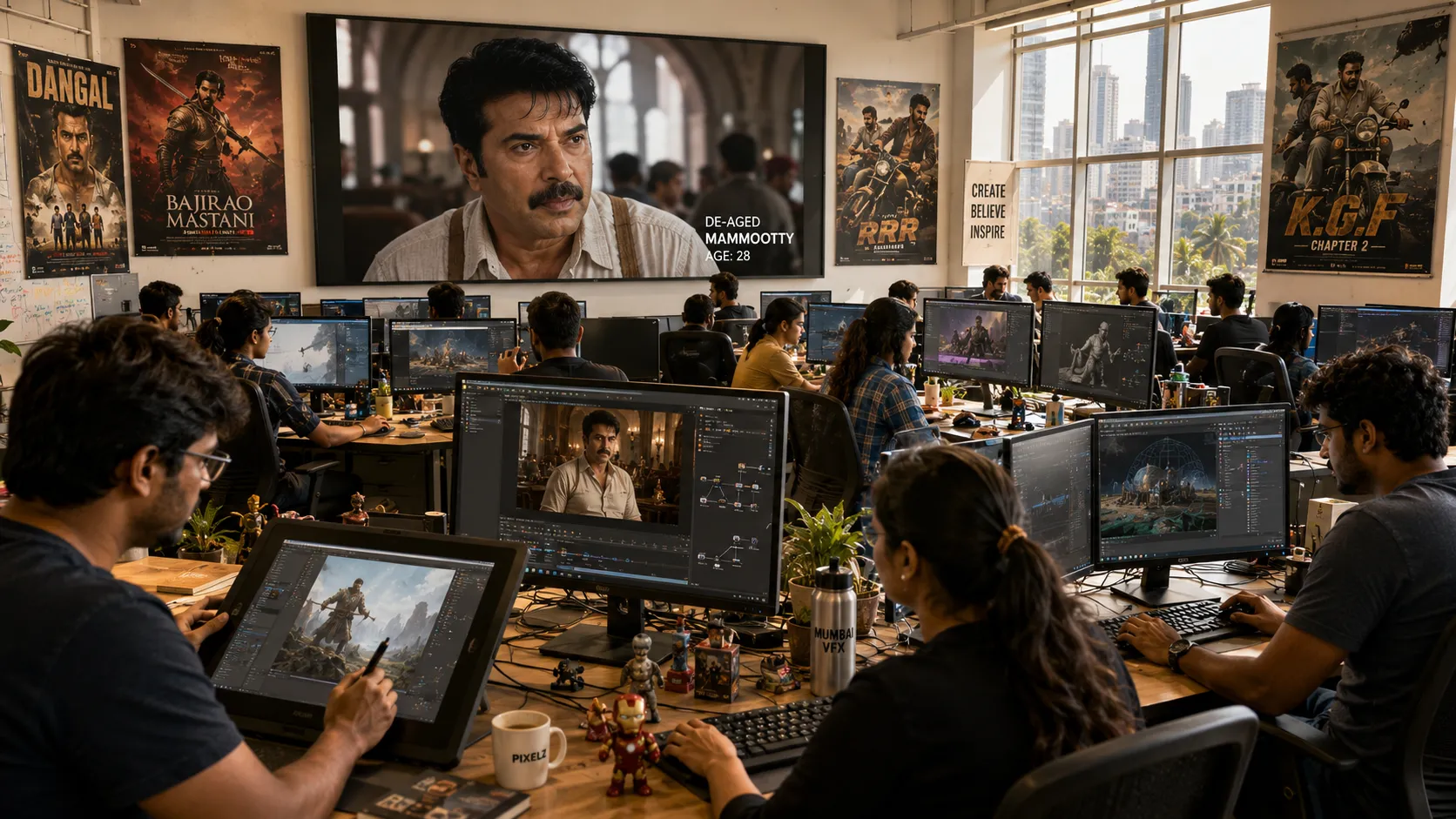
• A landmark de-aging case. The 2025 Malayalam film Rekhachithram used an AI-composited de-aged version of 74-year-old superstar Mammootty, built by feeding more than a thousand photographs of the actor from earlier in his career into an AI system — one of the most ambitious de-aging applications attempted in Indian cinema to date.
• Star-backed AI studios. Producer Danish Devgn's Lens Vault Studios, founded with Bollywood star Ajay Devgn, is using generative AI primarily in early development — concept art, environments, and character work — signalling that AI adoption in India isn't just a cost-cutting move by studios, but something major stars themselves are actively investing in.
• Netflix's big bet on India as an AI production hub. The Eyeline Studios facility in Hyderabad — built specifically for “generative virtual effects” — represents a significant vote of confidence in India's role not just as a low-cost VFX destination, but as a centre for the next generation of AI-driven effects work.
The Other Side of the Story: Jobs, Deepfakes, and Lawsuits
None of this has arrived without serious friction — and the friction is arguably most visible in India, even as the country races ahead on adoption.
The jobs question
A study commissioned by the Animation Guild, the Concept Art Association, and other Hollywood labour groups — surveying 300 entertainment industry executives — found that roughly 75% had already used AI to eliminate, reduce, or consolidate jobs by 2023, and projected that as many as 118,500 positions in the U.S. alone could be lost within three years, with 80% of early AI adopters concentrating that impact in post-production. Entry-level roles are seen as especially exposed: cleanup, relighting, and base compositing have traditionally been where junior VFX artists learn the craft, and these are exactly the tasks AI tools are starting to absorb. At the same time, industry voices caution this isn't purely a one-way street — AI may create different jobs even as it displaces others, though likely not in equal numbers in the near term.
Lionsgate's partnership with AI startup Runway — training AI on the studio's film and TV catalogue — became a flashpoint for exactly this debate: efficiency and cost savings for the studio, set against artists' concerns about whose work trained the models that may eventually do parts of their jobs.
The deepfake crisis — especially in India
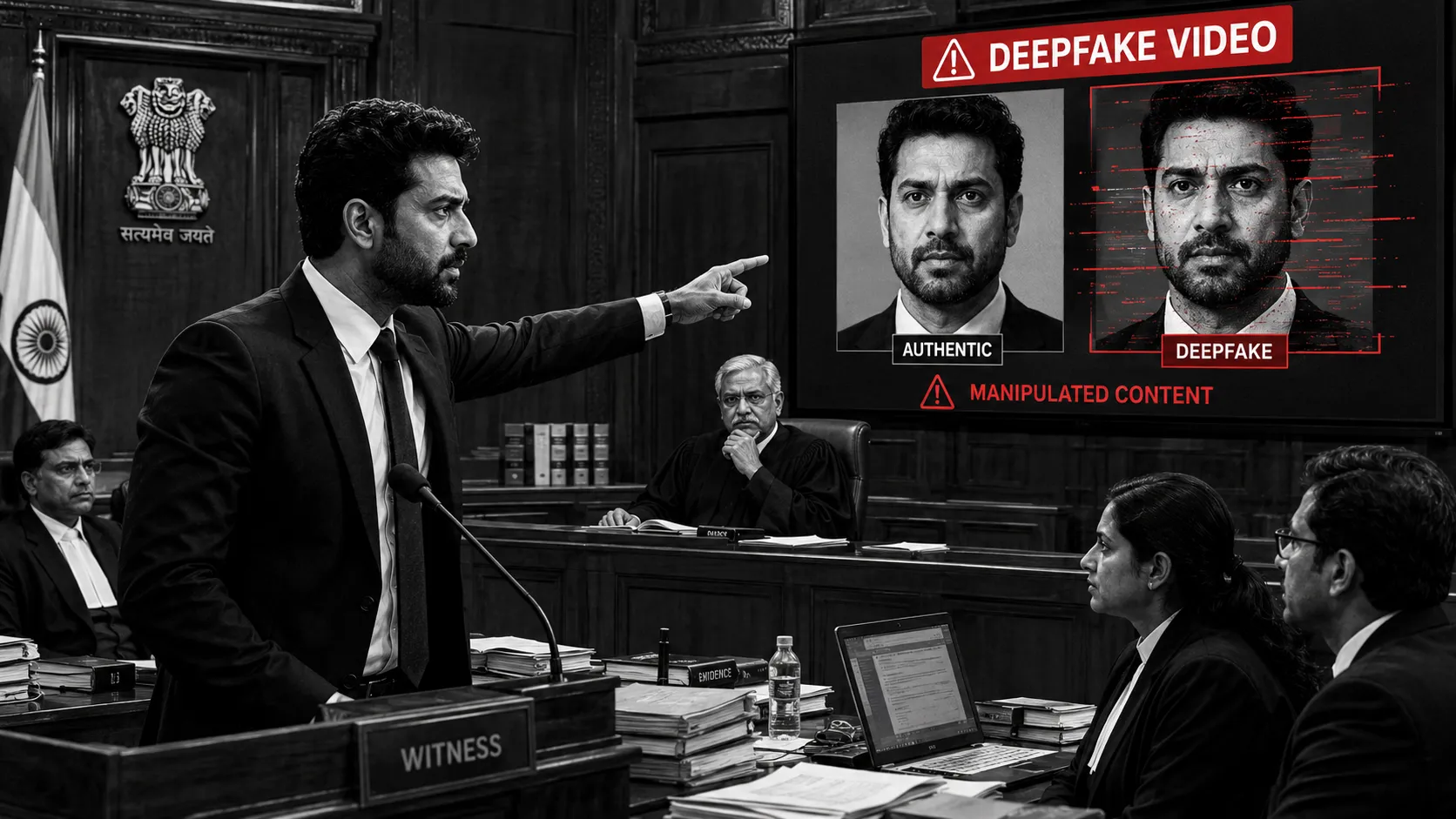
The same generative tools transforming VFX pipelines have made it dramatically easier to create non-consensual deepfakes of public figures — and Indian film stars have been hit particularly hard. Research presented at the 2025 ACM Conference on Fairness, Accountability, and Transparency found that AI image generators can now be fine-tuned on a celebrity's likeness using as few as 20 photos and about 15 minutes on consumer hardware, and that 99% of deepfake explicit content globally targets women.
The legal response from Bollywood has been forceful and fast. In a single wave through late 2025: Abhishek Bachchan and Aishwarya Rai Bachchan sued Google and YouTube over AI deepfakes and personality-rights violations, with the Delhi High Court demanding written responses from Google's legal team. By December 2025, NTR Jr., R. Madhavan, and Shilpa Shetty had each won emergency court orders in Delhi and Mumbai blocking the spread of AI-generated deepfakes, voice clones, and unauthorised synthetic merchandise bearing their likeness. Anil Kapoor and Jackie Shroff had already secured protections over their image, voice, and even signature catchphrases and nicknames in earlier rulings.
India's regulatory response — the IT (Intermediary Guidelines) Amendment Rules 2025 — came into force on November 15, 2025, requiring AI-generated content to be clearly labelled, with full penalty enforcement expected to extend into early 2026. There's a pointed irony underlying all of this: Indian film stars have themselves used AI-driven de-aging and digital-likeness technology in advertising for years — Shah Rukh Khan's AI-personalised retail ads in 2020, and Salman Khan's de-aged appearance in a 2022 soft-drink ad among the best-known examples — making the industry's current fight against deepfakes as much about control over the technology as opposition to it in principle.
The Business Opportunity: Where the Money Is
Strip away the headlines, and the market numbers tell their own story about how seriously capital is treating this shift.
Market | 2025 Value | Projection |
Global AI in VFX market | $4.87 billion | $28.66 billion by 2035 (19.46% CAGR) |
U.S. AI in VFX market | $1.46 billion | $8.50 billion by 2035 (19.24% CAGR) |
Global AI in Film market | $1.59 billion (→ $1.97bn in 2026) | $4.6 billion by 2030 (23.6% CAGR) |
A few specific opportunity areas stand out from the broader trend:
• Motion capture is the fastest-growing VFX sub-segment through 2035, driven by demand for realistic character movement across film, games, and virtual production — a category where AI-assisted capture and clean-up reduces both cost and turnaround time.
• AI-native VFX facilities can undercut on price without (yet) sacrificing quality — the India example shows facilities operating at 30–40% lower per-frame costs while the quality gap with Western studios continues to close, creating a genuine competitive disruption in global VFX outsourcing.
• Localisation and dubbing is an underrated growth area. AI-driven lip-sync dubbing (demonstrated by India's Neural Garage/VisualDub) has shown proven ROI — a meaningful opportunity given how central multilingual, multi-territory releases have become to streaming economics.
• Mid-budget production is a new addressable market. As virtual production and AI-assisted VFX become economical below the $200 million tentpole tier, an entire category of $1–20 million productions gains access to visual ambitions previously reserved for blockbusters — expanding the total pool of productions that need (and can afford) advanced visual effects work at all.
• Education and tooling is becoming its own business. Specialised programmes — from Kentucky Wesleyan College's dedicated AI Film-Making course to Full Sail's three-week Generative AI for Filmmaking course — reflect a growing market for training the workforce that will operate these new pipelines, alongside a fast-growing ecosystem of subscription AI tools priced for individual creators.
Where We're Heading: The 2026–2027 Roadmap
Industry forecasters converge on a few specific predictions for what comes next:
• A genuinely real-time, cloud-first video model. Rather than frame-by-frame generation, the expectation is for a model that behaves like a live feed — where changes to a generated scene appear instantly and can be directed interactively, similar to controlling a live camera rather than issuing a series of prompts.
• A productised VFX-specific model. Early tools like Beeble and Luma point toward a future model that can take high-resolution camera footage and produce full PBR (physically-based rendering) maps, remove rigging wires, relight scenes, and swap backgrounds — returning full-quality, non-destructive output that integrates directly into editorial and finishing workflows, rather than compressed preview-quality results.
• Richer ways to direct AI output. Expect more interfaces beyond typed prompts — virtual camera rigs, joysticks, motion-tracking, and uploaded camera-parameter data — giving filmmakers tactile, camera-like control over generative output.
• Clearer standards for AI-generated content. As generative 3D and video tools mature past their early, inconsistent stage, the expectation is for clearer technical standards and creative frameworks that make AI-generated content easier for studios to adopt with confidence around continuity and consistency — addressing one of the biggest practical complaints from VFX artists today.
• Active labour negotiations. Guild conversations in the U.S. — covering SAG-AFTRA, the Writers Guild, and IATSE — remain live, and productions seen as pursuing “AI-replacement” postures (rather than augmentation) are described as accumulating labour risk that tends to surface before a picture locks. How these negotiations resolve will significantly shape how openly studios can deploy AI tools without triggering disputes.
• Regulatory catch-up, especially around identity. India's November 2025 IT Rules amendment — mandating labelling of AI-generated content — is likely to be an early model other jurisdictions watch closely, particularly as personality-rights lawsuits from film stars create legal precedent for how an individual's AI-generated likeness can and can't be used.
The Bottom Line
AI hasn't replaced the director's chair, and — Spielberg aside — it's increasingly hard to find a major studio that isn't using it somewhere in its pipeline. The honest 2026 picture is a film industry where AI has become genuinely load-bearing infrastructure for the execution of visual effects, previsualisation, virtual production, colour, sound, and localisation — while the creative decisions about story and image remain, for now, firmly human.
The business opportunity is real and large — tens of billions of dollars across AI-in-VFX and AI-in-film markets by the early 2030s — but it's arriving alongside genuine job displacement, an unresolved deepfake crisis hitting film stars (and far more ordinary people) hardest in markets like India, and labour negotiations whose outcomes will shape how aggressively studios can deploy these tools without a fight. India's position as both the most aggressive adopter and the site of the most visible deepfake legal battles makes it, as much as anywhere, the place to watch for how this all plays out — for cinema, and for everyone whose face and voice can now be convincingly generated by a machine.


