TechFuture Tech10 MIN READ

All Eyes On Infosys: IT Bellwether's Q1 FY27 Results Due July 23 Could Set The Tone For India's Tech Sector

Infosys reports Q1 FY27 results on July 23, 2026. Here's what analysts expect on revenue, margins, guidance and large deal wins from India's IT bellwether.

By Aravind Kumar · Author20 July 2026New
All Eyes On Infosys: IT Bellwether's Q1 FY27 Results Due July 23 Could Set The Tone For India's Tech Sector

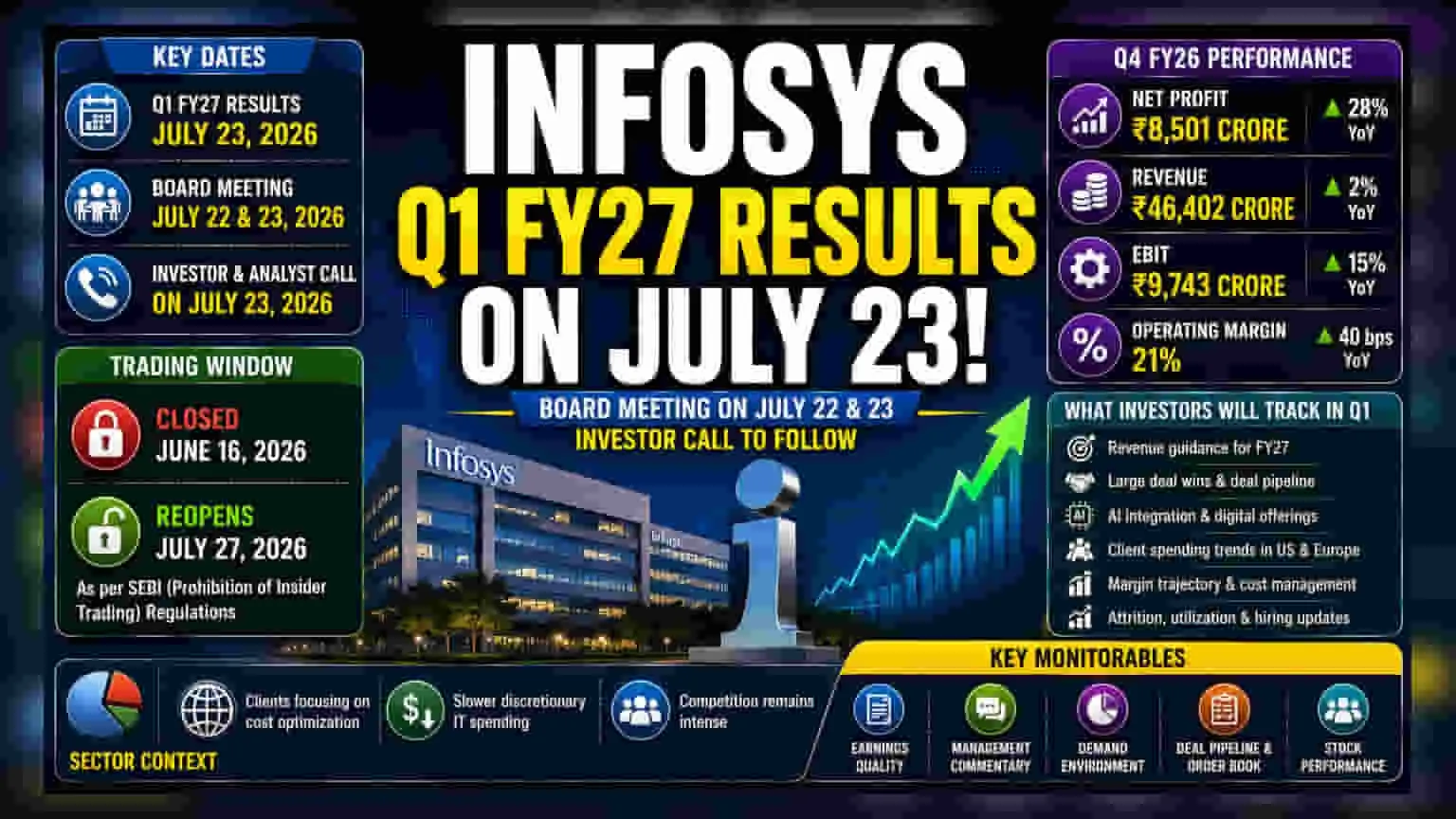
India's information technology sector is bracing for one of its most closely watched earnings events of the year, with Infosys, the country's second-largest IT services exporter, scheduled to announce its results for the first quarter of financial year 2026-27 on July 23, 2026. The company's board is set to meet across July 22 and 23 to approve the numbers, with investor and analyst calls following on results day itself — a sequence that will draw the attention of virtually every major domestic and international brokerage covering Indian technology stocks, given Infosys's outsized weight in the Nifty IT index and its long-standing role as an early guidance-setter for how the broader sector's discretionary technology spending environment is evolving.

The numbers themselves are being watched with unusually granular attention this quarter. Brokerage estimates ahead of the results point to expected revenue of around ₹41,000 crore, with an operating margin band of 20.5 per cent to 21.5 per cent, and constant currency quarter-on-quarter growth projected in the range of 1.5 per cent to 2.2 per cent — a notable improvement from the 1.1 per cent posted in the previous quarter. Some analysts have floated the possibility that Infosys could trim the upper end of its full-year FY27 revenue growth guidance by around 50 basis points, even as operating margins are expected to improve modestly on the back of continued cost discipline and operational efficiencies. That combination — slightly more conservative top-line guidance alongside steadier or improving margins — would be broadly consistent with the cautious-but-resilient tone that has characterised much of the Indian IT sector's commentary through recent quarters.
rlke9f9s_it-sector-q1-fy27-results-preview_625x300_01_July_26.webp

Three specific data points are expected to dominate how the market interprets Thursday's results: revenue guidance for the remainder of the financial year, the total contract value of large deals signed during the quarter, and the trajectory of operating margins as they stabilise near the 21 per cent mark. Each of these carries distinct signalling value. Revenue guidance offers the clearest read on how Infosys's own management views the demand environment for the next nine months, informed by direct conversations with its largest global clients about their technology budgets. Large-deal TCV, meanwhile, has become an increasingly important proxy for medium-term revenue visibility across the IT sector, since large multi-year outsourcing and digital transformation contracts tend to provide a more durable revenue base than shorter-cycle project work, which remains more exposed to clients pulling back discretionary spending during periods of macroeconomic uncertainty. Margin trajectory, for its part, offers a window into how effectively Infosys is managing the balance between pricing pressure from increasingly cost-conscious clients and its own internal efficiency levers, including automation, offshore delivery mix, and utilisation rates across its workforce.

The broader IT earnings season has, so far, opened on an encouraging note, setting a constructive backdrop against which Infosys's own results will be measured. Tata Consultancy Services, which reported earlier in the season, lifted the Nifty IT index with its own results, while HCL Technologies posted a 20.3 per cent year-on-year rise in net profit to ₹4,624 crore on revenue of ₹34,579 crore — a print that surprised several brokerages on the upside and reinforced the sense that this earnings season, at least among the early reporters, has outpaced the more cautious expectations that had built up over recent quarters. Whether Infosys can match or exceed that momentum, given its differing service mix and client concentration relative to TCS and HCL Technologies, will be a key point of comparison once its own numbers land.

Corporate governance and operational context also feed into how this quarter's results will be read. Infosys's trading window, closed since June 16 ahead of the results announcement, is set to re-open on July 27, giving company insiders and closely tracked institutional shareholders a clear compliance timeline around the quarter-end information flow. That closure period, standard practice ahead of material financial disclosures, has if anything heightened anticipation in the run-up to July 23, with market participants having had no fresh insider trading activity to parse for signals about how the quarter has actually gone, leaving analyst estimates as the primary basis for market positioning heading into the results.

Beyond the headline numbers, Infosys's commentary on artificial intelligence-related revenue streams and the broader disruption AI poses to traditional IT services business models is expected to draw particular scrutiny this quarter. Wipro Chairman Rishad Premji recently remarked that IT companies can leverage AI to transform client operations, even as AI-native firms increasingly threaten traditional revenue models and recurring business streams that have underpinned the sector's growth for decades — a tension that every major Indian IT services company, Infosys included, is now being forced to address directly in its own client conversations and, increasingly, in its public earnings commentary. How Infosys frames its own AI strategy, and whether it can demonstrate that AI-related engagements are net additive to revenue rather than merely cannibalising traditional application development and maintenance work, will likely feature prominently in analyst questions during the post-results investor call.

For the broader Nifty IT index and the sentiment surrounding India's technology sector more generally, Infosys's results carry significance well beyond the company's own stock price. As one of the two largest constituents of the index alongside TCS, any meaningful surprise — positive or negative — in Infosys's numbers or its forward guidance is likely to move sentiment across the sector, influencing how investors price in similarly structured but smaller IT services companies that report their own results in the days and weeks following. Given that the current Q1 FY27 earnings season has already been credited with helping lift the broader Sensex and Nifty to some of their strongest single-day gains in recent weeks, a strong Infosys print could reinforce that broader market momentum, while a disappointing one could introduce a note of caution into what has, so far, been an unusually constructive reporting season.

As July 23 approaches, brokerages across Mumbai, Bengaluru and international financial centres are finalising their preview notes, with most maintaining a cautiously optimistic stance heading into the results based on the encouraging signals from earlier IT sector reporters and Infosys's own historical track record of delivering results in line with, or modestly ahead of, its own guidance ranges. Whether that pattern holds for another quarter, or whether Infosys instead delivers a surprise that forces a broader re-rating of sentiment toward India's IT services sector, will become clear only once the company's board meeting concludes and the numbers are formally released to the market on results day itself.


The market focus areas center on revenue guidance for the full year, large deal total contract value, and the stabilization of operating margins near 21 per cent — the three numbers that will decide how the Street reads this quarter.
The Impactful Global Indian Business Desk

Client vertical performance will offer another important lens through which analysts parse Infosys's numbers this quarter. The company's exposure across banking, financial services and insurance, retail, manufacturing, and communications clients each carries a distinct demand profile, and any notable divergence between these verticals — for instance, continued softness in discretionary technology spending among European financial services clients even as North American retail and manufacturing clients show renewed appetite for digital transformation projects — would offer a considerably more textured read on the global demand environment than the aggregate revenue and margin figures alone. Historically, Infosys's management commentary on vertical-level performance has proven a useful leading indicator for how the rest of the IT sector's own vertical exposure is likely to perform once smaller peers report their own results in the weeks following.

Currency movements will also factor into how the market interprets Infosys's reported figures, given the company's substantial revenue exposure to the US dollar, the euro, and the British pound. Constant currency growth figures, which strip out the impact of exchange rate fluctuations, are generally regarded by analysts as the more reliable underlying measure of genuine business momentum, but the reported, currency-inclusive revenue figure remains what ultimately flows through to the company's rupee-denominated financial statements and, by extension, to its dividend and buyback capacity — a consideration that becomes particularly relevant given Infosys's history of returning a substantial share of its free cash flow to shareholders through a combination of dividends and periodic share buybacks.

Analysts will also be parsing commentary around Infosys's talent and hiring strategy this quarter, an area that has taken on renewed significance as the broader IT sector grapples with the dual pressures of AI-driven productivity gains reducing the need for certain categories of entry-level technical hiring, even as demand for more specialised AI and cloud engineering talent continues to grow. Net headcount additions, attrition rates, and utilisation levels — the proportion of billable employees actively deployed on client projects at any given time — together offer a granular window into how efficiently Infosys is managing its considerable workforce amid this ongoing structural shift in the skills the IT services industry requires from its people.

Comparative positioning against Infosys's closest domestic peer, Tata Consultancy Services, will also feature prominently in post-results analysis, given the two companies' historically close competitive dynamic across most major service lines and client verticals. TCS's own results, reported earlier in the current earnings season, provided the market with an initial benchmark for the sector's overall health, and Infosys's numbers will inevitably be read partly through the lens of how they compare on key metrics including revenue growth rates, margin trajectory, and large deal signings. Any meaningful divergence between the two companies' performance this quarter would likely prompt considerable analyst commentary on the underlying strategic or execution factors driving that gap, whether related to differing client mix, geographic exposure, or the relative pace at which each company has integrated AI-driven productivity tools into its own service delivery model.

Institutional investor positioning ahead of the results has also drawn attention, with several large domestic mutual funds and foreign portfolio investors reportedly adjusting their Infosys holdings in the days leading up to the announcement based on their own proprietary channel checks and estimates of likely quarterly performance. Options market activity tied to Infosys shares has similarly reflected elevated implied volatility heading into results day, a pattern typical of high-profile earnings events where the market anticipates a potentially significant single-day price move in either direction depending on how the actual results and management commentary compare against the range of analyst expectations that has built up over recent weeks.

6a588bc7c60b5-ai-generated-image-for-representational-purpose-only-164402344-16x9.webp

Beyond the immediate quarter, Infosys's July 23 results will also offer investors an early indication of how the company's leadership views the balance of risks and opportunities heading into the remainder of financial year 2026-27, at a moment when global macroeconomic conditions, ongoing trade policy uncertainty between India and the United States, and the accelerating disruption posed by generative AI to traditional technology services delivery models are all converging to make forward guidance considerably more consequential, and considerably harder to deliver with confidence, than in more stable prior periods. How Infosys's management navigates that uncertainty in its public commentary — striking a balance between transparency about genuine near-term challenges and confidence in the company's longer-term positioning — will itself be closely watched as a signal of how prepared India's IT services leadership is to guide investors through a period of unusually rapid technological and macroeconomic change.

Ultimately, whatever the specific numbers reveal on July 23, Infosys's results will function as one of the single most consequential data points shaping how global and domestic investors price the entire Indian IT services sector for the remainder of calendar year 2026, given the company's scale, its bellwether status, and the sheer breadth of client relationships and geographic markets its results collectively touch upon.

Historical context also informs how this quarter's results are likely to be received. Infosys has, over the preceding several years, built a reputation for delivering results that track reasonably closely with its own stated guidance ranges, a consistency that has helped the stock command a premium valuation relative to some peers less consistent in meeting their own forward projections. Any significant deviation from that pattern this quarter — whether a notable guidance miss or, conversely, a meaningfully better-than-expected print — would likely prompt a broader market reassessment not just of Infosys's own near-term trajectory, but of the reliability of forward guidance across the Indian IT services sector more generally, given how closely other companies' own guidance-setting practices are often benchmarked against Infosys's established track record. That broader signalling effect is part of why this particular quarter's results carry weight extending well beyond the company's own shareholder base, feeding into how analysts calibrate expectations for the dozens of smaller IT services companies still to report through the remainder of the current earnings season.

TagsInfosysQ1FY27ResultsITStocksIndiaNiftyITIndianTechSectorEarningsPreviewDalalStreetStockMarketIndiaTechEarningsInvestInIndia

Reader reviews

Sign in to rate and review this article.
Loading reviews…

