Most coverage of Indian diaspora achievement operates through anecdote: a CEO appointment here, a rich-list ranking there, a philanthropic award somewhere else entirely. A report published under the Indiaspora banner, titled India and its Diaspora: Partners in Progress, attempts something considerably more ambitious — putting an actual number on the diaspora's aggregate economic scale, rather than relying on the accumulation of individual success stories to imply a scale that has rarely been directly measured with any statistical rigor.
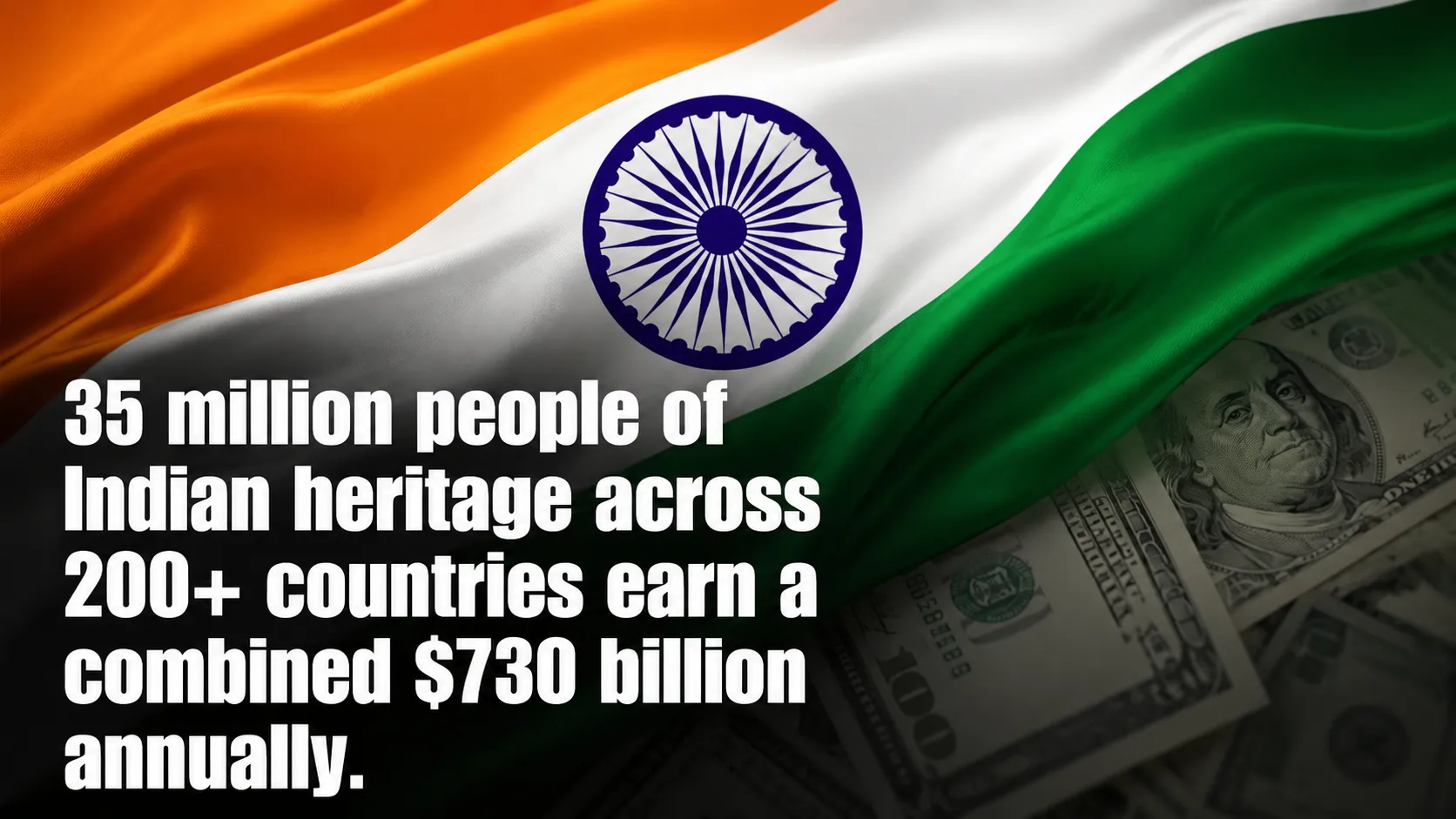
The headline figures are, on their own terms, genuinely striking and worth sitting with for a moment. The report estimates that more than 35 million people of Indian heritage now live across more than 200 countries, with a combined annual income estimated at roughly $730 billion. Considered as a single economic unit, that income figure would rank among the world's larger national economies, despite describing not a country but a dispersed population connected by heritage, ancestry, and cultural identity rather than by shared geography or citizenship.
Where a Number Like This Actually Comes From
Estimating the aggregate income of a globally dispersed population of this considerable size is a genuinely difficult statistical exercise, and understanding roughly how such figures get constructed helps calibrate how much confidence to place in the headline number. Reports of this kind typically combine several data sources: official immigration and census statistics from major destination countries, which provide reasonably reliable population counts of Indian-origin residents; income and wage data from those same countries, often broken down by occupation, industry, or educational attainment where Indian-origin populations are known to concentrate; and extrapolation methods that fill gaps where direct data is unavailable, particularly in countries with less rigorous demographic data collection infrastructure or where Indian-origin populations are harder to distinguish from other South Asian ethnic categories in official statistics.
That methodology means the resulting $730 billion figure should be understood as a considered estimate rather than a precisely measured fact, subject to the same kinds of uncertainty that affect any large-scale demographic and economic extrapolation exercise conducted across such a geographically dispersed population. The population figure of 35 million people across 200-plus countries is itself a notable undertaking, requiring assembling and reconciling data from national statistical agencies with very different data collection standards, definitions of ethnic or ancestral identity, and reporting timelines. Reasonable analysts could arrive at somewhat different headline numbers using different methodological choices, without any of those different approaches being clearly wrong or invalid.
Why the Framing Matters as Much as the Number
This shift arrives as part of a much broader, still-unfolding conversation about how the diaspora's relationship with India ought to be understood, measured, and engaged with going forward, a conversation this report itself contributes meaningfully to shaping.
Perhaps more significant than the specific dollar figure itself is the report's explicit and deliberate framing choice: describing the diaspora as partners in progress, rather than through the more traditional lens of remittance senders or a source of nostalgic cultural connection to a homeland left behind. That framing reflects a deliberate effort to reposition how both Indian policymakers and diaspora communities themselves think about the underlying relationship, shifting the emphasis from money flowing home to support individual families toward a broader vision of diaspora capital, expertise, and institutional credibility as active inputs into India's own development trajectory over the coming decades.
That reframing did not emerge in a vacuum, disconnected from other developments this year. It reflects a broader pattern visible across multiple stories in Indian diaspora coverage this year: IIT Kanpur's new medical school, backed by a nine-figure gift from an IndiGo co-founder and staffed in part by returning physician-scientists relocating from prestigious American academic institutions; diaspora business leaders in cities like Melbourne pressing visiting Indian officials for concrete trade and policy engagement rather than simply celebrating diplomatic visits; and a general shift in how diaspora philanthropy operates, moving from simple financial transfers toward sustained institutional involvement and direct expertise transfer. The Indiaspora report's $730 billion figure provides a kind of statistical backdrop against which all of these individual stories can be read as instances of a single, larger, quantifiable phenomenon rather than as scattered, disconnected anecdotes.
What a Number This Size Actually Implies
It is worth pausing on just how large a diaspora population of 35 million people actually is in absolute terms. That figure would make the global Indian diaspora, considered as a single population, larger than the individual populations of most countries in the world, comparable in scale to a mid-sized nation rather than simply a demographic subset of any single country's immigrant community. Combined with an estimated $730 billion in annual income, the diaspora's aggregate economic weight places it in a category most policymakers and businesses have historically underestimated, treating diaspora engagement as a matter of cultural goodwill and periodic ceremonial recognition rather than as serious economic strategy deserving of the same rigorous analysis applied to major trading partners or investment markets.
A combined annual income approaching three-quarters of a trillion dollars implies a diaspora with genuine capacity to function as an independent economic actor on the global stage: a source of foreign direct investment substantial enough to matter at a national policy level, a consumer market worth courting directly by both Indian and international businesses selling everything from financial products to cultural and educational services, and a philanthropic and institutional funding base capable of building universities, hospitals, and cultural institutions at a scale that most purely domestic Indian philanthropic sectors would struggle to match on their own.
The Distribution Question the Headline Number Doesn't Answer
The report's population estimate of 35 million diaspora members also invites comparison with how India's own government counts and categorizes its overseas population, distinguishing between Non-Resident Indians who retain Indian citizenship, Overseas Citizens of India who hold a specific long-term visa status short of full citizenship, and the broader category of persons of Indian origin whose ancestral connection to India may span multiple generations without any formal legal status connecting them to the country at all. The Indiaspora report's 35 million figure appears to draw on this broadest definition, capturing ancestral and cultural connection rather than any specific legal or citizenship status, a methodological choice that maximizes the reported population size but also means the figure describes a considerably more loosely defined community than India's own formal categories for its overseas population would capture on their own.
For all its usefulness in establishing aggregate scale, the $730 billion figure says relatively little about how that income is actually distributed across the 35 million people it purports to describe. A diaspora population this large and this geographically dispersed inevitably spans an enormous range of individual economic circumstances, from executives and professionals earning multiples of their host countries' median income to working-class immigrants, agricultural laborers in some destination countries, and vulnerable populations facing genuine economic precarity despite technically being counted within the same aggregate diaspora statistics.
That distributional question matters enormously for translating an aggregate statistic into meaningful policy or philanthropic action on the ground. A diaspora engagement strategy built around courting the wealthiest slice of this population — the executives, entrepreneurs, and professionals whose individual stories dominate business media coverage — will look considerably different from a strategy aimed at supporting the diaspora's more economically vulnerable members, whose experiences rarely generate the same kind of celebratory press coverage but who nonetheless form a genuine and numerically significant part of the 35 million people the report describes. The recent reports of violence affecting parts of the Indian diaspora community in Ireland, for instance, are a pointed reminder that aggregate economic success statistics can coexist, within the same broadly defined diaspora population, with genuine vulnerability and hardship experienced by specific individuals and communities living far from the headline figures that dominate most coverage of diaspora achievement.
How India Itself Might Use This Data
For Indian policymakers specifically, a report of this kind and scale offers a data-driven foundation for diaspora engagement strategies that have historically relied more heavily on cultural and emotional appeals than on rigorous economic analysis. Understanding not just the aggregate scale of diaspora income but its geographic concentration, occupational distribution, and generational composition could inform more targeted policy interventions: which countries and cities host the largest concentrations of diaspora wealth worth courting for investment, which professional sectors offer the greatest potential for expertise transfer back to India, and which generational cohorts within the diaspora — first-generation immigrants versus their children and grandchildren born abroad — are most likely to maintain active engagement with India over the coming decades as the diaspora's demographic composition continues to shift and evolve.
A Statistic That Will Outlive This News Cycle
Individual news stories about diaspora achievement — a CEO appointment, a philanthropic award, a rich-list ranking — tend to have a genuinely short shelf life, generating attention for a news cycle or two before fading as the next individual story takes their place. A report like Partners in Progress operates on a different timescale, providing a reference statistic that will likely be cited repeatedly across the coming years, in contexts ranging from Indian government policy discussions to diaspora organization fundraising appeals to academic research on global migration and diaspora economics.
That durability matters because it shapes how the underlying phenomenon gets understood by audiences well beyond those who read the original report closely enough to understand its methodological limitations. A headline figure like $730 billion, once it enters wider circulation, tends to take on a life of its own, cited with a confidence that may exceed what the underlying methodology can fully support, even as it serves the genuinely useful function of establishing that the diaspora's aggregate economic weight is large enough to merit serious, sustained attention from policymakers, businesses, and philanthropic institutions on both sides of the relationship.
Whatever refinements future editions of this kind of report eventually bring to the underlying methodology, the basic contribution of an effort like Partners in Progress is likely to endure: replacing a purely anecdotal sense of diaspora significance, built from an accumulation of individual success stories, with something closer to a genuine statistical foundation — imperfect, contestable in its specific numbers, but pointing unmistakably in the same direction that this entire year's parade of individual diaspora stories has already suggested. The Indian diaspora, however imprecisely measured, has become too large and too economically significant to be understood through anecdote alone.
How This Report Compares to Other Diaspora Studies
The Indiaspora report is certainly not the first attempt to quantify a major global diaspora's economic footprint, and situating it alongside comparable efforts for other diaspora populations helps clarify both its genuine, substantive contribution and its inherent limitations. Studies of the Chinese, Jewish, Irish, and other major global diasporas, among others, have each attempted similar exercises over the years, typically arriving at their own headline figures that, like the Indiaspora report's $730 billion estimate, function more as order-of-magnitude indicators than as precise accounting figures suitable for rigorous economic policy modeling. What distinguishes these efforts collectively is less their individual methodological rigor, which varies quite considerably from study to study, and more the broader function they serve: providing diaspora communities and their countries of origin with a shared statistical vocabulary for discussing a relationship that had previously been understood mostly through qualitative narrative and individual anecdote.
That comparative and international context matters for calibrating expectations about what the Indiaspora report can and cannot do reliably. It is unlikely to be the final or most methodologically rigorous word on Indian diaspora economics; subsequent research, potentially conducted by academic institutions or government statistical agencies with greater resources and more rigorous peer review processes, may well arrive at somewhat different figures using more refined methodologies and more granular underlying data. What the report has already accomplished, regardless of how future research eventually refines its specific numbers, is establishing a baseline figure prominent enough to anchor public discussion of diaspora economic scale for the foreseeable future, much as comparable reports have already done for other diaspora populations well before it.


