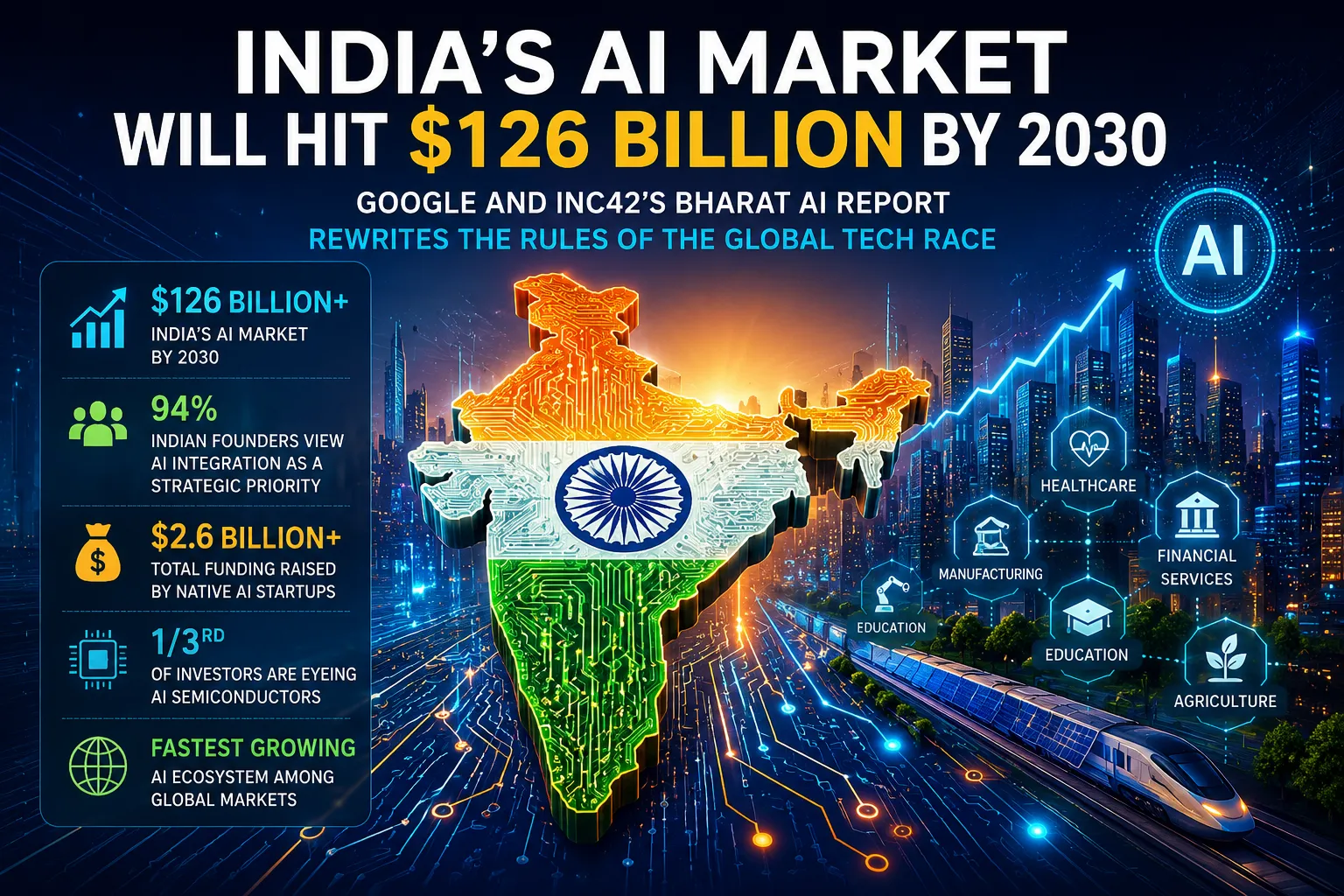
The morning of June 12, 2026 brought with it one of the most consequential research documents to emerge from the Indian technology ecosystem in years. Google and Inc42's co-authored Bharat AI Startups Report 2026 has crystallised a number that the global technology investment community has been circling for months: India's artificial intelligence market is on course to become a $126 billion opportunity by 2030, with a potential GDP impact of $1.7 trillion by 2035. These are not projections from optimistic think-tanks. They are derived from actual startup activity, enterprise adoption data, and infrastructure investment flows that make this trajectory not just plausible but — according to the analysts — probable.

India today is home to more than 170 AI startups that have collectively raised more than $2.6 billion in funding. They are building AI models, hardware devices, and enterprise tools across a spectrum that spans agriculture, healthcare, financial services, education, logistics, defence, and deep-tech research. The scale and diversity of this activity is what makes the $126 billion estimate credible: India's AI opportunity is not concentrated in a single sector or geography. It is distributed across the full breadth of the world's most populous democracy, in conditions — language diversity, resource constraints, massive underserved populations — that are forcing Indian AI founders to build solutions that are simultaneously more resilient and more inclusive than anything being built in Silicon Valley.
Enterprise AI is identified as the leading growth driver in the report. India's large IT services sector — which has spent decades building deep enterprise relationships across Fortune 500 companies, global banks, and public sector organisations — is now becoming the distribution channel through which AI solutions reach global enterprise buyers. Companies like Tata Consultancy Services, Infosys, Wipro, and HCLTech are all aggressively embedding AI into their service delivery. OrbitShift, backed by Peak XV and Stellaris Ventures, uses AI to cut research and sales planning time by 40–50% and increase sales productivity by 20–30%. This is the archetype of the wave.
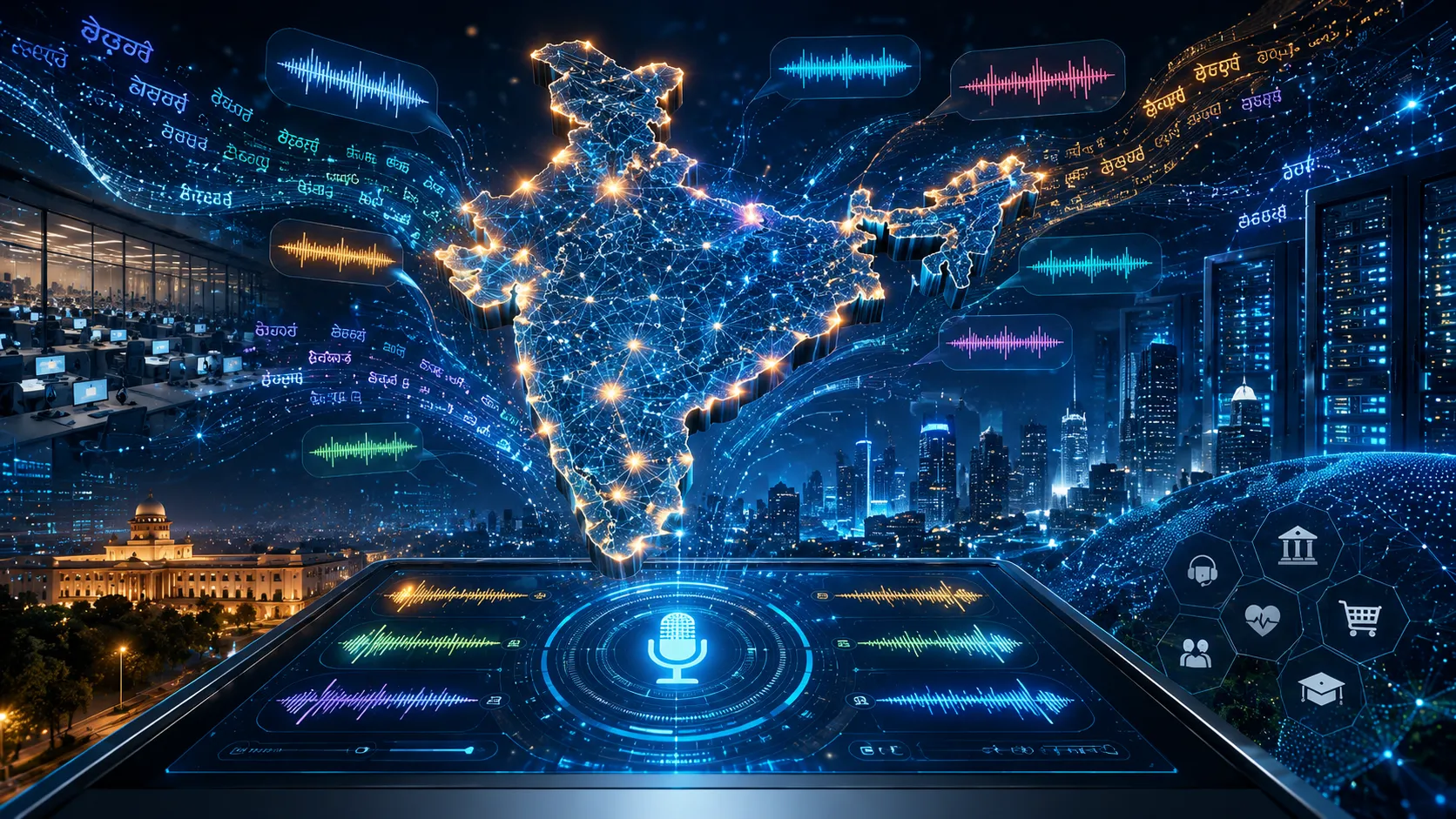
Language AI is the category where India's unique market conditions create the most distinctive competitive advantage. India has 22 official languages and hundreds of dialects — a multilingual challenge that is simultaneously a massive engineering problem and a massive market opportunity. Gnani AI, which supports over 20 Indian languages in its enterprise conversational AI platform, raised $10 million in its Series B in early 2026. The bet is that India's linguistic complexity is not a constraint for AI but a competitive differentiator that cannot be replicated by Western AI companies without the teams, the data, and the cultural context that Indian founders carry natively.
The infrastructure layer is being built on two fronts simultaneously. On the compute side, the IndiaAI Mission (backed by Rs 10,371 crore in public investment) is building indigenous GPU infrastructure, and Reliance's Jamnagar AI data centre partnership with Meta is creating private-sector compute scale. On the data side, India's Digital Public Infrastructure — UPI's transaction data, Aadhaar's identity stack, the Account Aggregator framework — is providing the structured, consented data flows that AI models need to train on genuinely Indian contexts. The government's SATAT initiative, IndiaAI Mission, and the Bharat AI report together constitute the clearest strategic roadmap any developing economy has yet produced for national AI leadership.
The agricultural AI layer completes the picture. India's 150 million farming households manage crops, weather, soil, and market variables with largely manual decision-making. AI advisory systems aggregating satellite imagery, weather data, soil sensor readings, and market prices into actionable guidance for individual farmers are potentially transformative. For Global Indians in AI — whether building startups, leading research labs, or making investment decisions — the Bharat AI Report 2026 is a document of existential importance. The $126 billion target is not the ceiling. It is the floor.
The competitive implications for global technology companies are significant. On June 10, 2026, tech giants announced a unified AI platform that is reshaping the enterprise software landscape. But the analysts at Inc42 note that Indian AI companies building deeply integrated, domain-specific solutions — particularly in Indic languages, agricultural intelligence, and healthcare — are positioned to withstand this pressure because their differentiation is rooted in market specificity rather than generic capability. India's AI moment is not a window of opportunity. It is a structural shift. And the Global Indian entrepreneurs who move earliest to own specific categories within it will write the companies that define the decade.