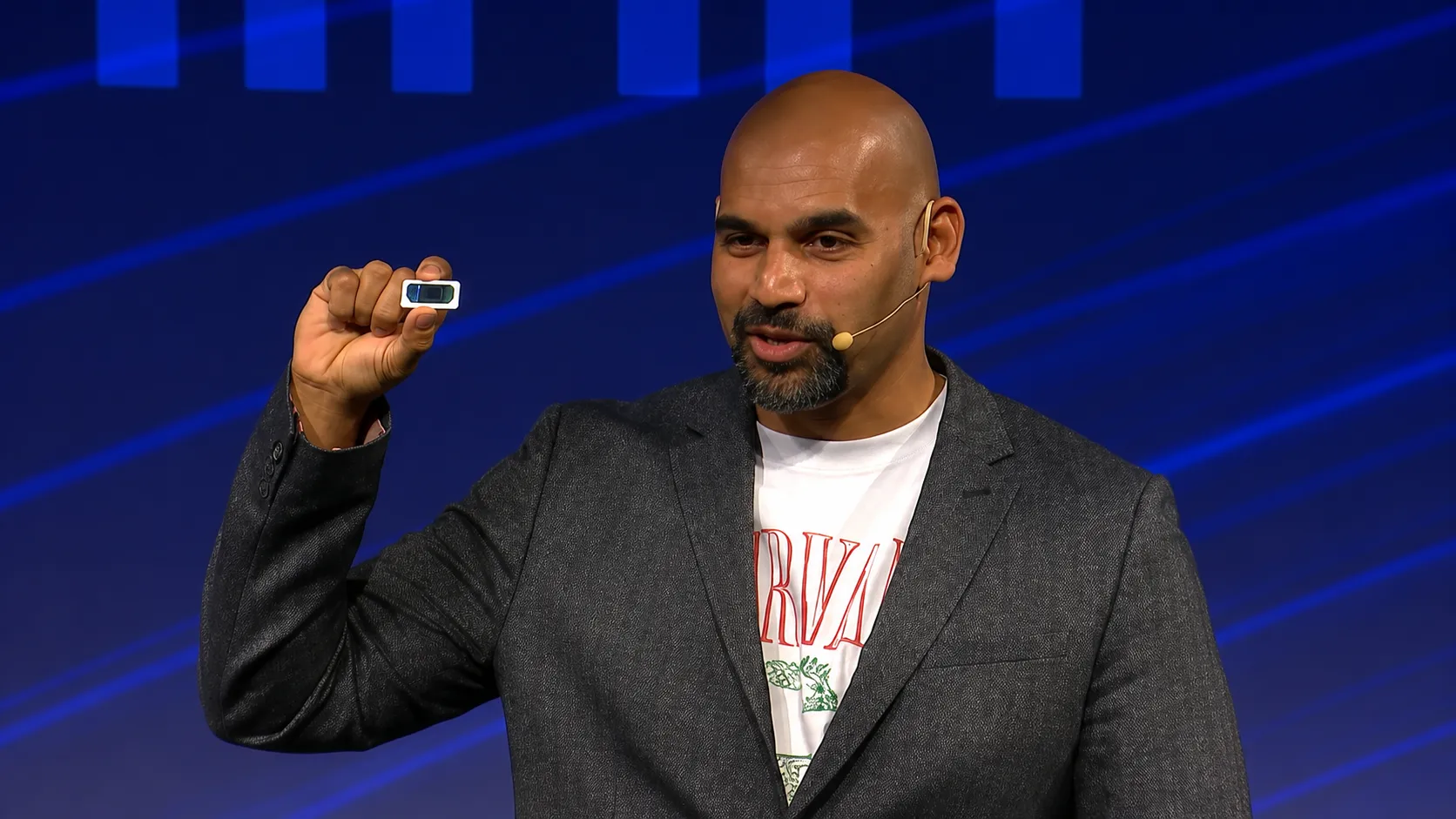
Unconventional AI, an artificial intelligence startup founded by Indian American entrepreneur and computational neuroscientist Naveen Rao, has released Un-0, an open-source image-generation model built on a radically different computing architecture than virtually anything else currently powering the AI industry. Rather than relying on the conventional graphics processing units and iterative digital denoising steps that underpin essentially every mainstream image-generation system in use today, Un-0 uses the mathematical principles governing coupled physical oscillators — systems of rhythmic components that naturally synchronise with one another — to generate visual output, offering an early but genuine proof of concept for a fundamentally different approach to how AI computation might eventually be performed.
The technical architecture underlying Un-0 draws on Kuramoto dynamics, a mathematical framework originally developed to describe how rhythmic physical systems synchronise with one another over time — the same broad category of physics that governs phenomena ranging from synchronised firefly flashing to the coordinated firing patterns of neurons in biological brains. Un-0's design assigns different oscillator phase patterns to specific visual categories, such as particular objects or scenes, with a smaller group of oscillators configured to the desired target pattern gradually pulling a much larger network of randomly initialised oscillators into the same synchronised arrangement, ultimately producing a numerical grid that a separate decoder then converts into a finished image.
That approach stands in sharp contrast to how standard generative AI image models currently operate, which typically begin with randomised visual noise and repeatedly calculate, across between 20 and 50 refinement steps, precisely what needs to be removed to progressively reveal the requested image — a computationally intensive process requiring extensive digital calculation across millions of transistors switching rapidly between on and off states. Un-0's oscillator-based approach instead treats the underlying dynamical physical system itself as the primary computing medium, an approach the Unconventional AI team argues could eventually prove dramatically more energy-efficient, given that current can, in principle, flow continuously through closed physical loops rather than requiring the constant, energy-intensive switching that characterises conventional digital logic circuits.
Rao and his team have stated that the underlying oscillator-based architecture could ultimately reduce AI inference power consumption by as much as 1,000 times compared to current digital computing approaches — an extraordinarily ambitious claim that, if it eventually proves out in physical hardware, would represent one of the more consequential potential breakthroughs in computing efficiency in recent memory, given the rapidly escalating energy demands that have accompanied the broader AI industry's growth over the past several years. For now, however, Rao has been notably candid that Un-0 represents only an early proof of concept, running entirely on a software simulation of Unconventional AI's proposed oscillator-chip architecture, with actual physical silicon chips still to come, followed eventually by a complete inference computing stack the company plans to operate itself.
Describing the release in characteristically direct terms, Rao called Un-0 the 'hello world' of a fundamentally new kind of computer — a reference to the simple introductory programme traditionally used to demonstrate a new programming language or computing system for the first time — while indicating that the coming year would likely bring considerably more significant developments building on this initial proof-of-concept release. That framing positions Un-0 less as a finished commercial product and more as a foundational technical demonstration intended to validate the broader oscillator-computing thesis before Unconventional AI moves toward building actual physical hardware based on the architecture.
Rao's own background offers useful context for why he has chosen to pursue such a fundamentally unconventional computing approach. Born in the United Kingdom to Indian immigrant parents, Rao grew up in Kentucky within a family of medical doctors, studying engineering and earning a bachelor's degree in electrical engineering and computer science from Duke University. After spending a decade working as a computer architect, he went on to complete a doctorate in computational neuroscience at Brown University — an educational trajectory that bridges precisely the two disciplines, computer architecture and brain-inspired computation, most directly relevant to the oscillator-based, brain-adjacent computing paradigm Unconventional AI is now pursuing.
Prior to founding San Francisco-based Unconventional AI, Rao built a substantial track record as a serial entrepreneur within the AI hardware and infrastructure space. He co-founded Nervana Systems, a deep-learning chip startup that Intel acquired for roughly $400 million in 2016, before going on to found MosaicML, an AI infrastructure company that Databricks subsequently acquired for approximately $1.3 billion in 2023 — a run of successful exits that has established Rao as one of the more consistently successful founders within the AI infrastructure and chip design space, and one whose track record has evidently given investors considerable confidence in backing his latest, genuinely unconventional computing bet.
That investor confidence has translated into substantial capital backing for Unconventional AI's ambitious technical roadmap, with the company having raised approximately $475 million in a seed round completed in December 2025, reportedly valuing the young company at around $4.5 billion — an extraordinary valuation for a seed-stage company, reflecting just how seriously sophisticated technology investors are taking Rao's oscillator-computing thesis despite the technology remaining, by the company's own account, in a genuinely early, pre-physical-hardware stage of development. Unconventional AI's founding team also includes other prominent researchers, including MIT associate professor Michael Carbin and Stanford assistant professor Sara Achour, whose academic research into nonlinear physical computing substrates has directly informed the theoretical foundations underlying the Un-0 model's design.
Un-0's initial release comes in six different model variants, ranging from 1,024 to 16,384 simulated oscillators, allowing the research and broader AI community to evaluate how the underlying architecture's performance scales as the number of oscillators in the simulated network increases — a genuinely important technical question for assessing whether the oscillator-computing approach can eventually match or exceed the performance of conventional AI systems at the scale required for commercially significant applications, rather than remaining a compelling but ultimately limited proof-of-concept confined to smaller, less computationally demanding tasks.
For the broader AI industry, currently grappling with rapidly escalating energy consumption concerns tied to the massive computational demands of training and running increasingly large AI models, Unconventional AI's oscillator-based approach represents one of the more genuinely novel attempts to address the problem at its computational-architecture root, rather than through the more incremental efficiency improvements that have characterised most recent advances in conventional AI chip design. Whether Rao's ambitious 1,000-fold power-reduction target eventually proves achievable in physical hardware remains, by his own admission, a question the coming months and years of continued development will need to answer — but for now, Un-0 stands as a genuinely significant early data point suggesting the underlying physics of the approach can, at minimum, replicate the functional output of today's leading conventional AI image-generation systems.
For the Indian American technology entrepreneurship community specifically, Rao's latest venture adds to an already substantial track record of successful exits and reinforces his standing as one of the more consequential Indian-origin founders currently operating at the frontier of fundamental AI hardware innovation — a position built not on incremental improvement to existing computing paradigms, but on a genuinely foundational bet that the entire architecture underlying modern AI computation may be due for fundamental reinvention.
Skeptics within the broader AI hardware community have, since Un-0's initial technical disclosure in June, raised legitimate questions about how readily the oscillator-computing approach will translate from software simulation into genuinely competitive physical silicon, given the substantial history of promising alternative computing paradigms that have struggled to match conventional digital hardware's decades of accumulated manufacturing optimisation once actual chip fabrication becomes necessary.
Rao has responded to that skepticism by emphasising the company's deliberately staged rollout plan, with physical chip schematics expected to follow the current software-simulation release, allowing the broader technical community to evaluate the approach's real-world manufacturing feasibility incrementally rather than requiring immediate, full confidence in the technology's ultimate commercial viability.
For now, the broader AI research and investment community appears content to treat Un-0 as exactly what Rao has described it as — an early, genuinely informative proof of concept, rather than either a fully validated breakthrough or a debunked overreach, with the real verdict awaiting the physical hardware still to come.