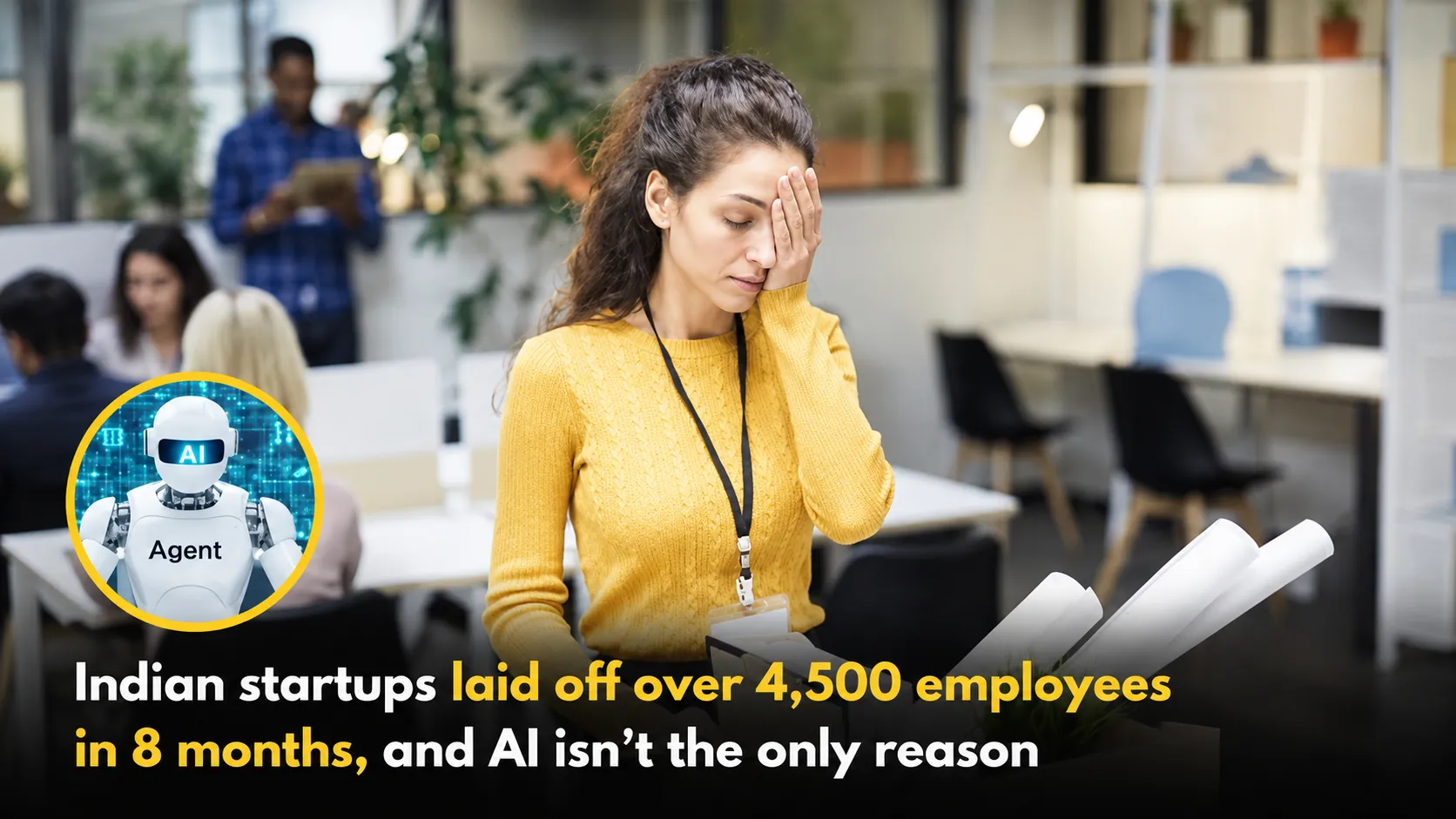
Bengaluru, July 31, 2026 — Every time a wave of tech-sector layoffs hits the headlines anywhere in the world, a familiar explanation tends to follow close behind: artificial intelligence is doing the work that used to require human employees. It is a tidy, media-friendly narrative, and India's own recent wave of startup layoffs — more than 4,500 job losses tallied since July of last year, according to data compiled by executive search firm Longhouse Consulting — has not been immune to this framing. But a closer, more granular look at exactly which companies cut how many jobs, and why, reveals a considerably messier and, in important respects, quite different story than the simple AI-displacement narrative suggests.
Doing the math on AI's actual contribution
Of the roughly 4,838 total layoffs captured in the most comprehensive available tally, only a relatively small subset — most prominently, home décor platform Livspace's reduction of approximately 1,000 roles — has been explicitly and directly attributed by the company itself to AI-driven cost rationalisation. Even in Livspace's case, the company's own public framing described the move as broader "operational streamlining" rather than exclusively AI-driven displacement, suggesting that even the layoff event most directly associated with AI in India's current data actually reflects a more complex, multi-causal set of business decisions rather than a clean case of algorithms replacing human workers on a one-to-one basis.
The remainder of the tally tells a considerably different story. Real-money gaming companies — Games24x7, GamesKraft, Zupee, Junglee Games and Mobile Premier League — collectively account for roughly 1,800 job losses, nearly two-fifths of the entire dataset, and every single one of these cuts traces directly back to a specific, identifiable regulatory event: India's sudden ban on online real-money gaming, which forced companies operating in this segment to halt core operations essentially overnight. There is no meaningful AI-displacement story here at all; this is a textbook case of regulatory shock producing abrupt, unavoidable workforce reduction as entire business lines ceased to exist within India's legal framework.
The regulatory shock, in detail
To understand the scale of what happened in India's real-money gaming sector, it helps to appreciate just how central this category had become to India's broader digital entertainment and startup ecosystem prior to the ban. Real-money gaming platforms, spanning fantasy sports, card games and various skill-based wagering formats, had attracted billions of dollars in cumulative venture capital investment over the preceding several years, building substantial user bases and correspondingly large operational workforces spanning game design, customer support, payments processing, marketing and regulatory compliance functions specific to this category.
When the regulatory ban took effect, companies operating in this space faced a fundamentally different kind of disruption than the gradual, demand-driven workforce reductions more typical of standard business cycle corrections. There was no extended runway to plan an orderly wind-down or pivot; core revenue-generating operations simply became illegal to continue, forcing near-immediate workforce reductions across companies that, in many cases, had been actively hiring and expanding mere months earlier. This abrupt, regulation-driven nature of the gaming sector layoffs represents a fundamentally different causal category than either "funding winter" cost-cutting or AI-driven efficiency gains — it is, more accurately, a case of an entire previously-legal business model being eliminated by policy fiat.
Quick-commerce and mobility: cost discipline, not algorithms
A second significant cluster of layoffs, spanning quick-commerce and mobility platforms including Porter and Zepto, together accounting for roughly 650 job losses, reflects yet another distinct causal pattern: straightforward cost discipline and capital efficiency pressure from investors, entirely separate from any specific AI-driven automation narrative. These companies operate in capital-intensive, still-unprofitable business categories where investors have, over the past year specifically, applied considerably more rigorous pressure around demonstrating a credible path to sustainable unit economics — exactly the kind of investor discipline pressure that led, in Zepto's specific case, to this week's separate decision to pause its planned IPO rather than proceed at a valuation institutional investors were unwilling to support.
These job cuts reflect companies responding to explicit investor demands for leaner operations and improved capital efficiency ratios — a rational, if difficult, business response to changed capital market conditions, but one that has essentially nothing to do with artificial intelligence directly replacing the specific roles that were eliminated. A delivery operations coordinator or a city-level expansion manager whose role is cut amid a broader cost-discipline drive has not, in any meaningful sense, been replaced by an AI system; their role has simply been deemed non-essential to a leaner, more cautiously managed version of the same underlying business.
Flipkart's annual review process: business as usual
A further data point worth examining closely is e-commerce giant Flipkart's reduction of approximately 500 roles, which the company has explicitly characterised as part of its recurring annual performance review process — language that suggests this particular round of job losses reflects Flipkart's standard, recurring approach to managing underperformance within its existing workforce, a practice the company has followed in previous years as well, rather than representing any new or unusual departure driven by either AI adoption or acute financial distress. Grouping this kind of routine, recurring performance-management-driven attrition together with the fundamentally different categories of regulatory-shock-driven and investor-discipline-driven layoffs described above risks meaningfully overstating the true scale of genuinely novel disruption occurring within India's startup ecosystem.
Where AI genuinely is reshaping hiring
None of this analysis is intended to suggest artificial intelligence plays no meaningful role whatsoever in how Indian startups are currently approaching workforce planning — it clearly does, but in a considerably more subtle and structural way than the simple "AI eliminated these specific jobs" framing suggests. Several startups across the ecosystem are reportedly designing new functions and teams from the outset around smaller headcount assumptions, explicitly building workflows that assume greater reliance on AI-powered automation tools for tasks including customer support, content generation, data analysis and various other functions that might previously have required proportionally larger human teams to execute at the same operational scale.
This represents a genuinely important, if less dramatic and headline-friendly, AI-driven shift: not mass displacement of existing employees by algorithms in a single dramatic event, but a gradual, ongoing recalibration of how many people any given function requires going forward, embedded quietly into hiring plans and organisational design decisions being made across the ecosystem on an ongoing basis, largely invisible to the kind of aggregate layoff statistics that tend to capture public attention.
Why the distinction matters
Getting this causal breakdown right matters for reasons well beyond simple journalistic accuracy. For policymakers, correctly identifying that the largest single driver of India's recent startup layoffs was a specific, deliberate regulatory action — the real-money gaming ban — rather than an uncontrollable technological force like AI, suggests very different policy implications. Regulatory-driven job losses of this kind are, at least in principle, more directly addressable through policy design choices, including potential transition support mechanisms for affected workers or industries, than the far more diffuse, difficult-to-target challenge of managing AI-driven workforce transformation across an entire economy.
For affected workers themselves, understanding the true cause of their job loss carries practical implications for how they approach their subsequent career transition. A gaming-sector employee whose role was eliminated by regulatory fiat faces a genuinely different re-employment landscape than someone whose position was rendered redundant by AI-driven automation of a specific task category — the former may find that their core skills remain valuable in adjacent, still-legal digital entertainment or technology categories, while the latter may need to more fundamentally reskill toward functions where human judgment and AI collaboration, rather than pure task execution, remains the primary value driver.
A more honest accounting
As India's startup ecosystem continues to navigate this period of workforce recalibration, a more precise, causally accurate accounting of what is actually driving job losses — regulatory shock in gaming, investor-driven capital efficiency pressure in quick-commerce and mobility, routine performance management at established players like Flipkart, and a genuine but more gradual and structural AI-driven hiring recalibration occurring across the broader ecosystem — offers a considerably more useful foundation for policymakers, investors, founders and affected workers alike than the simpler, more dramatic, but ultimately less accurate narrative that artificial intelligence is the primary force behind India's current wave of startup layoffs.
What HR leaders are actually saying internally
Conversations with human resources leaders across several affected companies, speaking on background given the sensitivity of the topic, reveal a more nuanced internal narrative than the public-facing communications around specific layoff events typically convey. Several HR executives describe a workforce planning environment in which AI-driven productivity tools are indeed changing hiring plans and headcount requirements for new roles and functions being built from scratch, but rarely serve as the sole or even primary justification communicated internally for existing employee terminations, which more commonly reference broader cost structure, business restructuring or performance-related considerations, even in companies that are simultaneously and separately investing heavily in AI tooling adoption across their operations.
This internal communication pattern suggests that the relationship between AI adoption and workforce reduction in India's startup ecosystem, at least as it currently stands, is better understood as correlation occurring within the same broad period of heightened cost discipline and capital efficiency focus, rather than a straightforward, single causal relationship in which specific AI tools are directly and traceably responsible for specific eliminated positions.
International comparisons: is India different?
Comparing India's layoff pattern to the parallel wave of technology sector layoffs occurring globally, particularly within the United States technology sector, reveals some genuine similarities alongside important differences. Global technology layoffs have, in various individual company cases, been more explicitly and directly attributed by company leadership to AI-driven productivity gains, particularly within specific functions like customer support, content moderation and certain categories of software engineering work increasingly augmented or partially automated by AI coding assistants. India's startup layoff wave, by contrast, appears more heavily weighted toward the country-specific regulatory shock in gaming and the broader capital-efficiency-driven cost discipline visible across quick-commerce and other capital-intensive new-age business categories — factors considerably more specific to India's particular regulatory and funding environment than to any universal, AI-driven global workforce transformation trend.
The road ahead for India's startup workforce
Looking forward, the composition of future workforce reduction within India's startup ecosystem will likely continue to reflect this same multi-causal pattern rather than converging toward any single dominant explanation. Continued regulatory evolution in sectors beyond gaming, ongoing investor discipline around capital efficiency across the broader new-age company landscape, and the genuinely ongoing, if gradual, structural shift toward AI-augmented operating models will each likely continue contributing to workforce planning decisions across India's startup ecosystem in the months and years ahead, reinforcing the case for policymakers, investors and workers alike to resist overly simplified single-cause explanations when assessing what is actually happening within this rapidly evolving employment landscape.
What this means for India's broader tech employment narrative
The tendency to reach for AI as a catch-all explanation for workforce reduction extends well beyond India's startup ecosystem specifically, reflecting a broader global media and public discourse pattern in which any technology-sector job loss risks being reflexively attributed to artificial intelligence, regardless of the actual underlying cause. This pattern carries real consequences: it can obscure more actionable, policy-relevant explanations like regulatory design choices, while simultaneously overstating the current pace and scale of genuine AI-driven labour displacement in ways that may generate excessive public anxiety disconnected from the more mundane, if still consequential, business and regulatory realities actually driving most current workforce reduction decisions. A more precise, evidence-based public conversation about the actual, varied causes of India's startup layoffs — one that resists the pull of the simpler, more dramatic AI narrative — would better serve everyone from policymakers designing transition support programmes to individual workers making decisions about their own next career steps.


