Bengaluru, July 31, 2026 — There was a time, not so long ago, when Indian startups measured success partly by how fast they could hire. Headcount growth was a badge of momentum, a signal to investors and rivals alike that a company was scaling aggressively enough to capture a fast-growing market before competitors could. That era, if not entirely over, has been forced into a period of sober recalibration. According to data compiled by executive search firm Longhouse Consulting, Indian startups have collectively laid off more than 4,500 employees since July of last year — with a more granular tally, including companies beyond the publicly listed cases, putting the estimated total closer to 4,838.
The scale of the correction spans an unusually wide cross-section of the startup economy: quick-commerce, real-money gaming, SaaS, AI-native companies, home décor, and more. Home décor platform Livspace alone accounts for roughly 1,000 of the job losses, while gaming platforms Games24x7 and GamesKraft each shed around 400 employees. Zupee, a real-money gaming company, has cut close to 370 jobs across two separate rounds since regulatory disruption hit its sector. Delivery and mobility platform Porter cut 350 roles, card and mobile gaming operator Junglee Games cut 350, Mobile Premier League cut 300, and even quick-commerce giant Zepto — itself in the headlines this week for pausing its IPO — has cut roughly 300 positions. AI company Krutrim, messaging platform Gupshup, low-code AI company Simpl, and voice-AI startup Bobble AI round out a list that reads almost like a cross-section of the entire modern Indian startup landscape.
Not just a funding story
The conventional narrative for startup layoffs in India has, for years, centred on the "funding winter" — the idea that venture capital simply dried up, forcing companies that had over-hired during the boom years of 2021 and 2022 into painful corrections once the money stopped flowing so freely. That narrative captures part of the current picture, but industry data suggests it is no longer the dominant explanation. According to reporting citing Longhouse Consulting's analysis, the current wave of layoffs is being driven largely by tighter funding conditions, regulatory disruption, and mounting investor demands for profitability — not, contrary to popular assumption, primarily by artificial intelligence-led automation replacing human workers.
This is a meaningfully different story than the one dominating global tech-layoff headlines, where AI-driven productivity gains are frequently cited as the primary driver of workforce reduction at large technology companies. In India's case, the picture is more structural and multi-causal. One of the sharpest and most identifiable triggers came from regulatory action: the sudden ban on online real-money gaming forced several companies operating in that segment to halt operations altogether, an abrupt regulatory shock that led to immediate, concentrated job losses and significantly inflated the overall layoff tally for the period. Zupee's founder and chief executive has described the resulting restructuring as a necessary step to align the business with long-term priorities and ensure sustainability going forward — corporate language that, translated plainly, reflects a company forced to rebuild its entire operating model around a regulatory environment that changed overnight.
The AI question — real, but more nuanced than headlines suggest
None of this is to say artificial intelligence plays no role in the current wave of workforce reduction. It clearly does, but in a more nuanced way than the simplistic "AI replaced jobs" framing that often dominates public discourse. Several startups are actively designing their operations around smaller teams from the outset, relying more heavily on automation and AI-driven efficiency tools not necessarily to replace existing headcount in a single dramatic layoff event, but to structurally rethink how many people a given function requires going forward. Livspace's roughly 1,000-person reduction, for instance, has been described by the company as part of an AI-driven cost rationalisation effort, even as the company itself has framed the move publicly as operational streamlining rather than a wholesale retreat from its business.
Separately, a related but distinct data point reinforces the pattern: a first-quarter 2026 analysis found that around 1,700 employees were laid off across just three Indian startups in that quarter alone, compared to 1,102 employees across three companies in the same period a year earlier — evidence that the pace, not just the cumulative scale, of workforce reduction has been accelerating. Notably, the number of companies resorting to layoffs in that comparison has not widened dramatically, suggesting the story is less about a broad-based panic sweeping the entire ecosystem and more about specific, larger-scale corrections at a concentrated group of companies. E-commerce major Flipkart, for example, cut around 500 jobs as part of its recurring annual performance review process — a pattern the company has followed in previous years, distinct from the more acute, one-time restructuring seen at companies like Zupee or Livspace.
A structural shift, not a cyclical panic
What makes the current moment distinct from earlier Indian startup layoff cycles — including the widely covered correction of 2022 and 2023, when funding dried up sharply following the end of the pandemic-era venture capital boom — is the underlying logic driving the decisions. In previous cycles, job cuts were most commonly explained by slowing demand, shrinking investor appetite broadly across the board, or simply poor cash discipline built up during over-exuberant hiring phases. Those factors have not disappeared, but industry observers increasingly describe the current wave as reflecting something more structural: startups are no longer hiring in anticipation of expected future growth, a practice that defined much of the 2021-2022 hiring boom. Instead, they are hiring — and correspondingly, cutting — based on demonstrated output and capital efficiency, function by function, role by role.
Investor behaviour has shifted in a complementary direction. Venture funding has not disappeared from the Indian startup ecosystem — capital remains available, and by some measures, total dollar volumes raised have even ticked up modestly year-on-year in certain periods of 2026. But that capital has become considerably more selective, concentrated increasingly in fewer, larger rounds for companies that can demonstrate clear operational milestones with an already-optimised headcount, rather than spread more broadly across a wider universe of early and growth-stage companies as was common during the 2021 boom years. This selectivity, in turn, creates its own pressure on companies further down the funding pecking order to demonstrate lean, efficient operations even before they approach investors for their next round — reinforcing, rather than easing, the pressure toward workforce reduction.
The human and sectoral toll
Behind the aggregate statistics sit thousands of individual employees navigating an increasingly uncertain job market, particularly in sectors like real-money gaming that were essentially forced to restructure overnight by regulatory fiat rather than gradual market pressure. For gaming-sector employees specifically, the ban on online real-money gaming created a uniquely abrupt form of job displacement — unlike a funding-driven layoff, which typically unfolds with at least some internal warning as a company's runway visibly shortens, a regulatory ban can force operational shutdowns with comparatively little lead time, leaving affected employees with far less opportunity to prepare or plan a transition.
For the broader startup ecosystem, the layoff wave also raises important questions about talent retention and the long-term attractiveness of startup careers relative to more established corporate or public-sector employment, particularly for India's large and growing pool of engineering and technology graduates who have, over the past decade, increasingly gravitated toward the startup ecosystem as a preferred career path. Whether this current correction meaningfully dents that longer-term talent flow, or proves to be a temporary rough patch in an otherwise structurally growing ecosystem, remains an open question that will likely only become clear over the next several quarters.
What comes next
Looking ahead, the trajectory of India's startup layoff wave will likely be shaped by several intersecting factors: the pace at which regulatory clarity emerges in sectors like real-money gaming that have already experienced acute disruption; whether venture funding conditions loosen meaningfully as global interest rate expectations evolve through the remainder of 2026; and whether the current generation of AI-native efficiency tools genuinely deliver the productivity gains that would justify startups' increasingly lean-team operating philosophy over the medium term, rather than simply serving as a convenient narrative for cost-cutting that would have happened regardless.
What seems clear, even amid the uncertainty, is that the simple, singular explanations that dominated earlier layoff cycles — "funding winter," or more recently, "AI is taking the jobs" — no longer fully capture what is happening on the ground in India's startup ecosystem. The reality, as this year's data makes clear, is a more tangled interplay of regulatory shock, investor discipline, and a genuine, structural rethinking of how many people it actually takes to build and scale a modern Indian technology company. For the more than 4,500 employees who have borne the direct human cost of that rethinking over the past year, the distinction between causes may matter less than the outcome. But for the ecosystem as a whole, understanding those distinct drivers will matter enormously in shaping how the next phase of India's startup story unfolds.
Sector-by-sector breakdown
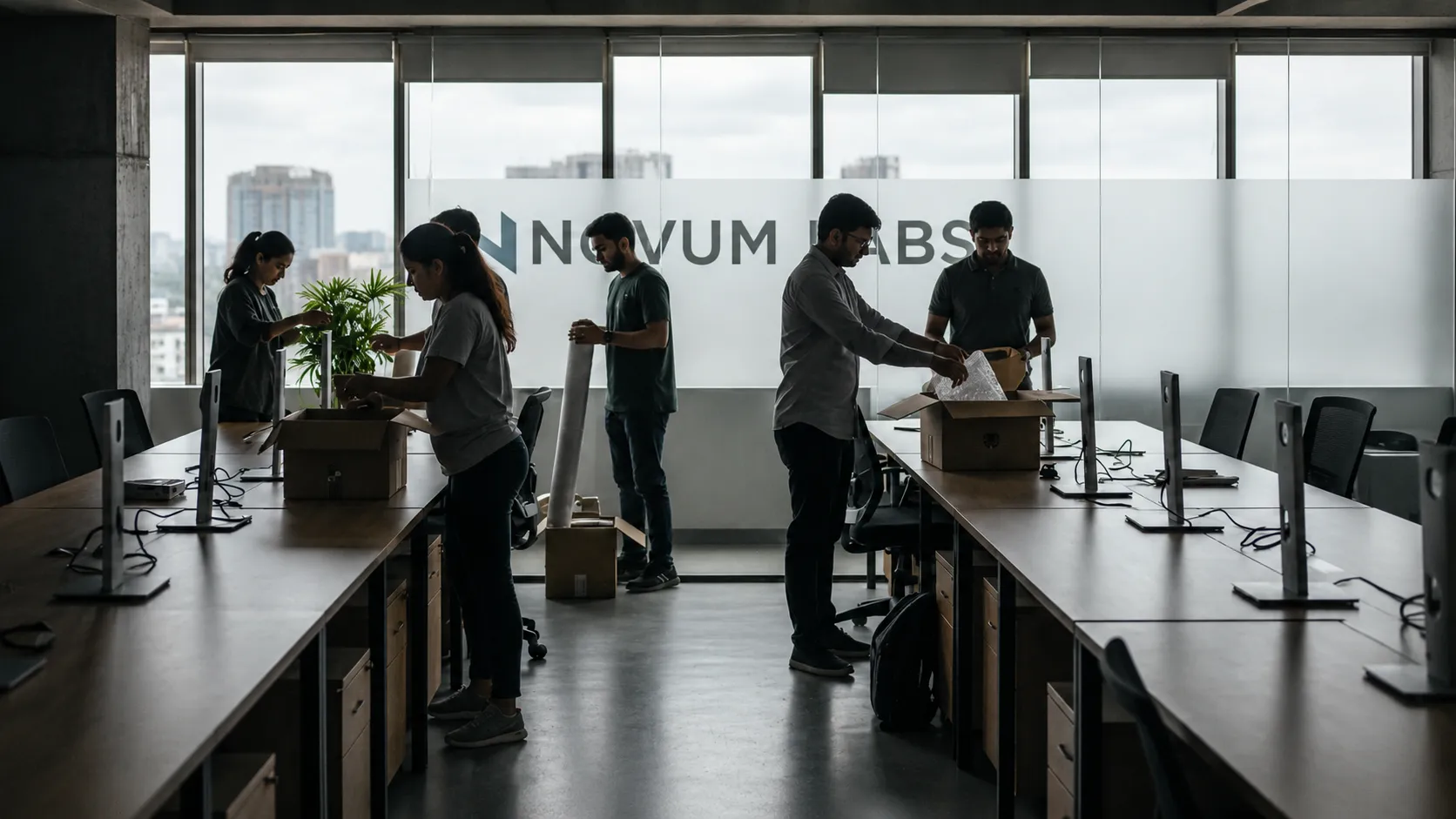
Looking across the affected companies sector by sector reveals just how broadly this correction has spread. In real-money gaming, the regulatory ban triggered some of the sharpest, most concentrated cuts — Games24x7, GamesKraft, Zupee, Junglee Games and Mobile Premier League collectively account for close to 1,800 of the total job losses tallied by Longhouse Consulting, making gaming easily the hardest-hit single vertical. In quick-commerce and adjacent delivery and mobility services, Porter and Zepto together account for a further 650 roles, reflecting the intensifying cost discipline sweeping that entire category even among companies not directly hit by any regulatory shock. Home décor and design-tech, represented almost entirely by Livspace's roughly 1,000-person reduction, stands out as the single largest individual company cut in the entire dataset, and one explicitly tied to AI-driven cost rationalisation rather than funding or regulatory pressure. AI-native and SaaS companies including Krutrim, Gupshup, Simpl and Bobble AI round out the list with smaller but still meaningful cuts, together totalling close to 400 roles.
The investor perspective: capital efficiency as the new north star
Conversations with venture capital investors active in the Indian market reveal a consistent, if somewhat uncomfortable, theme underpinning this year's layoff wave: a decisive shift in how portfolio companies are being coached and pressured on the topic of headcount and burn. Where growth-stage board meetings as recently as 2022 might have focused primarily on user growth, gross merchandise value, or market share metrics, investors increasingly report that revenue-per-employee, contribution margin trajectory, and runway-to-profitability have become the dominant metrics driving board-level conversation in 2026. This is not, investors emphasise, a uniquely Indian phenomenon — it mirrors a broader global recalibration in venture capital following the excesses of the 2021 zero-interest-rate funding boom — but the scale and speed of India's correction, given how rapidly the ecosystem had itself scaled headcount during that same boom period, has made the adjustment feel especially pronounced.
What employees are doing next
For the thousands of employees affected by this wave of restructuring, anecdotal reports suggest a range of outcomes. Some, particularly experienced engineers and product professionals from well-regarded companies like Flipkart or Livspace, appear to be finding reasonably quick re-employment elsewhere in the ecosystem or at more established technology companies, reflecting continued strong underlying demand for proven talent even amid the broader correction. Others, particularly those from more niche gaming-sector roles suddenly displaced by the abrupt regulatory ban, describe a more challenging transition, given the specificity of skills built around a business model that, in the case of real-money gaming, effectively ceased to exist in India almost overnight. Several affected employees have turned to India's broader IT services and enterprise software sectors, which have continued relatively steady hiring even as the startup ecosystem has pulled back, offering something of an absorption valve for displaced startup talent, even if the compensation and equity-upside profile of such roles typically looks quite different from what employees may have grown accustomed to in the startup world.
A generational inflection point
Perhaps the most significant long-term implication of this year's layoff wave is generational rather than purely economic. An entire cohort of young Indian professionals who entered the workforce during the 2020-2022 startup hiring boom is now, for the first time in many of their careers, experiencing the harsher, more cyclical realities of building businesses in a capital-constrained environment. How this generation adapts — whether by gravitating toward more established, stable employers, by starting their own leaner ventures informed by the lessons of this correction, or by developing a more risk-tolerant, resilient professional mindset forged through this downturn — could shape the character of India's startup ecosystem for the next decade, regardless of how quickly the current layoff wave itself subsides.


