India's Trade Surprise
Exports are booming — up nearly 15 percent — and the Strait of Hormuz is reopening. But can India's momentum survive the next shock?
Just as the war in West Asia sent oil prices into a tailspin and threatened to blow a hole in India's import bill, something unexpected happened.
Exporters fought back.
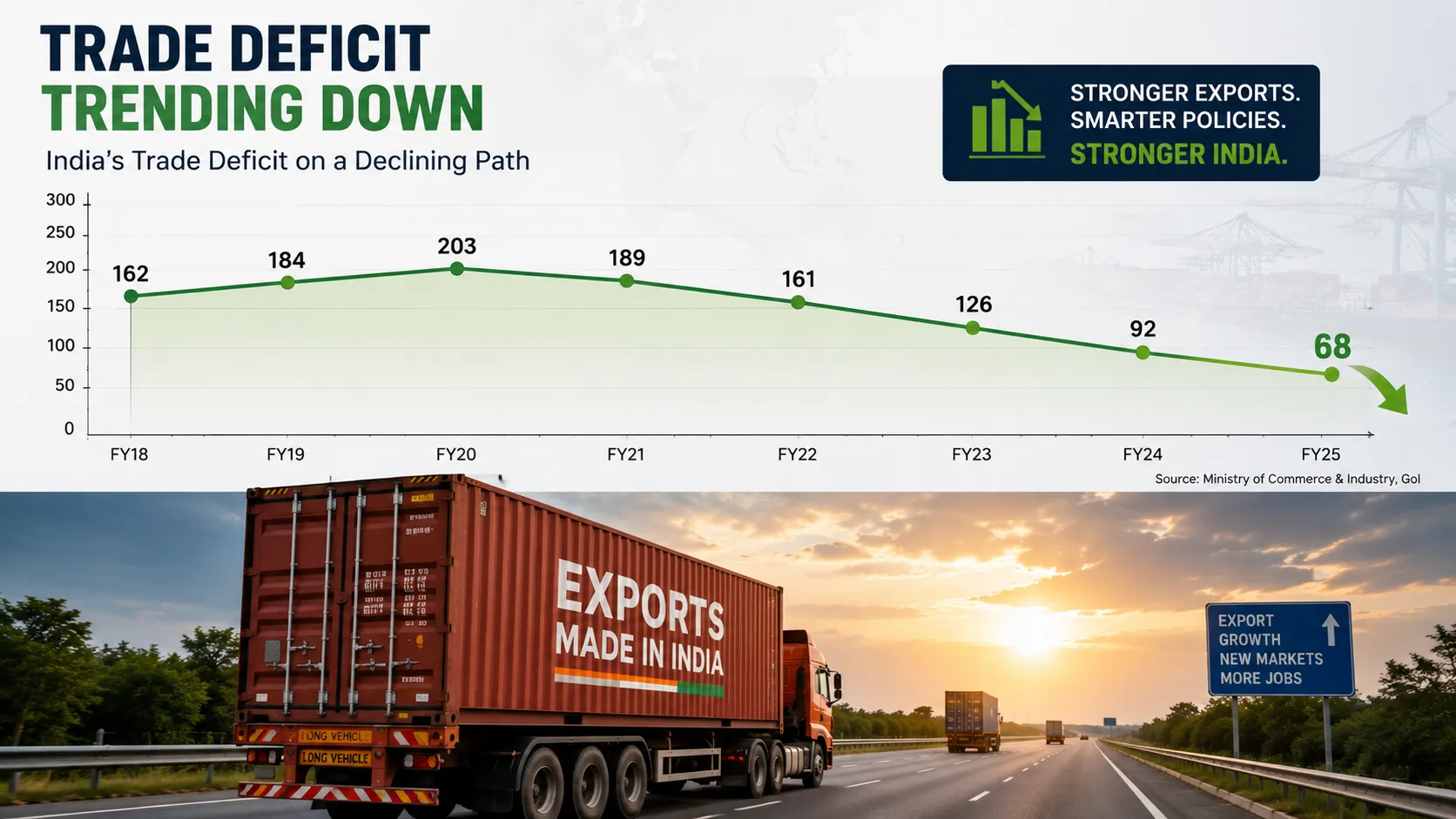
India's merchandise trade deficit narrowed marginally to $28.21 billion in May, defying economist expectations of a wider gap. Merchandise exports rose to $45.2 billion, up from $43.56 billion the previous month. Total exports — merchandise and services combined — reached $162.69 billion during April–May 2026‑27, registering a robust 14.66 percent growth over the same period last year.
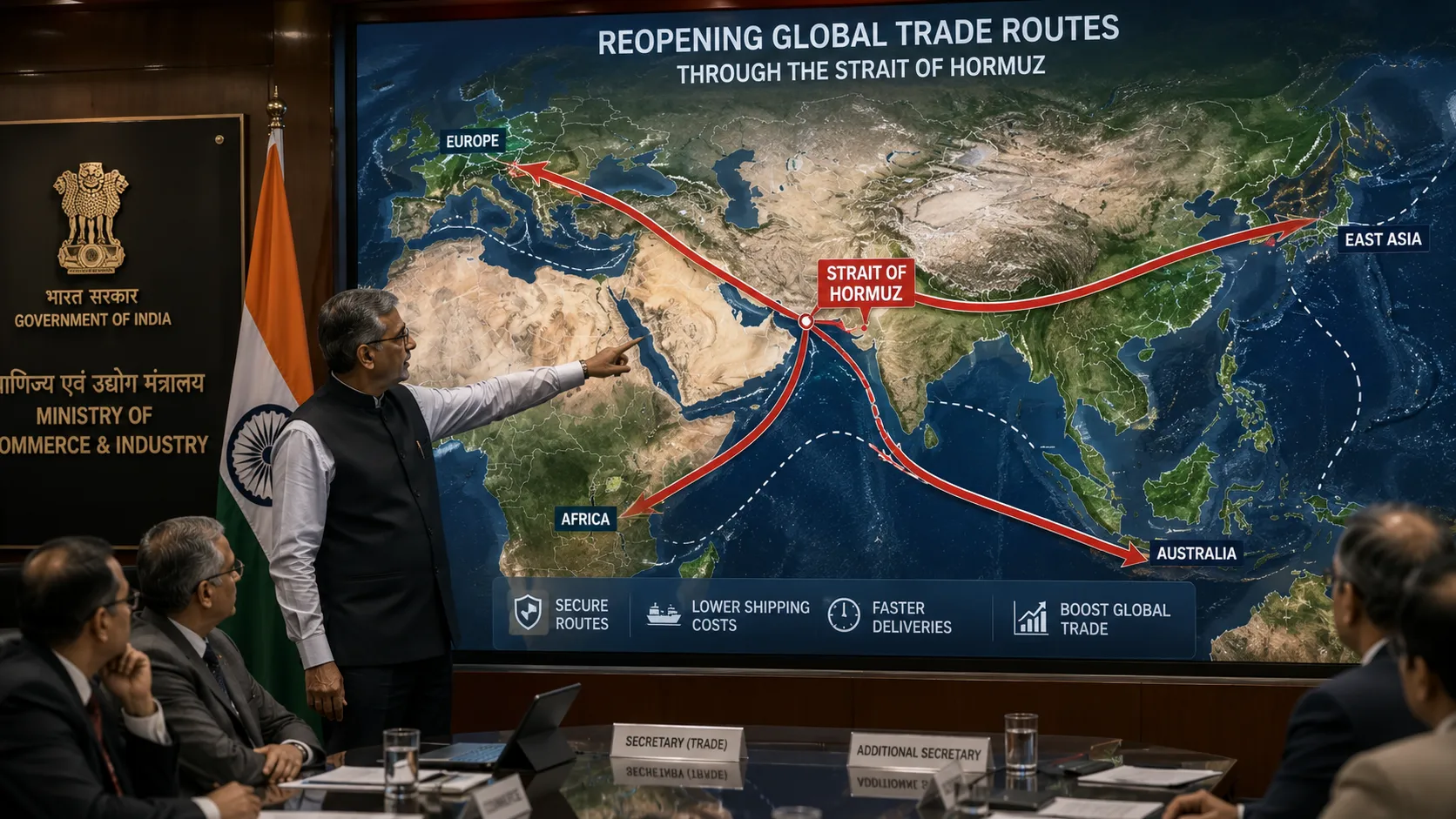
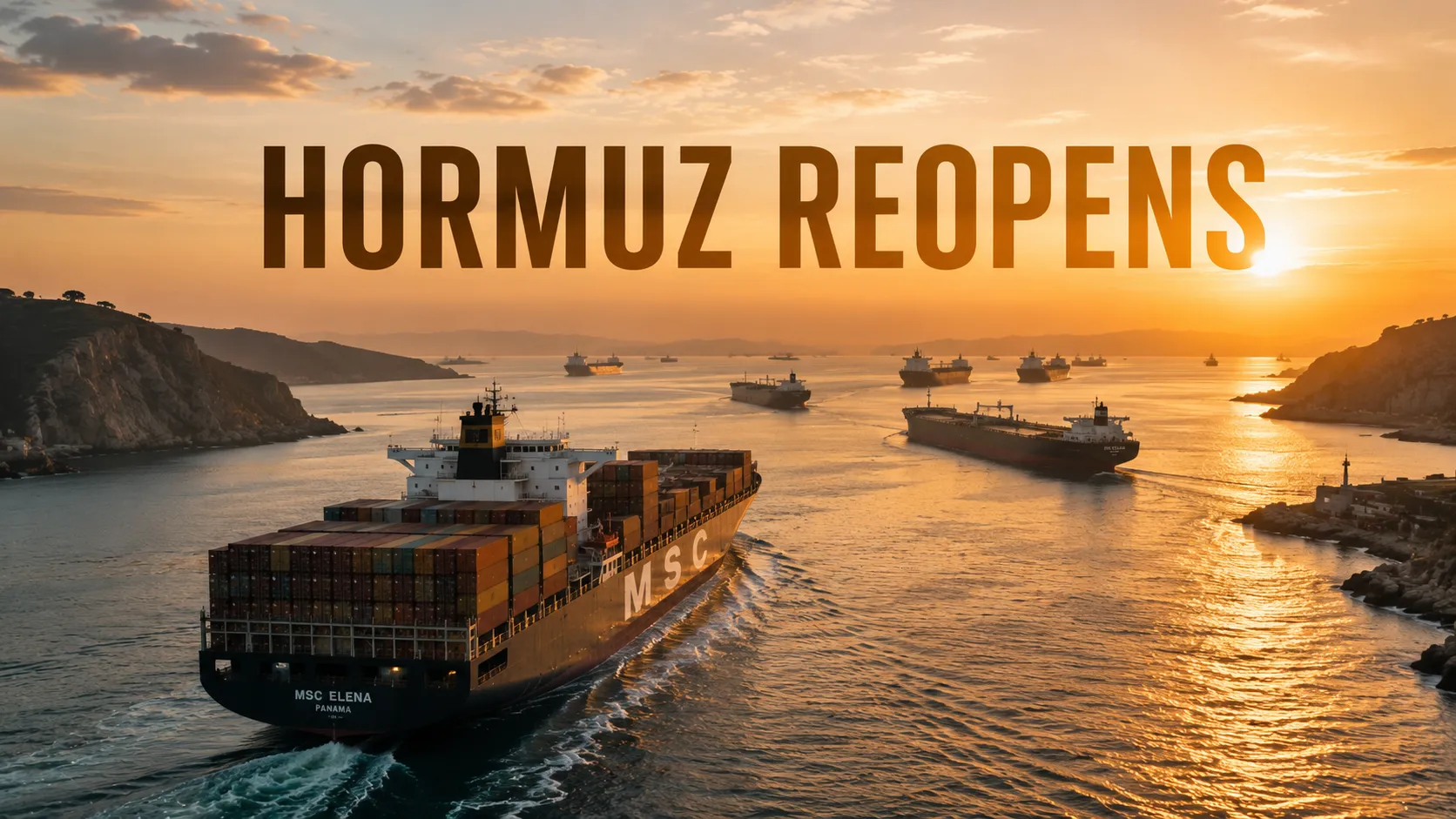
Then came the real bombshell: US and Iranian officials agreed on a framework to end their war, halt the blockade of Iran, and reopen the Strait of Hormuz by Friday, June 19.
For the world's third‑largest oil importer, which ships more than 80 percent of its crude needs through Middle Eastern waters, the reopening cannot come soon enough. The Strait has been effectively shut for months, forcing tankers to take longer, more expensive routes around Africa and pushing insurance premiums into the stratosphere.
But even as the trade numbers beat forecasts and the war edges toward ceasefire, the Ministry of Commerce struck a cautious note. The underlying pressures haven't vanished. And the lesson of the past six months is that global trade can turn on a dime — the next shock might come from an unexpected direction.
The Numbers That Surprised Everyone
Economists had braced for bad news. The Iran‑US war had disrupted shipping through the Strait of Hormuz, through which roughly 20 percent of the world's oil passes. India, which imports about 85 percent of its crude oil, was expected to see its import bill balloon and its trade deficit widen sharply.
Instead, the deficit narrowed — only slightly, from $29.14 billion in April to $28.21 billion in May, but the direction surprised forecasters who had predicted a jump to $30‑32 billion.
The hero of the story was merchandise exports. They rose to $45.2 billion in May, up from $43.56 billion in April. Engineering goods, pharmaceuticals, electronics, and chemicals all posted gains. Even traditional sectors like textiles and gems showed resilience.
Services exports continued their steady march upward, estimated at $36.76 billion in May. Services imports were $19.06 billion, leaving a services trade surplus of $17.7 billion — a healthy buffer that has consistently cushioned India's overall current account.
"The export performance in the face of a major shipping disruption tells you something about the underlying competitiveness of Indian manufacturing and services," said a trade economist at a Delhi‑based think tank. "Indian exporters found ways to ship goods around the blockade. They absorbed higher costs. They didn't just give up."
The Strait Reopens
The announcement from US and Iranian officials on June 14 sent a wave of relief through India's shipping, logistics, and manufacturing sectors. The Strait of Hormuz, a 21‑mile wide passage between Oman and Iran through which nearly 17 million barrels of oil pass daily, would be fully operational by June 19.
For Indian refiners, who had been paying war risk premiums of 500‑800 percent above normal insurance rates, the reopening means immediate cost relief. For exporters who had seen shipping container availability plummet and freight rates quadruple, it means the resumption of predictable supply chains.
"The US‑Iran announcement is a shot in the arm for India's textile and apparel sector," said Ashwin Chandran, chairman of the Confederation of Indian Textile Industry. He said normalisation in West Asia and the reopening of the strait would ease cost pressures across supply chains and support India's push to reach $100 billion in textile and apparel shipments by 2030.
Similar statements came from the electronics, pharmaceuticals, and automotive components sectors — all of which rely on predictable, affordable shipping to move goods to Europe, the United States, and Asia.
The Fragile Peace
But the ceasefire is fragile. The US‑Iran agreement is a framework, not a final treaty. It reopens the strait and halts active hostilities, but it does not resolve the underlying disputes over Iran's nuclear program, its support for regional militias, or US sanctions.
"The strait reopening is a necessary condition for trade normalisation, but it's not sufficient," the trade economist said. "Insurance rates will come down, but they won't return to pre‑war levels immediately. Shipping lines will redeploy vessels, but that takes weeks. And if there's any violation of the ceasefire, everything could snap back overnight."
India's Ministry of Commerce reflected this caution in its monthly trade statement. While celebrating the export growth, officials noted that elevated energy prices, higher insurance costs, and shipping‑related risks have not vanished. The war may be ending, but the era of cheap, predictable trade routes may not return.
The Oil Import Challenge
India's crude oil import bill remains stubbornly high. Even with the strait reopening, oil prices are not expected to fall below $90‑95 a barrel in the near term — down from war‑peak levels of $120‑130, but still significantly higher than the $70‑80 range that Indian policymakers prefer.
Higher oil prices feed into everything: diesel for trucks, petrol for cars, naphtha for petrochemicals, fuel for ships and planes. They raise manufacturing costs, transportation costs, and ultimately, retail inflation. The Reserve Bank of India has already signaled that it will keep interest rates higher for longer to fight imported inflation — a headwind for export‑oriented industries that borrow heavily.
"The reopening of the strait is a positive, but it's not a return to normal," said an energy analyst at a Mumbai brokerage. "The war has fundamentally changed the risk calculus for shipping in the Gulf. Insurance will be more expensive for years. Some shipping lines may permanently avoid the region. We're not going back to 2024."
Where Export Growth Came From
India's export resilience during the war was not accidental. It reflected years of policy effort to diversify both products and destinations.
On the product side, engineering goods — machinery, industrial equipment, iron and steel products — have become India's largest export category, surpassing traditional leaders like gems and jewellery and textiles. Electronics, led by mobile phone assembly, has grown rapidly. Pharmaceuticals, including generics and active pharmaceutical ingredients, remain a reliable performer.
On the destination side, India has aggressively pursued trade agreements with developed and emerging economies. The free trade agreement with the United Kingdom, signed in 2025, has boosted exports of everything from textiles to medical devices. The trade deal with Australia has opened new markets for Indian engineering and agricultural products. Negotiations with the European Union are ongoing.
"We're not as dependent on any single market as we used to be," a senior Ministry of Commerce official said. "When demand softens in the US, we have Europe. When Europe slows, we have the Middle East and Africa. That diversification paid off during the war."
The Services Surplus Cushion
India's services exports — IT, business process outsourcing, consulting, and increasingly, digital services — have been a consistent bright spot. At $36.76 billion in May, they remain on a steady growth trajectory.
The services surplus of $17.7 billion effectively cancels out a significant portion of the merchandise trade deficit. In months when the merchandise deficit is high, the services surplus provides a floor. In months when the deficit narrows, the surplus becomes a tailwind.
"The services surplus is India's secret weapon," the trade economist said. "It's not as visible as manufactured goods, but it's more stable, more profitable, and less susceptible to shipping disruptions. You can't put software on a tanker, but you also can't block it at Hormuz."
What Could Go Wrong?
For all the good news, the Ministry of Commerce's cautious tone reflects real risks.
First, the ceasefire could break. Iran and the US have a long history of failed agreements. One miscalculation, one drone strike, one tanker seizure could send the region back into crisis.
Second, global demand could soften. The US economy is showing signs of slowing under the weight of high interest rates. Europe is struggling with its own energy crisis. China's recovery remains uneven. If the world's major economies slow simultaneously, India's exports will slow with them.
Third, domestic challenges remain. India's manufacturing sector faces structural constraints — land acquisition, labour regulations, infrastructure bottlenecks — that limit its ability to scale up rapidly. The export surge of the past two years has been impressive, but sustaining it will require reforms that have been stalled for years.
"We've had a good run," the Commerce Ministry official said. "But good runs don't last forever. The question is whether we use this window to fix the underlying problems, or whether we relax and wait for the next crisis."
The Bottom Line
India's trade numbers for April–May 2026‑27 beat expectations. Exports are up nearly 15 percent. The trade deficit narrowed. The Strait of Hormuz is reopening. These are all genuinely good stories.
But the underlying vulnerability remains. India still imports most of its oil. It still relies on a single, geopolitically volatile chokepoint for much of its trade. Its manufacturing sector, while improved, is not yet globally competitive in the way that China's or Vietnam's or Mexico's are.
The war in West Asia was a stress test for India's trade infrastructure. By most measures, the country passed. But passing a stress test doesn't mean you're immune to future shocks. It means you survived this one. The next one — a different strait, a different war, a different disruption — will come eventually.
For now, Indian exporters are celebrating. The strait is reopening. The orders are flowing. The ships are moving again. But the lesson of the past six months is that nothing in global trade is guaranteed — and the only real hedge is to keep building, keep diversifying, and keep preparing for the next surprise.