MUMBAI — If you’ve been checking your broker’s IPO tab every morning since January, you’ve probably noticed something unusual: not much happening. India’s primary market has been unusually subdued through the first half of 2026. By May, only around 20 mainboard IPOs had listed for the year — a sharp slowdown compared with 2025, which itself saw a softening trend after a record‑breaking 2024.
Average subscription levels have also cooled considerably. Of the 20 IPOs listed so far in 2026, 17 received subscriptions of less than 10 times. The average sits at just over 10x — largely propped up by one standout issue, Bharat Coking Coal, which was subscribed roughly 107 times.
But here’s the thing: the filing pipeline has remained busy. DRHP filings hit a 10‑year high in 2025, with 85 companies filing draft papers between January and May alone, including marquee names like Tata Capital, Urban Company, and Canara Robeco Asset Management (most of which have since listed). The pattern suggests a market where companies are positioning themselves and waiting for the right window — which means July 2026 could see a meaningful pickup if sentiment improves.
The catch? Exact dates change weekly. Here’s what to watch — and exactly how to apply once the window opens.
The Big Names to Watch
While SME IPOs open and close on a near‑weekly basis, a handful of large mainboard issues are far enough along that they’re worth tracking specifically for July and the months around it.
NSE (National Stock Exchange of India) — the one everyone’s waiting for. After nearly a decade of delays, NSE’s own IPO has finally gathered real momentum in 2026. SEBI issued a No Objection Certificate, and NSE’s board approved the IPO plan in February 2026. As of early June 2026, NSE was targeting filing its Draft Red Herring Prospectus (DRHP) by the end of June 2026, with a listing targeted before December 2026 (within Q3 of FY27). The issue is expected to be structured entirely as an Offer for Sale (OFS) — meaning existing shareholders sell shares rather than the company issuing new ones — with a potential size in the range of ₹22,000–23,000 crore (roughly $1.5–2.5 billion). It could become one of the largest IPOs in Indian history. Given the late‑June DRHP target, July is realistically too early for this one to open for subscription — but it’s the single most‑watched name in the pipeline for the second half of 2026.

Zepto — the quick‑commerce bellwether. Quick‑commerce major Zepto filed an updated DRHP with SEBI on 8 June 2026, targeting a fresh issue of ₹8,010 crore plus an offer for sale by existing investors including Nexus Venture Partners, Contrary, and entities affiliated with Kaiser Permanente — taking the overall issue size toward roughly ₹10,000 crore. This would make Zepto the first quick‑commerce‑only company to list on Indian exchanges. Reports describe the listing as expected "in the next few months" from the June filing — which puts a possible window in the July–September 2026 range, subject to SEBI’s review (which typically takes 2–4 months from filing).

The broader DRHP‑stage pipeline. Beyond these two headline names, dozens of companies that filed draft papers through 2025 remain at various stages of the SEBI approval process and could surface in the July calendar depending on timing and market windows. The realistic approach for any investor is to treat July 2026 as likely to feature a mix of: one or two mid‑to‑large mainboard issues (financial services, consumer, or new‑age tech companies being the most active sectors), and a steady stream of SME IPOs across both NSE Emerge and BSE SME platforms — typically 3–8 SME issues opening in any given month.
Why There’s No Single "July List" Yet — and Where to Find It Live
Here’s the practical reality: even the exchanges and brokers themselves don’t publish a firm month‑ahead IPO calendar. Mainboard IPO open dates are typically confirmed only 1–2 weeks in advance, once SEBI has cleared the final prospectus and the company finalises its price band with merchant bankers. SME IPOs are confirmed on an even shorter timeline — often just days ahead.
This is why financial news outlets publish a fresh "IPO Calendar: Next Week" article every single week rather than a monthly one — the list genuinely changes that often, based on market conditions, regulatory clearances, and company‑specific timing decisions (many issuers deliberately avoid weeks with major competing listings, results season, or unfavourable market volatility).
For the live, up‑to‑date list once July arrives, the most reliable sources are:
NSE and BSE websites — official source for confirmed IPO open/close dates, price bands, and lot sizes.
SEBI’s website — for DRHP/RHP filings and approval status.
Broker apps (Zerodha, Groww, Upstox, Angel One, etc.) — most have a dedicated "Open IPOs"/"Upcoming IPOs" section updated in real time.
Dedicated IPO trackers like Chittorgarh’s IPO Dashboard, IPO Central, IPO Watch, and InvestorGain — they aggregate mainboard and SME calendars, GMP data, and subscription status.
How to Apply for an IPO in India: A Step‑by‑Step Guide
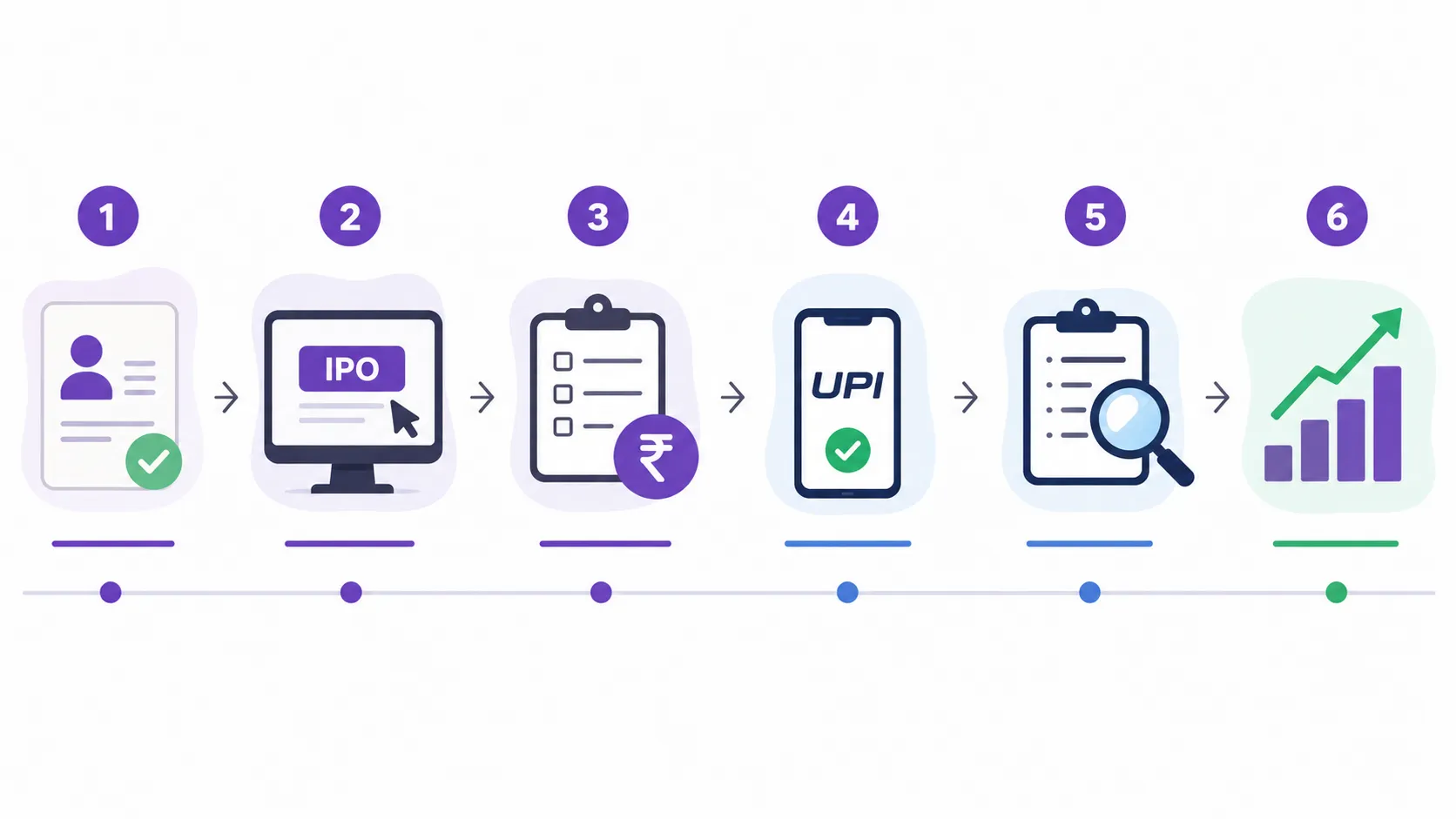
Whichever company ends up on July’s calendar, the application process itself is standardised across all mainboard and SME IPOs in India. Here’s exactly how it works.
Step 1: Get the prerequisites in place
A PAN card (mandatory — and the name must match your demat account exactly).
A Demat account with a SEBI‑registered broker or depository participant (CDSL or NSDL).
A bank account linked to UPI (almost all retail IPO applications now use the UPI mandate route under ASBA).
NRIs can also apply, provided they have a PAN card, an NRE or NRO bank account, and an NRI demat account — though the route may differ slightly.
Step 2: Understand the investor categories
Retail Individual Investor (RII): applications up to ₹2 lakh. Typically has a reserved portion of the issue (often 35% for mainboard IPOs).
Non‑Institutional Investors (NII / HNI): applications above ₹2 lakh.
Qualified Institutional Buyers (QIB): mutual funds, banks, insurers — not for retail individuals.
Employee/Shareholder quotas: some IPOs reserve a portion for employees or existing shareholders, often at a discount.
Step 3: Read the price band and lot size
Every IPO is issued within a price band (e.g., ₹310–₹326 per share) and a fixed lot size — the minimum number of shares you must apply for, and the only increments allowed. Multiply the lot size by the upper price band to get your minimum investment amount. Retail investors can typically apply at the cut‑off price (recommended — you agree to pay the final price within the band).

Step 4: Apply via your broker’s app or net banking (ASBA + UPI)
Open your broker’s app (Zerodha Console/Kite, Groww, Upstox, Angel One, or your bank’s net banking IPO section) and navigate to the "IPO" or "Open IPOs" section.
Select the IPO you want to apply for — it will only be visible/active during its open subscription window (typically 3 working days for mainboard issues).
Enter the number of lots, your bid price (or select "cut‑off"), and your UPI ID linked to your bank account.
Submit the application. Your broker sends a UPI mandate request to your UPI app (Google Pay, PhonePe, Paytm, your bank’s app, etc.).
Approve the UPI mandate within the app — this doesn’t deduct money immediately, but blocks the required amount in your bank account under ASBA. It remains in your account earning interest until allotment.
You can modify or withdraw your bid any time before the subscription window closes (typically up to 5 PM on the closing day).
Step 5: Wait for allotment
After the subscription window closes, the registrar (commonly Link Intime/MUFG Intime or KFin Technologies) finalises the Basis of Allotment — usually within 1–2 working days. If the issue is oversubscribed in the retail category (very common for popular IPOs), allotment is done via a computerised lottery system — even a single‑lot application has a real but not guaranteed chance. You can check your allotment status directly on the registrar’s website using your PAN, application number, or demat account details.
Step 6: Refunds, credit, and listing
If you’re not allotted shares, the blocked amount in your bank account is simply released — no separate "refund" is needed.
If you are allotted shares, the corresponding amount is debited and the shares are credited to your demat account, typically 1–2 working days after the allotment date.
On the listing date, the stock begins trading on BSE and/or NSE — typically starting around 10 AM after a pre‑open session between 9–10 AM — and you can choose to hold or sell from that point.
Before You Apply: A Few Things Worth Checking
This isn’t investment advice — only you can decide what fits your goals and risk appetite. But a few pieces of information are commonly used by investors to form their own view on any IPO:
The Red Herring Prospectus (RHP)/DRHP — the company’s own filing with SEBI, covering financials, risk factors, and use of proceeds.
Grey Market Premium (GMP) — an unofficial, informal indicator of where the stock might list. Widely watched but volatile and not reliable.
Subscription numbers by category — updated live on NSE/BSE. Heavy institutional (QIB) demand is sometimes read as a signal of stronger due diligence.
Anchor investor list — published the day before the issue opens, showing which mutual funds and institutions committed as anchor investors.
Use of proceeds — fresh issue (money to the company) vs Offer for Sale (money to exiting shareholders). This shapes how you read the company’s prospects.
The Bottom Line
July 2026’s exact IPO list won’t be fully clear until the weeks immediately before it — that’s simply how the Indian IPO market operates. Mainboard dates are confirmed roughly 1–2 weeks out; SME dates often just days. What’s clearer is the broader picture: a primary market that’s been quiet for most of 2026, a deep pipeline of companies that have already filed paperwork, and two genuinely landmark names — NSE’s long‑awaited mega‑listing and Zepto’s quick‑commerce debut — that could anchor the second half of the year, even if NSE itself looks more likely for later in 2026 than July specifically.
Whatever lands on the calendar, the process of applying won’t change: get your PAN, demat account, and UPI‑linked bank account ready. Watch your broker’s "Open IPOs" tab as July approaches. Apply at the cut‑off price within the lot‑size rules. Approve the UPI mandate promptly. And check allotment status through the registrar once the window closes. The mechanics are the same whether it’s a ₹50 crore SME issue or a multi‑billion‑dollar mainboard listing — only the size of the queue changes.


