A Number That Changes Everything
There is a number that has been quietly building for years, whispered in boardrooms in San Francisco, debated in policy circles in New Delhi, and celebrated by engineers in Bengaluru. That number is fifty billion dollars. And as of the first week of June 2026, it is no longer a projection or an aspiration. It is a verified, documented reality — one that places India among the most significant forces in the global artificial intelligence economy.
Indian artificial intelligence startups have collectively attracted fifty billion dollars in global funding. To understand the full weight of this milestone, it is useful to place it in historical context. When the IndiaAI Mission was first announced in 2024, accompanied by a government commitment of ₹10,371 crore — approximately $1.25 billion — many observers praised the ambition while privately wondering whether the private capital needed to translate government intent into ecosystem reality would materialize. What materialized was not merely satisfactory. It was transformational.
The journey from aspiration to fifty billion dollars is a story of compounding credibility. The first large international investments — early commitments from Microsoft, Google, and NVIDIA — created a demonstration effect. They told subsequent investors: the analytical work has been done, the thesis has been validated by sophisticated actors, and the risk of being early to India's AI story is substantially lower than the risk of being late. That demonstration effect cascaded through the investment community, drawing in sovereign wealth funds, institutional investors, family offices, and the full spectrum of venture capital from seed to growth stage.

The Government Bet That Started It All
The IndiaAI Mission, launched in 2024 with a strategic infusion of ₹10,371 crore, was built on a hypothesis that has since been validated: that a nation rich in mathematical talent, linguistic diversity, and an appetite for large-scale problem-solving could become a global leader in artificial intelligence — not merely a consumer of AI products built elsewhere, but an architect of the intelligence layer that will increasingly mediate human experience across the planet.
The mission's design reflected a nuanced understanding of where government intervention is most valuable. Rather than attempting to build AI companies directly — an approach that governments have historically executed poorly — the IndiaAI Mission focused on infrastructure, compute access, talent development, and the creation of international bridges that private capital tends to underprovide. The compute access initiative, which made high-performance GPU clusters available to startups and researchers at subsidized rates, addressed a genuine market failure that was suppressing AI experimentation in India. The early-stage AI research funding, channeled through IITs and research institutions, seeded the intellectual pipeline that produces the talent employed by India's AI companies.
The government's role was not to replace the market but to correct it — to ensure that the conditions for a competitive AI ecosystem existed before private capital arrived to scale what the ecosystem produced. This sequencing, which mirrors the approach that produced Silicon Valley's initial conditions through DARPA funding and university research grants, was strategically sound and has proven empirically effective.
The Big Three and Their India Thesis
The simultaneous commitment of Microsoft, Google, and NVIDIA — each pledging more than three billion dollars specifically for India between 2024 and 2025 — represents the most powerful external validation of India's AI story. These are not companies that make large strategic commitments casually. Each has analytical teams dedicated to assessing global market opportunities, and each concluded, independently, that India warranted this scale of commitment.
Microsoft's India thesis is centered on enterprise AI adoption. India's corporate sector, from the large conglomerates of the Tata and Reliance variety to the rapidly expanding mid-market of manufacturing, logistics, and services companies, is in the early stages of a profound AI-enabled transformation. Microsoft's Azure cloud and Copilot productivity suite are positioned to capture a dominant share of this enterprise AI spend. The investment in India is also an investment in the human capital that will develop, deploy, and maintain these systems: India is home to one of the world's largest communities of Microsoft-certified developers, and that community is growing in capability as fast as the AI tools it deploys.
Google's commitment is more architecturally diverse. It spans fundamental AI research — Google DeepMind has significant India-based research initiatives — as well as the language AI work required to make products like Search and Assistant genuinely useful for Hindi, Tamil, Telugu, Kannada, and Bengali speakers. Google's investment in India is simultaneously a product investment and a talent investment, reflecting the company's understanding that the next frontier of AI product development will be determined by the depth of multilingual and multimodal capability, and India is among the world's richest environments for developing that capability.
NVIDIA's bet is the most infrastructural. As the global provider of the GPU hardware that makes large-scale AI training and inference possible, NVIDIA's India commitment signals its expectation of significant demand for its most advanced chips from Indian AI companies, hyperscalers, and the government's IndiaAI compute infrastructure. The company's partnership with Indian data center operators and its developer ecosystem programs are planting roots that will compound in value as India's AI infrastructure buildout accelerates over the next decade.
What $50 Billion Actually Builds
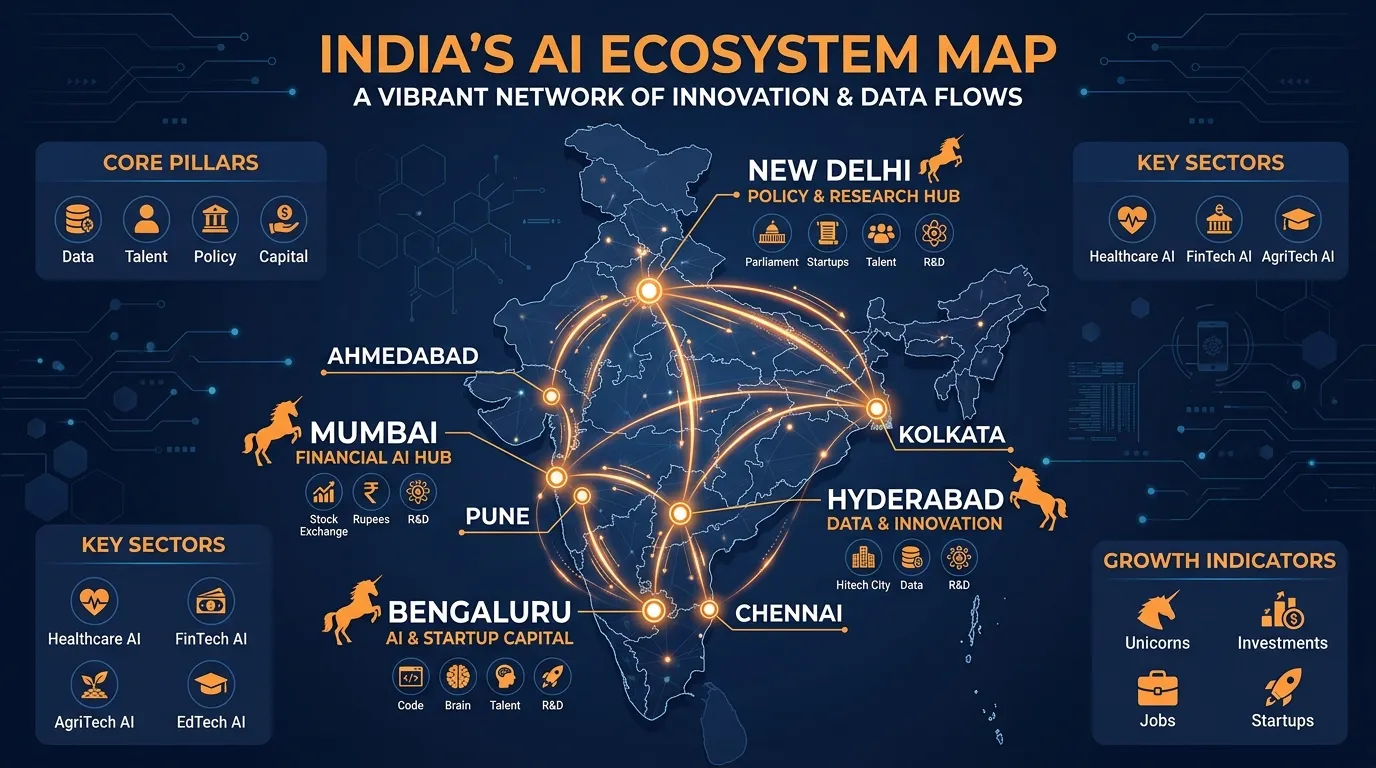
Abstract funding numbers acquire meaning only when translated into the companies, products, and capabilities they enable. The $50 billion flowing into Indian AI startups is building, among other things: sovereign large language models that understand Indian languages with the depth and nuance that models trained primarily on English cannot provide; AI-powered agricultural advisory systems that deliver agronomist-quality guidance to smallholder farmers through basic smartphones; diagnostic AI tools that extend the reac of India' chronically insufficient specialist physician base to communities that currently have no access to specialists; financial AI systems that use alternative data to make credit decisions for the hundreds of millions of Indians who are creditworthy but invisible to traditional banking models; and the infrastructure layer — data centers, GPU clusters, cloud platforms — that all of these applications require to run at the population scale that India demands.
Each of these applications represents not just a business opportunity but a genuine contribution to human welfare — a point that is easy to lose in the abstraction of funding rounds and valuation milestones. When an AI system helps a farmer in Vidarbha avoid a catastrophic yield loss by correctly predicting a pest outbreak, or enables a nurse in rural Rajasthan to correctly identify a case of diabetic retinopathy that would otherwise progress undetected to blindness, the connection between the fifty billion dollar investment number and the lived experience of real people becomes concrete and moving.
The Road Ahead: Promise and Responsibility
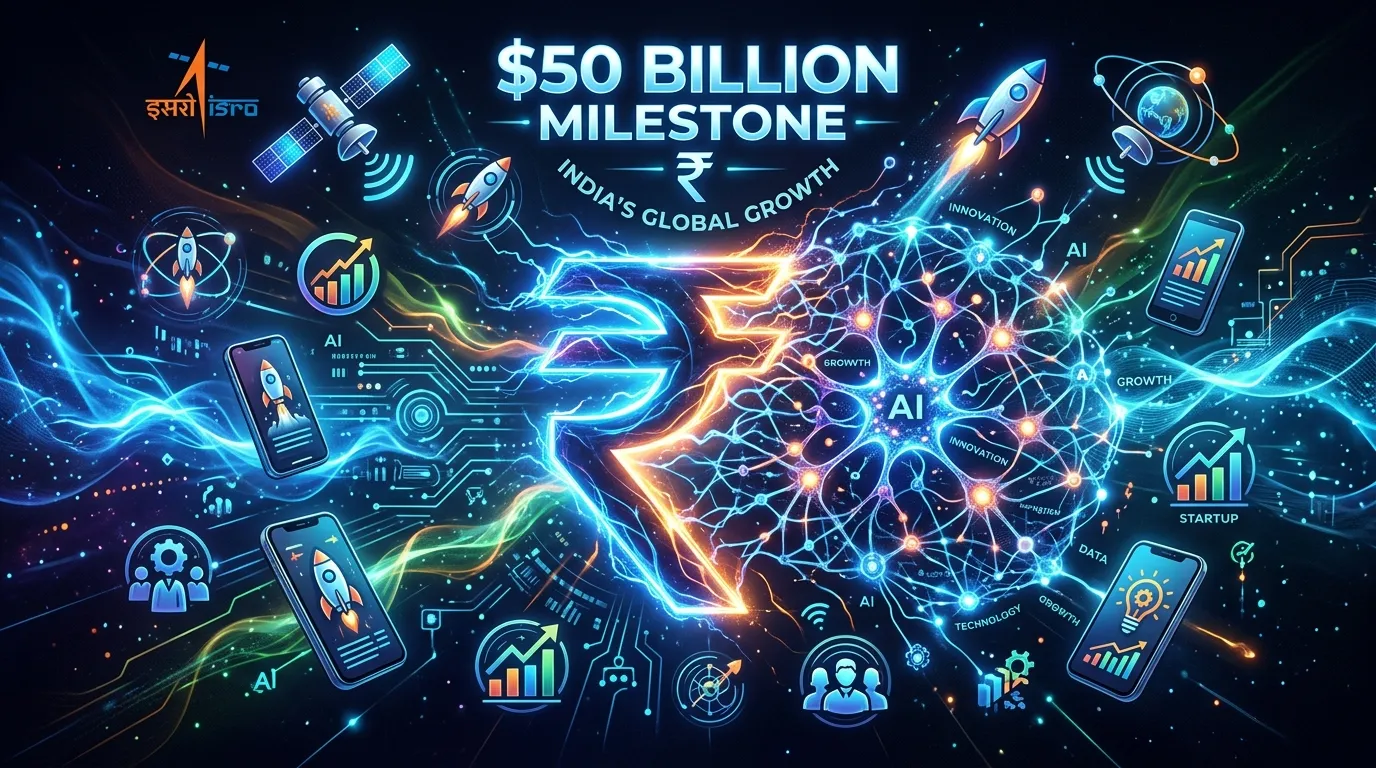
The $50 billion milestone is a beginning, not a conclusion. The questions that will determine whether India's AI investment translates into lasting economic and social value are only beginning to be seriously engaged.
Data sovereignty is paramount. The most valuable AI applications require access to data — and the governance frameworks that determine who controls, accesses, and benefits from India's data are still being negotiated. The choices made in the next few years about data governance will shape the competitive dynamics of Indian AI for decades.
Talent retention is equally critical. India produces world-class AI talent — but a significant fraction of that talent, attracted by compensation and opportunity differentials, has historically migrated to the United States, Europe, and elsewhere. The $50 billion ecosystem is beginning to change this calculus by creating Indian companies that can offer competitive compensation, meaningful equity, and the intangible but powerful attraction of building for India's own people. But the work of retaining India's best AI minds within its own ecosystem is not complete.
The equity of AI's benefits is a moral imperative that the ecosystem must take more seriously. If the products of India's $50 billion AI investment primarily serve urban, English-literate, economically comfortable Indians — the top 10% — while bypassing the hundreds of millions who most need AI's transformative potential, the investment will have failed in its most important dimension.
For The Impactful Global Indian, this milestone carries a particular resonance. The Indian diaspora — engineers at OpenAI, researchers at DeepMind, founders in Silicon Valley — has long powered global AI from behind the scenes. Now, the homeland itself is stepping onto the main stage. The fifty billion dollars is not just capital flowing in. It is recognition — recognition that the Indian approach to intelligence, characterized by mathematical depth, multilingual facility, and an orientation toward solving real human problems at massive scale, is among the world's most valuable assets. For a generation of young Indians who dream of building the future from their own soil, that recognition is itself transformative.