
The Night the Lights Went Out: India's AI Crisis Moment
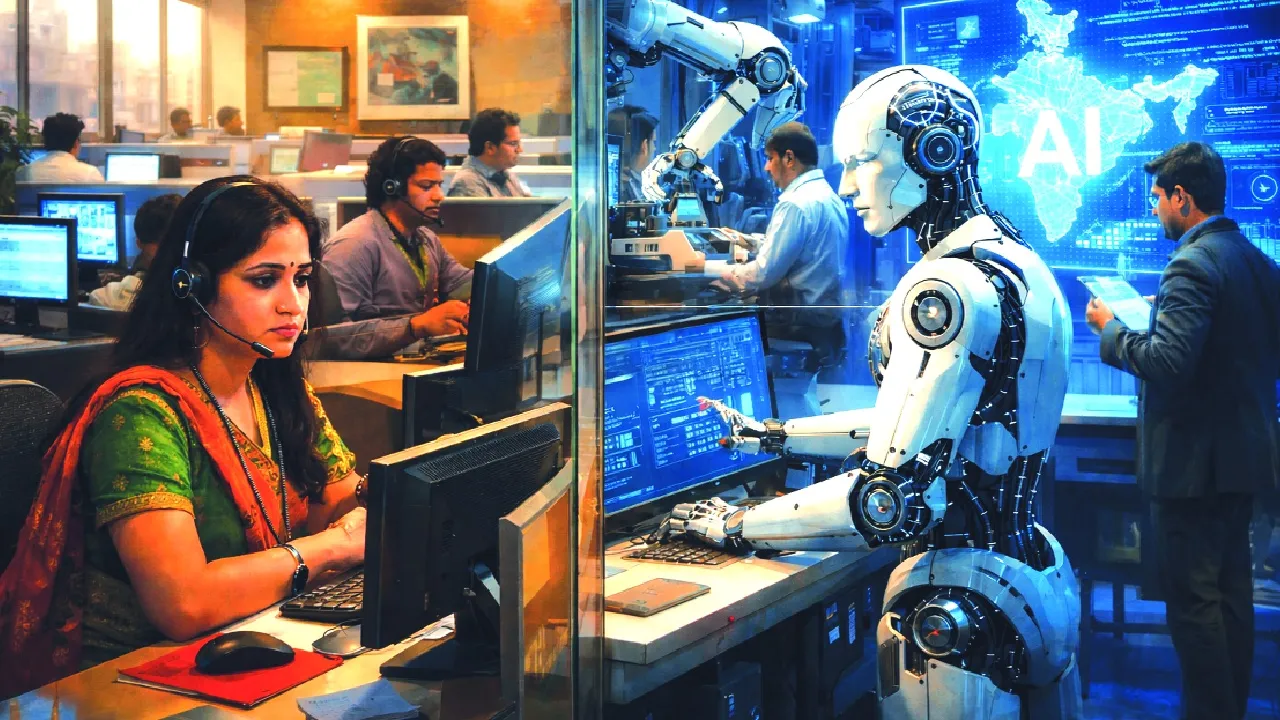
It happened without warning. Indian AI startups that had built entire product lines, customer relationships, and revenue models on top of frontier AI models from US companies suddenly found access suspended. The trigger: a US government export-control directive that restricted access to advanced AI models — including newly released frontier models — for foreign nationals. Overnight, the carefully constructed technology stacks of some of India's most promising AI companies became uncertain.
For Saket Dandotia, co-founder and CEO of Onetab.ai — a company building AI-powered enterprise applications — the episode was simultaneously a near-death experience and a clarifying moment. His company had diversified across multiple AI models, which bought time. But as he told CNBC with striking directness: diversification buys time; it does not buy independence. The underlying vulnerability, he said, was structural. India needed sovereign AI.
The episode shook India's AI ecosystem to its core. The country's AI strategy had rested on a seemingly sensible foundation: leverage India's vast IT talent pool to build applications on top of foundation models developed by US companies. It was capital-efficient, fast, and sensible — until it suddenly wasn't. One directive from Washington had exposed the fragility at the heart of India's AI ambitions, and the tech community was not going to forget it.
India's AI Strategy: The Ambition Before the Wake-Up Call
To understand the magnitude of what happened, one must first appreciate just how seriously India had been taking artificial intelligence as a national priority. The India AI Impact Summit 2026, held in New Delhi in February, brought together an extraordinary gathering: Prime Minister Narendra Modi flanked by OpenAI CEO Sam Altman, Anthropic CEO Dario Amodei, Google CEO Sundar Pichai, and Meta Chief AI Officer Alexandr Wang. The image of India's Prime Minister at the centre of global AI leadership was not an accident. It was a statement.
The government's IndiaAI Mission had been rolling out with ambition and momentum. The programme aimed to strengthen computing infrastructure, expand research capabilities, support startups, develop high-quality datasets, and build a robust talent pipeline. India was investing heavily in semiconductors through the India Semiconductor Mission, with a focus on chip design, assembly, testing, packaging, and manufacturing to reduce dependence on global supply chains.
India's digital public infrastructure — Aadhaar, UPI, DigiLocker, and CoWIN — had been cited as a key competitive advantage in expanding AI adoption at scale. The AI Kosha initiative was creating trusted, domestically-sourced datasets for researchers, universities, and businesses, explicitly aimed at reducing reliance on foreign data ecosystems. And the New Delhi Declaration on AI Impact, adopted by 91 countries and international organisations at the India AI Impact Summit, had positioned India as a global convening power on AI governance.
India had, in other words, been building carefully and ambitiously. The export control shock arrived just as confidence was reaching its peak — a reminder that in the age of AI, geopolitics and technology are inseparable.
The Numbers That Explain Why This Matters So Enormously
Before examining how India is responding, consider the scale of what is at stake. According to the Google and Inc42 Bharat AI Startups Report 2026, India's AI market could become a $126 billion opportunity by 2030, with a potential GDP impact of $1.7 trillion by 2035. The Centre has expressed confidence that the AI sector could attract over $200 billion in capital over the next two years. These are not aspirational numbers plucked from optimistic spreadsheets. They are projections grounded in real momentum.
India is home to more than 170 AI startups that have collectively raised over $2.6 billion in funding. Indian AI startup funding in 2025 alone made India the third-highest funded startup ecosystem in the world, after the US and UK. The talent base is world-class — India produces more STEM graduates annually than almost any other country, and Indian engineers are disproportionately represented in the leadership of every major US technology company.
The enterprise adoption story is equally compelling. According to an EY-CII report, 47 percent of Indian enterprises currently have multiple generative AI use cases running in production. Only 23 percent are still in pilot stages. A remarkable 92 percent of Indian professionals use AI tools regularly, and 57 percent of large Indian enterprises are actively integrating AI into everyday operations. India is not on the edge of the AI revolution. It is already inside it.
But all of this activity has been built, to a significant degree, on a foundation of foreign AI models and foreign compute infrastructure. The export control episode made the risks of that dependence undeniable.
India's Applied AI Era: Building for a Billion, Not Just the Valley
What is emerging from the crisis, however, is perhaps even more exciting than the pre-crisis narrative. India's AI response is not simply defensive. It is creative, distinctive, and grounded in a uniquely Indian competitive advantage: the ability to solve problems at billion-user scale, in multiple languages, at low cost.
Indian startups are pioneering what industry observers are calling the Applied AI era — a deliberate choice not to compete with OpenAI, Anthropic, or Google on foundational model development, but to build vertically-focused AI systems that solve real Indian problems at massive scale. From multilingual communication to healthcare access, enterprise automation, climate intelligence, and public service delivery, Indian AI companies are tackling uniquely Indian challenges with AI-first approaches.
Consider Sarvam AI, which was selected by the central government to build India's first homegrown sovereign large language model (LLM) under the IndiaAI Mission. At the India AI Impact Summit 2026, Sarvam unveiled two large language models — Sarvam-30B and Sarvam-105B — designed specifically to handle India's extraordinary linguistic diversity. With 22 constitutionally recognised languages and hundreds of dialects, India's language challenge dwarfs anything most AI models have been built to handle. Sarvam is building models that can genuinely serve an Indian farmer in Punjabi and a software engineer in Tamil with equal effectiveness. HCLTech, one of India's largest IT services companies, has since acquired a 10.5 percent stake in Sarvam, signalling that India's established tech giants see sovereign AI as a strategic priority.
Wipro has established a new Centre of Excellence for AI in Bengaluru. Infosys, TCS, and HCLTech are all racing to integrate AI into their service offerings — turning India's $200-billion IT services industry into an AI-augmented powerhouse that serves clients globally while developing deep AI capabilities domestically.
The Startup Stories That Will Define India's AI Generation
Behind the headline numbers and policy announcements, it is India's AI startup founders who are writing the most compelling chapters of this story. These are largely young, India-educated engineers and entrepreneurs who have chosen to build in India, for India, rather than relocating to Silicon Valley.
Autoset, founded by IIT alumni, is building AI-powered clinical workflow automation for the US skilled nursing industry — an early example of how Indian AI startups are solving global problems from Indian soil. The platform uses AI to automate clinical documentation, assessments, care planning, and reimbursement workflows, effectively acting as an AI nurse in facilities facing severe staffing shortages. Indian founders, educated at India's finest institutions, solving America's healthcare crisis — from Bengaluru.
NeuralZome Cybernetics has built a no-code, teachable AI agent to power autonomous robots, including an autonomous off-road ATV running on its proprietary NeuralBox platform. The startup's autonomous vehicle can drive at speeds up to 10 kmph and is applicable to precision agriculture and logistics — two sectors where India has enormous deployment potential.
Melvano, founded by an IIT Madras silver medallist, is using AI to transform competitive exam preparation for JEE and NEET aspirants — directly impacting the educational trajectories of millions of Indian students who aspire to India's most prestigious engineering and medical institutions. The platform analyses student performance in real time, recommends targeted practice questions, and predicts rank outcomes.
These are not peripheral stories. They represent a generation of Indian AI innovation that is grounded in deep problem awareness, technical excellence, and a commitment to building at the scale India demands.
The Sovereign AI Imperative: What India Must Do Now
The export control shock has catalysed a conversation in India's technology and policy communities that was long overdue. The consensus emerging is clear: India must accelerate its investment in sovereign AI capabilities — not because it wants to isolate itself from the global AI ecosystem, but because strategic autonomy in AI is as important as strategic autonomy in defence, energy, or space.
This means accelerating compute infrastructure investment. India's AI ambitions are constrained by a shortage of high-performance GPU computing resources. Building domestic AI compute capacity — through government investment, private sector partnerships, and international collaborations — is the most urgent infrastructure challenge India faces in the AI domain.
It means investing in India's semiconductor ambitions with greater urgency. Chips are the physical foundation of AI. The India Semiconductor Mission, while making progress, needs faster execution and deeper international partnerships to give India the hardware independence that complements its software strengths.
It means building and sharing data — at scale and in India's languages. AI models are only as good as the data they are trained on. India's extraordinary linguistic, cultural, and sectoral diversity is both a challenge and a unique opportunity. Datasets that capture India's reality can train models that no foreign company can easily replicate.
And it means nurturing the founders, researchers, and engineers who are choosing to build India's AI future from Indian soil. Visa reforms, research funding, startup support, and a culture that celebrates technical ambition are all part of creating the conditions for India's sovereign AI mission to succeed.
The Global Indian's Role in India's AI Future
For Global Indians in technology leadership roles across the United States, the United Kingdom, Canada, Singapore, and beyond — this story carries a personal resonance and a practical invitation. Indian-origin engineers, researchers, and executives hold senior positions at virtually every major AI company in the world. They are inside OpenAI, Google DeepMind, Meta AI, Microsoft Research, Amazon Web Services, and Anthropic. They are founders of AI startups valued in the billions.
The question India's AI ecosystem is increasingly asking — gently but persistently — is whether some of that talent, expertise, and capital can flow back to support India's sovereign AI mission. Not necessarily through relocation, but through mentorship, investment, technical collaboration, and advocacy.
India's AI story is the most important technology story in the world right now. It is the story of the world's most populous country deciding whether it will be a consumer of AI created elsewhere or a creator of AI for itself and the world. The export control wake-up call has made the choice starkly clear. And India — true to its history of rising to challenges — is choosing to build.
In that choice lies a story that every Global Indian, every technology leader, and every observer of India's extraordinary civilisational journey has a stake in watching, supporting, and celebrating.


