India’s $30 Million Bet to Become the World’s Animation & Gaming Foundry
A new budget allocation and a national Creator Lab network aim to transform India from Hollywood’s back office into a global owner of intellectual property.
MUMBAI — May 28, 2026
The ₹250 Crore Question
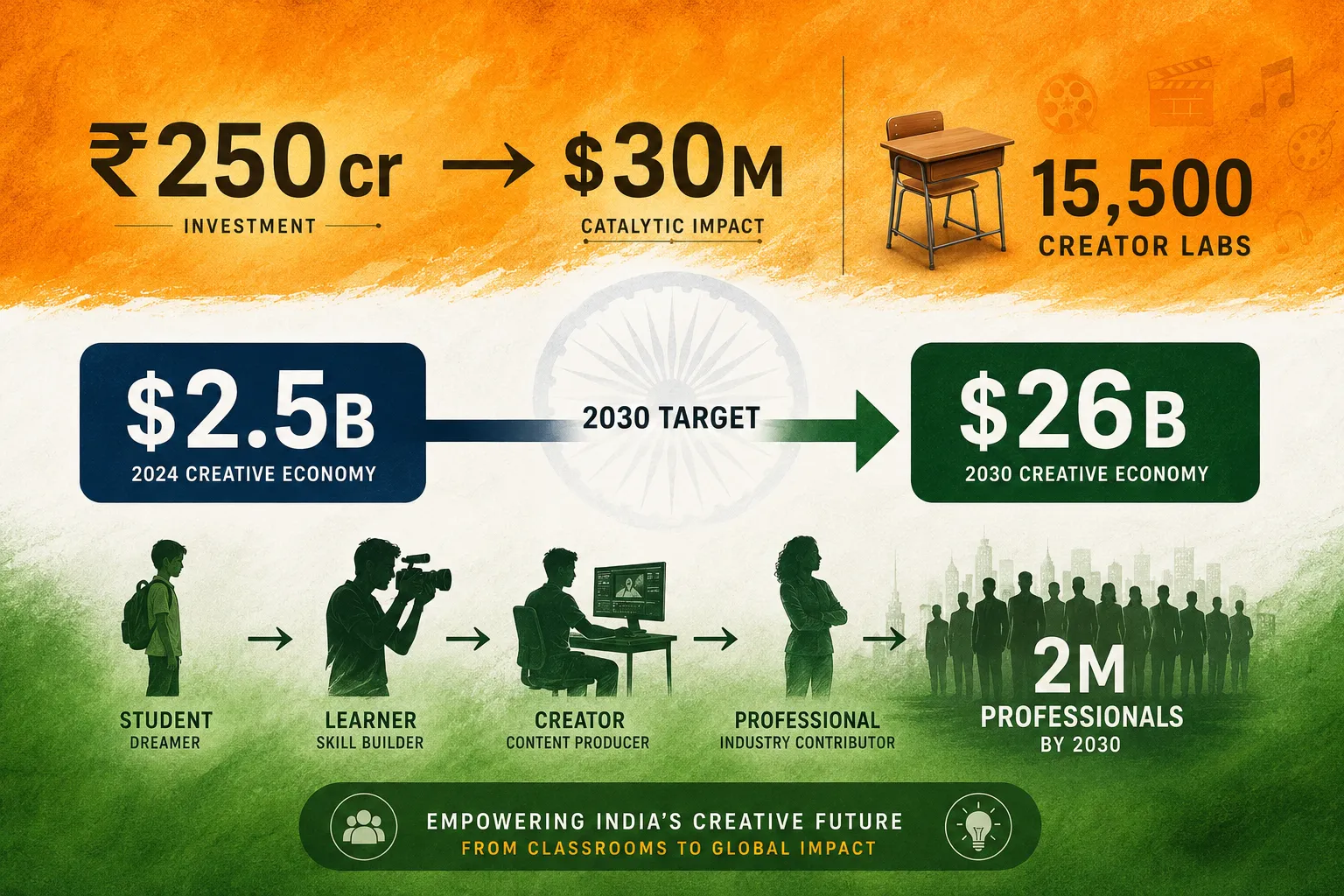
At first glance, ₹250 crore (approximately $30 million) seems like a rounding error in India’s $550 billion Union Budget. But for the country’s Animation, Visual Effects, Gaming, and Comics (AVGC) sector, this allocation is anything but modest. It is a carefully aimed lever — one designed to pry open a global creative economy currently dominated by the United States, Japan, and Canada.
The money will fund 15,500 Content Creator Labs — 15,000 in secondary schools and 500 in colleges — across India. The goal is not merely to teach software skills. It is to build a new national pipeline of intellectual property (IP) owners, storytellers, and technology creators who will eventually export Indian-origin characters, games, and animated series to the world.
For decades, American studios have outsourced animation and VFX work to India because of a 40–60% cost advantage and a deep pool of English‑speaking engineers. That model is mature, profitable, and stable. Now, New Delhi wants to break it — not by ending outsourcing, but by adding something new on top: original Indian creation.
The Orange Economy and “Create in India”
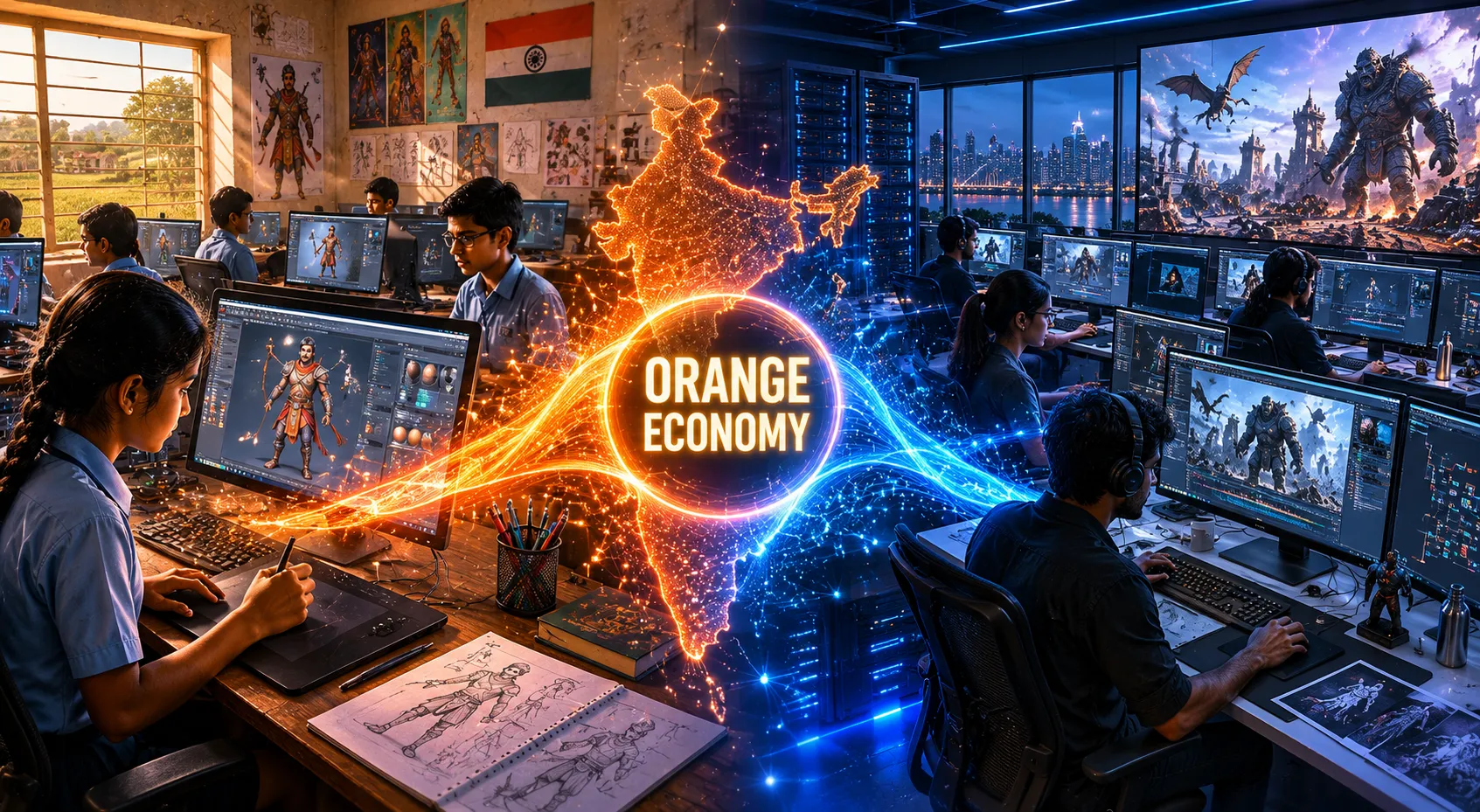
Finance Minister Nirmala Sitharaman explicitly framed the AVGC push within the “Orange Economy” — a term used by the Inter‑American Development Bank to describe creative and cultural industries that generate intangible value. In plain language: stories, art, and code have become tradable goods as valuable as steel or software.
India’s AVGC sector is currently worth $2.5–3 billion, contributing less than 1% of the global market. By 2030, the government projects that share could rise to 3%, representing a potential $26 billion in annual revenue. To get there, the government has activated a three‑layer strategy:
Talent (the ₹250 crore labs)
Institutions (the Indian Institute of Creative Technologies)
Global platforms (the WAVES summit)
“We don’t want to be the world’s render farm forever,” a senior official from the Ministry of Information and Broadcasting told this magazine. “We want to be the world’s story farm.”
The IICT: An IIT for Animation
The institutional anchor is the Indian Institute of Creative Technologies (IICT) in Mumbai, which has been allocated ₹391.15 crore (~$47 million) — more than the Creator Lab budget itself. Modelled on the prestigious IITs (Indian Institutes of Technology), the IICT is designed as a hub‑and‑spoke system. The hub is a flagship campus offering 18 advanced courses in VFX, game design, XR (extended reality), and AI‑driven animation. The spokes are the 15,500 Creator Labs, which will receive standardised curricula, remote mentorship, and hardware guidelines from the IICT.
What makes the IICT unusual is its public‑private partnership model. Global technology giants — Google, Meta, NVIDIA, and Microsoft — have already signed on to co‑design courses, provide cloud rendering credits, and sponsor faculty exchanges. Netflix has also partnered to offer scholarships for underprivileged students.
In other words, American tech companies are actively helping India build its future creative workforce. Why? Because a larger pool of skilled Indian creators means more content for their platforms — and eventually, more Indian IP that can be licensed globally.
The States Are Racing Ahead
While the central government focuses on education, India’s states are competing to attract industry investment. Maharashtra (home to Mumbai and Bollywood) has approved a ₹3,268 crore (~$394 million) AVGC‑XR Policy 2025. The state aims to attract ₹50,000 crore (~$6 billion) in private investment and create 200,000 jobs by 2050, including dedicated AVGC‑XR parks with subsidised studio space, motion capture stages, and co‑working hubs.
Karnataka (Bengaluru) and Telangana (Hyderabad) are drafting similar policies. This competitive federalism is deliberate: it forces states to offer better incentives, faster clearances, and stronger industry linkages than their neighbours. For American studios looking to set up a permanent India office, this means a buyer’s market.
WAVES: India’s SXSW for the Creative Economy
In early 2025, India launched the World Audio Visual & Entertainment Summit (WAVES) in Goa. The event was part trade fair, part startup accelerator, and part Bollywood spectacle. A dedicated vertical called WAVEX offered mentorship from Microsoft, Google, and leading Indian studios to early‑stage AVGC startups. More than 200 Indian creators pitched their original game concepts, animation pilots, and VFX demos to international buyers from the US, UK, Japan, and South Korea.
“Before WAVES, an Indian game developer had to fly to San Francisco or Tokyo to get in front of a publisher,” said a Mumbai‑based indie game founder who attended. “Now, the buyers come to us.”
The government has committed to making WAVES an annual event, rotating between major cities. The long‑term goal is to create a permanent deal‑making infrastructure — a “creative bazaar” — that reduces the friction of cross‑border IP collaboration.
Reality Check: Talent vs. Infrastructure
For an American reader, it is tempting to see this as another “India rising” story that ignores ground‑level constraints. And there are real challenges.
First, rolling out 15,500 high‑tech labs across a country with vastly different state education budgets is a logistical nightmare. Many rural schools still struggle with basic electricity and internet connectivity. The government plans to prioritise schools with existing digital infrastructure and partner with private ed‑tech firms to supply hardware — but the “train the trainer” problem remains acute. Without certified instructors, a lab full of high‑config computers becomes an expensive storage room.
Second, the Indian education system is famously exam‑oriented, leaving little room for creative problem‑solving. Introducing game design and VFX as legitimate career paths will require a cultural shift among parents and school administrators, who still push students toward engineering or medicine.
Third, India’s intellectual property laws, while compliant with international treaties, are poorly enforced for digital content. Piracy of games and animations remains widespread. The government has signalled that a stronger anti‑piracy framework is in the works, but no legislation has been tabled yet.
What This Means for American Industry
Despite the challenges, the direction is unmistakable. India is building the world’s largest formalised talent pipeline for creative technology — not by accident, but by design.
For American studios, this offers two distinct opportunities:
Lower‑cost, higher‑volume production partnerships – The Creator Labs will produce a steady stream of entry‑level artists and coders, reducing the upward pressure on wages in India’s established VFX hubs.
Co‑ownership of Indian IP – Unlike China, which restricts foreign ownership of content, India allows 100% FDI in the AVGC sector. American studios can co‑produce original Indian animations or games and retain global distribution rights. A few are already moving: Netflix has commissioned two original Indian animated series, and Warner Bros. Discovery is scouting gaming startups for partnership.
The risk for American incumbents is complacency. If India successfully builds a self‑sustaining creative ecosystem — one that generates its own hit franchises — the balance of power in global entertainment will shift. The next Minions or Among Us could be born in Mumbai, not Los Angeles or Stockholm.
The Bottom Line
₹250 crore is not a lot of money. But in the world of creative technology, leverage matters more than absolute size. India is using that modest sum to activate a much larger engine: its demographic dividend, its engineering culture, and its growing appetite for original storytelling. The Creator Labs, the IICT, and the WAVES summit are not isolated initiatives. They are the scaffolding of a national ambition to own a slice of the global imagination.
For American investors, studio executives, and policy makers, the question is no longer if India will become a major AVGC producer. It is when — and whether you will be inside the room when the deals are signed.


