Somewhere in the sprawling business districts of Bengaluru, Hyderabad, Pune, and a growing list of other Indian cities, a quiet but genuinely consequential transformation has been unfolding over the past several years — one that has fundamentally reshaped how multinational corporations think about India's role within their global operations. The country was home to more than 2,100 global capability centres, or GCCs, by the end of 2025, according to recent industry data, with that figure projected to climb past 4,000 by 2030 — a near-doubling in under five years that would cement India's position as, by a considerable margin, the world's leading destination for this increasingly strategic category of corporate infrastructure.
For readers less familiar with the terminology, global capability centres represent dedicated, wholly-owned offshore operations that multinational corporations establish to house a wide and steadily expanding range of business functions, historically including software engineering, IT support, and data analytics, but increasingly encompassing far more strategically significant activities including product research and development, finance and accounting operations, legal and compliance functions, human resources, marketing analytics, and, in a growing number of cases, genuine strategic decision-making authority that would, in earlier decades, have remained concentrated exclusively at a company's home-country headquarters.
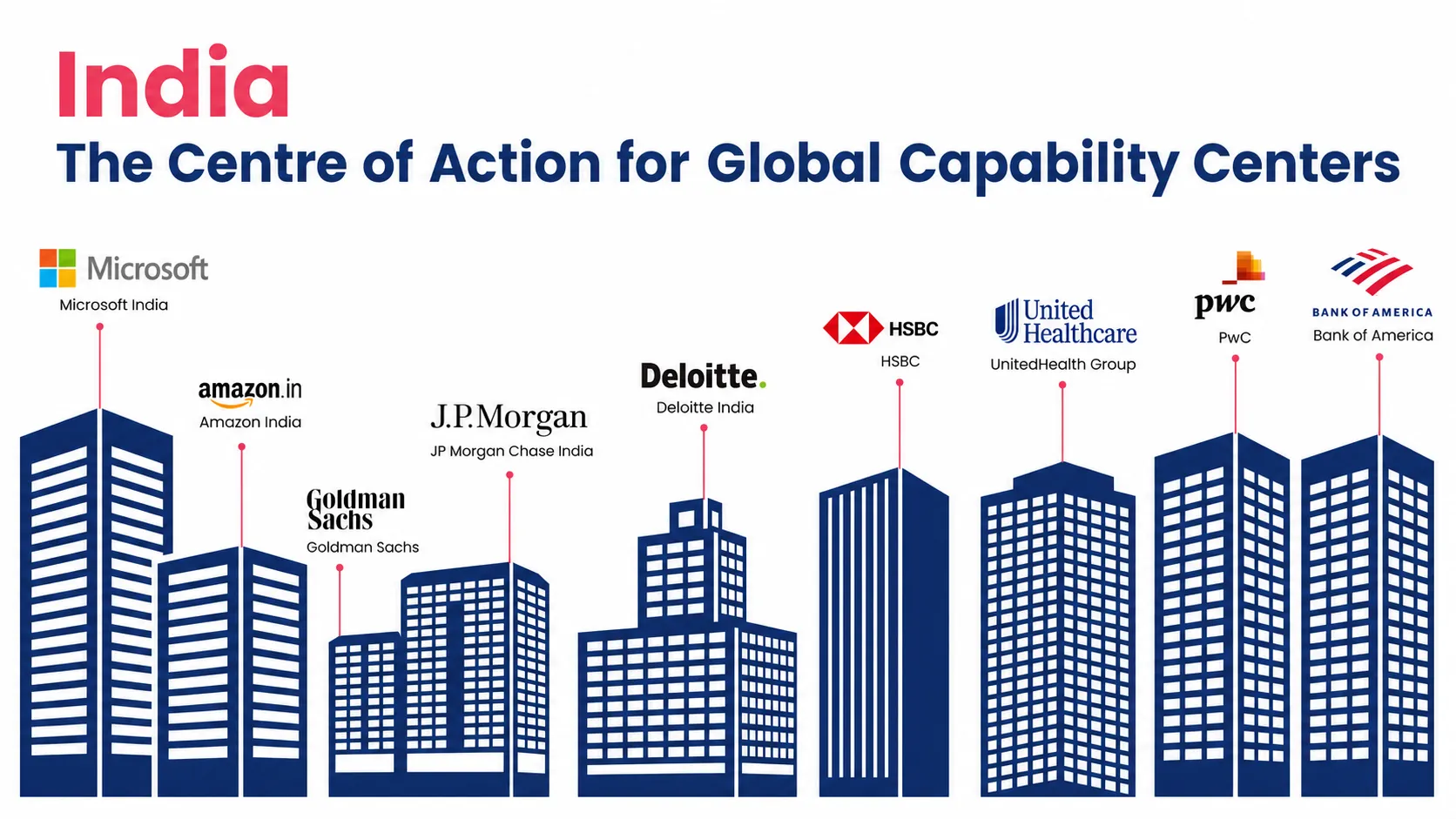
The distinction between GCCs and the more traditional business process outsourcing, or BPO, model that dominated India's earlier engagement with multinational corporations carries real significance for understanding the current growth trajectory. Where traditional outsourcing arrangements typically involved contracting discrete, often relatively low-value business processes to third-party service providers — arrangements characterised by transactional, cost-focused relationships with limited strategic depth — the GCC model involves multinationals establishing and directly operating their own wholly-owned facilities in India, staffed by employees who are, in every meaningful sense, integral members of the parent company's global workforce rather than employees of an external outsourcing vendor. This ownership structure has profound implications for the depth of integration, strategic importance, and career trajectory available to professionals working within these centres, compared to the more transactional, arms-length relationships characteristic of traditional outsourcing arrangements.
The scale of India's current GCC ecosystem — spanning more than 2,100 centres — reflects the cumulative result of a multi-decade evolution that began with relatively modest, cost-focused offshore technology and support operations established by early corporate pioneers, but which has progressively matured into today's considerably more sophisticated, strategically embedded model. Early GCCs, often established in the late 1990s and 2000s, tended to focus predominantly on IT infrastructure management, application development and maintenance, and various forms of technical support, functions chosen primarily for their relatively straightforward transferability to an offshore location and the substantial cost savings such transfers offered relative to maintaining equivalent capabilities in higher-cost home markets.
Over subsequent years, and particularly accelerating over the past decade, the scope and strategic ambition of India's GCC ecosystem has expanded dramatically. Today's leading GCCs increasingly house genuine research and development functions, contributing directly to global product roadmaps and innovation pipelines rather than merely executing predetermined technical specifications developed elsewhere. Financial services GCCs increasingly handle sophisticated risk management, quantitative analysis, and even portions of investment decision-making processes for global banking and asset management firms. Technology company GCCs frequently house core engineering teams responsible for building and maintaining globally significant product features and platforms, rather than merely providing maintenance support for systems designed elsewhere.
The India Site Lead role that has emerged at many of these GCCs offers a useful lens into how fundamentally the strategic positioning of these centres has shifted. Where earlier offshore operations were typically overseen by relatively junior management focused primarily on operational execution and cost control, today's larger, more strategically significant GCCs are increasingly led by senior executives who hold genuine authority over meaningful strategic decisions, even as questions about the precise boundaries of that decision-making authority relative to global headquarters remain an area of ongoing evolution and, at times, some organisational tension, as global companies work through exactly how much strategic autonomy to extend to their Indian operations relative to functions that remain more centrally controlled from corporate headquarters.
Several structural factors help explain why India has emerged as the overwhelmingly dominant global destination for this category of corporate investment, ahead of other potential offshore destinations including the Philippines, Poland, Mexico, and various other emerging markets that have also sought to attract GCC investment. India's enormous, English-speaking, technically skilled talent pool remains perhaps the single most frequently cited advantage, reflecting the country's decades-long investment in engineering and technical higher education, producing a vast annual pipeline of technically trained graduates at a scale that few other countries can match. This talent advantage has been further reinforced by India's well-established, mature technology services ecosystem, including major domestic IT services companies like Tata Consultancy Services, Infosys, and Wipro, whose decades of operational experience have helped cultivate a broader ecosystem of technology infrastructure, real estate, and support services that benefit GCC operations as well.
Cost advantages, while historically the primary driver of India's attractiveness as an offshore destination, have become progressively less central to the GCC value proposition as the model has matured, even as India continues to offer meaningful cost savings relative to equivalent operations in the United States, Western Europe, or other high-cost developed markets. Industry observers increasingly emphasise that the primary driver behind continued GCC expansion in India has shifted from pure cost arbitrage toward genuine access to skilled talent at a scale simply unavailable in most other markets, alongside India's demonstrated ability to execute increasingly sophisticated, higher-value business functions reliably and at scale — a track record built up over decades of GCC and IT services sector operation that provides multinationals considerable confidence in India's capability to handle genuinely mission-critical functions rather than merely peripheral, easily-disrupted activities.
The sectoral composition of India's GCC ecosystem has also diversified considerably over recent years, moving well beyond its earlier concentration in technology and financial services to encompass GCCs established by companies across manufacturing, retail, healthcare, pharmaceuticals, automotive, and a growing range of other industries, each bringing their own distinct functional requirements and strategic priorities to their Indian operations. This diversification has helped insulate the broader GCC ecosystem from being overly dependent on the fortunes of any single global industry, providing a degree of resilience that has likely contributed to the sector's continued growth even through periods of sector-specific volatility, such as the technology sector's own periodic hiring slowdowns and cost-optimisation cycles.