"I Was 39 With the Body of a 49-Year-Old": The Zomato Co-Founder Who Reversed His Biological Age—and Built a Health-Tech Startup With His Wife That Ranbir Kapoor Just Bet Millions On
GURUGRAM — May 26, 2026 — Gaurav Gupta was one of the architects of India's food-tech revolution. As a co-founder of Zomato, he spent more than a decade building the infrastructure that turned a restaurant-discovery website into India's largest food-delivery platform—a company that now serves hundreds of millions of users across multiple countries, that went public in 2021, and that fundamentally changed how India eats. He was, by any conventional measure, extraordinarily successful. He was also, by his own quiet admission, falling apart.
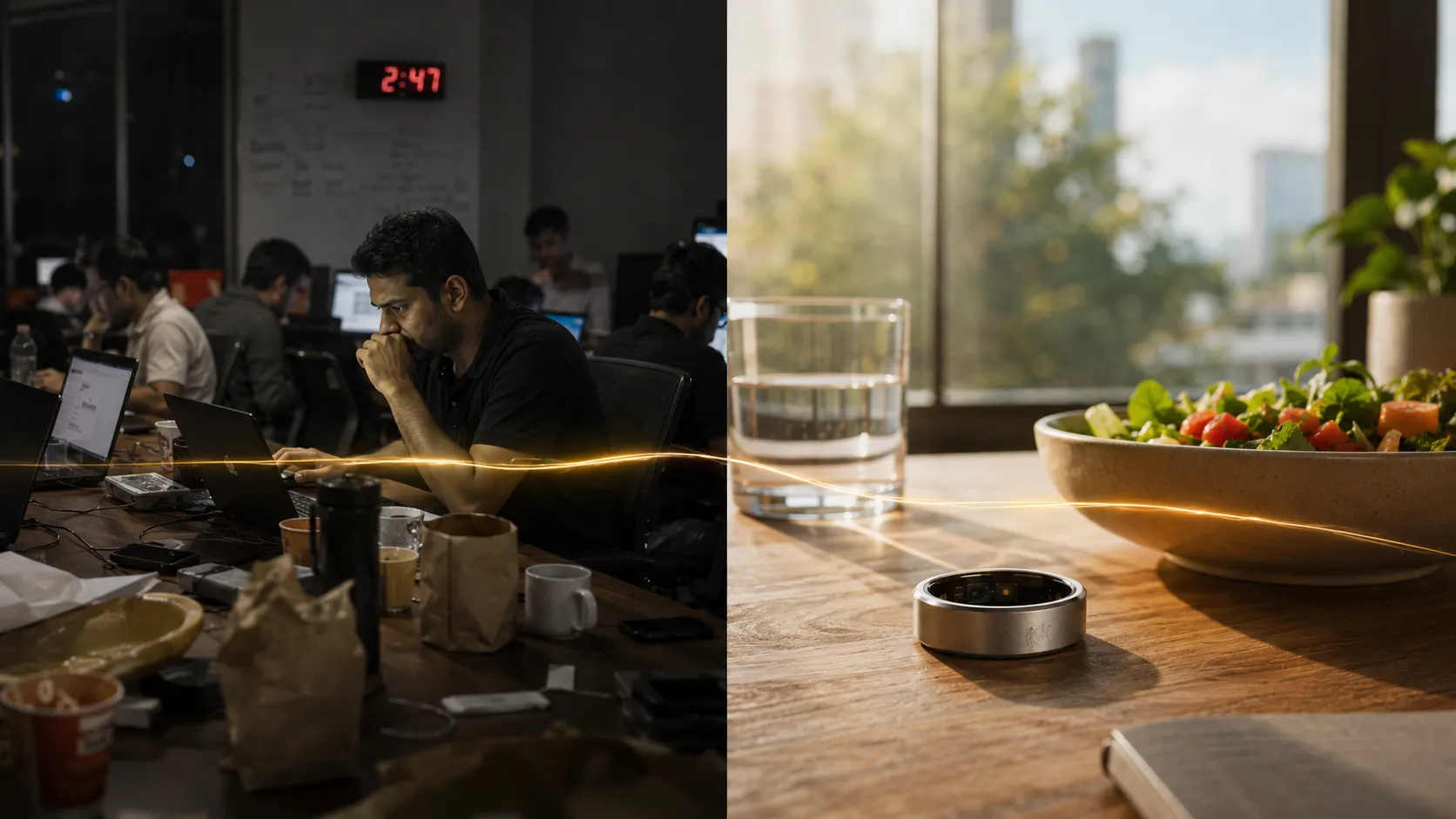
The years of building Zomato had taken a toll he could not see until the pandemic forced him to stop. The travel, the late nights, the meals grabbed between meetings, the sleep sacrificed to the relentless demands of scaling a startup—all of it had accumulated in ways that were invisible to him until the world shut down and he found himself, for the first time in years, with nowhere to go and nothing to do but look at his own body. What he saw shocked him. "During the pandemic, I reduced my metabolic age by 14 years," he told Mashable India. "I went from a metabolic age of 49 when I was actually 39, to 35 when I turned 41. I lost around 15 kilos." The transformation was not the result of an extreme diet or a punishing exercise regimen. It was the result of something far simpler—and, for most people, far harder. "The changes I made were simple. When my travel stopped with COVID, my sleep improved, and for the first time in years I fell into a rhythm with good food. Just the basics, done well."
The basics, done well. The phrase became the foundation of Gabit—the health-tech startup Gupta founded in 2022 with his wife, Arpana Shahi, a former entrepreneur who had founded the edtech platform SkillTap. The name is a deliberate collision of "good" and "habit," and the company's thesis is as simple as the insight that spawned it: most people do not need more data about their health. They need a system that nudges them, guides them, and helps them build the small, consistent routines that compound over time into longer, healthier lives. Four years later, Gabit has raised over $12.7 million from an investor roster that reads like a who's-who of Indian technology and entertainment: Norwest Venture Partners, Zomato founder Deepinder Goyal, CRED founder Kunal Shah, Amazon's Amit Agarwal, and—in a move that made headlines across the country—Bollywood star Ranbir Kapoor and musician Badshah, both of whom are not just brand ambassadors but equity holders. The company's flagship product, a titanium smart ring that weighs less than 3.1 grams and tracks over 150 biomarkers, was named Best Smart Ring of the Year at Amazon India's Best in Tech Awards. Its AI health coach, PEP, translates biometric data into personalised, actionable recommendations. And this month, Gabit closed a fresh ₹36.2 crore funding round from a clutch of angel investors—capital that will fuel its expansion from wearables into a fully integrated longevity ecosystem spanning nutrition, supplements, skincare, and diagnostics.
The Co-Founder Who Walked Away From a Unicorn
Gaurav Gupta's journey to Gabit began not with a business plan, but with a departure. In 2020, after more than a decade at Zomato—a company he had helped build from a scrappy startup into a publicly listed giant valued at over ₹1 lakh crore—he stepped away. The departure was amicable, by all accounts. But it was also definitive. Gupta was not leaving to start another food-tech company, or to launch a competitor, or to cash out and retire. He was leaving because the pandemic had shown him something about himself that he could not unsee: that the life he had been living was not sustainable, and that the same insight applied to millions of other Indians who were discovering, in the forced stillness of lockdown, that their own bodies were older than their years.
"I reduced my metabolic age by 14 years," he said. The statement, in its specificity, is worth pausing over. Metabolic age is not a marketing metric. It is a physiological measurement that compares an individual's basal metabolic rate to the average for their chronological age group. A metabolic age of 49 at an actual age of 39 means that Gupta's body was functioning, metabolically, like that of a man ten years older—burning calories less efficiently, recovering more slowly, and ageing faster at the cellular level than his birth certificate suggested. The reversal—from 49 to 35, a fourteen-year swing—was not achieved through expensive treatments or extreme interventions. It was achieved through sleep, nutrition, and movement. The basics, done well. "It made me realise that the four pillars of health: fitness, nutrition, sleep, and stress, are what truly move the needle," he said. "Yet most people lack the knowledge and systems to actually fix them."
The insight was not original. The global wellness industry has been built on it. But Gupta brought something to the problem that most wellness entrepreneurs lack: the systems-thinking of someone who had helped build one of the world's largest technology platforms. Zomato was, at its core, a logistics and data company—a machine for matching supply and demand at scale, optimised through algorithms, and delivered through a seamless consumer interface. Gupta believed the same architecture could be applied to health. Not a device that dumped numbers on the user, but an ecosystem that tracked, analysed, coached, and nudged—one that turned the abstract goal of "getting healthier" into a series of small, measurable, achievable habits. He called it Gabit—a name that collapsed "good habit" into a single word—and he convinced his wife, Arpana Shahi, to build it with him.
Shahi was not a health-tech entrepreneur. She was the founder of SkillTap, an edtech platform, and she brought a different set of competencies to the partnership: product thinking, user-experience design, and a conviction that technology built for women needed to be built by women who understood, at a visceral level, what women actually needed. The Gabit Smart Ring was designed, from the beginning, to include women's health features—period tracking, cycle-based wellness recommendations—that most wearable companies treated as an afterthought. The skincare vertical, which now includes sunscreens, serums, and facewashes tailored to different skin types and concerns, was built on the same principle: that health is not a single metric, and that the platform that served women well would serve everyone better.
The couple launched Gabit in 2022, operating from Gurugram, with a conviction that the smart ring—not the smartwatch—was the right form factor for the behavioural transformation they were trying to enable. A watch buzzes with notifications. It demands attention. It is, for many users, a source of stress rather than a tool for managing it. A ring, by contrast, is silent. It weighs less than 3.1 grams—barely noticeable on the finger. It tracks sleep, recovery, activity, stress, and nutrition without ever interrupting the user's day. It is, as Gupta described it, "a health coach on your finger"—one that observes quietly, learns continuously, and intervenes only when it has something useful to say. The philosophy was radical in its simplicity: the best health technology is the one you forget you are wearing.
The ₹36 Crore Ecosystem
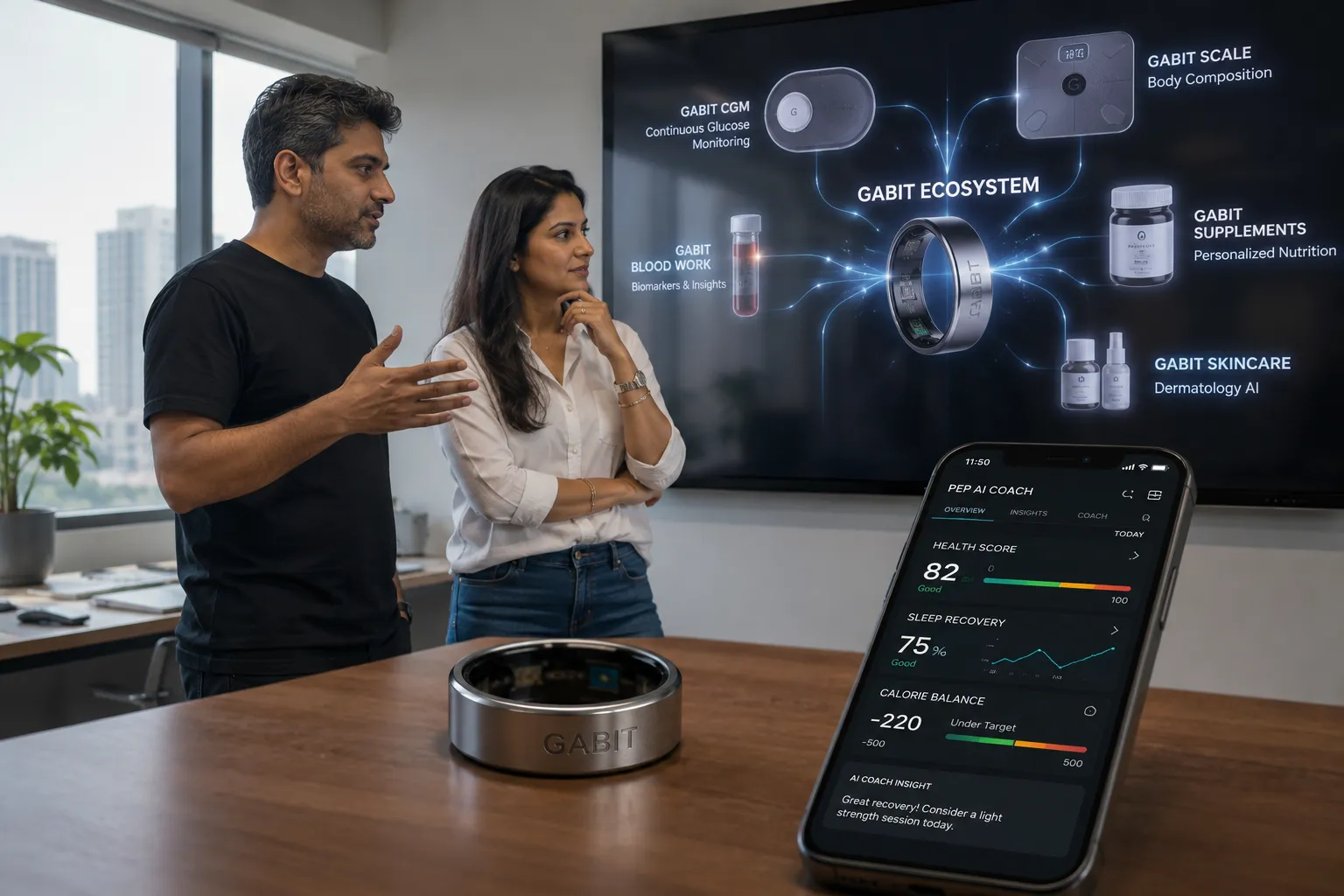
The most strategically significant dimension of Gabit's growth is not the funding rounds or the celebrity backers. It is the breadth of the platform that the funding is building. Gabit is not a smart-ring company. It is a longevity ecosystem—one that spans hardware, software, coaching, nutrition, supplements, skincare, and diagnostics, all integrated into a single platform that tracks over 150 biomarkers and translates them into personalised, actionable recommendations.
The smart ring is the entry point. Built from titanium, water-resistant, with a 7-to-10-day battery life, it tracks sleep, recovery, activity, stress, and nutrition—the four pillars that Gupta identified as the foundation of metabolic health. But the ring is only one node in a larger network. The platform also integrates with Gabit's Smart Scale, with continuous glucose monitors, and with blood work—the kind of comprehensive diagnostic panel that was once available only through expensive, clinic-based assessments. The data from all of these sources flows into PEP, the AI health coach, which analyses it and generates recommendations that are specific, actionable, and designed to change behaviour rather than simply report metrics.
PEP is the differentiator. Most wearables track. PEP coaches. It can log meals through voice commands—"I ate a chicken salad for lunch"—and instantly calculate the calorie surplus or deficit, a metric no other wearable can track. It can measure VO2 Max on demand, giving users a real-time sense of their cardiovascular endurance and recovery. It can detect workouts automatically, across more than 30 modes, and adjust daily activity targets based on recovery scores. It is, in effect, a personal trainer, nutritionist, sleep coach, and stress-management advisor, all compressed into an algorithm that lives on the user's phone and communicates through the ring on their finger.
The platform also includes Gabit Tribes—a community feature that allows users to create private groups, share select health metrics, and participate in daily challenges around steps, sleep, and activity scores. "Health isn't just personal, it's also social," Gupta said. The feature reflects a growing body of research suggesting that accountability—the knowledge that someone else is watching, competing, or simply sharing the journey—is one of the most powerful predictors of sustained behavioural change. The user who joins a Gabit Tribe with her colleagues or her family is statistically more likely to stick with her wellness goals than the user who goes it alone. The platform is engineered around that insight, and the community features are as central to its architecture as the hardware.
The acquisition of Näck, a Swedish clean-label nutrition brand, in December 2025 extended the platform into the supplement market. Näck's products—science-led, globally certified, and formulated for purity—were folded into Gabit's ecosystem, allowing users to link their supplement intake with measurable health outcomes. A user who takes a magnesium supplement for sleep can now see, in her Gabit dashboard, whether her sleep scores are actually improving. The feedback loop closes. The behaviour is reinforced. The platform becomes not just a tracker, but a coach, a nutritionist, and a pharmacy—all in one.
The skincare vertical completes the ecosystem. Gabit's range of sunscreens, serums, facewashes, and moisturisers is designed on the same principle as the ring: that health is holistic, that the skin is an organ like any other, and that the consumer who is tracking her sleep, nutrition, and activity should also have access to products that are formulated for her specific skin type and concerns. The integration of skincare into a health-tech platform is unusual, but it reflects Gupta's conviction that the artificial boundaries between fitness, nutrition, sleep, stress, and skin are exactly that—artificial—and that the platform that breaks them down will capture a disproportionate share of the consumer's wellness spending.
The ₹36.2 crore round, disclosed this month, brings Gabit's total funding to over $12.7 million, excluding an undisclosed round raised from Ranbir Kapoor and Badshah in 2025. The capital will fund the continued expansion of the platform—deeper AI capabilities, new hardware products, broader distribution, and the scaling of the nutrition and skincare verticals. The company competes with Ultrahuman, Muse Wearables, and a growing roster of health-tech startups in a market that is projected to grow from $2.94 billion in 2025 to $8.64 billion by 2030—a compound annual growth rate of nearly 24 percent. The market is large, growing, and increasingly crowded, and the company that wins will be the one that builds the most integrated, most behaviourally sophisticated platform. Gabit is betting that it can be that company.
The Celebrity Bet
The most publicly visible dimension of Gabit's growth is not the technology or the funding. It is the Bollywood star who wears the ring. In May 2025, Gabit signed Ranbir Kapoor as its brand ambassador—a deliberate choice that Gupta has explained with characteristic precision. "We didn't want to go with a sports personality because Gabit isn't just about athletes or performance; it's about every individual who wants to improve their health," he said. "Ranbir was the perfect fit because he embodies what Gabit stands for—effortless discipline. He's relatable, grounded, and doesn't believe in overcomplicating health."
The campaign that followed was not a standard celebrity endorsement. Kapoor appeared in a series of ads that presented the Gabit Smart Ring not as a fitness gadget for gym enthusiasts, but as a quiet, unobtrusive companion for everyday life—a device that tracks, nudges, and coaches without demanding attention. "Taking care of yourself shouldn't feel like a full-time job," Kapoor said. "What I love about the Gabit Smart Ring is that it quietly fits into your life. No noise, no distractions, just real change. It's built for our generation." The campaign went viral organically and was recognised as the Best Campaign of the Year at the International Advertising Association Awards India—a validation that Gupta described as "not just about marketing," but as evidence that "real stories and real intent connect far deeper than perfection ever could."
Kapoor did not stop at being the face of the brand. He invested. So did Badshah, the rapper and music producer, who framed his involvement in terms that reflected the aspirational energy of the brand. "In my world, performance is everything—and it starts with health," Badshah said. "Gabit gets that. It mixes tech, habit-building, and fun. That's why I wanted in." The dual endorsement—one from the most mainstream of Bollywood stars, the other from one of India's most influential musicians—gave Gabit a cultural reach that no amount of venture-capital marketing could have purchased. The smart ring, once a niche product for quantified-self enthusiasts, was now being worn by celebrities who were photographed by paparazzi and followed by millions.
The celebrity strategy was not without risk. Celebrity-founded or celebrity-backed startups have a mixed track record in India, and the association of a health-tech platform with Bollywood could have undermined its clinical credibility. Gupta was careful about the positioning. The celebrities were not the story. The technology was the story. The celebrities were simply users—prominent ones, who had chosen to use the product and invest in the company because they believed in it. The distinction was subtle, but it was the difference between a brand that was built on endorsements and a brand that was built on trust.
The Marriage That Built a Health-Tech Platform
The most powerful dimension of the Gabit story is not the technology or the funding. It is the partnership at the centre of it. Gaurav Gupta and Arpana Shahi are not just co-founders. They are a married couple who are building a company together—a dynamic that is as demanding as it is rare.
The division of labour between them is organic rather than formal. Gupta, the Zomato veteran, brings systems thinking, strategic vision, and the deep operational expertise that comes from having scaled one of India's largest technology platforms. Shahi, the former SkillTap founder, brings product thinking, user-experience design, and a conviction that health technology must be built for everyone—not just for the young, male, already-fit consumers who dominate the wearable market. The partnership works because each founder occupies a distinct lane. Gupta does not try to design the user interface. Shahi does not try to negotiate with investors. They trust each other's judgment in their respective domains, and that trust has allowed them to move faster, argue less, and execute more consistently than many venture-backed startups with larger teams and deeper pockets.
The broader context is an Indian health-tech ecosystem that is in the early stages of a structural transformation. The pandemic was a wake-up call—a mass event that reframed health from a reactive, treatment-oriented mindset to a preventive, longevity-focused one. "India isn't waiting for illness anymore—we're building wellness from the ground up," Gupta said. The smart ring market, which barely existed five years ago, is now attracting startups, venture capital, and celebrity attention at a pace that has surprised even optimistic observers. Ultrahuman, a notable competitor, reported a net profit of ₹71.5 crore in FY25—a stark contrast to its previous year's loss of ₹37.7 crore—a signal that the market for wearable health-tech is maturing from early adoption to mainstream consumption.
Gabit's differentiation within this increasingly crowded market is its focus on integration. Most wearables track. Gabit tracks, analyses, coaches, and connects—the ring, the scale, the CGM, the blood work, the supplements, and the skincare all feeding into a single platform that learns from every data point and translates the learning into action. The user who wears the ring, takes the supplements, uses the sunscreen, and participates in a Tribe is not just a customer. She is a participant in a longevity ecosystem that is designed to keep her healthy for decades, not just track her steps for a week. The lifetime value of that customer is exponentially higher than the lifetime value of someone who buys a fitness tracker and abandons it in a drawer, and the platform that captures her loyalty will have a business that compounds.
What This Signals
The Gabit story is not primarily about a smart ring. It is about the collision of two structural shifts that are reshaping the Indian health economy—and about the couple who are building at the intersection of both.
The first shift is the transition from treatment to prevention. For decades, the Indian healthcare system was built on a single, crushing assumption: that people would seek care only when they were already sick. The hospitals, the insurance products, the pharmaceutical supply chains, and the doctor-training programmes were all optimised for a world in which health was something you fixed after it broke. The pandemic shattered that assumption. Millions of Indians discovered, in the forced stillness of lockdown, that their own bodies were older than their years—that the same metabolic dysfunction that Gupta had experienced was quietly accumulating in their own cells, invisible to the naked eye but measurable in the data. The market for preventive health—wearables, diagnostics, coaching, nutrition, supplements—has been growing ever since, and the companies that established themselves in the category early will capture a disproportionate share of the value it creates.
The second shift is the integration of health data. For decades, the consumer's health information was scattered across silos—a step count on the phone, a blood test in a laboratory database, a nutrition plan from a dietician, a supplement regimen from a pharmacy, and a skincare routine from a beauty counter. None of these systems communicated with each other, and the consumer was left to synthesise the data herself—a task that most people, understandably, never completed. Gabit is built on the conviction that the integration of these data streams is the single most valuable service a health-tech platform can provide. The ring, the scale, the CGM, the blood work, the supplements, and the skincare are not separate products. They are nodes in a single network, and the platform that connects them becomes, over time, the operating system for the user's health.
Gaurav Gupta is no longer the Zomato co-founder who was 39 with the metabolic age of a 49-year-old. He is the founder of a health-tech platform that is building the infrastructure for India's longevity revolution, the husband of a co-founder who has ensured that the platform serves women as well as men, and the quiet, persistent embodiment of a truth that the pandemic taught millions of Indians: that the basics, done well, can reverse the clock. The smart ring on his finger is not a gadget. It is a reminder—of the fourteen metabolic years he shed, of the 15 kilos he lost, and of the conviction that what worked for him can work for everyone. The ring is titanium. The platform is growing. The habits are compounding. The man who helped build the platform that changed how India eats is now building the platform that helps India live longer. The basics, done well. The rest follows.


