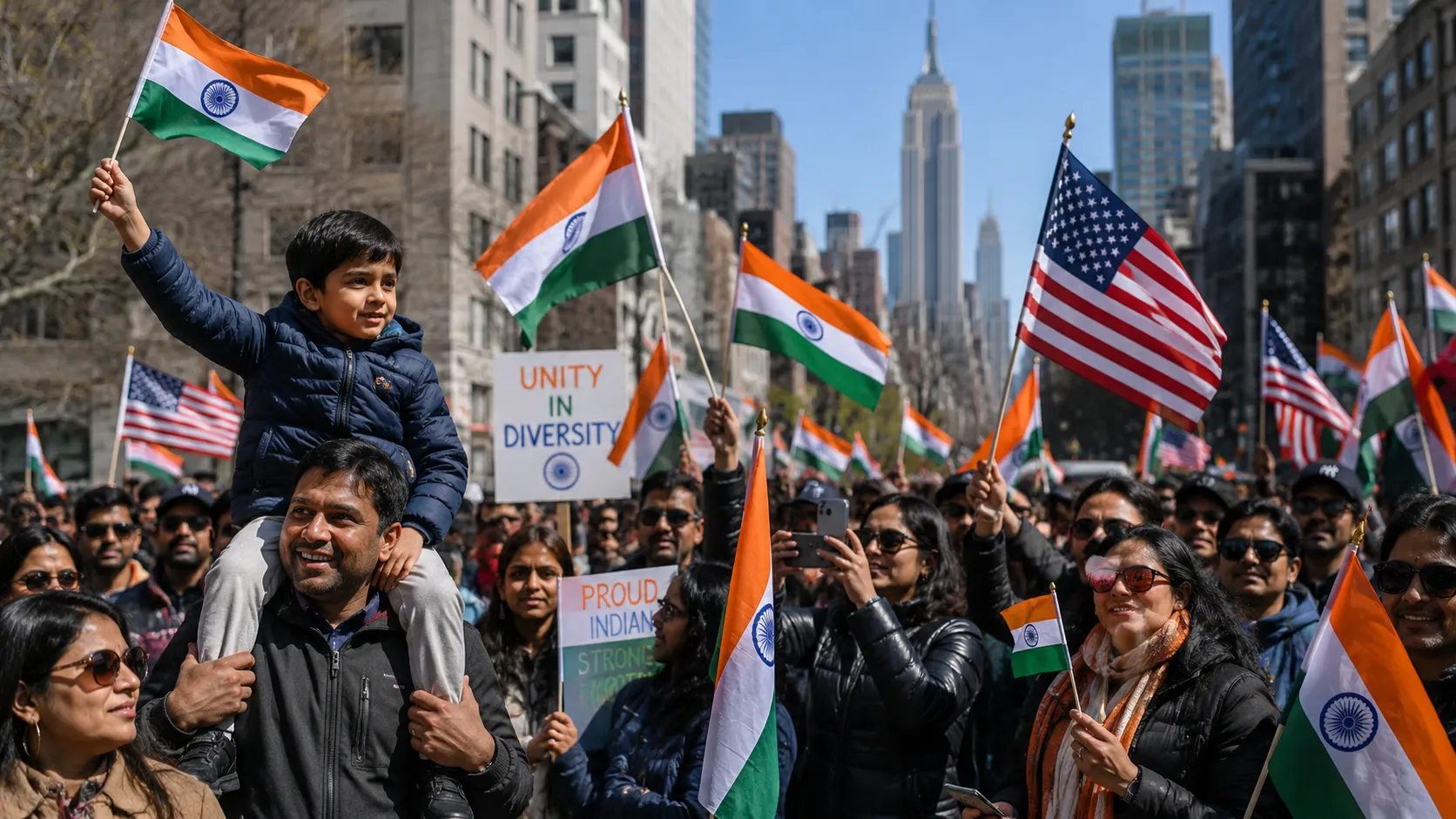
For most of the last three decades, the Indian American community's political story was simple to tell. They voted Democratic, donated Democratic, and ran as Democrats when they ran for office at all. The so-called "samosa caucus" in Congress — Ami Bera, Ro Khanna, Pramila Jayapal, Raja Krishnamoorthi, Shri Thanedar — is uniformly Democratic. India House Foundation research tracking two decades of political donations found that Indian Americans have overwhelmingly supported Democratic candidates, and that in almost every professional sector, Indian Americans lean more Democratic than Republican in their funding behaviour.
That story is becoming more complicated. And 2026 is the year in which the complications are most visible.
The Data That Changed the Narrative
The Carnegie Endowment for International Peace's 2026 Indian American Attitudes Survey — a nationally representative poll of 1,000 Indian American adults conducted between November 2025 and January 2026 — is the most systematic portrait available of where the community stands, and its findings do not support either the simple Democratic loyalty story or the sudden rightward realignment narrative that Trump's 2024 gains prompted.
The headline: 71 per cent of Indian Americans disapprove of Trump's performance in the first year of his second term. Large majorities oppose his approach to immigration and the domestic economy. If the 2024 election were held again today, 57 per cent say they would vote for the Democratic candidate and 25 per cent for Trump.
That is the floor of Democratic strength. The ceiling has moved.
Democratic Party identification has fallen from 52 per cent in 2020 to 46 per cent today. The independent share has risen commensurately to nearly one-third of the community — the fastest-growing identification category. Support for third-party candidates in a hypothetical rerun of the 2024 election has doubled to 10 per cent. And while opposition to Trump remains broad, Democratic enthusiasm has declined: ratings of the Democratic Party and its leaders have fallen over the past two survey waves, even as Republican identifiers maintain strong warmth toward their party — consistently rating it at 72 out of 100 across three survey waves.
The 2024 shift among young Indian American men was the most dramatic signal of the change: a sharp move toward Trump in 2024, followed by a 16-point drop in support by early 2026. The reversal suggests that the 2024 rightward movement was partly a protest and partly a genuine realignment — and that the protest dimension is receding as Trump's second-term policies have taken shape.
Carnegie's own summary is precise: Indian Americans remain disproportionately Democratic, but reflexive, high-intensity loyalty appears to be eroding. The lesson for both parties is that Indian American support must now be earned, not assumed.
The Zohran Mamdani Factor
The most striking political development involving Indian Americans in 2026 has nothing to do with the community's own electoral behaviour. It is the election of Zohran Mamdani as Mayor of New York City.
Mamdani identifies as a Muslim. He was born in Uganda and raised in the United States. He is not of Indian origin. And yet the Carnegie 2026 survey found that 68 per cent of Indian American respondents reported feeling enthusiastic about his election, and 73 per cent believed that electing more politicians like Mamdani would strengthen the status of the Indian American community.
The finding is initially counterintuitive and ultimately revealing. The community's response to Mamdani is driven primarily by ideology — he represents progressive economic policy, strong tenant protections, expanded public services, and an explicit commitment to immigrant communities — rather than by shared ethnicity or religion. Indian Americans are not simply rallying around a co-ethnic candidate. They are rallying around a political agenda that reflects their values.
That distinction matters enormously for how both parties should think about the Indian American vote. It means that Indian Americans cannot be reliably mobilised through identity appeals alone. A Democratic candidate who is Indian American will not automatically capture Indian American votes if their policy platform does not align with what the community prioritises. And a non-Indian candidate who effectively advocates for the issues the community cares about most — cost of living, immigration policy, religious inclusion — may outperform a co-ethnic candidate who does not.
The top policy priorities for Indian Americans in the 2026 survey are inflation and jobs — cited by 37 per cent and 33 per cent of respondents respectively. Foreign policy and US-India relations barely register, which helps explain why dissatisfaction with Trump's handling of US-India relations has not meaningfully reshaped vote intentions. Like most Americans, Indian Americans evaluate politics primarily through the lens of economic concerns.
The Republican Side of the Ledger
It would be incomplete to tell the story of Indian Americans and American politics in 2026 without accounting for the substantial Indian American presence in the Trump administration — a presence that is in genuine tension with the community's overwhelmingly Democratic voting behaviour.
Kash Patel leads the FBI. Jay Bhattacharya leads the National Institutes of Health. Harmeet Dhillon heads the Department of Justice's Civil Rights Division. Vivek Ramaswamy co-led the Department of Government Efficiency until his departure to run for Ohio governor. Usha Vance is the Second Lady of the United States.
The Indian American faces in Trump's administration have been interpreted through conflicting lenses. Some Indian Americans take pride in the visibility regardless of the political context. The Carnegie survey found that reactions to these appointments are ideologically polarised: Indian Americans who identify as Republicans view the appointments as evidence of the community's rising influence; those who identify as Democrats view them with varying degrees of concern about the policies and conduct of the appointees themselves.
The broader question — whether the presence of Indian Americans in a Republican administration is translating into political realignment among Indian American voters — is answered clearly by the data. It is not. 71 per cent disapproval of Trump. Democratic identification still at 46 per cent compared to Republican identification in the low teens. The political economy of Trumpism, particularly the H-1B attacks, the immigration enforcement, and the nativist rhetoric about Indian professionals, cuts against any significant Indian American realignment toward the Republican Party at the voter level.
The Infrastructure Being Built for 2026
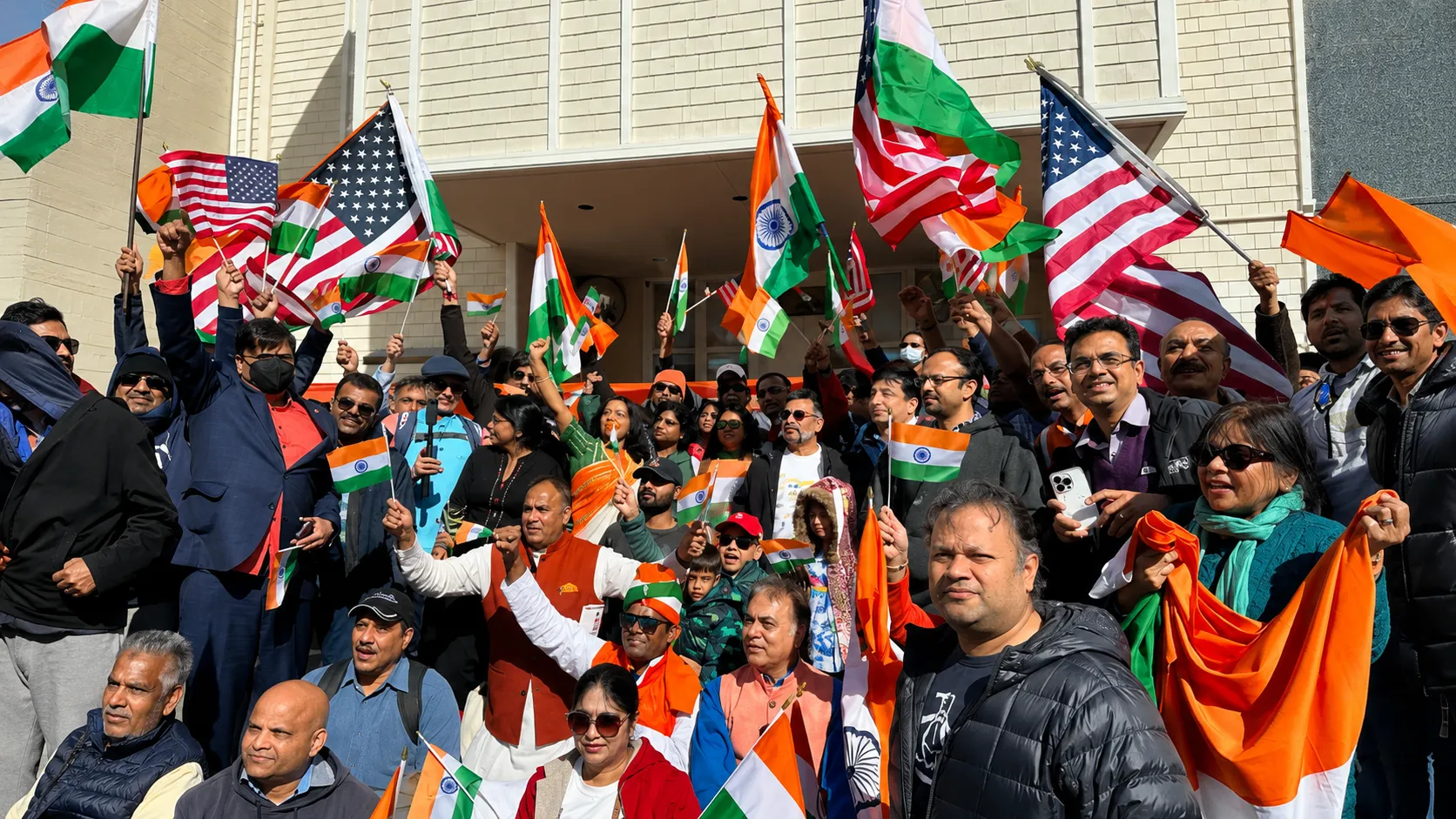
The midterm elections of November 2026 are the first national electoral test of the Indian American community's evolving political behaviour — and for the first time, the community has purpose-built infrastructure to understand and leverage its own political position.
Indian American Impact — founded in 2016 by Deepak Raj and Raj Goyle specifically to build Indian American political power — is running its most ambitious electoral engagement cycle. The organisation focuses on mobilising, engaging, and electing members of Indian and South Asian American communities, and it published an endorsed candidate list for 2026 cycle races.
The Indian American Voter Atlas, launched by Capitol Hill veteran Anang Mittal in early 2026, is described as the first nonpartisan, open civic data platform built specifically for and about the Indian American community. The platform maps Indian American population concentrations against congressional district competitiveness ratings, economic presence data, and a proprietary Persuasion Index — giving campaigns, community organisations, and the community itself a granular picture of where Indian American voters are concentrated and how much those concentrations matter to competitive races.
The scale of the community's potential electoral influence is made visible by a single statistic Mittal highlighted in his launch announcement: Indian Americans are the highest-income ethnic group in the United States, and they are concentrated in some of the most competitive congressional districts in the country. In districts where the margin between winning and losing is measured in thousands of votes, a politically engaged, high-turnout community of several thousand voters can be determinative.
What the Backlash Has Done to Political Behaviour
The Carnegie survey found that discrimination is reshaping Indian American behaviour in specific and important ways. Half of respondents report experiencing discrimination in the past year. One in four has been called a slur. One in four has been called a slur. Half have encountered anti-Indian racist posts online very or somewhat often.
The response to this discrimination is not the exit from American political life that one might expect. Most respondents do not plan to leave the United States, and a majority still recommend the country for employment. But many report preemptively changing how they live, speak, or participate in public life to avoid harassment.
American Bazaar's January 2026 analysis put it directly: political neutrality is no longer a sustainable strategy. The community that had built its success on being useful and unobtrusive is discovering that visibility — even the visibility of success — generates hostility that unobtrusive behaviour cannot address.
The midterms of 2026 are the first major electoral test of whether that recognition translates into organised political power. The pieces are in place: the data platform, the advocacy organisation, the record number of Indian Americans in elected office, and a community that is more politically engaged than at any previous point in its history.
What remains to be seen is whether the energy of political engagement will be channelled into the institutional infrastructure that converts community preferences into durable political power — or whether it disperses into individual voting decisions and social media commentary that records the moment without changing the outcome.
The community that built the Voter Atlas, that produced the samosa caucus, that gave 68 per cent of its members enthusiastic reactions to Zohran Mamdani, and that is simultaneously watching its deportment shift from assumed Democratic loyalty to contested swing constituency — that community is more politically consequential in 2026 than at any previous point in its history.
Whether it becomes as politically powerful as it is politically important depends on choices the community is in the process of making right now.


