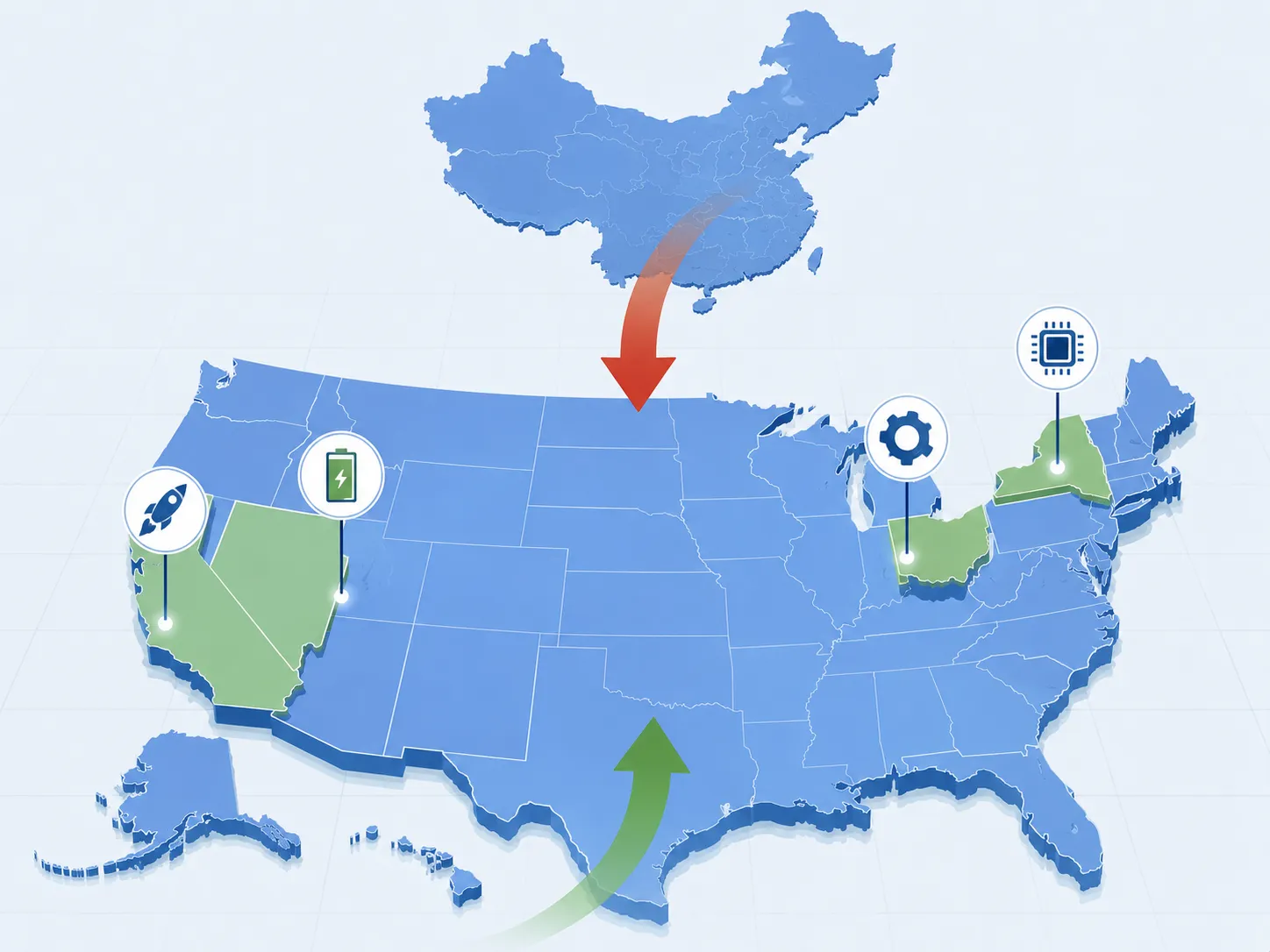
How American hardware startups are winning the supply chain war – and bringing manufacturing back home
DETROIT, Michigan – For thirty years, the story of American manufacturing was a funeral dirge.
Factories closed. Jobs moved overseas. Rust Belt cities became punchlines. The assumption was ironclad: the United States would design, China would build, and everyone would get rich.
That assumption has been shattered.
A new generation of hardware startups is doing the unthinkable: bringing manufacturing back to America. Not the old, dirty, union‑dominated factories of the 20th century. But sleek, automated, AI‑powered micro‑factories that can out‑compete China on speed, quality, and total cost – even with higher labor rates.
The numbers are staggering. According to the Reshoring Initiative, American companies brought back 350,000 manufacturing jobs in 2025 – the highest number since the organization began tracking in 2010. Of those, nearly 40% came from startup activity, not legacy corporations.
"The offshoring era is over," says Harry Moser, founder of the Reshoring Initiative. "Companies have learned that cheap labor in Asia is not cheap when you factor in shipping delays, intellectual property theft, and geopolitical risk. The total cost of ownership now favors the United States for many products."
And a new wave of American hardware startups is leading the charge.
The Three Pillars of the New Reshoring
Three distinct forces are driving the manufacturing renaissance. Each is being led by startups, not incumbents.
1. Battery and Energy Storage
The Inflation Reduction Act created massive subsidies for domestic battery production. Startups are responding.
Redwood Materials, founded by Tesla co‑founder JB Straubel, is building a battery recycling and materials campus outside Reno, Nevada. The company just raised $1 billion from the Department of Energy and is on track to produce enough anode and cathode foil for 1 million EVs annually by 2027.
"We are not just recycling," says Straubel. "We are creating a circular supply chain for lithium, cobalt, nickel, and copper – all on American soil. That is national security as much as it is environmentalism."
Our Next Energy (ONE) , based in Novi, Michigan, is developing a cobalt‑free, nickel‑free battery cell using iron and phosphate. The company just opened a 100,000‑square‑foot factory and has a $2.5 billion order backlog from commercial truck manufacturers.
2. Advanced 3D Printing (Additive Manufacturing)
Traditional manufacturing requires expensive molds, long lead times, and massive minimum order quantities. 3D printing flips that model: you print exactly what you need, when you need it, with no tooling.
Formlabs, based in Ohio, has become the leader in accessible industrial 3D printing. Its new "Factory of the Future" in Columbus runs 200 printers 24/7, producing custom parts for aerospace, medical, and automotive customers – with lead times measured in days, not months.
"We are seeing a massive shift," says Max Lobovsky, Formlabs co‑founder. "Companies that used to source injection‑molded parts from China are now printing them in Ohio. The cost per part is sometimes higher, but the speed and flexibility are unbeatable."
VulcanForms, a Massachusetts startup founded by MIT professors, takes it further. Its industrial‑scale laser printers can produce metal parts at volumes that compete with traditional casting – but with zero tooling cost. The company just raised $500 million and is building a 500,000‑square‑foot facility in upstate New York.
3. Automated Precision Machining
The third pillar is the automation of traditional machining – milling, turning, grinding – using robotics and AI.
Hadrian, a Los Angeles‑based startup, has built a fully automated "lights‑out" factory for precision metal components used in aerospace and defense. Human engineers design the parts. Robots run the machines 24 hours a day. The result: parts that cost 40% less and ship 10x faster than traditional job shops.
"The old model is a machinist making $30 an hour, working one shift, taking coffee breaks," says Chris Power, Hadrian's founder and CEO. "Our model is a robot that works 24/7, never gets tired, and never makes a mistake. That is how we compete with China."
Hadrian just closed a $200 million Series C led by Lux Capital and is now supplying parts to SpaceX, Anduril, and several defense prime contractors.
The CHIPS Act Fallout: Semiconductors Come Home
While batteries and 3D printing grab headlines, the biggest reshoring story is semiconductors.
The CHIPS and Science Act allocated $52 billion to boost domestic chip manufacturing. The results are already visible. Intel is building a $20 billion fab in Ohio. TSMC is constructing a $40 billion complex in Arizona. Micron is investing $100 billion in New York and Idaho.
But the real innovation is happening at startups.
Efficient Computer (Pittsburgh) – which we profiled in our AI chip article – is designing ultra‑low‑power inference chips. Celestial AI (Santa Clara) is developing optical interconnects. Both plan to manufacture in the United States using SkyWater Technology, a domestic foundry.
"We are seeing a renaissance in American semiconductor design and manufacturing," says Doug O'Laughlin, founder of the semiconductor research firm Fabricated Knowledge. "Five years ago, it was 'design in the US, fab in Taiwan.' Now, startups are insisting on domestic production from day one. That is a profound shift."
The Geography of the New Manufacturing
The reshoring boom is not集中在 the coasts. It is happening in the Rust Belt – and beyond.
Detroit is no longer just cars. It is battery startups (ONE), autonomous vehicle software, and advanced materials. Columbus is becoming a 3D printing hub. Pittsburgh is robotics and AI manufacturing. Reno is battery recycling. Upstate New York is semiconductor fabs.
"The old manufacturing belt is coming back to life," says John Austin, director of the Michigan Economic Center. "But it is not the same industry. These are not giant union factories making commodities. These are smaller, agile, automated facilities making high‑value components. The jobs are different – more technical, more skilled – but they are jobs."
Chattanooga, Tennessee is another surprise hub. The city has attracted Volkswagen's EV assembly plant, Toyota's battery plant, and a cluster of startup suppliers. Elementum 3D, a metal 3D printing startup, just opened a facility there.
The Challenges: Talent, Cost, and Time
Despite the momentum, reshoring faces serious headwinds.
Talent is the biggest bottleneck. The United States simply does not have enough industrial engineers, CNC machinists, and semiconductor technicians. "We are hiring anyone with a pulse and a willingness to learn," says Hadrian's Power. "We train them ourselves. But it takes time."
Cost remains higher than China for many products. While total cost of ownership has narrowed – factoring in shipping, tariffs, and risk – raw labor costs in the US are still 5x to 10x higher than in Vietnam or India.
Time is the third factor. Building a factory takes years. Permitting, environmental reviews, construction, and tooling cannot be rushed. Many reshoring projects announced in 2022 are only now coming online.
The Bottom Line: A Manufacturing Renaissance
The great reshoring is not a guarantee. It is a bet – a bet that American startups can out‑innovate, out‑automate, and out‑compete any country in the world.
So far, that bet is paying off. Factory construction spending in the US hit $225 billion in 2025 – double the 2020 level. Startup formation in advanced manufacturing is up 400% since 2021.
"We are not going to bring back every job that left," says Redwood's Straubel. "But we are building the industries of the future – batteries, chips, advanced materials – right here, right now. That is not nostalgia. That is strategy."
In the new American manufacturing, the flag is not just a symbol. It is a supply chain.


